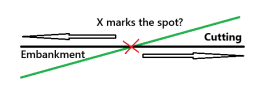
On probability and for practical reasons, I would have thought where you (a contractor) has to build a new route in Victorian days that would start at a point where you need a long cutting in one direction, and long embankment in the other direction? X marks the starting point? see attached.
In your opinion, would you start work here?
Are there examples of this please?
Would the railway company tell you where to start work?
Would you be given targets of say X cubic yards this month to be dug and tipped etc?
In the 1980s and '90s I did some muckshift planning for new road construction at both tender and contract stages, and I don't think there's a "one size fits all" answer to your question - there are too many variables which affect the decision. These include the ground conditions, the type(s) of plant you have available, the location of accesses to the site, whether there are new structures under construction in the way of your haul, how you are going to keep it drained, even the season and weather conditions.
So yes, you might start from a cut/fill line (where the new alignment is at existing ground level), and work the cutting as a full depth cut face. But equally you might start at the point where the cutting will be deepest, and work down layer by layer while digging over the full length of the cutting.
Embankments nowadays are normally built up layer by layer over their full lengths, but I think that in Victorian times contractors often built them to full height working from one end, laying temporary railway track along the top and end-tipping the fill. This results in poor compaction which often lead to settlement and/or instability in those embankments.
Obviously the objective of the designer is to balance the available cut and fill volumes, but the objective for the contractor is to minimise the mass haul, measured in metres^4 = volume of muck (m^3) x distance hauled (m). It would previously have been yds^4 but the principle is the same. The production of a mass haul diagram is used to determine this.
In terms of timings, production rates, etc., the contractor will be working to a completion date determined by the client, with liquidated damages payable for late delivery. It would be left up to the contractor to decide on how to meet that, but the client (or their Engineer) would normally want to see and agree the proposed programme at the time of contract award. That contract programme has to be updated throughout the contract period, to reflect progress to date (sometimes a contentious process!). At least, that's how it worked in my day on ICE 5th Edition contracts, and I think it would have been broadly similar at the time your line was built.