• Our new ticketing site is now live! Using either this or the original site (both powered by TrainSplit) helps support the running of the forum with every ticket purchase! Find out more and ask any questions/give us feedback in this thread!

Where you would begin forming a track bed

Status
Not open for further replies.

Andy873

Established Member
Joined
23 Mar 2017
Messages
1,421
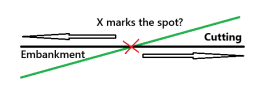
On probability and for practical reasons, I would have thought where you (a contractor) has to build a new route in Victorian days that would start at a point where you need a long cutting in one direction, and long embankment in the other direction? X marks the starting point? see attached.

In your opinion, would you start work here?
Are there examples of this please?
Would the railway company tell you where to start work?
Would you be given targets of say X cubic yards this month to be dug and tipped etc?

I know this sounds a basic question!
 

Attachments

  • X marks the spot.png
    X marks the spot.png
    5.5 KB · Views: 15
Sponsor Post - registered members do not see these adverts; click here to register, or click here to log in
R

RailUK Forums

Snow1964

Established Member
Joined
7 Oct 2019
Messages
11,232
Location
West Wiltshire
I think most early railways employed contractors, and so wouldn't have told them where to start, the contractor would decide how their workforce were used.

Reading books of lines, suggests normal practice was to employ a surveyor (who rode a horse along approx line finding best route), then after legals and land purchase the build contractor moved in.

In some cases canals brought in materials (bricks etc), some even set up own kilns to make materials. The masons were the skilled part, the navvies did the hard graft.

But generally yes, need to avoid workings flooding so start by building where it is roughly at correct height and move muck from there
 
Last edited:

D Williams

Member
Joined
27 Jul 2022
Messages
298
Location
Worcestershire
If we go back to the concept stage the promotors of the railway would decide the starting and ending points eg London to Bristol. Money to fund the survey and design works would be raised. An Engineer ( not the chap that comes along today to fix the washing machine) would be appointed eg Mr Brunel. He would survey the route and usually produce a number of options depending on the geography, local opposition or support , possible business along the route. The result would be a very comprehensive design that was presented to parliament in order that the necessary legislation could be obtained. This latter part could be a very long and expensive process. If successful the railway company would then have legally enforceable powers to buy land and generally lay waste along the designed route ( HS2?) . Having raised the dosh by promising riches to the investors contractors would be appointed. Mr Peto for example. In fact on a large scheme more than one contractor would be used. Shovels out and work starts. The work would be supervised by the Engineer and his assistants in the way that a project management team would work today. However, this is where things often got interesting as all manner of problems would arise. Have a read of the many histories of the building of railway lines.

Turing to your question, that I don't really understand, the performance of the contractor would be dictated by the legal terms of the contract between him and the railway company. Modern forms of contract are basically the same ie contractor X agrees to build something for Y price to be completed by Z date. Financial penalties can be invoked eg claims for loss of income etc for late completion. But, then, as now, this is a minefield for the lawyers. With regard to the detail of construction the starting point would be determined by the need to move materials to and from the work site.
 

DelW

Established Member
Joined
15 Jan 2015
Messages
6,036
On probability and for practical reasons, I would have thought where you (a contractor) has to build a new route in Victorian days that would start at a point where you need a long cutting in one direction, and long embankment in the other direction? X marks the starting point? see attached.

In your opinion, would you start work here?
Are there examples of this please?
Would the railway company tell you where to start work?
Would you be given targets of say X cubic yards this month to be dug and tipped etc?

In the 1980s and '90s I did some muckshift planning for new road construction at both tender and contract stages, and I don't think there's a "one size fits all" answer to your question - there are too many variables which affect the decision. These include the ground conditions, the type(s) of plant you have available, the location of accesses to the site, whether there are new structures under construction in the way of your haul, how you are going to keep it drained, even the season and weather conditions.

So yes, you might start from a cut/fill line (where the new alignment is at existing ground level), and work the cutting as a full depth cut face. But equally you might start at the point where the cutting will be deepest, and work down layer by layer while digging over the full length of the cutting.

Embankments nowadays are normally built up layer by layer over their full lengths, but I think that in Victorian times contractors often built them to full height working from one end, laying temporary railway track along the top and end-tipping the fill. This results in poor compaction which often lead to settlement and/or instability in those embankments.

Obviously the objective of the designer is to balance the available cut and fill volumes, but the objective for the contractor is to minimise the mass haul, measured in metres^4 = volume of muck (m^3) x distance hauled (m). It would previously have been yds^4 but the principle is the same. The production of a mass haul diagram is used to determine this.

In terms of timings, production rates, etc., the contractor will be working to a completion date determined by the client, with liquidated damages payable for late delivery. It would be left up to the contractor to decide on how to meet that, but the client (or their Engineer) would normally want to see and agree the proposed programme at the time of contract award. That contract programme has to be updated throughout the contract period, to reflect progress to date (sometimes a contentious process!). At least, that's how it worked in my day on ICE 5th Edition contracts, and I think it would have been broadly similar at the time your line was built.

 

Gloster

Veteran Member
Joined
4 Sep 2020
Messages
13,042
Location
Up the creek
I think that if the railway was fairly long it would be divided into a number of contracts that would be offered out separately, but usually at the same time. Contractors would then tender for one or more contract according to their capabilities, which they often overestimated. By the time you line was built, I would suspect that access to allow the heavier equipment to be brought in to the site was a factor: it was long after the days when a packhorse or a cart would suffice for everything.
 

Andy873

Established Member
Joined
23 Mar 2017
Messages
1,421
Very interesting comments from all of you as usual, thanks.

I've taken a couple of day to digest what's been said and I was trying to keep it general, but as usual @Gloster has rumbled me once more!

Please have a look at this map sheet from the National Library of Scotland:


This map shows the most detail, the line going top left becomes a long embankment all the way to the station. In the other direction, a long cutting all the way to Rose Grove and the junction there, and the section between seems to be generally at ground level. Where the cutting starts (bottom right), Knott's Lane crosses under the line. This lane, which connects to another called Lower House Lane goes to Rose Grove station, where I believe the rails would have been delivered to during construction. These lanes were there even in 1844.

Knott's Lane gives an access point for the contractor and his workers. The section between the embankment and the cutting is also around 1,600 feet long, which is long enough for the first section of rails to be laid. Once laid, the contractor's rail wagons can be filled with earth, and as this whole section is on a downward gradient (going towards the embankment), I believe the wagons full with earth would be rolled down the hill, and pulled back up by horses.

I've studied this whole section from beyond Padiham station, to the station itself, and up to Rose Grove junction. I simply can't find any other probable starting point based on what I've been told and can see. I'm still led back to the simple fact that you need earth etc to build an embankment, and you're going to get that from a cutting or cuttings.

I'll never know for sure where the starting point was but...

Given what I've said, what probability rating would you give this location as the original starting point? 80%? 50%? etc.
 
Status
Not open for further replies.

Top