
Peter Sarf
Established Member
Took the following posts from the class 230 thread as it looks like these will feed speculation on UK electrification. which risks pulling the 230 thread off topic.
My reply at the bottom but quoted all these to keep context.
I think battery technology should not affect core route electrification. So getting to Oxford for example is a core route. Furthermore Oxford has not been electrified yet due to the impending re-build and layout changes, whenever that happens. Indeed getting beyond to Birmingham is also core and I would see Birmingham suburbs through Snow Hill to Stratford-Upon-Avon as a precursor.
I see battery technology allowing for services that start on the core ideally or use fast charge as demonstrated by the GWR class 230 trial. This would apply to the Thames and Cornish branches. Another example would be through electric services beyond Oxenholme to Windermere as these spend plenty of time under the wires so will get plenty of charge for the battery pack.
I do not think intercity routes should be viewed as appropriate for battery technology at the expense of putting wires up. For difficult parts maybe (plus allows for coping with overhead failures) and also for diversionary routes if short enough.
So I can see modern battery technology will cope with the Midland Main Line when most of it is electrified (so just diversionary routes and a few hard bits to wire on battery). THEN the Bi-Mode 810s would be more useful on longer non-electrified stretches like cross country where there are a lot more gaps in the electrification (to put it mildly). That would work for the foreseeable future but especially where some is already electrified (say Manchester to the South coast) but not enough for battery. The North-East to South-West services would gradually work more cleanly with more electrification (Particularly in deepest South-West but parts in central England are more likely). That's using diesel Bi-Modes as having enough electrified to allow battery charging is a long long way off.
My reply at the bottom but quoted all these to keep context.
It did complete its Reading, Paddington, Oxford, Paddington, Reading trip last night
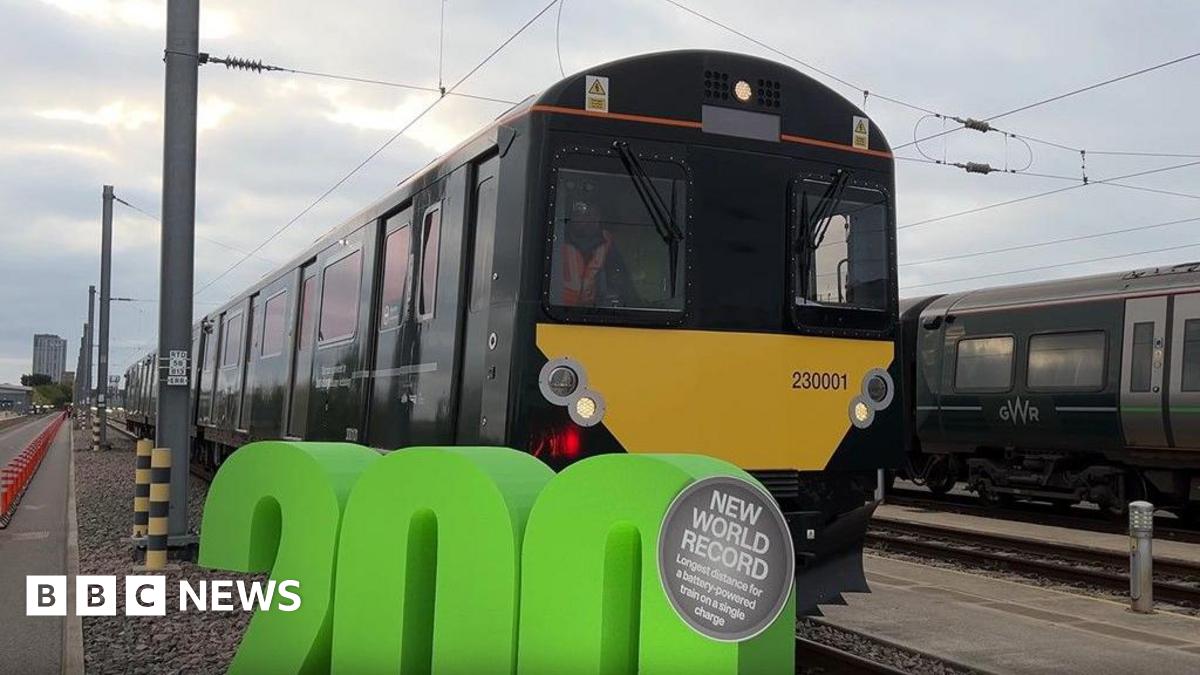
Battery-powered GWR train breaks distance record from Reading
A GWR train completes a 200-mile (322km) return journey from Reading without charging its batteries.www.bbc.co.uk
Important to realise that this was done without any internal train lighting, heating or air-con, no doors opening and closing etc.
Still impressive but more a PR stunt than real life.
Does anyone know if the existing record by Stadler was also done without heating/air con.
I would imagine lights and doors would have a relatively low impact (although keeping the doors closed would make heating/air con less power intensive)
none of these are as important as not calling at any stations though!
Yes, of course.
Although I imagine the Stadler test did the same, that's the main thing I'm wondering about.
It had 22% charge remaining at the end of the test, enough for anther 58 miles.
Stopping and starting again, like what a train normally does at stations and signals, would use a hell of a lot more energy than just cruising at a constant speed. I see it ran overnight, presumably to avoid all that.
And how long would it take to recharge from fully depleted?
Regenerative braking would recoup some of the energy from a more stop start journey. I wonder how much ?.
Some, but not enough to cover the subsequent acceleration as nothing is 100% efficient.
Then of course you have the extra load of the passengers, on both the traction motors and the aircon.
Would be interesting to see how far these can go in real world conditions and not just a range cruise.
Used by some (govt) as an excuse not to electrify to Oxford?
Exactly what I was thinking. Battery trains have their place but Oxford needs wires.
Yep can imagine the Treasury seeing this with glee. No need to electrify let's keep putting projects off.
Batteries have their place but it's not hard to imagine HMT using this as an excuse to fund little, anywhere.
Is it impressive? Electric buses are going further in the real world and they have far greater rolling resistance with rubber wheels rather than steel.
To be honest, I don't understand why the public sector is spending any money on battery train trials at all. Surely it is for the private train manufacturers to demonstrate that their products work if they want to win tenders?
I think battery technology should not affect core route electrification. So getting to Oxford for example is a core route. Furthermore Oxford has not been electrified yet due to the impending re-build and layout changes, whenever that happens. Indeed getting beyond to Birmingham is also core and I would see Birmingham suburbs through Snow Hill to Stratford-Upon-Avon as a precursor.
I see battery technology allowing for services that start on the core ideally or use fast charge as demonstrated by the GWR class 230 trial. This would apply to the Thames and Cornish branches. Another example would be through electric services beyond Oxenholme to Windermere as these spend plenty of time under the wires so will get plenty of charge for the battery pack.
I do not think intercity routes should be viewed as appropriate for battery technology at the expense of putting wires up. For difficult parts maybe (plus allows for coping with overhead failures) and also for diversionary routes if short enough.
So I can see modern battery technology will cope with the Midland Main Line when most of it is electrified (so just diversionary routes and a few hard bits to wire on battery). THEN the Bi-Mode 810s would be more useful on longer non-electrified stretches like cross country where there are a lot more gaps in the electrification (to put it mildly). That would work for the foreseeable future but especially where some is already electrified (say Manchester to the South coast) but not enough for battery. The North-East to South-West services would gradually work more cleanly with more electrification (Particularly in deepest South-West but parts in central England are more likely). That's using diesel Bi-Modes as having enough electrified to allow battery charging is a long long way off.
Last edited:


