
I should imagine that on routes with request stops drivers very quickly learn to distinguish between someone loitering at a station with no intent to board a train and someone who is intending to travel and this reacting to the approach of a train. If there’s any doubt, I’m sure they would stop -hand signal or no hand signal. I would guess also that on really foul days they approach half-expecting someone to dash out from any shelter there is at the last minute (not that that’s to be recommended)Not wishing to be awkward but what if you are unable to give a hand signal due to some sort of disability?

-
Our new ticketing site is now live! Using either this or the original site (both powered by TrainSplit) helps support the running of the forum with every ticket purchase! Find out more and ask any questions/give us feedback in this thread!
You are using an out of date browser. It may not display this or other websites correctly.
You should upgrade or use an alternative browser.
You should upgrade or use an alternative browser.
What happened to Request stops?
- Thread starter thenorthern
- Start date
- Status
- Not open for further replies.
Sponsor Post - registered members do not see these adverts; click here to register, or click here to log in
R
RailUK Forums
I made a similar point to you up above and no-one responded, so I guess it's not deemed to be very important, for whatever reason.No idea what that means. Thought I was raising a perfectly legitimate point. I do actually have a friend who has no arms, he uses public transport a great deal though happily doesn't have to deal with any request stops
Indeed they do. They're pretty forgiving on the whole. Even stopping when the only person there was the Chargeman's spotter nephew clearly intent upon taking pictures rather than intending to board.I should imagine that on routes with request stops drivers very quickly learn to distinguish between someone loitering at a station with no intent to board a train and someone who is intending to travel and this reacting to the approach of a train. If there’s any doubt, I’m sure they would stop -hand signal or no hand signal. I would guess also that on really foul days they approach half-expecting someone to dash out from any shelter there is at the last minute (not that that’s to be recommended)
With 15x units it was easier for the driver to stick their head out of the window as the train approached and ask if it wasn't obvious whether the person intended to board.
thenorthern
Established Member
- Joined
- 27 May 2013
- Messages
- 4,711
I remember Conwy and Llanfairfechan both being request stops but when I used them regularly between 2004 and 2009 almost every train stopped there due to someone getting on or off so it seemed a pointless excercise maintaining it as a request stop
== Doublepost prevention - post automatically merged: ==
Not wishing to be awkward but what if you are unable to give a hand signal due to some sort of disability?
Might you also have trouble with pressing a button at least five minutes before departure? We're getting into "RUK Standard Minority" territory here, I think.
No idea what that means. Thought I was raising a perfectly legitimate point. I do actually have a friend who has no arms, he uses public transport a great deal though happily doesn't have to deal with any request stops
The railway is required to be Disability compliant under equality laws. That does not just mean persons with reduced mobility it covers all disabilities. Quite a lot of older people especially those with arthritis struggle to lift their arms up. As I say as well if someone is blind or hard of hearing as well it's not the easiest thing to work out of a train is coming.
While there are obviously some disabilities that can't be accommodated like those with an ultra weak immune system won't be able to travel on trains for safety reasons. It is not unreasonable however to expect trains to provide adjustments for those who are blind, deaf or have arthritis.
I suspect that this is another reason why many request stops have been “upgraded”.The railway is required to be Disability compliant under equality laws. That does not just mean persons with reduced mobility it covers all disabilities. Quite a lot of older people especially those with arthritis struggle to lift their arms up. As I say as well if someone is blind or hard of hearing as well it's not the easiest thing to work out of a train is coming.
While there are obviously some disabilities that can't be accommodated like those with an ultra weak immune system won't be able to travel on trains for safety reasons. It is not unreasonable however to expect trains to provide adjustments for those who are blind, deaf or have arthritis.

. I know in Cumbria there used to be 18 request stops in the First North Western days now there are only 2 at Braystones and Nethertown.
Soon to be three as Appleby-in-Westmorland is to be re-designated as a "request stop area", but only if you are a landowner with exclusive solum rights up to 1¼ miles either side of the station.

I know the preference is for an arm to be put out, but in practice trains do have to slow for request stop platforms already and I would expect/hope that a driver seeing somebody on the platform with no arms would stop regardless. Much like if I, a person with two arms, stood at Culrain station looking at a train on its approach, I would expect the train to stop. Not least because a lot of passengers likely don't know what the expected train stopping procedure is.
Indeed, and without wishing to seem flippant or callous, given the location of most request stops the likelihood of someone who is totally unable to give a recognisable signal to a driver at the appropriate time having reached the station unaided in the first place is pretty low . Ant really local resident with difficulties would quickly become known to / by train crews.I know the preference is for an arm to be put out, but in practice trains do have to slow for request stop platforms already and I would expect/hope that a driver seeing somebody on the platform with no arms would stop regardless. Much like if I, a person with two arms, stood at Culrain station looking at a train on its approach, I would expect the train to stop. Not least because a lot of passengers likely don't know what the expected train stopping procedure is.

Tetchytyke
Veteran Member
The railway offers an assisted travel service for people with disabilities. If you are disabled and arrange assisted travel from a request stop, one would expect that this means the train will stop there.The railway is required to be Disability compliant under equality laws. That does not just mean persons with reduced mobility it covers all disabilities.

Allwinter_Kit
Member
- Joined
- 12 Jul 2017
- Messages
- 218
Request stops seem a mad anachronism to me, to be honest. I also can't really see the benefit, apart from the odd train that is 2 or 3 min late being able to make it back to "on time" if it runs through a bunch of them.
But I could be wrong, so let's take a hypothetical simple example - maybe the way I'm thinking about this is all wrong in which case I am happy to be schooled by those more in the know!
We have a branch line that comes off the mainline, has 2 request stops, a mandated stop, 3 request stops and then the terminus.
ML - R1 - R2 - MS - R3 - R4 - R5 - TR
Let us also assume (?) that the driver has to slow down to check for passengers but not stop in the event that he passes through a request stop (assuming no one is alighting), which is my understanding based on the thread. Let us say this costs 30 seconds rather than 2 minutes for a full station stop.
From the above it also sounds like if we have 5 request stops we can expect to stop at 2 or 3 of them every journey. So the timetable is set that between the mainline and the mandated stop it will stop once, and between the mandated stop and the terminus it will stop twice.
If the train doesn't stop between the mainline and the mandated stop it presents early and has to wait to depart on time.
If it has to stop at both request stops it arrives late. Assuming it then stops at another couple as expected It will then arrive late at the terminus where its layover would provide the buffer to soak up the delay anyway.
All we've done is create an opportunity to maybe shave a minute or so of time off the whole branch timetable. Why or for what?
- we have made the journey more intimidating for passengers "be there AT LEAST 5 minutes early and push a button, be paying attention, stick your hand out, be clear, it's YOUR FAULT if the train doesn't stop for you"
- Added extra duties to the guard "where are you getting off? Don't forget it's the next stop, I'd better remind the driver"
- added extra uncertainty for the driver "what if someone is on the platform?"
All of this for absolutely negligible timetable gains.
The joy of the railway is it's reliability and permanence. There is a station. Trains run every 30 / 60 / 120 minutes. They stop at the same places. There is a system you can rely on.
One of the reasons people prefer trains to buses is that they aren't caught up in congestion, snarl ups, etc. they tend to arrive broadly when expected and stop in the same places. They aren't expected to be 30 seconds or 3 or 15 minutes different every day based on external factors. Obviously they actually are, but they have good Realtime Information to overcome that, but as a concept they are much more reliable in terms of presentation and journey time than buses. So... what benefit does binning that off bring?
Just sling in the extra few minutes to stop properly at the locations, remove the uncertainty for everyone and... i don't see a real meaningful downside?
But I could be wrong, so let's take a hypothetical simple example - maybe the way I'm thinking about this is all wrong in which case I am happy to be schooled by those more in the know!
We have a branch line that comes off the mainline, has 2 request stops, a mandated stop, 3 request stops and then the terminus.
ML - R1 - R2 - MS - R3 - R4 - R5 - TR
Let us also assume (?) that the driver has to slow down to check for passengers but not stop in the event that he passes through a request stop (assuming no one is alighting), which is my understanding based on the thread. Let us say this costs 30 seconds rather than 2 minutes for a full station stop.
From the above it also sounds like if we have 5 request stops we can expect to stop at 2 or 3 of them every journey. So the timetable is set that between the mainline and the mandated stop it will stop once, and between the mandated stop and the terminus it will stop twice.
If the train doesn't stop between the mainline and the mandated stop it presents early and has to wait to depart on time.
If it has to stop at both request stops it arrives late. Assuming it then stops at another couple as expected It will then arrive late at the terminus where its layover would provide the buffer to soak up the delay anyway.
All we've done is create an opportunity to maybe shave a minute or so of time off the whole branch timetable. Why or for what?
- we have made the journey more intimidating for passengers "be there AT LEAST 5 minutes early and push a button, be paying attention, stick your hand out, be clear, it's YOUR FAULT if the train doesn't stop for you"
- Added extra duties to the guard "where are you getting off? Don't forget it's the next stop, I'd better remind the driver"
- added extra uncertainty for the driver "what if someone is on the platform?"
All of this for absolutely negligible timetable gains.
The joy of the railway is it's reliability and permanence. There is a station. Trains run every 30 / 60 / 120 minutes. They stop at the same places. There is a system you can rely on.
One of the reasons people prefer trains to buses is that they aren't caught up in congestion, snarl ups, etc. they tend to arrive broadly when expected and stop in the same places. They aren't expected to be 30 seconds or 3 or 15 minutes different every day based on external factors. Obviously they actually are, but they have good Realtime Information to overcome that, but as a concept they are much more reliable in terms of presentation and journey time than buses. So... what benefit does binning that off bring?
Just sling in the extra few minutes to stop properly at the locations, remove the uncertainty for everyone and... i don't see a real meaningful downside?
Last edited:
To my simple mind this translates as you need to be at the station five minutes utes early - so in actual fact the 1330 train should actually be regarded as the 1325 - unless you’re ‘late’ at 1329 and some other traveller pressed it before the 1325 deadline?Scotrail's website says anyone boarding at a request stop must press the magic button five minutes prior to the arrival of the train, and that if it is pressed less than five minutes before arrival the train "will NOT stop". Is that what happens in practice?
AIUI, The timetabling implications /advantages are incidental ;unless there is a long string of request stops. It’s the fuel /brakewear savings that are more important.Request stops seem a mad anachronism to me, to be honest. I also can't really see the benefit, apart from the odd train that is 2 or 3 min late being able to make it back to "on time" if it runs through a bunch of them.
But I could be wrong, so let's take a hypothetical simple example - maybe the way I'm thinking about this is all wrong in which case I am happy to be schooled by those more in the know!
We have a branch line that comes off the mainline, has 2 request stops, a mandated stop, 3 request stops and then the terminus.
ML - R1 - R2 - MS - R3 - R4 - R5 - TR
Let us also assume (?) that the driver has to slow down to check for passengers but not stop in the event that he passes through a request stop (assuming no one is alighting), which is my understanding based on the thread. Let us say this costs 30 seconds rather than 2 minutes for a full station stop.
From the above it also sounds like if we have 5 request stops we can expect to stop at 2 or 3 of them every journey. So the timetable is set that between the mainline and the mandated stop it will stop once, and between the mandated stop and the terminus it will stop twice.
If the train doesn't stop between the mainline and the mandated stop it presents early and has to wait to depart on time.
If it has to stop at both request stops it arrives late. Assuming it then stops at another couple as expected It will then arrive late at the terminus where its layover would provide the buffer to soak up the delay anyway.
All we've done is create an opportunity to maybe shave a minute or so of time off the whole branch timetable. Why or for what?
- we have made the journey more intimidating for passengers "be there AT LEAST 5 minutes early and push a button, be paying attention, stick your hand out, be clear, it's YOUR FAULT if the train doesn't stop for you"
- Added extra duties to the guard "where are you getting off? Don't forget it's the next stop, I'd better remind the driver"
- added extra uncertainty for the driver "what if someone is on the platform?"
All of this for absolutely negligible timetable gains.
The joy of the railway is it's reliability and permanence. There is a station. Trains run every 30 / 60 / 120 minutes. They stop at the same places. There is a system you can rely on.
One of the reasons people prefer trains to buses is that they aren't caught up in congestion, snarl ups, etc. they tend to arrive broadly when expected and stop in the same places. They aren't expected to be 30 seconds or 3 or 15 minutes different every day based on external factors. Obviously they actually are, but they have good Realtime Information to overcome that, but as a concept they are much more reliable in terms of presentation and journey time than buses. So... what benefit does binning that off bring?
Just sling in the extra few minutes to stop properly at the locations, remove the uncertainty for everyone and... i don't see a real meaningful downside?
Last edited:

Western Sunset
Established Member
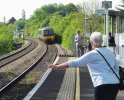
That’s one where I cannot understand the logic of it being a request stop.Dilton Marsh in action...

RPI
Established Member
- Joined
- 6 Dec 2010
- Messages
- 3,332
Quintrell Downs used to be rare in that it was a request stop in one direction (heading to Newquay) but booked stop on the way to Par - due to having to stop to operate the level crossing, I noticed that it's booked stop both ways now.
JohnRegular
Member
- Joined
- 12 Dec 2016
- Messages
- 308
It's a bit out of place, being the only request stop for some distance (nearest being Thornford?).That’s one where I cannot understand the logic of it being a request stop.
In my experience passing through at various times the train stops more often than not, but definitely not always.
I suppose bringing hundreds of tonnes of machinery to a halt and then starting it up again for nobody to board or alight seems wasteful, but it happens all the time at tiny Avoncliff a few miles away.
thenorthern
Established Member
- Joined
- 27 May 2013
- Messages
- 4,711
I suppose another issue is that if it's raining the passengers may choose to sit in the shelter rather than stand on the platform. In those instances for the drivers it's difficult to know if there are any passengers waiting.
Palmerston
Member
I can only imagine the anguish of escaping a kidnapper, successfully making it to a station and then seeing the train roll on through without stopping.If you have escaped a kidnapper and have your hands tied behind your back.
There are quite a few on the Heart of Wales line like this still, for similar reasons. Dolau, Ffairfach, Bucknell, Llandybie, Llangadog and Llanwrda from memory.Quintrell Downs used to be rare in that it was a request stop in one direction (heading to Newquay) but booked stop on the way to Par - due to having to stop to operate the level crossing, I noticed that it's booked stop both ways now.
Falcon1200
Established Member
Request stops seem a mad anachronism to me, to be honest. I also can't really see the benefit, apart from the odd train that is 2 or 3 min late being able to make it back to "on time" if it runs through a bunch of them.
Perhaps request stops allow stations with minimal passenger usage to remain open without detriment to the great majority of people whose journey would otherwise be lengthened by trains stopping everywhere to, very often, little or no purpose?
zwk500
Veteran Member
How much time do Request stops actually save? The timetable must plan for all (or at least most) of the stops to be requested otherwise it would routinely lose time. IIRC Request stops are timed as a zero-dwell stop with 30 seconds adjustment allowance after the stop. So they are functionally equivalent to being timed as a 30-second stop.Perhaps request stops allow stations with minimal passenger usage to remain open without detriment to the great majority of people whose journey would otherwise be lengthened by trains stopping everywhere to, very often, little or no purpose?
The only situation in which I can see request stops saving any time *in the plan* is if the units require longer than 30 second dwells for door cycles, and there are several request stops in a row. But then they'll usually need to wait for the booked departure time at the next mandatory stop anyway.
They may help in delay recovery a little bit, and save a fractional amount of wear, but in general Request stops feel like a anachronistic hangover from when stock had far poorer performance characteristics and station dwells had more risk of delay from things like a door not slamming home fully. There'll be edge cases on lines like the West Highland, Far North, and Heart of wales, but most of them should probably just be made full booked stops.
Falcon1200
Established Member
The timetable must plan for all (or at least most) of the stops to be requested otherwise it would routinely lose time.
The railway operators surely know, through decades of experience, how many request stops each given train will actually require to call at, and plan the timetable accordingly? There is also the saving in wear, tear and fuel from not having to stop everywhere. If there really is no benefit, why go to the expense of providing the electronic systems as per Scotrail?

Ashley Hill
Established Member
Avoncliff used to be a request stop, but with a stop signal off the down platform it wasn’t really a good idea to buzz the driver to not stop approaching a red signal. Therefore it became a booked stop. Keyham was the same and is now a booked stop.It's a bit out of place, being the only request stop for some distance (nearest being Thornford?).
In my experience passing through at various times the train stops more often than not, but definitely not always.
I suppose bringing hundreds of tonnes of machinery to a halt and then starting it up again for nobody to board or alight seems wasteful, but it happens all the time at tiny Avoncliff a few miles away.
Tal-y-Cafn on the Conwy Valley too.There are quite a few on the Heart of Wales line like this still, for similar reasons. Dolau, Ffairfach, Bucknell, Llandybie, Llangadog and Llanwrda from memory.
Surely the problem is where that usage is nil on many runs, and there are a number of stations like that? By reducing the amount of time required in the timetable, it's possible to average out the impact on the (far more important) end to end timetable. With 22 stations between Georgemas and Inverness, that can easily add up.The railway operators surely know, through decades of experience, how many request stops each given train will actually require to call at, and plan the timetable accordingly? There is also the saving in wear, tear and fuel from not having to stop everywhere. If there really is no benefit, why go to the expense of providing the electronic systems as per Scotrail?
SuspectUsual
Established Member
- Joined
- 11 Jul 2018
- Messages
- 6,698
With 22 stations between Georgemas and Inverness, that can easily add up.
But only 8 of them are request stops
Tetchytyke
Veteran Member
I think they make sense in extremely rural areas, and the purpose of the electronic kiosks on Scotrail is to allow the train to approach at a higher speed if nobody has pressed the request button. There will be a benefit to it at stations like Scotscalder.The railway operators surely know, through decades of experience, how many request stops each given train will actually require to call at, and plan the timetable accordingly? There is also the saving in wear, tear and fuel from not having to stop everywhere. If there really is no benefit, why go to the expense of providing the electronic systems as per Scotrail?
But even then the benefit is fairly marginal. An example is today's 0700 Inverness-Wick. It looks as though it didn't stop at the request stops and all that meant was that it sat for almost ten minutes at Lairg.
edwin_m
Veteran Member
At Avoncliff the guard has to walk through the train asking if there is anyone alighting there even though it isn't a request stop, as anyone doing so has to move through to the first door. Just as well the platform access is a steep flight of steps, as the accessible door will never be opened. Not sure what happens if anyone wants to take a bike there - perhaps they get a free ride to Bradford or Freshford and are expected to cycle back (a long way round in the case of Freshford).It's a bit out of place, being the only request stop for some distance (nearest being Thornford?).
In my experience passing through at various times the train stops more often than not, but definitely not always.
I suppose bringing hundreds of tonnes of machinery to a halt and then starting it up again for nobody to board or alight seems wasteful, but it happens all the time at tiny Avoncliff a few miles away.
That makes sense, although I guess it could have stayed as a request stop in the other direction like the level crossing ones mentioned above. But the nearby pub is a popular destination so there are usually passengers boarding or alighting, at least during opening hours.Avoncliff used to be a request stop, but with a stop signal off the down platform it wasn’t really a good idea to buzz the driver to not stop approaching a red signal. Therefore it became a booked stop. Keyham was the same and is now a booked stop.

Revilo
Member
- Joined
- 13 Jan 2018
- Messages
- 346
Freshford also used to be a request stop, back in the day. But it’s well used now.At Avoncliff the guard has to walk through the train asking if there is anyone alighting there even though it isn't a request stop, as anyone doing so has to move through to the first door. Just as well the platform access is a steep flight of steps, as the accessible door will never be opened. Not sure what happens if anyone wants to take a bike there - perhaps they get a free ride to Bradford or Freshford and are expected to cycle back (a long way round in the case of Freshford).
That makes sense, although I guess it could have stayed as a request stop in the other direction like the level crossing ones mentioned above. But the nearby pub is a popular destination so there are usually passengers boarding or alighting, at least during opening hours.
zwk500
Veteran Member
They have a good idea, but as timetabling has developed and the railway has got busier you can't give as much leeway to schedule running times as used to be possible (or rather acceptable)The railway operators surely know, through decades of experience, how many request stops each given train will actually require to call at, and plan the timetable accordingly?
Agree, but with modern units is it a cost that is actually worth saving?There is also the saving in wear, tear and fuel from not having to stop everywhere.
Probably because of a combination of the railway being hesitant to leave things behind and the way public funding is allocated to quite specific activities.If there really is no benefit, why go to the expense of providing the electronic systems as per Scotrail?
- Status
- Not open for further replies.