• Our new ticketing site is now live! Using either this or the original site (both powered by TrainSplit) helps support the running of the forum with every ticket purchase! Find out more and ask any questions/give us feedback in this thread!

What decisions could the UK actually take to avoid managed decline?

Status
Not open for further replies.

RT4038

Established Member
Joined
22 Feb 2014
Messages
5,457
Buy to rent is an area that needs to be controlled. Some private renting is useful/desirable, however the market needs to be clipped so as not to use up all the starter capacity.
That sounds like a 'wisdom of Solomon' task, to get the balance right whilst getting the best of both!

== Doublepost prevention - post automatically merged: ==

But house prices themselves are not the primary issue.

The issue, as you state, is affordability, which is the true driver of housing and rent prices.

It doesn't matter if the nominal price falls, if people still can't afford it then nothing has changed. The market pressures fix affordability, not notional 'price'.

The only thing that will cause affordability to change is increasing supply in the areas where people want to live.
And if that is not practicable and/or desirable then

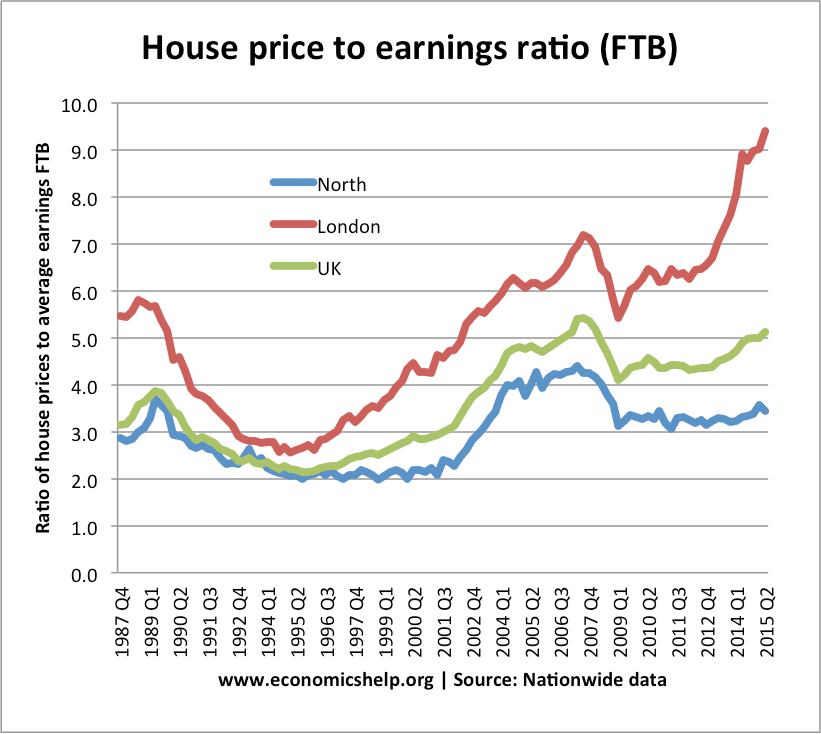
But the data shows that houses are as affordable now as they were 40 years ago.

Whilst some area (London for example) are not as affordable as they once were, plenty of areas are actually more affordable.

The issue is not house prices but the concentration of employment and more importantly, wealth, in the south east.

It is the death of jobs that had a reason to be other than in the South East that is the main driver of economic disparity.


If this country is to recover it needs to find a way of increasing the economic attractiveness of the regions to business compared with the SE.
which I guess the building of HS2 is one of the means of doing this.
 
Sponsor Post - registered members do not see these adverts; click here to register, or click here to log in
R

RailUK Forums

HSTEd

Veteran Member
Joined
14 Jul 2011
Messages
20,342
And if that is not practicable and/or desirable then
In that highly unlikely situation then you might have to take other measures, for example using internal passports to expel the economically inactive from high-demand areas. Send the pensioners to wherever the cheapest housing is.

But the reality is that there is nowhere in the UK where increased housing provision is not practical.
As to desirable, desirable for the general population or for the subset of comparatively rich homeowners?

== Doublepost prevention - post automatically merged: ==

If this country is to recover it needs to find a way of increasing the economic attractiveness of the regions to business compared with the SE.
But the reality is that those areas' unattractiveness is inherent!

Human history has been characterised by ever-increasing urbanisation, it even survived the coming of massively increased mobility from motor vehicles.

Living in small towns in the middle of nowhere is simply not attractive to a large enough fraction of the population. They were only sustained by outmoded means of agricultural production that simply no longer exist.
Human settlements have appeared and vanished throughout human history, it is only in 1948 that we suddenly decide that the urban structure of the country must remain fixed for the rest of time.

Economic output will be dramatically held down if we continue to force people to live in random small towns in the countryside, which the house price imbalance demonstrates they don't want to live in.
And in any case, there is still a massive national housing shortage.
 
Last edited:

Bletchleyite

Veteran Member
Joined
20 Oct 2014
Messages
113,558
Location
"Marston Vale mafia"
Human history has been characterised by ever-increasing urbanisation, it even survived the coming of massively increased mobility from motor vehicles.

Living in small towns in the middle of nowhere is simply not attractive to a large enough fraction of the population. They were only sustained by outmoded means of agricultural production that simply no longer exist.
Human settlements have appeared and vanished throughout human history, it is only in 1948 that we suddenly decide that the urban structure of the country must remain fixed for the rest of time.

Economic output will be dramatically held down if we continue to force people to live in random small towns in the countryside, which the house price imbalance demonstrates they don't want to live in.
And in any case, there is still a massive national housing shortage.

Wha? Many of the deprived areas of "the regions" are cities, such as Liverpool which is grossly underpopulated due to the poor quality of the living environment and the comparative lack of employment.

Even places like the Lancashire mill towns and South Wales Valleys are well-connected to cities. They're not popular because they are, by and large, dumps. Not nice places to live at all.
 

HSTEd

Veteran Member
Joined
14 Jul 2011
Messages
20,342
Wha? Many of the deprived areas of "the regions" are cities, such as Liverpool which is grossly underpopulated due to the poor quality of the living environment and the comparative lack of employment.
The exception proves the rule.
Without getting into the argument about whether Liverpool is a large city again, the trend has been towards living in larger and larger urban centres, even if some urban areas do occasionally trend the other way
Even places like the Lancashire mill towns and South Wales Valleys are well-connected to cities. They're not popular because they are, by and large, dumps. Not nice places to live at all.
I'd hardly call the likes of Blackburn and Burnley well connected to cities.

A small handful of painfully slow trains at some times a day is not "well connected" - think more like tube lines.
 

johncrossley

Established Member
Joined
30 Mar 2021
Messages
4,419
Location
London
I'd hardly call the likes of Blackburn and Burnley well connected to cities.

But what about Oldham, Rochdale, Bolton and Bradford (in W Yorkshire)? They are usually considered similar in character to those towns in modern day Lancashire. The term "Lancashire mill town" usually includes towns which are now in Greater Manchester.

== Doublepost prevention - post automatically merged: ==

Without getting into the argument about whether Liverpool is a large city again, the trend has been towards living in larger and larger urban centres, even if some urban areas do occasionally trend the other way

It is only a recent trend. Until 1990, cities were losing population.
 
Last edited:

Phil56

Member
Joined
1 Jan 2022
Messages
199
Location
Rural NW England
But what about Oldham, Rochdale, Bolton and Bradford (in W Yorkshire)? They are usually considered similar in character to those towns in modern day Lancashire.

I live in Lancashire and think Blackburn and Burnley are VERY different to the likes of Oldham, Rochdale, Bolton and Bradford.

Blackburn and Burnley are also within Lancashire county boundaries whereas Oldham, Rochdale, Bolton and Bradford are within the Greater Manchester "county".
 

johncrossley

Established Member
Joined
30 Mar 2021
Messages
4,419
Location
London
I live in Lancashire and think Blackburn and Burnley are VERY different to the likes of Oldham, Rochdale, Bolton and Bradford.

Why do you think they are so different? Clearly there are many similarities.

The main point is that you can get a job in Manchester or Leeds without paying silly money for accommodation.
 

DynamicSpirit

Established Member
Joined
12 Apr 2012
Messages
9,213
Location
SE London
If public transport is good, people will use it for what it's good for. In the posh areas of Merseyside and surrounds, people don't even consider going to Liverpool by any means other than the train. Car isn't the first choice for urban travel if public transport is to scratch. That's the carrot.

I would think there is a stick there too: The stick comes in the form of a congested road network that makes journey times uncompetitive with the train, plus few/expensive places to park in Liverpool City Centre.

== Doublepost prevention - post automatically merged: ==

The private sector is building lots of houses - they're just the wrong ones - it's mostly larger, more lucrative houses, and poorly designed leasehold flats.

Larger houses wouldn't be more lucrative if people didn't want to buy them! So, unless the builders are being exceptionally stupid, I think we can surmise that what they are building does meet a demand from people.

As for leasehold, it should ideally be banned outright in favour of commonhold/condominium ownership, including existing blocks. For houses, it should be a legal requirement that freehold is the only tenure possible.

I agree there is an issue about unfair leasehold agreements that needs to be sorted out. While that is important, I doubt that's really related to the issue of not enough houses or its impact on GDP though :)

But also, the building of badly designed flats should stop. Every time I see one, I see something stupid about its layout. For instance, my friend's flat has a lift and is so wheelchair accessible, but there's a step up onto the balcony so a wheelchair user can't go outside. This is just ridiculous. Another issue is inside bathrooms with inadequate ventilation.

Badly designed places is a tricky area. The problem is, how do you regulate it? You can't after all regulate everything about the design - there comes a point where you'd just end up making houses even more expensive, while reducing creativity/variety.

In the case of your example of the lift, I would hypothesize that that situation occurs because the regulations require lift access, but don't require a step-free balcony. I guess you could add a regulation requiring balconies to be step-free but then that starts to look like over-regulation. Besides, from your description, I could see a possible rationale: The lift makes the flat accessible to people with heavy luggage/pushchairs/people unable to access more than a few stairs. The balcony is inaccessible to the (much, much smaller) group of people who cannot manage even one step, which may be regrettable but then it's probably not practical to make every house accessible to every person in the country. So perhaps it's a compromise that makes the flat accessible to all but a tiny minority of people?
 
Last edited:

Peter Sarf

Established Member
Joined
12 Oct 2010
Messages
9,674
Location
Croydon
Houses in the South East are cheap enough to build, maybe not quite as cheap as outside the South East but near enough. But the problem is the value of the land. There is such a scarcity of land in Greater London that the cost of the land dominates the price of the finished property.

So it does not matter how cheaply you can build the property the real problem is the cost of the land to put it on.
I think you are worrying too much. We currently have a shortage of labour, which seems to be set on getting worse due to an ageing population (which is also creating more and more care jobs which cannot be easily automated). Many people are also complaining about their work/life balance and would welcome working fewer hours. Not everything can be practically automated anyway [who maintains the automation, for instance?) When we get to the stage of having surplus labour that is the time to engage in job creation, not in futile attempts to hang on to outdated practices to try and prevent us from getting to that point.
Furthermore these futile attempts to hang onto jobs that can be automated means other jobs are not getting done. That is harming the economy.
I said that because it seems to be happening on a very large scale now. Where are all these new jobs coming from, to replace (say) Boots or restaurant till staff? Genuinely curious, and it's contrary to the normal observation that economic hard times equal high unemployment.

An odd way of thinking (to me). Retiring before the age of 60 would, to me, be not much fun. Through having no job, you'd basically lose your raison d'etre, and have to live on a fraction of your former income. So you'd have all this "freedom" but no money to enjoy it with.

On the other hand I would object to raising retirement age above 70.
Until you try it (early retirement) you will not know. To follow your argument means that you should never retire but work until you drop dead !.
Fair point, but why worry about a small percentage of railway with antiquated signalling when those signallers are contributing to the wider economy anyway.

This is all moot when set against the real reason we have mechanical signalling - the capital cost of replacing more modern signalling systems every 30-40 years.
Those signallers could be contributing to the economy but while doing a job that is needed.
Never going to happen - The London Plan specifies car free for areas with PTAL above 6 I think. This area has the highest PTAL so therefore has to be car free.
What is PTAL please ?.
 

Bletchleyite

Veteran Member
Joined
20 Oct 2014
Messages
113,558
Location
"Marston Vale mafia"
I'd hardly call the likes of Blackburn and Burnley well connected to cities.

A small handful of painfully slow trains at some times a day is not "well connected" - think more like tube lines.

Blackburn has 3tph to Manchester Victoria. I know, I know, I'd prefer Castlefield, but that's not "a small handfull of painfully slow trains are some times a day".

Burnley only 1tph to Manchester but it is well connected to other places.

OK, at about 1h-1h10 it's a bit slow, and the first train should be earlier and the last one later, but it's not terrible.

The reason people don't want to live in Blackburn is because it's an absolute dump. Admittedly, people might choose to live there anyway if it had Metrolink (see Oldham, which is also, largely, a dump) but really we should be looking to improve the environment of these places.

It can be nice living in a smaller town well connected to nearby larger places. Ormskirk was a great place to grow up and to bring up a family, for instance, and it's got 4tph into Liverpool from early to late.
 
Last edited:

Bletchleyite

Veteran Member
Joined
20 Oct 2014
Messages
113,558
Location
"Marston Vale mafia"
I would think there is a stick there too: The stick comes in the form of a congested road network that makes journey times uncompetitive with the train, plus few/expensive places to park in Liverpool City Centre.

There's a stick that cities are grim to drive into, yes, but it's not a wilful stick.

I agree there is an issue about unfair leasehold agreements that needs to be sorted out. While that is important, I doubt that's really related to the issue of not enough houses or its impact on GDP though :)

Leasehold is a big dissuader to buying flats in the UK.

Badly designed places is a tricky area. The problem is, how do you regulate it? You can't after all regulate everything about the design - there comes a point where you'd just end up making houses even more expensive, while reducing creativity/variety.

In the case of your example of the lift, I would hypothesize that that situation occurs because the regulations require lift access, but don't require a step-free balcony. I guess you could add a regulation requiring balconies to be step-free but then that starts to look like over-regulation. Besides, from your description, I could see a possible rationale: The lift makes the flat accessible to people with heavy luggage/pushchairs/people unable to access more than a few stairs. The balcony is inaccessible to the (much, much smaller) group of people who cannot manage even one step, which may be regrettable but then it's probably not practical to make every house accessible to every person in the country. So perhaps it's a compromise that makes the flat accessible to all but a tiny minority of people?

It's simply bad design, I wouldn't try to excuse it.
 

The Ham

Veteran Member
Joined
6 Jul 2012
Messages
12,036
Fourth graph down is one example


There's two issues with that graph, first up it doesn't take into account our aging population. This means that there's a good chance that mortgage payments will be falling overall as there's now people near the end of their mortgage than those at the beginning.

Secondly, whilst those younger people who have mortgages will be paying more, they will be being compared against their combined salary and so when compared to a time when there were more people living in just one income it will appear to be broadly the same, even though their household income has increased significantly.

What is PTAL please ?.

It's a scoring system rated from 1 to 6 based on how many buses, rail and tube services are within a given distance. 1 is low and 6 is high.

It's used in London, most places outside of London would struggle to get above 3 with even places with 2tph and some buses likely to end up being a 1.

It's used to determine how likely someone is to use public transport.

If a site is 6 it's likely to be closer to a major station or a tube station with at least 3 lines. As such it's for about an much good public transport as you can think of (i.e. almost all the carrots you could throw at a site to stop people from using a car).
 

Bletchleyite

Veteran Member
Joined
20 Oct 2014
Messages
113,558
Location
"Marston Vale mafia"
If a site is 6 it's likely to be closer to a major station or a tube station with at least 3 lines. As such it's for about an much good public transport as you can think of (i.e. almost all the carrots you could throw at a site to stop people from using a car).

I'd still want to own one. There are places to go that aren't London, and often a car is useful for going to them. This is the New Town style error.
 

JamesT

Established Member
Joined
25 Feb 2015
Messages
4,886
If public transport is good, people will use it for what it's good for. In the posh areas of Merseyside and surrounds, people don't even consider going to Liverpool by any means other than the train. Car isn't the first choice for urban travel if public transport is to scratch. That's the carrot.

The UK prefers the stick despite it demonstrably not working and creating sink estates.

Urban public transport doesn't have to make a profit, it's a public good. That's the UK's other error.
Obviously different for larger urban areas, but within Oxford or commuting from nearby locations the train is irrelevant as there isn't one.
Public transport means buses. Which Oxford at least to be pretty good at, it used to have one of the best percentages of commuting using public transport. But increasing traffic is destroying the bus network. Journey times increasing as the buses are stuck in traffic, which has led to the bus companies chopping services as they can't resource the increased numbers of buses/drivers needed to keep the previous frequency up.
I don't know what kind of carrot you could offer to make public transport attractive in that situation. It has to be the stick to get rid of the private motorists getting in the way of the public transport.
 

Bletchleyite

Veteran Member
Joined
20 Oct 2014
Messages
113,558
Location
"Marston Vale mafia"
It has to be the stick to get rid of the private motorists getting in the way of the public transport.

No, the carrot (which might have a stick on the end, but not a wilful one).

You need to design the bus infrastructure properly so the buses aren't stuck in the traffic and so are an attractive choice.

This is something the UK is woeful at.
 

HSTEd

Veteran Member
Joined
14 Jul 2011
Messages
20,342
Houses in the South East are cheap enough to build, maybe not quite as cheap as outside the South East but near enough. But the problem is the value of the land. There is such a scarcity of land in Greater London that the cost of the land dominates the price of the finished property.

So it does not matter how cheaply you can build the property the real problem is the cost of the land to put it on.
The cost of the land is negligible.

That is how we have agricultural land directly adjacent to tube stations on the CEentral Line.

The cost is in the piece of paper from the state allowing the housing to exist.
 

Peter Sarf

Established Member
Joined
12 Oct 2010
Messages
9,674
Location
Croydon
................................


It's a scoring system rated from 1 to 6 based on how many buses, rail and tube services are within a given distance. 1 is low and 6 is high.

It's used in London, most places outside of London would struggle to get above 3 with even places with 2tph and some buses likely to end up being a 1.

It's used to determine how likely someone is to use public transport.

If a site is 6 it's likely to be closer to a major station or a tube station with at least 3 lines. As such it's for about an much good public transport as you can think of (i.e. almost all the carrots you could throw at a site to stop people from using a car).
Thanks, being Croydon I must be up at 5 or 6.
I'd still want to own one. There are places to go that aren't London, and often a car is useful for going to them. This is the New Town style error.
Yes, very true. For instance, although I am well furnished with public transport, I still need a car to get to my favourite music festival at Cropredy near Banbury. Even if Cropredy station was re-opened I doubt if we could carry all the camping paraphernalia. Then there is the diy trips. But a descent car/van hire scheme would help.
 

HSTEd

Veteran Member
Joined
14 Jul 2011
Messages
20,342
It is only a recent trend. Until 1990, cities were losing population.
True, but the period before 1990 was the abberation.

For almost all of human history the trend has been to increased urbanisation, there was a brief period in the second half of the 20th CEntury where this went into reverse.
But now, normal service has resumed
 

Broucek

Member
Joined
13 Aug 2020
Messages
945
Location
UK
There's another problem with building lots of new homes which I don't THINK I've seen mentioned (apologies if I've missed it). It's the fact that building companies are already finding it hard to get and keep competent people and so we might not be able to manage a building boom... (There's also been a shortage of certain types of materials but my sense is that's getting better.)

I'd love to see a huge chunk of the economically inactive working age population trained in electrics, plumbing, carpentry, roofing, bricklaying or whatever but I'm not holding my breath....

But perhaps we could switch funding to that from low quality degrees in subjects that are not particularly socially or economically useful.
* typed with tongue in cheek by this music graduate...
 

HSTEd

Veteran Member
Joined
14 Jul 2011
Messages
20,342
There's another problem with building lots of new homes which I don't THINK I've seen mentioned (apologies if I've missed it). It's the fact that building companies are already finding it hard to get and keep competent people and so we might not be able to manage a building boom... (There's also been a shortage of certain types of materials but my sense is that's getting better.)

I'd love to see a huge chunk of the economically inactive working age population trained in electrics, plumbing, carpentry, roofing, bricklaying or whatever but I'm not holding my breath....
The problem is that modern housing is still being built using techniques that are predicated on huge quantities of cheap labour being available.

A house built with modern construction techniques would likely use modular busbar electrics like those used in office IT installations, contain no structural bricks, no tiled roof and little hand-installed timber.
Commercial buildings are not built using any of these things, and given the choice between a house built with those techniques and none at all, people will jump at the former.

Beyond this, plumbing has also de-skilled to a very large degree with the rise of all plastic pipework systems and the death of significant soldering.
 

Bletchleyite

Veteran Member
Joined
20 Oct 2014
Messages
113,558
Location
"Marston Vale mafia"
The cost of the land is negligible.

In London, it's really not.

That is how we have agricultural land directly adjacent to tube stations on the CEentral Line

Where? On the outer Central Line it's because of green belt policies, not because of the land's value. It may also be because the farmer doesn't want to sell it.

The cost is in the piece of paper from the state allowing the housing to exist.

Applying for planning permission is not expensive. Do you mean planning gain, perhaps? That is very much needed, it pays for infrastructure to go with the housing.
 

yorksrob

Veteran Member
Joined
6 Aug 2009
Messages
44,368
Location
Yorks
Houses in the South East are cheap enough to build, maybe not quite as cheap as outside the South East but near enough. But the problem is the value of the land. There is such a scarcity of land in Greater London that the cost of the land dominates the price of the finished property.

So it does not matter how cheaply you can build the property the real problem is the cost of the land to put it on.

Furthermore these futile attempts to hang onto jobs that can be automated means other jobs are not getting done. That is harming the economy.

Until you try it (early retirement) you will not know. To follow your argument means that you should never retire but work until you drop dead !.

Those signallers could be contributing to the economy but while doing a job that is needed.

What is PTAL please ?.

Well, at the moment, they're needed to signal those lines, so until someone pays to update them, that is a job that's needed.
 

HSTEd

Veteran Member
Joined
14 Jul 2011
Messages
20,342
Where? On the outer Central Line it's because of green belt policies, not because of the land's value.
The land's value is dictated by the Green Belt policies!

Land values for housing are not the value of the land, they are overwhelmingly the value of the planning permission or lack of outright prohibition on construction.

If the state was not desperate to hold house prices in London artificially high it could sweep away the green belt tomorrow. It's not a real constraint.


Applying for planning permission is not expensive. Do you mean planning gain, perhaps? That is very much needed, it pays for infrastructure to go with the housing.
The process is not expensive, no, but the value of the land is still dictated entirely by the permission because the state will not grant permission if it doesn't want.

I can't buy a plot of land in the green belt and apply for planning because they won't give it to me, entirely artificially.
But if they were to grant permission the "value" of that land would increase by at least one order of magnitude, probably more, overnight.

The price of building plots is generated almost entirely from planning permission.
 

johncrossley

Established Member
Joined
30 Mar 2021
Messages
4,419
Location
London
If you read this thread you would think that the cities are where all the jobs are. But if you look at the maps here


the highest unemployment rates are in the major metropolitan areas. The lowest unemployment rates are in rural England.

== Doublepost prevention - post automatically merged: ==

If the state was not desperate to hold house prices in London artificially high it could sweep away the green belt tomorrow. It's not a real constraint.

London's green belt simply pushes the development beyond the green belt into the wider south east.
 

The Ham

Veteran Member
Joined
6 Jul 2012
Messages
12,036
I'd still want to own one. There are places to go that aren't London, and often a car is useful for going to them. This is the New Town style error.

Most places which are 6 are likely to have access to a choice of car club vehicles.

Why would you spend over £2,000 a year (average car ownership costs are currently over £3,500/year, see link below, so £2,000 is quite a way below the average) for something that you probably aren't going to use all that often.


Someone with 2 kids who lived in Brighton never owned a car, used public transport for day to day. When they went to visit their parents would use a car club car for the weekend (using their own kids car seats), as they did that less than a dozen times a year.

Thanks, being Croydon I must be up at 5 or 6.

Depends where, check out this map, it's surprising just how much the scores drop off:


For example whilst South Croydon Station is 5, not that far from it drops to 3 and not much further out dropping to 1b.
 

Bletchleyite

Veteran Member
Joined
20 Oct 2014
Messages
113,558
Location
"Marston Vale mafia"
Why would you spend over £2,000 a year (average car ownership costs are currently over £3,500/year, see link below, so £2,000 is quite a way below the average) for something that you probably aren't going to use all that often.

It's the membership cost for the lifestyle option of always having one available. Most people are totally willing to spend that.
 

CeeJ

Member
Joined
25 Jun 2017
Messages
168
Regardless of whether someone might, or might not, want a car. Building car-free housing in highly accessible areas means those who don't need a car have a place to live, freeing up other housing for those that do. A parking space for every flat would increase both construction costs and house price. It increases the viability of local transport options, and doesn't contribute to congestion.
 

The Ham

Veteran Member
Joined
6 Jul 2012
Messages
12,036
It's the membership cost for the lifestyle option of always having one available. Most people are totally willing to spend that.

And herein lies the reason that we have to use rather large sticks to stop people from owning a car which is used maybe a few dozen times a year when public transport is very good (actually crazily good compared to almost anywhere else in the country).

Within most urban areas, especially those with a high PTAL rate car club vehicles are almost always available (at least within a short distance of a where the individual is or can get to very easily).

Whilst not designed for use out of London use, if you were to do the calculation on somewhere like Milton Keynes Central it's likely to be a 4 with an outside edge of it just scrapping a 5 or dropping down to a 3, however within 400m it's going to drop away very very quickly.

Milton Keynes Central had 9 trains, whilst Twickenham Station had 11, it's not clear how many buses MKC has (about 15 looks about right) with Twickenham Station having 18.

Whilst those two extra trains and a few extra buses don't sound a lot it's number of designations which is a higher score factor than actual frequency and so with 5 different (non Waterloo) destinations vs MKC's 4.

Twickenham Station has a PTAL of 5 dropping to a 4 within a few metres (mostly due to the higher bus frequencies in the centre, circa 25 buses).

Unless there's a few extra buses and trains which I've missed I suspect that 4 is about right.

That just showed how "good" those 6's will be in terms of number of services.
 

Bletchleyite

Veteran Member
Joined
20 Oct 2014
Messages
113,558
Location
"Marston Vale mafia"
And herein lies the reason that we have to use rather large sticks to stop people from owning a car which is used maybe a few dozen times a year when public transport is very good (actually crazily good compared to almost anywhere else in the country).

Within most urban areas, especially those with a high PTAL rate car club vehicles are almost always available (at least within a short distance of a where the individual is or can get to very easily).

Whilst not designed for use out of London use, if you were to do the calculation on somewhere like Milton Keynes Central it's likely to be a 4 with an outside edge of it just scrapping a 5 or dropping down to a 3, however within 400m it's going to drop away very very quickly.

Milton Keynes Central had 9 trains, whilst Twickenham Station had 11, it's not clear how many buses MKC has (about 15 looks about right) with Twickenham Station having 18.

Whilst those two extra trains and a few extra buses don't sound a lot it's number of designations which is a higher score factor than actual frequency and so with 5 different (non Waterloo) destinations vs MKC's 4.

Twickenham Station has a PTAL of 5 dropping to a 4 within a few metres (mostly due to the higher bus frequencies in the centre, circa 25 buses).

Unless there's a few extra buses and trains which I've missed I suspect that 4 is about right.

That just showed how "good" those 6's will be in terms of number of services.

Which demonstrates a massive, massive flaw in that PTAL figure.

MKC is excellently connected by rail to London, and good (but not excellent due to a lack of late evening service on Saturdays when most needed) to Birmingham.

Public transport to Stansted Airport, say? Nope. Occasional coach from Coachway. Wellingborough? Nope. And so on.

Public transport in the SE is good at getting people to/from Central London, and only that. Clearly PTAL doesn't consider enough about practicalities.

Cars will not and should not go away. The approach needs to be to discourage their most harmful uses (that is, driving them into the very dense parts of large cities) and on electrifying them. A car club isn't good enough, as there's not guaranteed availability.
 
Status
Not open for further replies.

Top