
Railsigns
Established Member
- Joined
- 15 Feb 2010
- Messages
- 2,754
Provided on 11 January 1981.The first flashing yellows I recall seeing, around about 1984, where [were] on the Down line on the approach to Weaver Junction.

Provided on 11 January 1981.The first flashing yellows I recall seeing, around about 1984, where [were] on the Down line on the approach to Weaver Junction.

Thank you. I had no idea they had been there that long.Provided on 11 January 1981.
Don't forget Motherwell which retained its original flat rooves.WCML electrification was really done on the cheap. Boxes at Euston, Watford ? and Rugby and Nuneaton then mechanical interlocking Atherstone, Polesworth, Tamworth TV, Litchfield TV (Was there a box between for a level crossing or was it a gate box?), then a power installation at Rugeley, then mechanical through Stafford and Crewe except for a small panel at Norton Bridge. not sure about between Crewe and Weaver Jct, then into the 70's power boxes at Warrington, Preston and Carlisle.
And lets not forget Stockport!
They will have to replace Warrington, Preston and Carlisle soon. They are 50 years old now.
The 4 tracks there are paired by direction, rather than use. The Fast lines are bidirectional so that trains can be run on one pair of tracks while work procedes on the other two.The bi-di between Rugby and Lichfield is worth further scrutiny. To my knowledge, it’s the only bi-directional 4-track in the country. Elsewhere it’s assumed that during engineering work, all traffic can be accommodated by two of the 4 tracks in the normal direction.
Can anyone advise how often the bidi facility gets used?
Trawling the memory banks here, Uddingston?The first flashing yellows in the country were at Didcot in March 1979. I don't where they were first provided on the WCML, but Law Junction got them in April 1980.
The flashing yellows at Uddingston came into use one week after Law Junction's, according to the weekly notices.Trawling the memory banks here, Uddingston?
The present speed-related criteria for the provision of flashing yellow aspects are:I'm not sure there's any speed-related restriction now other than that the flashing yellow can only be used for the fastest diverging route if there's more than one.
Others will correct or amplify this I'm sure!

If there is no differentiation in the routing indication, presumably it would not be allowed to reduce the risk of confusion?There are two turnouts, the second to 10mph, but seemingly from post #65/66 flashing yellows on the earlier 50mph turnout would be allowed.

The thinking is that Crewe will be eventually, in combination with ATO. But it will be resignalled with lineside signals for HS2, so this would be a long, long way offCrewe won't be ETCS as it stands, only Warrington, Preston and Carlisle.

My notes, could be wrong, is that WN217 has position 1 & 2 junction indicators only, implying down passenger loop & down slow both via the 50mph turnout only, with subsidiary signal plus theatre indicator which might allow a route over the 15mph turnout (as was, you & sectional appendix say now 10mph). If so, there can be no confusion.Could do with some on the Down Fast approaching Warrington BQ P4 (90-50mph).
Every train (mostly from from Chester), heading for the Slow/P4, gets checked to walking pace on the approach to red, reducing fast line capacity.
There are two turnouts, the second to 10mph, but seemingly from post #65/66 flashing yellows on the earlier 50mph turnout would be allowed.
This is in progress. Route in to P1 will have the speed lowered to 50mph from 60mph as a mitigation due to P2 route being 40mph from the DF it reduces the risk of anything happening should a train traverse the route to quickly.Having a flashing aspect from the DM into P1 at Rugby would improve things no end. I’d also make the DF bi-di at Rugby too as it would be of great use when the Up side of the station is under possession and we’ve got freights stood waiting relief in the station. I’d also make the UM at Northampton bi-di too so there’s a through route for Down trains when all platforms are occupied with abandoned units.
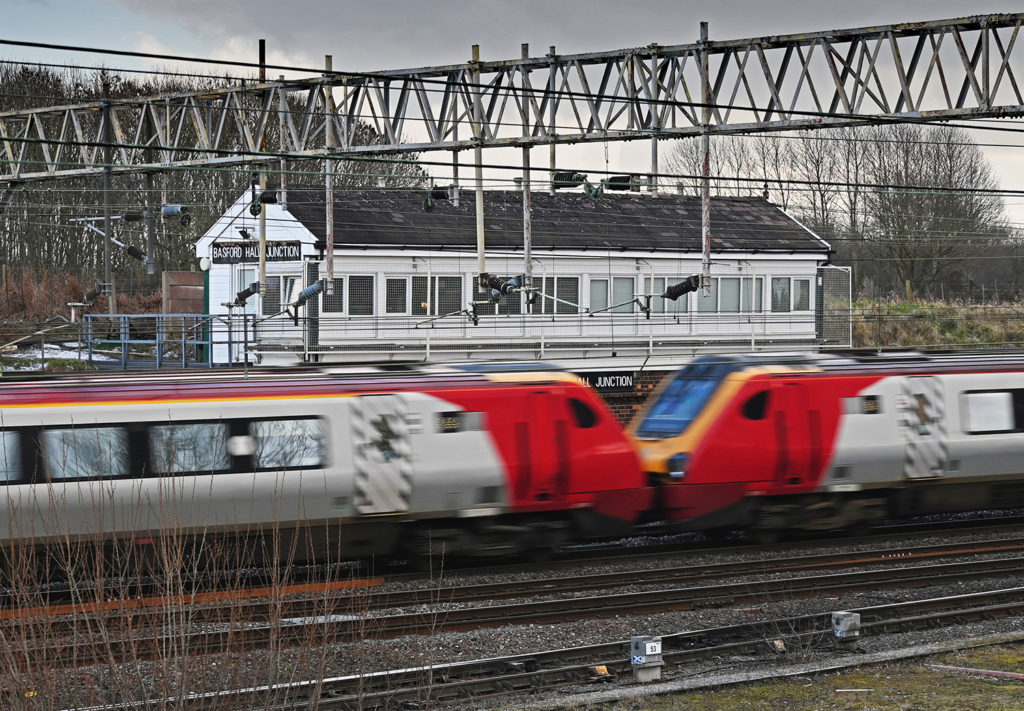
Soon (https://www.railforums.co.uk/threads/crewe-resignalling-crewe-south-basford-hall.234061/)When is the 126-year-old LNWR Basford Hall Junction signalbox due to close?
 www.railengineer.co.uk
Next year at the earliest.Soon (https://www.railforums.co.uk/threads/crewe-resignalling-crewe-south-basford-hall.234061/)
Crewe Basford Hall and Independent Lines resignalling - Rail Engineer
Listen to this article If you have ever stood on Crewe station, you may have noticed that hardly any freight trains pass through it. This is because they are diverted via a separate four-track railway in a deep cutting to the west. Known as the Crewe Independent Lines, it is tunnelled beneath...

December 2024 was this year but now delayedWhen is the 126-year-old LNWR Basford Hall Junction signalbox due to close?

2025 more likely.December 2024 was this year but now delayed
My understanding is that compared to cantilivers or portals headspan wires have two major downsides.Is it true to say headspan catenary is less reliable?

My understanding is that compared to cantilivers or portals headspan wires have two major downsides.
1. They are more vulnerable to wind.
2. If something goes wrong with a pantograph then it is likely to screw up the catenery on all the lines.