Our new ticketing site is now live! Using either this or the original site (both powered by TrainSplit) helps support the running of the forum with every ticket purchase! Find out more and ask any questions/give us feedback in this thread!
It's a combination of factors - clear priority in both markings and the highway code will help, as will additional liability for drivers so they need to look out more, as well as actually prosecuting drivers who don't drive safely around cyclists with serious penalties. And that includes charging people with assault, attempted murder, manslaughter or murder when they've used their car in a manner likely to kill or actually killing somebody.
There's plenty of room for segregation. I did a bit of an exercise the other year looking at available space around Oxford, which has narrower roads than most. You can get a stepped cycle track with standards-compliant dimensions in the majority of the places where OCC is putting painted lines.
In a city which is less constrained by medieval road layouts and Victorian housing, the world's your oyster.
OCC aren't competent enough to design and implement one new junction with existing off road cycle paths correctly (look at the Pig's Ear that is the A40 Northern gateway) let alone retrofitting whole streets, especially one like Cowley Rd.
There's plenty of room for segregation. I did a bit of an exercise the other year looking at available space around Oxford, which has narrower roads than most. You can get a stepped cycle track with standards-compliant dimensions in the majority of the places where OCC is putting painted lines.
From a quick look at Streetview I don’t see how you get compliant cyclepaths down those roads, certainly not without removing all parking, removing some bike parking, and leaving bus stops in the way.
And if they aren’t complete they aren’t much use.
From a quick look at Streetview I don’t see how you get compliant cyclepaths down those roads, certainly not without removing all parking, removing some bike parking, and leaving bus stops in the way.
And if they aren’t complete they aren’t much use.
Removing street parking is probably desirable in its own right if you want to drive a switch to cycling and public transport. Storing cars on thoroughfares is a terrible use of space. You might want a few 20 minute bays by shopping areas, but not a lot else.
Removing street parking is probably desirable in its own right if you want to drive a switch to cycling and public transport. Storing cars on thoroughfares is a terrible use of space. You might want a few 20 minute bays by shopping areas, but not a lot else.
The bit I looked at was a shopping area - so the point that would generate the most heat over removing parking also coincides with the busiest bit.
Removing lots of parking is just going to add to the naysayers.
From a quick look at Streetview I don’t see how you get compliant cyclepaths down those roads, certainly not without removing all parking, removing some bike parking, and leaving bus stops in the way.
I worked from the official Oxfordshire County Council engineering drawings with widths marked on them, which is probably a bit more rigorous than "a quick look at Streetview". Most of the parking has already been removed for the Quickways scheme anyway.
I worked from the official Oxfordshire County Council engineering drawings with widths marked on them, which is probably a bit more rigorous than "a quick look at Streetview". Most of the parking has already been removed for the Quickways scheme anyway.
Outside the city centre itself, the two shopping areas on radial roads in Oxford are Summertown and the Cowley Road. Both have such a high volume of motor traffic that you'd want segregation regardless of speed, but generally there's lots of available space, and rather unfortunate road layouts.
Cowley Road is quite an interesting case study in older approaches that don't necessarily work as well as intended - the current design dates from c.2000, so fairly recent, but even as an experienced, assertive cyclist I find it a stressful place to ride. But the really difficult place in Oxford for safe cycling is the Plain, the roundabout which all the East Oxford radials funnel into.
Removing street parking is probably desirable in its own right if you want to drive a switch to cycling and public transport. Storing cars on thoroughfares is a terrible use of space. You might want a few 20 minute bays by shopping areas, but not a lot else.
Outside the city centre itself, the two shopping areas on radial roads in Oxford are Summertown and the Cowley Road. Both have such a high volume of motor traffic that you'd want segregation regardless of speed, but generally there's lots of available space, and rather unfortunate road layouts.
Cowley Road is quite an interesting case study in older approaches that don't necessarily work as well as intended - the current design dates from c.2000, so fairly recent, but even as an experienced, assertive cyclist I find it a stressful place to ride. But the really difficult place in Oxford for safe cycling is the Plain, the roundabout which all the East Oxford radials funnel into.
As @Doctor Fegg says, Cowley Road was remodelled about 20 years ago. The designers were working from a "shared space" concept, so cyclists mostly pushed into the main path of traffic. There is very limited parking, I can't see that you can remove much of the remaining, you still need some way of loading without jamming everything up as there's no rear access.
As I cycle Cowley Road on days I can be bothered to go to work, I'm astounded that you can get segregated cycle lanes down there. Last time I saw a Cyclox presentation there was someone talking about making it one-way in order to fit full segregated cycle lanes in both directions.
I don't really remember segregation in Holland in places that looked like the towns round here. The newer places on the polders were more like MK than traditional English towns. What I do remember is that Holland seemed to have an incredibly dense road and motorway network.
New places in polders are an exception. Lots of Dutch cities are more like UK cities and towns with narrow roads which were later reconfigured for cycling. Newer developments were designed around cycling (from the 1980s onwards), but older ones certainly were not.
The Dutch have the "dragon teeth" marking for that purpose which implies more than a zebra but also vehicular/cycle give way, perhaps we should introduce them, or indeed just mark give ways like you get in central MK at the porte cochere crossings which I'm pretty sure are like that to indicate "give way to cyclists and pedestrians" rather than to simply act like a zebra, unusual though they are
We call the marking you mean "shark teeth" literally translated from Dutch and are just a give way marking. They don't imply anything with respect to pedestrians, it's a replacement and/or addition to the give way sign. To give pedestrians priority, zebra markings are required or a special kind of speed bump at the end of a road needs to be built.
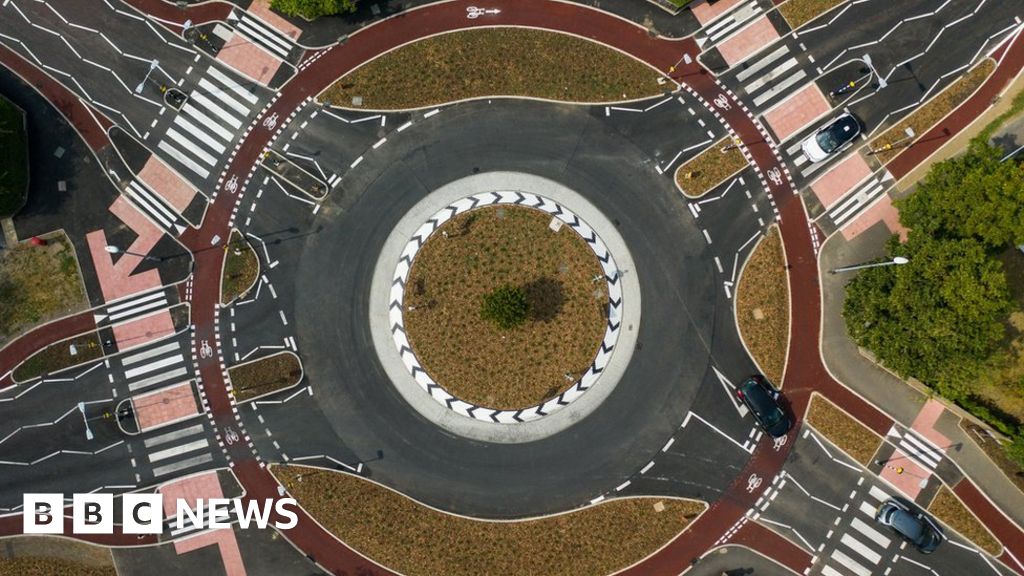
Cambridge does have its own "Dutch Roundabout" at the junction of Queen Ediths Way, Fendon Road and Mowbray Road. It was installed at vast expense not long ago, went massively over budget, and is not big enough to include bus stops. It is not very popular, and has had some minor accidents because people don't really know how to use it safely. I avoid it.
The Cambridge "Dutch Roundabout" is in the news today with statistics of 10 accidents since it was installed, 8 of those involving cyclists. The council said that use of the roundabout had increased by about 50%, compared with 2017, and that cyclists are about 11% of all users.
Figures show there have been more collisions on the Cambridge roundabout than the one it replaced.
www.bbc.co.uk
A Dutch-style roundabout has seen more collisions in the three years since it was built compared to its predecessor over the previous three years.
The new layout on Fendon Road, Cambridge, came into use in 2020 offering priority to cyclists and pedestrians.
There have been 10 collisions since then, three of them serious, compared to six minor incidents 2017-2019.
I'm just not sure I'm convinced by that design - people coming off a roundabout don't expect a give way immediately after they turn and may be distracted with the turn. I have seen roundabouts where a zebra is present just after but it's usually more set back than that. And remember that confused or overstressed drivers make mistakes.
Are there many of these in NL? My experience there is that they largely prefer traffic-light junctions where cyclists can be given full priority.
I'm just not sure I'm convinced by that design - people coming off a roundabout don't expect a give way immediately after they turn and may be distracted with the turn. I have seen roundabouts where a zebra is present just after but it's usually more set back than that. And remember that confused or overstressed drivers make mistakes.
As people get used to it, that will improve. I've had a couple of lifts from Dutch friends and even out in the countryside they look around fully to make sure there's no cyclists at roundabouts and junctions (the Netherlands has bike lanes marked on an amazing proportion of it's roads, with a standard-width 2-lane road having dashed cycle lanes either side) because they're taught to be mindful for cyclists at any point. It's notable that because people expect cyclists anywhere, the standard of driving around cyclists is generally good (although I will admit that my experience of 'rural' cycling was on a typically flat road where I would have been visible from a very long distance, and I was the only cyclist about travelling not very fast so people weren't held up for long).
It varies depending on the road and traffic situation. Near me most roundabouts have a concentric cycle lane with give-ways for the cars. However further out the roads are bigger and faster, so the bike lanes have signalised crossings and are set further back from the roundabouts. Nearer the inner city there isn't room for roundabouts, so it's just signalised junctions with a bike phase (some turning moves can require 2 phases for bikes).
The issue with the design at Cambridge is the lack of clear priority. 3 Arms are ambiguous on both entry and exit between cyclist and driver priority, with only the Zebra being a clear indication. Then there's a 4th arm with full give-way markings, for no clear reason why it's different from the others (this arm also has a narrower zebra, so is it possibly an older cycle path?). I'm also not entirely convinced that geometry is set up for any decent sighting of cyclists coming around the bend.
I found this quote from the article interesting (from a 95 year old Gent):
"It's a very busy roundabout and motorists use it at quite high speed.
"It's too much for even an experienced driver to take in, with cyclists and pedestrians coming from left and right, and vehicles from the right," he added.
"You would be looking for vehicles traversing in front of you while a cyclist can be coming at high speed from your left.
"I've witnessed motorists making emergency stops and getting into rear-end bumps."
The solution to which is for motorists to slow down and leave space, not that the roundabout is inherently bad. Give yourself time to take everything in.
The issue with the design at Cambridge is the lack of clear priority. 3 Arms are ambiguous on both entry and exit between cyclist and driver priority, with only the Zebra being a clear indication. Then there's a 4th arm with full give-way markings, for no clear reason why it's different from the others (this arm also has a narrower zebra, so is it possibly an older cycle path?). I'm also not entirely convinced that geometry is set up for any decent sighting of cyclists coming around the bend.
I did look into this with regard to a couple of local roundabouts where there are traditional give way markings on one or two arms but not all of them (the example is linked in one of the posts above). Apparently the reason for this is that a regular give way marking with a give way sign should be used when there's a possibility an approaching driver may mistake, due to the shape of the road, the roundabout for a regular junction. However it's actively confusing, and a lot of people here seem to strongly believe (and won't be swayed) that it affects the priority on some roundabouts, which it doesn't - and I was confused enough by it all to look up the marking regulations to see exactly what it meant. The manual does say that it shouldn't be used where it might cause confusion, but that is a judgement call which MK Council has got wrong at least twice that I know of!
This is just downright stupid. We should have one unmistakeable set of give way markings used in absolutely all situations where one must potentially stop and give way, be that a roundabout, a junction or whatever. The one place I'd not use them is acceleration lanes which have a subtly different meaning - don't stop at the bottom but rather adjust your speed to merge.
My suggestion would be to introduce the European style "shark teeth". They are intuitively a warning in shape, and because they're unlike anything else we use wouldn't pose a danger of confusion with anything else, though it'd be an option just to progressively remark all roundabouts to use conventional double-dashed-line give ways and add give way signage.
Confused drivers are dangerous drivers. We should use every tool in our toolbox to ensure that drivers aren't confused.
I found this quote from the article interesting (from a 95 year old Gent):
The solution to which is for motorists to slow down and leave space, not that the roundabout is inherently bad. Give yourself time to take everything in.
I'm forever seeing "drivers should behave better" from cycling Twitter, and yes, ideally they should. But equally this is the real world, and drivers are people, and people make mistakes. You can mitigate a bit by way of dropping speed limits to 20, but few people (outside of Milton Keynes) will take a roundabout above 20mph anyway. To me the key is understanding that drivers are people, and that people make mistakes, and thus that you need to design road layouts to be intuitive and consistent in order to minimise stress and confusion.
I'd be concerned that that 95 year old may well have an excessively high estimation of the quality of his own driving or cycling (a lot of old people do as they simply can't accept that their reactions are now so poor they shouldn't be on the road at all), and as such may pose a high risk on the road simply because of that. Arrogance is about the most dangerous trait possible on the roads.
I'm forever seeing "drivers should behave better" from cycling Twitter, and yes, ideally they should. But equally this is the real world, and drivers are people, and people make mistakes.
I'm not expecting professional race car of Bodyguard level driving skills. Driving at a speed appropriate to the conditions and leaving space in front of you in case of an emergency stop is driving 101. The signage and markings could be improved to reduce the workload, but I don't think it's asking for too much to say that if you complain that you're driving too fast to take in the situation, you should lower your speed.
Otherwise we should just get rid of speed limits and speed limit enforcement and let people crash headlong into each other all day long.
I'm not expecting professional race car of Bodyguard level driving skills. Driving at a speed appropriate to the conditions and leaving space in front of you in case of an emergency stop is driving 101.
Certainly, but the problem is that the conditions (a crossing on a roundabout exit) are not apparent until you get to them. It's not an intuitive thing to have and is quite rare.
If anyone rear ends a car that stops on that then they were too close, but I'm more concerned about them not stopping. There's simply not enough time to take in what is happening on the off-arm when you're still thinking about exiting safely, particularly if you're not exiting straight on so you wouldn't necessarily see it in advance.
I'm inclined to think a signalised junction would be preferable. Roundabouts do work with underpasses (well over a hundred exist in MK) but these things just don't seem possible to make intuitive, either for the cyclist or the driver.
The signage and markings could be improved to reduce the workload, but I don't think it's asking for too much to say that if you complain that you're driving too fast to take in the situation, you should lower your speed.
Otherwise we should just get rid of speed limits and speed limit enforcement and let people crash headlong into each other all day long.
Certainly, but the problem is that the conditions (a crossing on a roundabout exit) are not apparent until you get to them. It's not an intuitive thing to have and is quite rare.
If anyone rear ends a car that stops on that then they were too close, but I'm more concerned about them not stopping. There's simply not enough time to take in what is happening on the off-arm when you're still thinking about exiting safely, particularly if you're not exiting straight on so you wouldn't necessarily see it in advance.
I'm inclined to think a signalised junction would be preferable. Roundabouts do work with underpasses (well over a hundred exist in MK) but these things just don't seem possible to make intuitive, either for the cyclist or the driver.
"Drivers should behave better" is a constant mantra, and it's not wrong, but it just isn't going to happen any more than the relevant cyclists behaving better! (Almost every Twitter campaigner I see bleating this mantra likes posting videos of them cycling dangerously and attempting to justify it - Jeremy Vine is one of the "best" at this).
Road layouts need to be designed to be intuitively safe. People are not going to start taking roundabouts at 5mph however much you might want them to, and the lowest speed limit you can apply is 20mph, which everyone using that roundabout will be below anyway.
== Doublepost prevention - post automatically merged: ==
Every single one of those bar the second one has simpler, clearer and more intuitive markings than the Cambridge one, and I think in all cases where the cycle provision isn't on the main carriageway it's set back further along the arms rather than immediately off the roundabout.
The second one is interesting, as it's on the face of it quite confusing, including a bus lane too - but it's marked as junctions, and as such all you need to do is treat it as a normal junction and if confused just go round for another pass without any risk of conflicting with anything as there's only a single circulatory lane. I'd go so far as to say that is actually the most cleverly designed roundabout I've ever seen, and while I haven't driven around it it looks to me like it would be super-intuitive, has few conflicts (which cause stress and confusion) and as such is probably the safest of the lot.
So what we're back to is "the UK just can't do this right - copy the Dutch!" - the Cambridge one is a pale and much less safe imitation of several of these. The differences are subtle but - particularly the setting-back of the cycle crossing - are vital to avoiding driver overload.
FWIW it isn't just about slowing down, anyway. A while back I drove to a show at Wembley (train strike, so it was that or not go) and despite it all being a 20 (and me driving with the limiter set, so no need to pay any attention to the speedo) the road layouts surrounding the stadium area were some of the most stressful and confusing I've ever used, and as a result I made a few mistakes (none harming anyone, but stuff like being stuck the wrong side of a red traffic light blocking a crossing). This really isn't good enough; humans aren't perfect so roads need to be designed to be intuitively safe.
"Drivers should behave better" is a constant mantra, and it's not wrong, but it just isn't going to happen any more than the relevant cyclists behaving better! (Almost every Twitter campaigner I see bleating this mantra likes posting videos of them cycling dangerously and attempting to justify it - Jeremy Vine is one of the "best" at this).
I don't cycle militantly, and I don't have time to edit my videos or post them on twitter.
I say drivers should drive better because in my experience driving, walking and cycling in the UK there are an awful lot of bad drivers about. From people who can't understand that they're not the only ones on the road to people who know and admit they are unsafe but feel they have no other transport option due to a lack of public transport.
Again, asking somebody to approach a roundabout slowly and leave space to the car in front is hardly a revolutionary concept, and is at about the same level as use the leftmost lane unless overtaking - a position that IIRC you support!
Road layouts need to be designed to be intuitively safe. People are not going to start taking roundabouts at 5mph however much you might want them to, and the lowest speed limit you can apply is 20mph, which everyone using that roundabout will be below anyway.
You don't need to slow to 5mph to be safe on a roundabout, you need to be approaching at 20mph from further back. It will cost you 5 seconds, but that's 5 seconds of valuable processing time that may save a life.
Equally, cyclists need to slow down approaching roundabouts, sit up and give clear indications while looking about and making eye contact where necessary to cross safely. Safety on the road is everybody's responsibility, I do not advocate cyclists being led to believe its a private velodrome.
I do fully support your call for intuitive design though - road design in the UK has been slowly moving more towards theory-based than practice-based and this increases the workload of the driver, which is bad.
Lanes squeezed into to small space, lack of advance signage, requirements for multiple successive lane changes to stay on a road, badly marked lane drips or gains, poorly signed roundabouts, badly laid out traffic lights etc. Road design should be focused on being far more consistent and user-friendly, so that you don't have to be a local resident to know the precise moment for every lane change, etc.
I say drivers should drive better because in my experience driving, walking and cycling in the UK there are an awful lot of bad drivers about. From people who can't understand that they're not the only ones on the road to people who know and admit they are unsafe but feel they have no other transport option due to a lack of public transport.
Again, asking somebody to approach a roundabout slowly and leave space to the car in front is hardly a revolutionary concept, and is at about the same level as use the leftmost lane unless overtaking - a position that IIRC you support!
Drivers should be better, yes, but the thing is they aren't, and there isn't going to be much you can do about that.
You can throw enforcement at them, or you can design for intuitive safety. Passive safety is better than active safety in basically every possible situation including people. A nice example of active safety is the shouty blokes and red line at Manchester Piccadilly platform 14 - it's ineffective and stressful. Passive safety in that case would be things like the redesigned "upstairs lounge" to reduce the number of people down there, and stuff like moving to using consistent-doored rolling stock so platform edge barriers (not necessarily doors) can be fitted and door positions marked, for instance.
That's one reason I prefer 20 Zones over 20 limits, for instance - 20 Zones are designed so you naturally do 20, not by overloading people with signs and markings, but by way of things like natural chicanes by adding greenery and managing parking as well as Dutch style "table crossings" into side roads that intuitively indicate pedestrian and cycle priority in a way a million signs never will.
You don't need to slow to 5mph to be safe on a roundabout, you need to be approaching at 20mph from further back. It will cost you 5 seconds, but that's 5 seconds of valuable processing time that may save a life.
The fundamental problem with that roundabout is, if you're approaching it for the first time, you can't see the thing that's a safety risk - the cycle crossing too close to the off-arms.
The Dutch ones have it further back so as to provide enough thinking and stopping time from 15-20mph on exiting the roundabout. As usual the Dutch have it right.
== Doublepost prevention - post automatically merged: ==
I do fully support your call for intuitive design though - road design in the UK has been slowly moving more towards theory-based than practice-based and this increases the workload of the driver, which is bad.
Lanes squeezed into to small space, lack of advance signage, requirements for multiple successive lane changes to stay on a road, badly marked lane drips or gains, poorly signed roundabouts, badly laid out traffic lights etc. Road design should be focused on being far more consistent and user-friendly, so that you don't have to be a local resident to know the precise moment for every lane change, etc.
Exactly. Central London is terrible for this - satnav helps a bit, but we really shouldn't design road layouts where you round a corner in the left lane and may need to move right 4 lanes within 50 yards. Ironically such layouts (and there are loads in central London) are worse for cars than if you took it down to 2 lanes, making space for better cycle and pedestrian provision too.
As for roundabouts, we should have more single-lane ones (though the UK is starting to use them, there are a couple near me) as they make people drive slower and avoid conflicts, and anything with more than two lanes should always be spiral-marked, and if there isn't room for proper spiral-marking, copy that second Dutch example above by having a single circulatory lane and a load of slips off it.
Drivers should be better, yes, but the thing is they aren't, and there isn't going to be much you can do about that.
You can throw enforcement at them, or you can design for intuitive safety. Passive safety is better than active safety in basically every possible situation including people.
I totally agree with this, and we are starting to get it in the UK. However I think there's also room for more active measures - like recertifying your theory test.
Exactly. Central London is terrible for this - satnav helps a bit, but we really shouldn't design road layouts where you round a corner in the left lane and may need to move right 4 lanes within 50 yards. Ironically such layouts (and there are loads in central London) are worse for cars than if you took it down to 2 lanes, making space for better cycle and pedestrian provision too.
Central London but also places there's really no excuse - Like J13 of the M1, the link to the road to Bedford from the roundabout at the slip roads is shockingly marked.
As for roundabouts, we should have more single-lane ones (though the UK is starting to use them, there are a couple near me) as they make people drive slower and avoid conflicts, and anything with more than two lanes should always be spiral-marked, and if there isn't room for proper spiral-marking, copy that second Dutch example above by having a single circulatory lane and a load of slips off it.
Yes, the spiral dutch roundabout is a joy to use as a cyclist. The one with the filter lane outside the bike lane is probably the one I like the least - the geometry is nasty and cars can approach quite fast.
I totally agree with this, and we are starting to get it in the UK. However I think there's also room for more active measures - like recertifying your theory test.
Yes, that would help as part of things that change in the Highway Code. You'd never know for instance that drivers and cyclists are now meant to give way to pedestrians at junctions if they wish to cross, because nobody is doing it - drivers/cyclists aren't stopping, and pedestrians aren't risking it!
Central London but also places there's really no excuse - Like J13 of the M1, the link to the road to Bedford from the roundabout at the slip roads is shockingly marked.
The bottom of the M1 (possibly the busiest junction in the UK?) is the worst-marked piece of road I've ever had the misfortune to use, and even some of those bad markings are faded so badly that you can't see them at night. Truly awful - welcome to London!
The bottom of the M1 (possibly the busiest junction in the UK?) is the worst-marked piece of road I've ever had the misfortune to use, and even some of those bad markings are faded so badly that you can't see them at night. Truly awful - welcome to London!
I'm lucky as I usually come off at the North Circular so avoid Brent Cross, but Archway is a particular bugbear of mine, as well as the generally shocking standard of markings on the Western section of the North Circular between kew and Hangar Lane (and, of course, Hangar Lane Gyratory itself).
But this is a little off-topic. Back on-topic, there's also a point about designing cycle infrastructure to be intuitive. Near my Dad's place they built a lovely cycle path for the 3 miles between his village and the local town. However at the edge of town there wasn't room the cycle lane to continue alongside the road, so they sent it through a back lane and it comes out a little further along the road. It's a shorter route if anything, but because it involves a short sharp climb and then a very steep descent to some problematic crossroads most cyclists revert to the road for that section - probably the worst section for cyclists to be on the road! More thought needs to be given to the 'usability' of cycle infrastructure as well as vehicles.
Here's the picture: https://www.google.com/maps/@50.884...4!1sotL580qtV72Syq17EbgSmA!2e0!7i16384!8i8192
The cycle lane goes off to the left, but the hill is steep and the lane crammed with parked cars on the other side of the brow, so most cyclists go back on to the road down to some hairy traffic lights.
Lots of the lane issues would be eased by little signs below relevant signs and traffic lights telling you which lane does what.
Too often you are relying on faded roadmarkings that don't show up in the rain and have randomly abbreviated and selected destinations on them. You can't predict where they will be and in slow moving traffic have little time to spot and read them as they appear from under the vehicle in front of you....whilst you are also trying to read signs and traffic lights and not crash into anything.
Often the lane indications don't even appear until you are pretty much trapped in your current lane.
The Satnav might say carry straight on but in town 'straight on' isn't always straight on, and might not correspond to where most of the traffic is going leading to the middle lane actually not going straight on.
And if you are on a bike you aren't looking at the middle of the traffic lane and need to know much earlier - much more dangerous to stop in lane or barge across.
But this is a little off-topic. Back on-topic, there's also a point about designing cycle infrastructure to be intuitive. Near my Dad's place they built a lovely cycle path for the 3 miles between his village and the local town. However at the edge of town there wasn't room the cycle lane to continue alongside the road, so they sent it through a back lane and it comes out a little further along the road. It's a shorter route if anything, but because it involves a short sharp climb and then a very steep descent to some problematic crossroads most cyclists revert to the road for that section - probably the worst section for cyclists to be on the road! More thought needs to be given to the 'usability' of cycle infrastructure as well as vehicles.
Here's the picture: https://www.google.com/maps/@50.884...4!1sotL580qtV72Syq17EbgSmA!2e0!7i16384!8i8192
The cycle lane goes off to the left, but the hill is steep and the lane crammed with parked cars on the other side of the brow, so most cyclists go back on to the road down to some hairy traffic lights.
Totally agree on usability, yes. Hills are bad for bikes unless you've got an e-bike.
This is why I won't cycle from here to my friend in Buckingham. The A421 and A422 are grim, and you can't avoid one or the other via an even vaguely direct route. There's an off road route via Winslow but it almost adds half again to the distance plus a massive hill. Just 4-5 miles of segregated cycle facilities on one of the two main roads would solve it, after that the back roads are fine.
"Lack of space" isn't necessarily a problem. The typical Dutch approach to the lack of space in old town centres - often even less space than British towns because of the canals - is to make cycling possible by largely excluding cars.
"Lack of space" isn't necessarily a problem. The typical Dutch approach to the lack of space in old town centres - often even less space than British towns because of the canals - is to make cycling possible by largely excluding cars.
Besides the difference in design, I also think UK drivers are not used enough to Dutch-style roundabouts. It needs to become a habit to check for cyclists before turning into a side road. It will need many more roundabouts before that will happen.