lazonbytunnel
Member
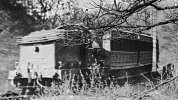
Unfortunately the image is somewhat distorted, perhaps due to a development fault, but does anyone have any location suggestions for this one? Likely 1910s-20s. Many thanks in advance.




Nothing on the back, acquired online as part of a random job lot.Any more context? Like where did you get the photo, anything written on the back?
This may be fantasy, but could this be the famed "Carlisle" on the Bishops Castle Railway? The scene is suitably sylvan. The tender looks about right with spring hangers above the framing and the cab-side looks about right too. But did the BCR ever run anything other than mixed trains? If this really is the BCR, it may be possible to pin down the location too as signals were surely something of a rarity.
I would concur, certainly with regards Adam's designs. Have trawled through my selection of Adams associated locomotive designs, and not one had a tender with above frame springs. My knowledge of Beattie is not so good, so won't comment. I have found a couple of pics of locos with such an arrangement (springs) on the GER, both 2-4-0s I think, but one was a four wheel tender without coal rails, the other a 6w tender, but again without coal rails. Thinking the Sinclair era possibly?but that is certainly not an ex-LSWR loco in the photograph
Funny you mention the 'South Eastern'. As a company associated with such loco (tender) design, that did cross my mind briefly, but half of me is thinking I am remembering the film, 'The First Great Train Robbery' or some such, with Sean Connery and Donald Sutherland....didn't the loco in that display above frame springs on the tender, real or otherwise? A warning: my memory may be going do-lally here.....Stirling’s South Eastern 0-6-0s

Funny you mention the 'South Eastern'. As a company associated with such loco (tender) design, that did cross my mind briefly, but half of me is thinking I am remembering the film, 'The First Great Train Robbery' or some such, with Sean Connery and Donald Sutherland....didn't the loco in that display above frame springs on the tender, real or otherwise? A warning: my memory may be going do-lally here.....
Thank you, a nod to sanity! Note to self: NEVER rely on events shown in media/film......!But that a CIE J15. Although they originally had outside tender springs, I am not sure if they ever had coal rails
Yes....that was filmed in Ireland using J15 No. 184 which still has its outside tender springs, unlike preserved sister No. 186, which has a later, larger and more modern tender.But that a CIE J15. Although they originally had outside tender springs, I am not sure if they ever had coal rails.
Yes....that was filmed in Ireland using J15 No. 184 which still has its outside tender springs, unlike preserved sister No. 186, which has a later, larger and more modern tender.


 mikemorant.smugmug.com
A few further thoughts.
- Both Stirlings spent some some time as Loco Superintendent of the Glasgow and South Western - not that the photo suggests the hills of Galloway.
- The number of compartments suggests these are bogie carriages rather than 6-wheelers, so decidedly modern for a local working pre-1914.
- As 30907 says, the use of an elderly local attached to modern coaches is unusual.
- The loco is working tender first. This implies the line is a bit of a backwater without a turntable at the location where the train started out.
- I take Gloster's point about the lack of a telegraph line on the BCR, but could this be another light/minor railway? I had wondered about somewhere on the Col Stephens empire perhaps, but this loco surely isn't one of his preferred ex LSWR Ilfracombe Goods.
Certainly fits a lot of the criteria. I think it's possible that there are splasher cutaways for coupling rods on the loco in the original photo.This photo of an NER Fletcher E6 at Castle Howard looks like a good match for the the loco and carriages.

I would agree, it also matches other images of the NER 901 and 1440 class 2-4-0s l've seen (these did not receive an LNER classification, although there may have an intention to classify them E6, they didn't last long enough). I can't see the loco in the picture clearly enough, or know them well enough, to distinguish between tham. Pictures of them do show them having large oval cab side numberplates, as in the OP's image. And the 1440 class (in particular) ended up on rural branches in Northhumberland and Durham.This photo of an NER Fletcher E6 at Castle Howard looks like a good match for the the loco and carriages.
Edwardian cameras were quite capable of capturing images of moving trains - and the one in the image wouldn't have been going very fast - so I doubt the train was posed, it may not even have been planned to include it. But if they had been stood there for a while waiting for it, that might explain the expression of the girls on the right.Given film exposure times c1910 I presume the train must be stationary so it would be a posed shot. The fence looks very new. Were there any North Eastern line openings 1900-1914?
Not necessarily- they did occasionally fail.Certainly fits a lot of the criteria. I think it's possible that there are splasher cutaways for coupling rods on the loco in the original photo.
Now all we need is a branch without a turntable!
I've stretched the train a bit to compensate for the foreshortening. (Although the forum ensquarifies the miniature version so it looks like I haven't.

I wonder if it is a through coach working to some obscure branch off a mainline train. Hence the newer coaches.
- The number of compartments suggests these are bogie carriages rather than 6-wheelers, so decidedly modern for a local working pre-1914.
- As 30907 says, the use of an elderly local attached to modern coaches is unusual.
- The loco is working tender first. This implies the line is a bit of a backwater without a turntable at the location where the train started out.