• Our new ticketing site is now live! Using either this or the original site (both powered by TrainSplit) helps support the running of the forum with every ticket purchase! Find out more and ask any questions/give us feedback in this thread!

UK switching to electric vehicles discussion

The Ham

Veteran Member
Joined
6 Jul 2012
Messages
12,021
With EVs generally costing more up front, the selling point has been you save on the running costs. But if you’re restricted to public chargers it’s not unlikely that it will cost you more per mile than the ICE. Which destroys the value proposition.

The list price of a Vauxhall Frontera:
Design EV £23,995
Design Hybrid £24,870

GS EV £26,395
Gs Hybrid £27,270

Ultimate EV £27,195
Ultimate Hybrid £28,080

Prices from:
 
Sponsor Post - registered members do not see these adverts; click here to register, or click here to log in
R

RailUK Forums

JamesT

Established Member
Joined
25 Feb 2015
Messages
4,824
The list price of a Vauxhall Frontera:
Design EV £23,995
Design Hybrid £24,870

GS EV £26,395
Gs Hybrid £27,270

Ultimate EV £27,195
Ultimate Hybrid £28,080

Prices from:
I can pick and choose too. Let’s try the Corsa instead of the Frontera.
YES Petrol Manual £19,740
YES EV £26,780

GS Petrol £23,985
GS EV £30,515

There may be a few new models where prices have equalised, but in general EVs are still more expensive.
 

Mawkie

Established Member
Joined
17 Feb 2016
Messages
1,242
An easy way to work out comparative fuel costs - an EV doing 4.5 mi/kWh breaks even at roughly half the petrol price per litre with a car doing 40 mpg (0.512 × petrol price).

So if petrol is 156p/L, the break-even electricity price is about 80p/kWh.

If premium unleaded is 173p/L, then break-even happens at 88p/kWh.

Obviously, if someone is paying 7p/kWh at home then they are saving massively. But if someone is paying 21p/kWh at the Supercharger, then they're still paying a quarter of the cost of Asda petrol.

It's a curious argument that says "I could save 75% on fuel costs, but because I'm not saving 90%, I won't bother."

I think it's still true to say insurance is a little higher on EVs over fossil fuel cars, but that gap is narrowing as insurers gain more data and become more confident in repair costs and crash rates etc.

Of course all the above assumes price is the only comparison worth making and that is true for a lot of people. If it were true for everyone though, we wouldn't see the massive SUV type vehicles on the road, nor the large luxo-barge saloons.

I personally would be happy to pay slightly more to drive an EV for the benefits it brings my local community through cleaner air, and the benefits it brings me through silent and smooth running. (I actually don't like driving if I'm honest, but needs must for shifts workers.)
 

Harpers Tate

Established Member
Joined
10 May 2013
Messages
2,033
....reports of manufacturers losing £11,000 per ZEV.....
No sympathy here. What they should have done many years ago is embraced EVs rather than tolerating them. Not bastardising conventional car designs to shoehorn EV components in (the most externally visible thing being a flat slab where the radiator grille would have been) but investing properly in converting themselves to EV design and build. They have had easily enough notice, yet chose to delay their "conversion" to the point where they can no longer keep up with the far more advanced far eastern countries. Europe could have been world leaders.
 

JamesT

Established Member
Joined
25 Feb 2015
Messages
4,824
An easy way to work out comparative fuel costs - an EV doing 4.5 mi/kWh breaks even at roughly half the petrol price per litre with a car doing 40 mpg (0.512 × petrol price).

So if petrol is 156p/L, the break-even electricity price is about 80p/kWh.

If premium unleaded is 173p/L, then break-even happens at 88p/kWh.

Obviously, if someone is paying 7p/kWh at home then they are saving massively. But if someone is paying 21p/kWh at the Supercharger, then they're still paying a quarter of the cost of Asda petrol.

It's a curious argument that says "I could save 75% on fuel costs, but because I'm not saving 90%, I won't bother."

I think it's still true to say insurance is a little higher on EVs over fossil fuel cars, but that gap is narrowing as insurers gain more data and become more confident in repair costs and crash rates etc.

Of course all the above assumes price is the only comparison worth making and that is true for a lot of people. If it were true for everyone though, we wouldn't see the massive SUV type vehicles on the road, nor the large luxo-barge saloons.

I personally would be happy to pay slightly more to drive an EV for the benefits it brings my local community through cleaner air, and the benefits it brings me through silent and smooth running. (I actually don't like driving if I'm honest, but needs must for shifts workers.)
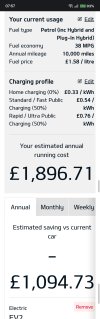
You should tell people like Kia their calculators are broken. https://www.kia.com/uk/electric-hybrid-cars/electric-cars/ev-cost-calculator/
Leaving it on the default 10,000 miles and £1.58 for petrol, but choosing only public charging it reckons the EV is more than £1000 a year more expensive in fuel costs.
 

thejuggler

Established Member
Joined
8 Jan 2016
Messages
1,639
Having much cheaper electricity and no domestic car industry to harm by putting punitive tariffs on car imports.
What works for a population of 6m who are generally socially democratic. doesn't work in the UK with a population of c65m.
 

Mawkie

Established Member
Joined
17 Feb 2016
Messages
1,242
You should tell people like Kia their calculators are broken. https://www.kia.com/uk/electric-hybrid-cars/electric-cars/ev-cost-calculator/
Leaving it on the default 10,000 miles and £1.58 for petrol, but choosing only public charging it reckons the EV is more than £1000 a year more expensive in fuel costs.
I too left the default costing for "existing car" and compared to an EV2 (with 50% fast and 50% ultra public charging) and got an increased cost of £1094. So not sure what they're doing. The maths ain't mathing as they say.

Edit: on an EV4, they say I would save £503
 

Attachments

  • Screenshot_2026-06-17-07-57-13-06.jpg
    Screenshot_2026-06-17-07-57-13-06.jpg
    576.5 KB · Views: 5

JamesT

Established Member
Joined
25 Feb 2015
Messages
4,824
I too left the default costing for "existing car" and compared to an EV2 (with 50% fast and 50% ultra public charging) and got savings of £1094. So not sure what's happened with your comparison.
Note the minus sign in front of the savings.

ICE running costs £1,896.71, EV running costs £2,991.44
 
Joined
9 Jul 2011
Messages
824
Currently, a pre-registered Corsa electric with deliver mileage, can be had for a little over £15k (Yes), or around £18k (Ultimate).


.
 

Mawkie

Established Member
Joined
17 Feb 2016
Messages
1,242
Note the minus sign in front of the savings.

ICE running costs £1,896.71, EV running costs £2,991.44
Apologies, I did notice that minus sign just after I posted and amended my post.

If those figures are true, why is there such a difference between EV2 and EV4? Is it down to efficiency?
 

JamesT

Established Member
Joined
25 Feb 2015
Messages
4,824
Currently, a pre-registered Corsa electric with deliver mileage, can be had for a little over £15k (Yes), or around £18k (Ultimate).
Do you have equivalent numbers for their petrol brethren? I don’t doubt those numbers, but the comparisons were list price to be apples to apples.

Apologies, I did notice that minus sign just after I posted and amended my post.

If those figures are true, why is there such a difference between EV2 and EV4? Is it down to efficiency?
If it’s the same price per kWh and the same mileage, then it can only be efficiency. So the EV2 is a “gas guzzler” of the EV world. It is a much boxier shape than the EV4, so perhaps aero drag is playing a part. The EV9 also has negative savings and a similar shape (though not as much). Otherwise you’d have to assume they’ve put a less efficient motor in the EV2 as that is going to be the primary driver of this.
I have to assume Kia are putting realistic numbers for their cars. They would be hammered for “cheating” if they were overly optimistic and it won’t help sales to be too pessimistic.
 

telstarbox

Established Member
Joined
23 Jul 2010
Messages
6,361
Location
Wennington Crossovers
If you do a lot of motorway driving as opposed to town driving, your miles / kWh will go down slightly and you will be paying supercharger prices if you can't always get home on the charge you started with. However these users would mostly be people travelling for work so it's less of a personal finance concern anyway.
 

Harpers Tate

Established Member
Joined
10 May 2013
Messages
2,033
Dealers and mfgs don't typically push "MPG" on EVs - something they do/did headline with ICEs. They push range. If longer range is provided solely by a bigger battery then it makes no comment on efficiency. For me, that is a factor, just as it would be if I were ICE shopping. I believe the EV4 has one of the lowest drag coefficients currently available, whereas almost everything else (Tesla 3 aside) has the aerodynamics of a brick. So, yes, the comparitive running costs of the EV4 will be heavily influenced by its efficiency.
 

Mawkie

Established Member
Joined
17 Feb 2016
Messages
1,242
So, yes, the comparitive running costs of the EV4 will be heavily influenced by its efficiency.
But comparing the EV2 to the EV4 - not to the tune of £1500 difference over 10k miles surely? It seems literally incredible. What am I missing?
 

OuterDistant

Member
Joined
25 Oct 2010
Messages
604
Location
TOPS Area 43
They have had easily enough notice, yet chose to delay their "conversion" to the point where they can no longer keep up with the far more advanced far eastern countries. Europe could have been world leaders.
Quite. I can go down to our local BYD dealership and they have a complete range of electric cars for sale right now.

Bring on the "Chinese state subsidies" vs "European manufacturer bailouts" war!
 

Snow1964

Established Member
Joined
7 Oct 2019
Messages
11,012
Location
West Wiltshire
Quite. I can go down to our local BYD dealership and they have a complete range of electric cars for sale right now.
Yes ready to go, almost just need to add registration plates and do some paperwork.

But if you stroll into many brands dealers, it's a one or two week wait because their new car stock is off site often hundreds of miles away, or it is a factory order which will take 2-5 months.

Different attitude, put customer first, rather than assume they want to wait for new car.
 

Harpers Tate

Established Member
Joined
10 May 2013
Messages
2,033
....BYD dealership ....
and if you need a loaner while it's having something done to it, you'll likely get another EV rather than some bottom-of-the-range petrol manual (that you have to fuel yourself ££). I guess the same would be necessarily true at Tesla.
 

GLC

Member
Joined
21 Nov 2018
Messages
394
Different attitude, put customer first, rather than assume they want to wait for new car.
Lots of luxury manufacturers (Porsche for sure), intentionally don’t keep stock waiting, as customers (especially the ones based outside Europe) feel more special when hearing their car has to be built specially for them. They have dedicated tracking system for customers so they can see where their car is in the process. The wait is part of the luxury experience, as silly as that sounds
 

jon0844

Veteran Member
Joined
1 Feb 2009
Messages
30,836
Location
UK
Lots of luxury manufacturers (Porsche for sure), intentionally don’t keep stock waiting, as customers (especially the ones based outside Europe) feel more special when hearing their car has to be built specially for them. They have dedicated tracking system for customers so they can see where their car is in the process. The wait is part of the luxury experience, as silly as that sounds

Luxury cars usually offer a lot more customisation and colours, which means you have little choice but to wait.

But living near a business park that has all the major brands (Porsche, MacLaren, Ferrari, Bugatti, Lamborghini and more) in various HR Owen sites, there are plenty of cars you could walk in today and drive out in - mostly used but almost certainly low mileage and well serviced.

I get that many people with money are going to want to be able to say they have a new car on order, with a custom trim level, in a custom colour and anything else to make them stand out.

Chinese car makers entering the UK and elsewhere have generally gone for very limited customisation, sometimes offering just one single spec (which is usually a high trim level, where in their native Chinese market they will have models that are more limited) and also a limited number of colours. Think of it like having a smartphone from, say, Honor where you have just one RAM/storage configuration and a choice of three or four colours.

By having so few SKUs, it's easy to stockpile and have cars ready to go. That then helps keep prices low as you're doing away with the need for dealers to keep track of the build status, waiting for shipping, having potential prep issues upon delivery (it's far easier to swap out a car at a late stage when you may have loads of them available) and so on.

Frankly, European car makers need to look at doing similar and I think in many cases they are now.
 

The Ham

Veteran Member
Joined
6 Jul 2012
Messages
12,021
I can pick and choose too. Let’s try the Corsa instead of the Frontera.
YES Petrol Manual £19,740
YES EV £26,780

GS Petrol £23,985
GS EV £30,515

There may be a few new models where prices have equalised, but in general EVs are still more expensive.

Indeed, although the power train is more powerful in the Corsa EV than the petrol (petrol is 100PS vs the EV is 136PS), whilst the Frontera the difference is comparable (110PS vs 113PS).

Likewise, (also from Vauxhall) sometimes the extra for having an EV vs petrol isn't all that much:

Grandland:
Design:
Hybrid £35,715
EV £36,055
(£340, just less than 1% difference)

Astra sports tourer:
Griffin:
Petrol £29,025
EV £29,120
(£95, less than 0.4% difference,)

Although, it should be noted that the higher trims are cheaper for the EV versions of these.

Looking at the full Vauxhall range:
Corsa is noticeable cheaper
Grandland is marginally cheaper on one trim level, otherwise more expensive
Astra is noticeably cheaper on the entry level specification but the EV has a range of 280 miles and it's between £600 and £1,200 more on the upper two tears (within 5%)
Astra Sports Tourer is marginally cheaper on one trim level, otherwise more expensive
Mokka is noticeably cheaper, but the EV has a range of 250 miles
Frontera is more expensive for the hybrid

Whilst that's generally cheaper across the models, it's where the cars can do over 200 miles (and noticeably so for two of four) where the EV is more expensive and realistically you need to be doing significant milage to need those ranges (note we as a family regularly do trips of 240 miles and we're generally happy with a range of 190).

Although, given the battery is the main cost, it could be that if Vauxhall thought there was a market they could reduce the battery size (obviously that would impact range). For example the price difference on the Frontera for a 44kWh battery and a 54kWh battery is £3,500, so a similar capacity reduction (for example for the Astra from 58kWh) would then put most the EV's as cheaper.

Such a move is clearly a business one, however does illiterate that if the brands wanted to they could offer more options where the EV could be cheaper.

However, roughly 50% of the car options for that brand are cheaper. With it being 50% for those which are basically a rounding error (less than 1%) and slightly more than 50% for those where the cost difference is less than 5%. With those which aren't cheaper mostly being due to not having a smaller battery option (which would still deliver a reasonable range).

Therefore, not necessarily as significant as some may think when the word generally cheaper is used.

 

marshlinker

Member
Joined
18 May 2026
Messages
141
Location
Romney Marsh
With a subscription that's probably less, while the new Home Bargains nearby is charging around 65p or so. Not as cheap, but it's likely very possible to do a near full charge in the time it takes to do a shop inside. Many supermarkets are now offering rapid chargers rather than just 7-22kW chargers that might only be good for a small top-up.

Aldi and Lidl are rolling them out. Tesco is still a bit hit and miss, while Sainsbury's has set up as a charge operator. I think Morrisons has a contract with MFG, which includes other things like car washing and hoover facilities, although sadly you can't do those things and charge at the same time!
The new Aldi on the outskirts of Ashford about a mile from Junction 10A of the M20 offers 6 x 11KW chargers, its the cheapest charger available in this area at 42p according to Electroverse.
its about 15 miles away from me. The only fast charger available on the Marsh is Salts Farm just outside Rye at 95p/kwh about 8miles away, for 7KW chargers we are paying between 53 and 65p/Kwh.
My limitation on charging at home is the overhead supply. Without an expensive upgrade the only way I could charge in the winter would be to change my heating from Electric to Oil or LPG (there is no mains gas in the village) which would defeat the green objective. I'm doing what most people are doing down here I suspect running a ICE vehicle in to the ground and seeing what happens. Even at the recent prices Ive got to buy an awful lot of diesel to cover the monthly PCP payment for an EV.
 

ic31420

Member
Joined
23 Aug 2017
Messages
392
Location
United Kingdom
i suspect running a ICE vehicle in to the ground and seeing what happens. Even at the recent prices Ive got to buy an awful lot of diesel to cover the monthly PCP payment for an EV.

Interesting you say that.

I do relatively few miles. I use generally about £30 of diesel a month the car goes out 1 day a week. However a couple of times a year I do about a thousand miles in a couple of weeks as we holiday with a trailer.

My current car is reaching the end of its life , it's a 2012 model on 150k. I anticipate it'll need replacing in 18months time at which point I expect scrap value of £200. This will mean it's cost me about £480 a year to buy/own. Currently tax is £35 a year, MOT £40 and insurance £190.

That said it owes me nothing and keeping it going til it dies or becomes uneconomic is what will happen so it may well last longer

I need an estate car, I don't want an SUV, and it needs a tow bar and the ability to have a bolt on roof rack.

Doing relatively few miles I often buy high milage lower price cars. usually 5+ years old.

PCP seems to me to be an awful way to acquire the use of a car in terms of value. As does getting a car newer than 4yrs old. I'm looking at whole life cost. I couldn't care less about having a new or trendy car.

At the time of replacement I'll probably be looking at Passats, Toyota Corollas, Skoda Octavia/ Superbs around 2018-2019 plates and on 100-120k+ I'll be ideally after a diesel, but the Toyota eCVT is as close as I'll get to EV.

While my duty cycle is pretty perfect for an EV the problem is the outright cost.

My neighbour raves about their EVs and how cheap it is to run. But then hes paying £400 a month, £5600 a year, plus some electric, albeit cheap, for PCPs cars they'll have to hand back

I'm playing over the life of the car £480 a year for the car and £600 a year on diesel, so I'm still over £4k better off albeit driving and older, less hip and cool car. But the car gets me from a - b and brings the shopping home.

It's the overall life costs that are at best unknown that makes an EV unattractive to me. Taking a 2018 EV and running it into the ground is pretty much unknown territory.. Will the Battery go to 15 - 20yrs Like my Korean ICE? Yes there are some Prius around of that age and a few leafs, but not many and battery tech has changed.

We have some 4yr old Corolla eCVT Hybrids at work that are getting towards 100k and are noticeably less perky and run the ICE more.


Heat pumps are another thing... One of the utility companies has just tried get me to convert to a heat pump.
£8k it would cost me apparently.
Last year our annual gas bill was £320.
 
Last edited:

Mawkie

Established Member
Joined
17 Feb 2016
Messages
1,242
Without an expensive upgrade the only way I could charge in the winter would be to change my heating from Electric to Oil or LPG (there is no mains gas in the village) which would defeat the green objective.
I did spot a few public 11 and 22kW chargers down your neck of the woods, but I was wondering why 'granny charging' won't work for you? A 3kW charge will add about 10 miles an hour on average - or 60 a day.

Surely your supply isn't that borderline that the equivalent of a small fan heater sends you over the edge? Perhaps you are a very niche case?

== Doublepost prevention - post automatically merged: ==

I have to assume Kia are putting realistic numbers for their cars. They would be hammered for “cheating” if they were overly optimistic and it won’t help sales to be too pessimistic.
I actually believe that Kia have made a mistake with their figures Screenshot_2026-06-17-19-35-07-76_3aea4af51f236e4932235fdada7d1643.jpg
The EV2 Air 61 kWh has a range of 281 miles as seen above.

Screenshot_2026-06-17-19-33-40-44_41453ac94f418184dfd859d8c1bcdad8.jpg
On the comparison page, they claim a range of just 133 miles (from the same 61 kWh battery). Coincidentally, 133 is exactly the same as the claimed bhp - could it be the bhp figure has been mistakenly entered as the range?
 
Last edited:

bspahh

Established Member
Joined
5 Jan 2017
Messages
2,414
I actually believe that Kia have made a mistake with their figures View attachment 206157
The EV2 Air 61 kWh has a range of 281 miles as seen above.

View attachment 206158
On the comparison page, they claim a range of just 133 miles (from the same 61 kWh battery). Coincidentally, 133 is exactly the same as the claimed bhp - could it be the bhp figure has been mistakenly entered as the range?
The 281 mile range is one that you would struggle to reproduce in normal driving.

At https://ev-database.org/uk/car/3491/Kia-EV2-61-kWh the range on the combined mode in mild weather is 245 miles, and with my EV3, the combined mode is much closer to the range that I get.
 

Energy

Established Member
Joined
29 Dec 2018
Messages
5,135
My limitation on charging at home is the overhead supply. Without an expensive upgrade the only way I could charge in the winter would be to change my heating from Electric to Oil or LPG (there is no mains gas in the village) which would defeat the green objective. I'm doing what most people are doing down here I suspect running a ICE vehicle in to the ground and seeing what happens. Even at the recent prices Ive got to buy an awful lot of diesel to cover the monthly PCP payment for an EV.
Switching your heating to a heat pump would likely resolve these issues and significantly reduce your bills. Given you don't already have (wet) radiators, I'd look at an air-to-air system and keep direct electric for hot water. You'd get the benefit of cooling in the summer, too.

The government has a £2500 grant for air-to-air systems, though I'm not sure if it's available yet.

For hot water, a tank heated by an immersion element overnight on a cheap tariff is the preferable option. I quite like waste hot water heat recovery systems too, they're just a heat exchanger between the drain and incoming cold water, so require minimal maintenance and can roughly halve (or better) the energy used for showering. They're definitely worth it for electric showers, and for overnight-charged tank systems, they're useful for reducing the size of the tank required. They are best installed when you are redoing the bathroom, though.

There are a few hot water cylinders with an integrated mini-heat pump. The significant additional cost outlay takes too long to pay back on a cheap overnight tariff, and there's the additional cost of maintaining the small heat pump, but they can be worth it if you have to recharge during the day.

In most homes, A2A will be <16A (often much less...). Electric showers and immersion hobs (with all the "burners" at full) are around 32A. EV chargers are typically rated at 32A, but most can be easily fitted with a CT clamp to limit current to the remaining capacity of your line.
 

Peter Sarf

Established Member
Joined
12 Oct 2010
Messages
9,559
Location
Croydon
Why?

I have always work colleague who frequently charges their EV in the local public car park, and nips back there to move it at lunchtime or whenever it is charged to avoid hogging the space.

We have family who have an EV and no home charger. Doesn't seem to cause them a problem either.

Our local Sainsbury's has 10 chargers - 4x300kW, 5x150kW and a 50kW. Should be able to get a reasonable charge done whilst doing your weekly shop I'd have thought.

A little further afield, I can see an Instavolt location with 44x160kW chargers and 10x60kW chargers, with Starbucks onsite.
As someone who does not pop out to buy premium coffee drinks Startbucks and their chargers are irrelevant to me !. Not saying that is true of the majority but will be more true of those hesitating to buy a new EV and also buying a used EV.
I can't agree with you that home charging is vital. I manage perfectly well charging every 2 or 3 weeks without it.

I also have to disagree that public charging isn't improving. The figures simply tell us a different story. Public charging has never been easier.

I'm feeling contrary today, so I also have to disagree with this statement. If running costs are someone's primary concern, then surely the cost of charging has to compete favourably with fossil fuels?
I would prefer home charging so I can charge cheaper BUT also a slower gentler charge for the battery. Especially true as I would be buying a much older EV - obviously I would be worried by how much life is left in the second hand battery. So I can see myself wanting to see receipts for the previous owners charging and also the presence of a charger at the driveway *. BUT also I would want to preserve that battery life.

* = I wonder if an EV keeps a long term record of how it was charged ?.
(I am thinking date, rate of charge and how empty at start & full at end)
Gosh, thinking about it we will no longer worry about how much the ICE engine has been ragged but how aggressively the owner charged their EV battery. Plus of course how much strain the ever present speed bumps put on a heaver ICE car !.
I read that as they're having to discount EVs and make a loss to hit targets (i.e they aren't or weren't selling enough EVs vs ICE), not that every EV sold loses the manufacturer £11k.
+
I mean, if I was a manufacturer that had an incentive to slow down the adoption of EVs due to competition from the cheaper far east EVs and dwindling servicing revenues, I might artificially inflate the recommended retail price of my vehicles to offset some of the loss of servicing over the subsequent years.

I might then be able to use a 'discount', but still make a profit, as an excuse to cry to my highly influential trade association and hope they lobby central government on my behalf.

Or they could genuinely be losing £11k on every car.
£11k is a lot. Certainly likely some is clever pricing but plenty of room for a problem with viability.
If you're able to charge at home, EVs win out on convience and cost to the extent that it seems crazy not to have an EV, hence my recommendation.

Other situations as you're all describing are neutral or worse in cost and/or convience compared to an ICE so I don't recommend. I agree these inconvinences can be minor if you drive little, or have reasonably priced charging at work/supermarkets. However most people don't want to spend 5 minutes moving their car at lunch, or pick when to go to the supermarket and which supermarket based on the price of electricity.

I should have specified that by improving charging I meant access to home charging rather than public charging. Public charging is in a good place, but access home charging for flats or terraces needs improving as cheap driving is such an advantage. Unfortunately it's a divide that means those who can't afford driveways have to pay more to drive.
For me not having to take the car out to charge it would be better. But, given the amount I use my current car, the actual costs of charging are less important than the faff. It follows that the fuel/energy economy is less of an issue the lower the actual annual usage is.

I think allowing a cable across the pavement would help. Obviously with precautions - under a mat designed for the purpose.
Obviously lots of people in Norway don't charge at home, otherwise they wouldn't have near 100% new cars being electric. How much do they pay to charge away from home and where do they charge?
+
Having much cheaper electricity and no domestic car industry to harm by putting punitive tariffs on car imports.
+
But most pertinently to the question being asked, almost 100% take up of EVs in new car sales, and lots of Norwegian residents without off-street parking. So if Norway can manage 100% EV sales, the issue of charging if you don’t have off street parking must be resolvable.
I wonder what Norwegians par for their domestic electricity - maybe it is higher that in the UK (unlikely) ?.

Also it might be that people not buying an EV are sticking with their old ICE car because they don't have a drive. There will be a proportion of that but unlikely to be 100%.

There are some interesting facts lurking in Norways 100% EV sales. We in the UK could probably learn from them, dare I say it !.
Obviously someone somewhere in Norway must be buying a new ICE but it must be an outlier case.
Lots of luxury manufacturers (Porsche for sure), intentionally don’t keep stock waiting, as customers (especially the ones based outside Europe) feel more special when hearing their car has to be built specially for them. They have dedicated tracking system for customers so they can see where their car is in the process. The wait is part of the luxury experience, as silly as that sounds
Indeed, playing hard to get is a way of justifying the price.
Interesting you say that.

I do relatively few miles. I use generally about £30 of diesel a month the car goes out 1 day a week. However a couple of times a year I do about a thousand miles in a couple of weeks as we holiday with a trailer.

My current car is reaching the end of its life , it's a 2012 model on 150k. I anticipate it'll need replacing in 18months time at which point I expect scrap value of £200. This will mean it's cost me about £480 a year to buy/own. Currently tax is £35 a year, MOT £40 and insurance £190.

That said it owes me nothing and keeping it going til it dies or becomes uneconomic is what will happen so it may well last longer

I need an estate car, I don't want an SUV, and it needs a tow bar and the ability to have a bolt on roof rack.

Doing relatively few miles I often buy high milage lower price cars. usually 5+ years old.

PCP seems to me to be an awful way to acquire the use of a car in terms of value. As does getting a car newer than 4yrs old. I'm looking at whole life cost. I couldn't care less about having a new or trendy car.

At the time of replacement I'll probably be looking at Passats, Toyota Corollas, Skoda Octavia/ Superbs around 2018-2019 plates and on 100-120k+ I'll be ideally after a diesel, but the Toyota eCVT is as close as I'll get to EV.

While my duty cycle is pretty perfect for an EV the problem is the outright cost.

My neighbour raves about their EVs and how cheap it is to run. But then hes paying £400 a month, £5600 a year, plus some electric, albeit cheap, for PCPs cars they'll have to hand back

I'm playing over the life of the car £480 a year for the car and £600 a year on diesel, so I'm still over £4k better off albeit driving and older, less hip and cool car. But the car gets me from a - b and brings the shopping home.

It's the overall life costs that are at best unknown that makes an EV unattractive to me. Taking a 2018 EV and running it into the ground is pretty much unknown territory.. Will the Battery go to 15 - 20yrs Like my Korean ICE? Yes there are some Prius around of that age and a few leafs, but not many and battery tech has changed.

We have some 4yr old Corolla eCVT Hybrids at work that are getting towards 100k and are noticeably less perky and run the ICE more.
This roughly sums me up. Get a good second hand ICE and keep it for as long as possible. Living in London I can manage without a car a lot. No driveway.

It means the relative prices quoted on here of new or nearly new ICE vs EV just make my eyes glaze over. But there are plenty of newish (3 year old) car buyers out there.

For me a second hand EV will need to have a good battery life left. I would prefer a slower home charge just to be gentle on the battery for all the years I will keep it. I don't buy expensive coffee so a charger at a Starbucks would be irrelevant for me anyway !.

It just depends how representative I am. But certainly the most likely people to switch will have done so first obviously (I think a mix of having enough money to buy new and a desire to be at the forefront of technology). So perhaps now need to consider the next likely group who might be more penny pinching (they are more likely to buy secondhand so feed off the first group when they replace their car).
Heat pumps are another thing... One of the utility companies has just tried get me to convert to a heat pump.
£8k it would cost me apparently.
Last year our annual gas bill was £320.
There is a whole thread to be had on Heat Pumps.
Someone mentioned heat transfer from the waste water to the incoming water (presumably that heading for the water heater). That sounds like a low tech solution worth exploring.
 

bspahh

Established Member
Joined
5 Jan 2017
Messages
2,414
£11k is a lot. Certainly likely some is clever pricing but plenty of room for a problem with viability.
£11k is a lot of money to lose on each car if it was the difference between two retail prices. However, here its the difference between the manufacturer's list price and a retail price. The list price is important for setting tax rates, but very few people will pay it, and if they do, they will be getting discounts in other forms (cheap finance, a friendly part-exchange deal etc).
 

gswindale

Member
Joined
1 Jun 2010
Messages
1,016
As someone who does not pop out to buy premium coffee drinks Startbucks and their chargers are irrelevant to me !. Not saying that is true of the majority but will be more true of those hesitating to buy a new EV and also buying a used EV.
I don't pop out to buy premium coffee drinks, so should I skip visiting petrol stations as "Wild Bean Cafe"? Similarly, should I not bother stopping at Leigh Delamere on my way to South Wales as I don't want to buy a drink, have a burger and buy over-priced tat from the WHSmith equivalent?

The point is more that we are now seeing Motorway Service Area sized locations with 50+ charging bays with facilities for those who wish to make use of them - you can simply charge if you like, but if you want to take a break, then the toilet and a drink will be available should you so wish.

I'm not about to drive to this particular site to charge up as it is an hour from me, but if it was en-route, then I could stop and not worry about whether or not I'm likely to find a working charger.

I can understand the convenience of home charging, but is it really a necessity for all? For instance, going back to the supermarket chargers, you can park up, plug your car in, do your shopping, come back and go home. You don't then need to drive round to the petrol station to fill up either before or after you've done your shopping, so a few minutes saved here & there even without home charging.
 

Top