• Our new ticketing site is now live! Using either this or the original site (both powered by TrainSplit) helps support the running of the forum with every ticket purchase! Find out more and ask any questions/give us feedback in this thread!

Turbine powered trains

Status
Not open for further replies.

gsnedders

Established Member
Joined
6 Sep 2015
Messages
1,472
[Apologies if this is the wrong forum, please move it if it is!]

As far as I'm aware, the only notable turbine powered train in recent years has been Bombardier's JetTrain, with very little happening after the period where both Britain (with the APT-E) and France (with the TGV 001) were seriously looking at turbine powered trains.

My understanding is that turbines, especially in combined cycle applications, are very efficient at constant speed, with two major downsides: they have horrendous fuel consumption at idle, and they're slow to respond to changes of power demand.

It seems like a perfect application for them would be combined with batteries to power traction motors: you run them as a generator motor to charge the batteries at a constant, efficient, speed, then turn them off until the batteries reach a certain level of charge. Given their low weight, even combined with batteries I'd expect them to weigh no more than a conventional diesel engine.

I'm sure I'm missing something here, given nobody has seriously considered doing this, as far as I'm aware. Anyone care to enlighten where I am miseducated? :)
 
Sponsor Post - registered members do not see these adverts; click here to register, or click here to log in
R

RailUK Forums

theageofthetra

Established Member
Joined
27 May 2012
Messages
3,565
Location
Beckenham
I agree with you re running it at its most efficient rpm to charge batteries. The same applies to diesel engines- they can be incredibly efficient if running at their optimum rpm for long periods. Once whilst working on a river ship the captain wanted to increase speed by a knot or two to make a time slot on a lock. This required a call to the ships owner as the slightly higher speed meant that the engines were not operating at their optimum speed and the extra fuel costs would come to several thousand USD. If I recall the request was denied!
 

Emblematic

Member
Joined
14 Aug 2013
Messages
659
Cost. Turbines in this power range cost $millions per unit. They make sense where either the high efficiency at full power pays back over time, so baseload power generation, CHP etc., or high power to weight \ size is critical, e.g. aircraft APUs. Low duty cycle or standby power generation, and airport ground power units (GPUs) are almost always reciprocating engines.
JetTrain had diesel engines for starting and low-speed use, employing the turbine for sustained high speeds. High locomotive and fuel costs were intended to be offset by savings in infrastructure (i.e. thousands of miles of OLE) for North American high speed services.
Batteries aren't cheap either, although getting cheaper all the time.
 

Peter Mugridge

Veteran Member
Joined
8 Apr 2010
Messages
17,813
Location
Epsom
SNCF ran a fleet of gas turbine powered trains from Paris St Lazare to various destinations in the north east of France via Evereaux between 1972 and 2004; as far as I know that was the only time this form of traction has been used long term on a fleet basis in commercial service.
 

edwin_m

Veteran Member
Joined
21 Apr 2013
Messages
28,625
Location
Nottingham
SNCF ran a fleet of gas turbine powered trains from Paris St Lazare to various destinations in the north east of France via Evereaux between 1972 and 2004; as far as I know that was the only time this form of traction has been used long term on a fleet basis in commercial service.

They sold a few to Amtrak too, for the Hudson Valley routes out of Grand Central.

Union Pacific (I think) had a small fleet of gas turbine locomotives.
 

Phil.

Established Member
Joined
10 Oct 2015
Messages
1,323
Location
Penzance
SNCF ran a fleet of gas turbine powered trains from Paris St Lazare to various destinations in the north east of France via Evereaux between 1972 and 2004; as far as I know that was the only time this form of traction has been used long term on a fleet basis in commercial service.

Ah yes, the Turbo Trains. I remember getting one at Boulogne to Paris circa 1978. Horrendously noisy externally.
 

mark-h

Member
Joined
14 Jan 2015
Messages
374
Gas Turbines have the advantage of being lightweight (for the power produced) which is an advantage for use in aircraft (especially as the power can be used more directly in an turbo-fan engine).

They are not as fuel efficient as piston engines unless the weight saving provides an offset.

Some marine examples of turbine issues:

The QM2 has both diesel and gas-turbine engines (the turbines being located towards the top of the ship due to their light weight and high air requirement) but the diesel engines are used most of the time with the turbines providing peak power.

Finnjet (built in 1977) was retrofitted with extra diesel-electric engines in 1981 to increase fuel efficiency at low speeds.

The high cost of fuel was one of the contributing factors towards the demise of the Stena HSS services.
 

gimmea50anyday

Established Member
Joined
8 Jan 2013
Messages
3,456
Location
Back Cab
In the UK the APT-E parked up in Shildon is gas turbine powered.

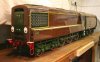
There was also GT3, which looked like a BR Standard Class 5 kettle with tender
 

Attachments

  • image.jpeg
    image.jpeg
    70.5 KB · Views: 48
Last edited:

Kentish Paul

Member
Joined
25 Apr 2012
Messages
454
Location
Ashford Kent
Ah yes, the Turbo Trains. I remember getting one at Boulogne to Paris circa 1978. Horrendously noisy externally.

Yes they ran from the Hoverport station at Boulogne to Paris Nord. A trip from Dover to Paris all powered by gas turbines. This was 1988 and a memorable weekend followed. :p
 

randyrippley

Established Member
Joined
21 Feb 2016
Messages
5,382
the reason turbines have never been used along with batteries in that way is that quite simply the battery technology hasn't been good enough. It may just be getting there now. Arguably for the power burst required at acceleration you'd be better off with a turbine/batttery/capacitor 3-way system as batteries aren't too keen on rapid discharges. Or a big flywheel, with all the safety issues that brings.....

Another possible problem is that after Leyland dropped production of gas turbines, I'm not sure if there's any suitable small-scale turbine suitable for distributed power applications commercially available. I guess you could bodge a helicopter turboshaft to work if you just wanted a pair of HST-style power cars.
 

randyrippley

Established Member
Joined
21 Feb 2016
Messages
5,382
something thats just come back to me: the American turbo locomotives were only cost effective because (1) they ran long distances without stops (2) they burnt a cheap naphtha fraction byproduct that at the time couldn't be used for much else and was therefore a lot cheaper than diesel.
Changing oil processing technologies resulted in the naphtha fraction being used for other oil products and the price increasing, taking the turbine's advantage away. Given that the turbine is inherently less efficient than a diesel for most motive power work, the interest died.
 

apk55

Member
Joined
7 Jul 2011
Messages
446
Location
Altrincham
Modern Gas turbines can be more efficient than diesels on full load. However on part load the efficiency falls off very considerably and the idling fuel consumption is horrific compared to a diesel. Since many railway applications only require full power for short periods and most time is spent on part load or idling a diesel is much more efficient
 

RichmondCommu

Established Member
Joined
23 Feb 2010
Messages
6,906
Location
Richmond, London
SNCF ran a fleet of gas turbine powered trains from Paris St Lazare to various destinations in the north east of France via Evereaux between 1972 and 2004; as far as I know that was the only time this form of traction has been used long term on a fleet basis in commercial service.

They also ran from Gare du Nord for a short while in the late 1980's. I'm pretty sure that I caught one on a service to one of the Channel Ports but I certainly remember seeing them at Gare du Nord. From memory they had a different livery to the rest of the SNCF fleet.
 

Bletchleyite

Veteran Member
Joined
20 Oct 2014
Messages
113,162
Location
"Marston Vale mafia"
Gas turbine hybrid?

It did occur to me that (possibly also for automotive applications) a small turbine that charges a battery that is actually used for traction could be a viable option, as it can, from startup to shutdown, run at maximum efficiency - something a turbine does very well, hence its success in aviation applications.
 

coppercapped

Established Member
Joined
13 Sep 2015
Messages
3,320
Location
Reading
It did occur to me that (possibly also for automotive applications) a small turbine that charges a battery that is actually used for traction could be a viable option, as it can, from startup to shutdown, run at maximum efficiency - something a turbine does very well, hence its success in aviation applications.
I can see it now - a kerosene powered Dyson Airblade...;)
 

Emblematic

Member
Joined
14 Aug 2013
Messages
659
It did occur to me that (possibly also for automotive applications) a small turbine that charges a battery that is actually used for traction could be a viable option, as it can, from startup to shutdown, run at maximum efficiency - something a turbine does very well, hence its success in aviation applications.

Aviation is rather different, as power/weight is the dominant factor. A light, inefficient engine is better than a heavier, efficient engine as you have to provide lift, hence energy, for every kg you add. The extreme example is the APU, which isn't needed in flight at all but you can't really do without one. Once on the ground, it's replaced by a GPU cart as soon as possible, as it typically uses 30 times less fuel, as well as being much quieter.

Turbines alone aren't very efficient, but unlike IC engines they benefit from reprocessing recovered exhaust heat, so combined-cycle, CHP and recuperation can all be used as part of an efficient sŷstem.

There is research looking at microturbines for hybrid vehicles, for exactly the reason you mention that they can run, periodically at top efficienĉy, to range-extend a battery vehicle. It's more about using minimum space and weight, to allow more batteries and hence longer plug-in range, than efficiency of the turbine.

For rail, we don't really have the issues turbines solve. We don't need more power than we can generate with available diesels. We don't have a surfeit of cheap refinery residue (and even if we did, we wouldn't be allowed to fuel a turbine with it.) Weight and size isn't really a problem. And if we do want to use turbines, we can put them in buildings, use any fuel we like (gas, coal, biomass, nuclear) and connect them to the trains with wires.
 

gsnedders

Established Member
Joined
6 Sep 2015
Messages
1,472
As I mentioned in the OP, I really am questioning about gas-turbine electrics with batteries (or some other energy storage means—though I doubt anything else is practical yet, given flywheels would have to be massive to allow you to run without the turbine for any length of time). I think it's quite clear cut from all the previous trains that have used turbines that running it without any sort of energy storage is simply infeasible given the performance and fuel consumption characteristics.

It did occur to me that (possibly also for automotive applications) a small turbine that charges a battery that is actually used for traction could be a viable option, as it can, from startup to shutdown, run at maximum efficiency - something a turbine does very well, hence its success in aviation applications.

With regards to automotive applications: that was the original plan for the Jaguar C-X75, to run a pair of micro-turbines at maximum efficiency with batteries for storage. As far as I'm aware, the concept car and the development cars genuinely used micro-turbines, though the production version switched to an ICE before it was abandoned.

Undoubtedly cost is part of the issue—but it seems more viable for trains than it does for cars. The cost of turbines is a far smaller percentage of the cost of a train than even the projected cost of the C-X75 (c. 750k).

the reason turbines have never been used along with batteries in that way is that quite simply the battery technology hasn't been good enough. It may just be getting there now. Arguably for the power burst required at acceleration you'd be better off with a turbine/batttery/capacitor 3-way system as batteries aren't too keen on rapid discharges. Or a big flywheel, with all the safety issues that brings.....

Another possible problem is that after Leyland dropped production of gas turbines, I'm not sure if there's any suitable small-scale turbine suitable for distributed power applications commercially available. I guess you could bodge a helicopter turboshaft to work if you just wanted a pair of HST-style power cars.

Hmm, I was assuming batteries were good enough nowadays given the Electrostar BEMU trial? There again, as the recent thread mentioned, there's not been that much said about the results.

There's plenty of turbines available, including the JetTrain's P&W ST40 and the Rolls Royce MT7—though really those are more suited dedicated power cars. There certainly are plenty of smaller turbines, though; I'm not entirely sure there are marine variants of them which would be the obvious basis for any rail engine, however.
 
Status
Not open for further replies.

Top