• Our new ticketing site is now live! Using either this or the original site (both powered by TrainSplit) helps support the running of the forum with every ticket purchase! Find out more and ask any questions/give us feedback in this thread!

The UK's 'strongest' buffer stop

Status
Not open for further replies.

_Henry_

Member
Joined
5 Jan 2020
Messages
28
Location
Ashford, Kent
Hi All,

I wonder what is the UK's strongest buffer stop? (i.e. the one that would stop the fastest or heaviest train). I am thinking about this from a modelling perspective and if a long enough model train could be shown going into such a buffer stop.

Any thoughts would be appreciated!
 
Sponsor Post - registered members do not see these adverts; click here to register, or click here to log in
R

RailUK Forums

Snow1964

Established Member
Joined
7 Oct 2019
Messages
11,026
Location
West Wiltshire
There are some that are massive concrete blocks (think these date from WW2), physically strong, and rely on deadweight, but often not anchored to ground very well.

Think the hydraulic buffers installed at Waterloo by LSWR were designed to absorb train colliding at 15mph, by another definition could be deemed as strong
 

Trainman40083

Established Member
Joined
29 Jan 2024
Messages
4,524
Location
Derby
It seems strange to see buffer stops in platforms, where the trains that use them, don't even have buffers. In fact the point furthest forward is often the central coupling
 

Dr Hoo

Established Member
Joined
10 Nov 2015
Messages
5,605
Location
Hope Valley
Although no longer in use the ‘catch pit’ at the foot of Sheep Pasture Incline on the Cromford & High Peak line was installed after it was discovered that breakaway wagons on the c. 1:9 cable-operated slope exceeded 100mph. It occasionally ‘successfully’ operated at that speed during its life.
 

Benjwri

Established Member
Joined
16 Jan 2022
Messages
3,269
Location
Bath
Depending on what you count as part of the buffers the ones for the Twyford bay platform are embedded entirely in a retaining wall for the forecourt, so if you count said wall and forecourt as part of the buffer eventually they’d stop anything.
 

lll

New Member
Joined
20 May 2022
Messages
1
Location
hong kong
Hi All,

I wonder what is the UK's strongest buffer stop? (i.e. the one that would stop the fastest or heaviest train). I am thinking about this from a modelling perspective and if a long enough model train could be shown going into such a buffer stop.

Any thoughts would be appreciated!
 

Gostav

Member
Joined
14 May 2016
Messages
541
I noticed that some older hydraulic buffer stop had complicated assemblies - tanks, pipes, pressure gauges and any newly installed buffer is generally much simple.
 

edwin_m

Veteran Member
Joined
21 Apr 2013
Messages
28,599
Location
Nottingham
I noticed that some older hydraulic buffer stop had complicated assemblies - tanks, pipes, pressure gauges and any newly installed buffer is generally much simple.
Modern practice is to use a friction buffer stop, which is clamped to the rails and slides backwards if hit. These usually have some extra fittings clamped onto the rails behind the stop, so if it moves back a certain distance these start being pushed too, increasing the amount of retardation. Much simpler than the hydraulic ones, and if space is available they should also be safer because they slow the train more gradually over a longer distance.
 

ac6000cw

Established Member
Joined
10 May 2014
Messages
3,891
Location
Cambridge, UK
It seems strange to see buffer stops in platforms, where the trains that use them, don't even have buffers. In fact the point furthest forward is often the central coupling
Some modern buffer stops have three pads - centre and sides. IIRC, the recently shortened Platform 5 at Cambridge has a modern 3-pad design but in contrast Platforms 1 & 2 have pretty old buffer stops fabricated out of old rails, at least one of which is somewhat dented in the middle where I assume it's been hit by a centre coupler at some point.

(In the US, where centre couplers have long been standard on everything, the equivalent of a buffer stop is called a 'bumping post' - which is quite descriptive of their function in freight yards sometimes...)
 

32475

Member
Joined
2 Nov 2019
Messages
815
Location
Sandwich
In November ‘21 I started a thread entitled ‘The Variety of Station Buffers’ which drew some interesting observations from various members.
I was prompted having admired these impressive examples at Glasgow Central IMG_8952.jpeg
 

Nottingham59

Established Member
Joined
10 Dec 2019
Messages
3,326
Location
Nottingham
Hi All,

I wonder what is the UK's strongest buffer stop? (i.e. the one that would stop the fastest or heaviest train). I am thinking about this from a modelling perspective and if a long enough model train could be shown going into such a buffer stop.

Any thoughts would be appreciated!
I'd vote for the CEGB nuclear flask at Old Dalby in 1984.
 

Supercoss

Member
Joined
5 Jun 2016
Messages
457
Not wishing to ruin the party but buffer stops exist just to mark the end of the line and should not be driven into during normal train operation at any time.
 

Belperpete

Established Member
Joined
17 Aug 2018
Messages
3,586
There are some that are massive concrete blocks (think these date from WW2), physically strong, and rely on deadweight, but often not anchored to ground very well.

Think the hydraulic buffers installed at Waterloo by LSWR were designed to absorb train colliding at 15mph, by another definition could be deemed as strong
There was such a massive concrete block buffer stop in the V of the junction at Balham, at the end of the shunt neck down from Streatham Hill sidings. One day an empty train ran out of the sidings downhill toward the stop. The superstructures of the coaches rode straight over the top of the stop, which sheared all the bogies off. The stop itself was hardly damaged, but the force of the impact had pushed it back several feet so that it was well foul of the running lines. No way that they could lift it, so they had to resort to peckering away at the concrete until it was clear. I seem to recall that the clear up operation took many days. I think the remains of the concrete block may still be there?
 

Bill57p9

Member
Joined
1 Dec 2019
Messages
862
Location
Ayrshire
Although no longer in use the ‘catch pit’ at the foot of Sheep Pasture Incline on the Cromford & High Peak line was installed after it was discovered that breakaway wagons on the c. 1:9 cable-operated slope exceeded 100mph. It occasionally ‘successfully’ operated at that speed during its life.
And just to prove that particular installation worked, there is still a wagon buried deep inside The trap
 

Sun Chariot

Established Member
Joined
16 Mar 2009
Messages
6,526
Location
2 miles and 50 years away from the Longmoor Milita
Depending on what you count as part of the buffers the ones for the Twyford bay platform are embedded entirely in a retaining wall for the forecourt, so if you count said wall and forecourt as part of the buffer eventually they’d stop anything.
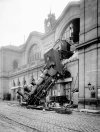
Depends on the building structure. This link and the attached photo - Montparnasse, France, 1895 - is when a retaining wall and forecourt definitely didn’t stop the train...
 

Attachments

  • Montparnasse-Train-Wreck-photos (1).jpg
    Montparnasse-Train-Wreck-photos (1).jpg
    563.3 KB · Views: 74

Benjwri

Established Member
Joined
16 Jan 2022
Messages
3,269
Location
Bath
Depends on the building structure. This link and this attached photo - Montparnasse in France, 1895 - shows when a retaining wall and forecourt definitely didn’t stop the train...
A retaining wall is one that holds back earth on the other side. The level of the forecourt on the other side is higher than the buffer itself, so short of the train ‘jumping’ over the buffer, there is practically infinite earth and asphalt behind the buffer to stop the train.
 

plugwash

Established Member
Joined
29 May 2015
Messages
1,988
It seems strange to see buffer stops in platforms, where the trains that use them, don't even have buffers. In fact the point furthest forward is often the central coupling
Some modern buffer stops seem to be designed with a central pad which has a cutout presumablly designed to accomodate autocouplers.

How well it works with the wide variety of different autocoupler configurations on the network today though, I do not know.
 

Snow1964

Established Member
Joined
7 Oct 2019
Messages
11,026
Location
West Wiltshire
Some modern buffer stops seem to be designed with a central pad which has a cutout presumablly designed to accomodate autocouplers.

How well it works with the wide variety of different autocoupler configurations on the network today though, I do not know.

That is interesting question, ignoring buffers in freight sidings where wagons and locos have buffers. It is probably a historical oversight that those in terminal stations still have flat disc style buffers (with or without a central pad), rather than serrated anti-climb buffers

Majority of modern passenger stock has the serrated anti-climb buffers, rather than round ones (although sometimes behind fairings) but never seen any at stations having same instead of flat surface buffers
 

Trainman40083

Established Member
Joined
29 Jan 2024
Messages
4,524
Location
Derby
Some years ago, I was contacted to supply buffer stops for the old bay platform, platform 5 at Derby. I highlighted that the vast majority of trains that used it, had no buffers .In addition the placement of buffer stops might have further restricted train length.
 

Accura

Member
Joined
31 Jan 2011
Messages
60
Always thought this set at Mayfield look like they could handle a lot - ignoring the decades of gradual decay! Photo taken in 2019:

1719425029611.jpeg
 

Tio Terry

Member
Joined
2 May 2014
Messages
1,197
Location
Spain
Waterloo International buffer stops were pretty strong, gone now of course.
At a guess those at St Pancras for Eurostar are probably designed to take a similar impact load.
 

McRhu

Member
Joined
14 Oct 2015
Messages
666
Location
Lanark
In November ‘21 I started a thread entitled ‘The Variety of Station Buffers’ which drew some interesting observations from various members.
I was prompted having admired these impressive examples at Glasgow Central
I remember seeing a class 86 testing those very buffers in the days before they had the friction section added. It drove up against them, stopped, then pushed them in a short way.
 

_Henry_

Member
Joined
5 Jan 2020
Messages
28
Location
Ashford, Kent
I have also seen sand drags on the network - like these down near Dorridge and Bordesley - which are placed before a conventional buffer stop. But, wouldn't a train or wagon derail as it goes over the sand? Does the train wheels push down on the sand and then the wheel will ride up and over the sand be derail? Or am I overthinking this and the sand just moves out of the way of the wheel - like a knife through butter?
1720016070987.png
1720016098793.png
 

Bryson

Member
Joined
24 Jan 2022
Messages
118
Location
Yorkshire
I remember seeing a class 86 testing those very buffers in the days before they had the friction section added. It drove up against them, stopped, then pushed them in a short way.
I was on a service around 1990 on which the 87 + mk2s gave the buffers at central a serious test. By the time it stopped they were pushed nearly to the end. It was quite a lurch on board!
 
Status
Not open for further replies.

Top