
Is there any reason for pumped water rather than a flange greaser? I've never heard of one of those before.Used to have a pumped water lubrication system but long term out of use

-
Our new ticketing site is now live! Using either this or the original site (both powered by TrainSplit) helps support the running of the forum with every ticket purchase! Find out more and ask any questions/give us feedback in this thread!
You are using an out of date browser. It may not display this or other websites correctly.
You should upgrade or use an alternative browser.
You should upgrade or use an alternative browser.
The sharpest curves
- Thread starter railfan99
- Start date
- Status
- Not open for further replies.
Sponsor Post - registered members do not see these adverts; click here to register, or click here to log in
R
RailUK Forums
JohnRegular
Member
- Joined
- 12 Dec 2016
- Messages
- 307
The north-east (or east-north depending on your outlook on life) curve near Westbury is a real squealer.
Honourable mention to the Rhubarb curve in Bristol.
Honourable mention to the Rhubarb curve in Bristol.
I just checked and for anyone wanting to experience it, I think the only service to use it is the 09:12 to Meadowhall on a Sunday, starting at Retford Platform 2.The curve from Retford high level down to the Worksop line is pretty sharp, made the Pacer I was on last time I experienced it squeal!

Railcar
Member
- Joined
- 27 Nov 2017
- Messages
- 297
The 'Wall Of Death' between Sutton and West Sutton?

frodshamfella
Established Member
Yes thats the one !!I think you mean at Earlestown station. The south-to-east and south-to-west curves there are both extremely tight, with the former being perhaps a bit tighter, to judge from the OS 1:25k map.

SteveyBee131
Member
There's a couple of early morning and late evening weekday trips too...I just checked and for anyone wanting to experience it, I think the only service to use it is the 09:12 to Meadowhall on a Sunday, starting at Retford Platform 2.
... this is Real Time Trains showing several Northern workings using platform 2 at Retford Upper today

Western 52
Established Member
In Wales, the curve over the mainline bridge between Cardiff Central and Queen Street is very sharp with a lot of flange squeel.

ThameslinkUser
Member
Leaving Shepherd's Bush LU westbound is the sharpest I've personally seen.
They are both 25 mphI just watched a cab ride of it and it said 25 eastbound. Westbound is a tighter curve so might be slower.
MadMarsupial
Member
Gotham curve 5 mph
After 6 mins or so

Springs Branch
Established Member
I believe that's the Caxton Curve, the sharpest on the entire Underground system, according to this link on Wayback MachineLeaving Shepherd's Bush LU westbound is the sharpest I've personally seen.
The relevant extract is:-
TfL Central line factsheet (dated Sep 2012) said:To avoid paying compensation to property owners, the line was constructed as far as possible underneath existing roads, hence the twists and turns in the Bank area. But the sharpest curve on the Central line, and indeed the entire London Underground system, is actually the Caxton Curve, between Shepherds Bush and White City.
It's a 60 m (200 ft) radius, but hard to appreciate being totally underground.
Much of the tube was constructed under roads to avoid wayleave payments. Victoria Line broke that tradition. So thats why there are many curves underground.I believe that's the Caxton Curve, the sharpest on the entire Underground system, according to this link on Wayback Machine
The relevant extract is:-
It's a 60 m (200 ft) radius, but hard to appreciate being totally underground.


ac6000cw
Established Member
I don't know the radius, but Stourbridge North Junction where the line to Birmingham curves away has check rails, a 15 mph limit and is on an upward slope towards Stourbridge from Lye, so trains in that direction are climbing around a sharp curve, just to add to the fun.
In Cambridge, the curve away from Coldhams Lane Junction towards Newmarket is 20 mph (or possibly lower at the level crossing point) with a check rail.
In Cambridge, the curve away from Coldhams Lane Junction towards Newmarket is 20 mph (or possibly lower at the level crossing point) with a check rail.

Express380
Member
Bere Alston to Gunnislake must be a shout, most of that is 10-15 mph with the maximum being 20 mph

Train jaune
Member
Yes, out of Carnforth heading for Skipton on a Pacer! You needed to have your fingers in your ears
ac6000cw
Established Member
A 'What are the sharpest curves on Network Rail routes?' thread from 2014 - https://railforums.co.uk/threads/trivia-what-are-the-sharpest-curves-on-network-rail-routes.103979/
Pinus contorta
Member
I was walking underneath the bridge there one time when a pacer passed through. Its was very noisy!Yes, out of Carnforth heading for Skipton on a Pacer! You needed to have your fingers in your ears

AJG3
Member
- Joined
- 9 Jan 2015
- Messages
- 55
Currock Junction where the Cumbrian coast line diverges from the WCML just south of Carlisle Citadel would be a contender
tallpaul82
Member
- Joined
- 4 Jan 2017
- Messages
- 43
I was just going to post the same. 20mph speed restrictionLeeds - Harrogate line, Crimple Curve sub 200m radius.

About 220m radius, according to Google Earth.I don't know the radius, but Stourbridge North Junction where the line to Birmingham curves away has check rails, a 15 mph limit and is on an upward slope towards Stourbridge from Lye, so trains in that direction are climbing around a sharp curve, just to add to the fun.
About 180m radius.In Cambridge, the curve away from Coldhams Lane Junction towards Newmarket is 20 mph (or possibly lower at the level crossing point) with a check rail.
I'm finding it interesting that there are so many 'contenders'. Are there no definitive figures? I woild have imagined it might be a factor in deciding what lengths of train or vehicle might be permitted and also a factor in matters of speed limits? I guess it's also a factor in determining wheel profile design?
No definitive source unfortunately, but I've read, possibly in these forums, that for new UK construction, an absolute minimum for passenger curves today is 150m radius. Might be in TSIs? There are equations for curve speed clearly which also depends on the degree of cant used and the acceptable cant deficiency. Here's one cited in handy mixed UK units, with a bonus graph!I'm finding it interesting that there are so many 'contenders'. Are there no definitive figures? I woild have imagined it might be a factor in deciding what lengths of train or vehicle might be permitted and also a factor in matters of speed limits? I guess it's also a factor in determining wheel profile design?
Appendix C: Calculation of rail line speed as a function of track curvature
We have adopted the following limit for curve radius as a function of line speed:
Thank you for that. I'm trying to picture the research carried out to determine the formula- trains wizzing round bends of declining radius until they fall off or over.No definitive source unfortunately, but I've read, possibly in these forums, that for new UK construction, an absolute minimum for passenger curves today is 150m radius. Might be in TSIs? There are equations for curve speed clearly which also depends on the degree of cant used and the acceptable cant deficiency. Here's one cited in handy mixed UK units, with a bonus graph!
A bit like the apochryphal London Double-decker Bus being tilted with a kind of swingometer big hand to show the degree of tilt:
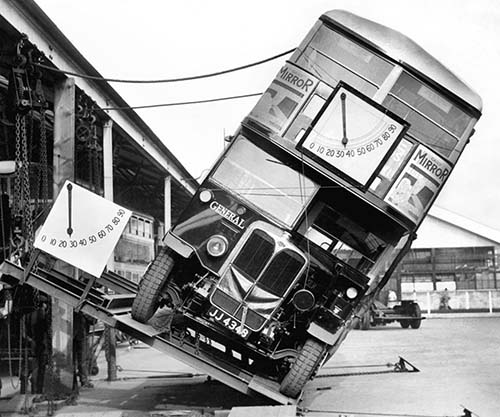
Proving that London's Double-Decker Buses Were Not a Tipping Hazard, 1933 - Rare Historical Photos
The first engine-powered double-decker bus appeared in London in 1923. The red double-decker buses in London would become a national symbol of England.
 rarehistoricalphotos.com
I'm sure it's all calculated theoretically initially by boffins, but I suppose you could confirm it with an ever-tightening spiral. You send the test train in fully sensored up from the outside at a set speed and see at what radius it starts to tip alarmingly, hoping you can then brake sufficiently before it actually turns over!Thank you for that. I'm trying to picture the research carried out to determine the formula- trains wizzing round bends of declining radius until they fall off or over.
frodshamfella
Established Member
Having travelled from Liverpool to Frodsham last Sunday via Halton Curve, that was rather screechy !
That’s 20mph though, and it doesn’t look, from a drivers point of view at least, that tight. Same goes for Earlstown as suggested by @frodshamfella whilst this is probably the tightest curve on a platform, it’s not the tightest curve.Having travelled from Liverpool to Frodsham last Sunday via Halton Curve, that was rather screechy !
Wrexham Central to General is 15mph but I don’t think that’s as tight as Llandudno Junction to Deganwy.
I have noticed on the crossover from one of the lines between Dutton and Halewood (can’t think exactly where) that the track is at an angle rather than a curve, don’t know how the freight manages it safely!
- Status
- Not open for further replies.