• Our new ticketing site is now live! Using either this or the original site (both powered by TrainSplit) helps support the running of the forum with every ticket purchase! Find out more and ask any questions/give us feedback in this thread!

The mighty Class 74 (some questions!)

Harlequinuk

On Moderation
Joined
15 May 2025
Messages
329
Location
UK
Greetings all!

I have a soft spot for the Class 74, im sure the reaction will be one of wide eye astonishment, but i do like the `Big Ed`. But some questions if i may!

What happened to the bogies/ traction motors/ generators etc once scrapped? Also the engines? 10 Paxman Ventura , would they be cut up as well or moved on to something else?

and ofc, a request for any photos or even video of them running would be very much appreciated.
 
Sponsor Post - registered members do not see these adverts; click here to register, or click here to log in
R

RailUK Forums

Big Jumby 74

Established Member
Joined
12 Feb 2022
Messages
2,217
Location
UK
Can post a couple of photos, but they are of very poor quality. The locos were on their last legs when I was a junior in the industry, and were renown for their failings more than anything else.
 

bishdunster

Member
Joined
9 Oct 2012
Messages
323
Location
Dunster
They certaintly werent that reliable on the 13.30 Poole to Clapham vans in the 1970s, often being unable to make it up Parkstone bank (before the juice reached that far) , oddly enough the 73s were far better :!:
 

mike57

Established Member
Joined
13 Mar 2015
Messages
2,369
Location
East coast of Yorkshire
May be an obvious question, and I never expereinced them 'live' but the Class 74 diesel engine is rated at 650hp, the Class 73 at 600hp, so what was the point...

I realise the 74 had more power on third rail, but the 73 was already successful, if they had been able to squeeze in something that would have given 1000hp+ on diesel then it would have been an improvement, but otherwise they just seem like a 'dead end' in terms of development.
 

Harpo

Established Member
Joined
21 Aug 2024
Messages
3,733
Location
Newport
the Class 74 diesel engine is rated at 650hp, the Class 73 at 600hp, so what was the point...
My meagre understanding of EDs is that the diesel capability wasn’t about planned main line running but more about the last few hundred yards of operation into unelectrified yards and sidings.
 

ac6000cw

Established Member
Joined
10 May 2014
Messages
3,884
Location
Cambridge, UK
May be an obvious question, and I never expereinced them 'live' but the Class 74 diesel engine is rated at 650hp, the Class 73 at 600hp, so what was the point...

I realise the 74 had more power on third rail, but the 73 was already successful, if they had been able to squeeze in something that would have given 1000hp+ on diesel then it would have been an improvement, but otherwise they just seem like a 'dead end' in terms of development.
They were a 'dead end' in terms of development, being intended primarily for hauling Southampton boat trains which needed 'last mile' diesel capability to get inside and around the port. For that use, 650hp was enough. The 73's weren't powerful enough on 3rd-rail (and probably too useful elsewhere), and the 71's could be spared.

AFAIK the rolling stock program to go with the mid-1960s Southampton/Bournemouth electrification project was based around rebuilding/re-engineering/adapting existing stock where possible with minimal new-build, hence the cl. 71 rebuilds into 74s, the cl. 33 push-pull conversions, creating 4TC units (and 4REP trailer cars) out of existing Mk1 hauled stock etc. BR didn't have the money to do much else, and the class 33s and 71s weren't that old in the mid-60's, neither was the hauled stock - and of course to some extent the Southern Region inherited the Southern Railway philosophy of recycling old into new.

IIRC, the cl. 71s had a flywheel-based temporary energy storage system to get them over 3rd-rail gaps (like the earlier experimental CCx SR electric locos). For the cl. 74 conversions, that was removed and a diesel engine, generator/alternator, cooling system, fuel tank and extra electrical/electronics kit was squeezed into the space instead. Based on comments I've read over the years, it wasn't an easy thing to do and that contributed to their reliability problems. I particularly remember reading a comment from a senior BR engineer involved in the cl. 74 project, along the lines of 'never again' as far as doing that sort of major conversion.

Shades of the 769s conversions, really.
 
Last edited:

Haywain

Veteran Member
Joined
3 Feb 2013
Messages
24,479
May be an obvious question, and I never expereinced them 'live' but the Class 74 diesel engine is rated at 650hp, the Class 73 at 600hp, so what was the point...

I realise the 74 had more power on third rail, but the 73 was already successful, if they had been able to squeeze in something that would have given 1000hp+ on diesel then it would have been an improvement, but otherwise they just seem like a 'dead end' in terms of development.
They were a conversion from class 71s, and intended for Southampton and Weymouth boat trains. So the diesel capability was for the last stretches off the main line..
 

D6130

Established Member
Joined
12 Jan 2021
Messages
8,925
Location
West Yorkshire/Tuscany
By strange coincidence, I was looking through one of my old notebooks yesterday from my time working on the Southern in the mid-'70s and this note caught my eye:

Friday 19/12/1975: 74 006 damaged by fire and explosion at Worting Junction.

The big 'JBs' (Southern Region classification....the 71s were 'JAs') also worked some early morning newspaper/passenger trains from Waterloo....a particular favourite of mine being the 03 40 (Sundays only) to Petersfield which - with only one coach and three vans after Guildford - resulted in some spectacularly fast climbs of Haslemere bank. After running round at Petersfield (there were two crossovers in those days) the train returned empty to Guildford at 06 00, formed the 07 00 Guildford to Woking passenger service and then ran empty to Clapham Yard.

In July 1977 I travelled on the Southern Region-organised "Anniversaries Railtour"....commemorating the fortieth anniversary of the Portsmouth Direct electrification and the tenth anniversary of the Bournemouth electrification. Formed of a 12 car all first class consist of Southampton boat train FOs and FKs - plus a BCK for the guard - we travelled from Waterloo to Bournemouth non-stop via Havant and Netley behind a pair of 33s. After a couple of hours 'refreshment' stop in Bournemouth we were treated to a blistering non-stop run back to Waterloo behind 74 007 taking an hour and twenty minutes.

Later that year the 74s were withdrawn after only ten years' service and 007 was one of those broken-up by Pounds shipbreakers of Tipner, Portsmouth, after a brief period in store at Fratton Yard.
 
Last edited:

ac6000cw

Established Member
Joined
10 May 2014
Messages
3,884
Location
Cambridge, UK
They were a conversion from class 71s, and intended for Southampton and Weymouth boat trains. So the diesel capability was for the last stretches off the main line..
...although they couldn't realistically haul the Weymouth boat trains beyond Bournemouth/Branksome (as Branksome - Weymouth wasn't electrified until 1988, and all the 74s had been withdrawn by then).
 

30907

Veteran Member
Joined
30 Sep 2012
Messages
21,922
Location
Airedale
...although they couldn't realistically haul the Weymouth boat trains beyond Bournemouth/Branksome (as Branksome - Weymouth wasn't electrified until 1988, and all the 74s had been withdrawn by then).
No, but they were rostered as far as Bournemouth where time was allowed for the loco changes.
Did they also turn up on ordinary Bournemouth workings (with or without the 3TC sets)?
 

contrex

Established Member
Joined
19 May 2009
Messages
1,655
Location
St Werburghs, Bristol
I particularly remember reading a comment from a senior BR engineer involved in the cl. 74 project, along the lines of 'never again' as far as doing that sort of major conversion.
I seem to remember reading that a contributing factor in the lack of reliability was the electronic systems, in particular the lack of robustness of the printed circuit boards, the way they were mounted, and the connections thereto. I gather that the rail environment is particularly hard on electronics. On a side note, don't the Class 91s suffer from shortages of 1980s components, e.g. 8080 processors?
 
Last edited:

43096

On Moderation
Joined
23 Nov 2015
Messages
18,727
The big 'JBs' (Southern Region classification....the 71s were 'JAs')
That’s not correct.
Class 71 were HA
Class 74 were HB
Class 73/0 were JA
Class 73/1 were JB
 

norbitonflyer

Established Member
Joined
24 Mar 2020
Messages
5,657
Location
SW London
May be an obvious question, and I never expereinced them 'live' but the Class 74 diesel engine is rated at 650hp, the Class 73 at 600hp, so what was the point...
Ther point was that the 73s had proved very useful, so making a few more electro-diesels was a good idea. And there wasn't enough work for the 71s, so that looked like a cheap and cheerful way of doing it.

Unfortunately they didn't use EE 4SRKT engines in the conversions, although the Paxman engine was not an entirely off the wall choice, they were already being used in the Class 14s (another white elephant class for BR, but there was nothing wrong with their engines, and many class 14s saw long service in induistrial use)
 
Last edited:

norbitonflyer

Established Member
Joined
24 Mar 2020
Messages
5,657
Location
SW London
IIRC, the cl. 71s had a flywheel-based temporary energy storage system to get them over 3rd-rail gaps (like the earlier experimental CCx SR electric locos). For the cl. 74 conversions, that was removed and a diesel engine, generator/alternator, cooling system, fuel tank and extra electrical/electronics kit was squeezed into the space instead.
I thought I'd read that the bodies were lengthened to fit it all in - some changes were needed anyway to remove the pantograph and its well. However, i can't find a figure for the length of a 71 (Wikipedia gives a 74 as 50ft 5.5in)
I'm not sure from these pictures, but I think the spacing between the middle two axles is shorter in the 71 than in the 74
RIC01229_wqxga.jpg

74003_Eastleigh_23091978-2.jpg
 

ac6000cw

Established Member
Joined
10 May 2014
Messages
3,884
Location
Cambridge, UK
I thought I'd read that the bodies were lengthened to fit it all in - some changes were needed anyway to remove the pantograph and its well. However, i can't find a figure for the length of a 71 (Wikipedia gives a 74 as 50ft 5.5in)
I'm not sure from these pictures, but I think the spacing between the middle two axles is shorter in the 71 than in the 74
RIC01229_wqxga.jpg

74003_Eastleigh_23091978-2.jpg

This website - http://www.clag.org.uk/wheelbase.html - lists the same wheelbase for both classes (copied below). I suspect lengthening them would likely have been too costly to contemplate (especially if they were monocoque construction). Also after trying to do a a decent estimation from the photos, I think the distance between the inner ends of the bogies is the same (within estimation errors!)

1751562603388.png
1751562275539.png
1751562307532.png
 
Last edited:

D6130

Established Member
Joined
12 Jan 2021
Messages
8,925
Location
West Yorkshire/Tuscany
That’s not correct.
Class 71 were HA
Class 74 were HB
Class 73/0 were JA
Class 73/1 were JB
Yes, sorry.... you're quite correct. The class letters were, of course, allocated in order of construction - apart from the 74s (HB) which were a modification of the 71s (HA). Senior brain fog!
 

contrex

Established Member
Joined
19 May 2009
Messages
1,655
Location
St Werburghs, Bristol
I thought I'd read that the bodies were lengthened to fit it all in

Strengthened, certainly. Wikipedia describes the bodywork mods...

The bodies of Class 71 locomotives were not designed to be structural components capable of carrying any weight, following the principle of earlier designs in that the underframe was the main structural member of the locomotive while the body served primarily as weatherproofing. In August 1966, after initial strip-down and examination of E5016, engineers were forced to re-assess the build when it became apparent that the planned equipment changes could not be accommodated. Although at one point it was mooted that the body would have to be divided and lengthened, the problem was eventually resolved by rebuilding the bodies with a Warren truss framework and outriggers to support the curved body skin. Translucent roof panels were fitted to increase daytime illumination in the engine room. Modifications were also made to the locations of the cooler groups, water tanks, and exhaust silencer.
 

Harlequinuk

On Moderation
Joined
15 May 2025
Messages
329
Location
UK
As i understood, there was a potential plan for retro fitting Class 86 electronics to make the 74`s more reliable? And what happened to the engines / bogies/ traction motors?
 

Cowley

Forum Staff
Staff Member
Global Moderator
Joined
15 Apr 2016
Messages
18,858
Location
Devon
Ah - I was probably misremembering that lengthening had been proposed at one stage.

Yes, definitely strengthened if not lengthened. Quite a lot of body mods (grilles etc) though, and I think some fairly major modifications to the bogies as well.
 

jonty14

Member
Joined
3 Aug 2009
Messages
240
Location
Rottweil Germany
May be an obvious question, and I never expereinced them 'live' but the Class 74 diesel engine is rated at 650hp, the Class 73 at 600hp, so what was the point... I realise the 74 had more power on third rail, but the 73 was already successful, if they had been able to squeeze in something that would have given 1000hp+ on diesel then it would have been an improvement, but otherwise they just seem like a 'dead end' in terms of development.
 

Haywain

Veteran Member
Joined
3 Feb 2013
Messages
24,479
May be an obvious question, and I never expereinced them 'live' but the Class 74 diesel engine is rated at 650hp, the Class 73 at 600hp, so what was the point... I realise the 74 had more power on third rail, but the 73 was already successful, if they had been able to squeeze in something that would have given 1000hp+ on diesel then it would have been an improvement, but otherwise they just seem like a 'dead end' in terms of development.
It wasn't intended to go anywhere in terms of development. It was a cheap way of building additional ED locomotives using surplus class 71s.
 

Taunton

Veteran Member
Joined
1 Aug 2013
Messages
12,218
The purpose of the diesel engine was to give slow speed running on non-electrified sidings and short spurs, , possibly even just to heat a train standing off the power, not open line running. For this horsepower is not really relevant - a 350hp Class 08 will start a full size train up to about 20 mph.
 

Big Jumby 74

Established Member
Joined
12 Feb 2022
Messages
2,217
Location
UK
Can post a couple of photos, but they are of very poor quality.
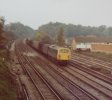
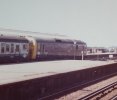
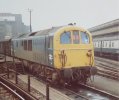
As said do not expect too much!

74004 approaching Woking with an UP van train.

74007 deputising for a failed REP on a Down Weymouth service at Basingstoke.

74010 at Clapham Yard.

Ref comments above about 006, this was the one that eluded me in service, although did make its acquaintance on Eastleigh Depot after withdrawal.
 

Attachments

  • BJ-74004.jpg
    BJ-74004.jpg
    1.1 MB · Views: 147
  • BJ-74007.jpg
    BJ-74007.jpg
    734 KB · Views: 147
  • BJ-74010.jpg
    BJ-74010.jpg
    1.2 MB · Views: 143

Bald Rick

Veteran Member
Joined
28 Sep 2010
Messages
35,581
I reckon I have a photo of one somewhere, will see if i can dig it out.
 

Harlequinuk

On Moderation
Joined
15 May 2025
Messages
329
Location
UK
Thank you all! I guess, no videos of diesel running exist? And of course, what about `bits` of them? Engines etc?
 

D7666

Member
Joined
12 Aug 2013
Messages
986
What happened to the bogies/ traction motors/ generators etc once scrapped?

Some booster sets survived for some time.

2 or 3 booster sets ex-74s were bolted to the ground at Strawberry Hill depot where the BR SR CM&EE testing bit was based. The sets were used inconjunction with DC chopper traction equipment testing and the need to test out a wide range of voltages. This is way before chopper 455s came into being, but before and during the period when the CM&EE test motor coaches "Romeo" and "Juliet" (DB975808 and DB975809) were used. I have no info when the boosters were removed, if they were, nor if they went on to be used with 457 prototype AC traction testing and 465 introduction, that also required a wide range of test traction voltage supplies.
_

Also a 74 on diesel was less powerful than a 73 on diesel, by quite a long way.

A 73 is 600 hp at the engine crankshaft, and a 74 650 hp likewise.

BUT.

A 73 (taking 73/1 as example) was maximum 420 hp at rail on diesel, but a 74 was only 315 hp, i.e. a diesel 74 was only 3/4 power of a diesel 73/1.
_

Re. the choice of Paxman 6YJ engine instead of EE 6SRKT, first Paxman came part of EE in 1966, just before 74s came about. Second, the YJ us part of the Ventura range, as used in D830 as well as 14s and the re-engined D6100s, and was itself a robust reliable peice of kit the BR engineers were impressed with and liked the YJ, third, it is a great deal more compact and lighter and 4th BR SR had an almost love affair with EE things (even if from the Paxman part of EE).

A 74 with a 6RKT would simply have been too heavy, they were 21 t 3 c on each axle as it was.

Must not be forgotten that SR CM&EE was no stranger to 1960s Paxman engines - the 07s were Paxman (of a different model).

_


On the subject of microprocessors, 8080 and 8088/8086 dating from 1974 and 1978/1979, and 68000 1979, is a bit of a simplistic view. It takes many years and much development to adopt into safety vital areas like traction control. Desktop computers do not go round hauling 1000 tons or 1000 passengers at 100 mph.

The first use of microprocessor (in ths case x86) in any safety vital GB traction application was in Class 319, something like 9-10 years later. Any previous use of microprocessors in GB trains was not on the safety vital elements. Electronics yes, microprocessors no. The potential use in possible refurbled 74s referred to here is safety vital. Given the more complex traction nature of a 74 compared to a 319, and as BoBo they are comparable, i.e. AC/DC changeover c.f. DC/diesel, I'd question unlikely that anything before 1990 would have been practical for a 74, and, by then, you were well into sectorisation from the operating view, and, specific to the Bomo line, 442s were on order from 1988, and class 457 three phase AC gubbins testing from 1989 ready for 465s already. No-one would have had a use for a 74 by then, you were well into the NSE "get rid of locos" scene by then, and, really, even for freight such as DC channel tunnel freight work with 46 92s on order what would you want 10 other non standard things for that had no 25 kV ? And, if by now, today, Freightliner STILL has no use for ED locos, no way would they have back then and Soton container traffic is not an answer.
_

If you can find it, BY FAR the best book on Class 71 and 74 simply called "Class 71/74 Locomotives" by Simon Lilley and John Wenyon isbn 9781909328686, part of the "Southern Way" series full title "The Southern Way Special No. 14 Class 71/74 Locomotive". There are other books on the subject, but they are nowhere near as accurate and comprehensive as that.

 
Last edited:

D6130

Established Member
Joined
12 Jan 2021
Messages
8,925
Location
West Yorkshire/Tuscany
Thank you all! I guess, no videos of diesel running exist? And of course, what about `bits` of them? Engines etc?
I can't find any videos of 74s on YouTube....but somebody may have some old 8mm or 16mm amateur footage in their attic. I've had a look at my old 8mm footage from the 1970s. I have classes 27/31/33/37/47/52 and 73....but no 74 unfortunately.
 

Taunton

Veteran Member
Joined
1 Aug 2013
Messages
12,218
A 74 with a 6RKT would simply have been too heavy, they were 21 t 3 c on each axle as it was.
However can a DC loco, which is fundamentally a resistor switch in a loco body, be so heavy?

The booster must have been a part of it I suppose. The previous booster locos, Southern 20001-3, were 6-axle.
 

ac6000cw

Established Member
Joined
10 May 2014
Messages
3,884
Location
Cambridge, UK
However can a DC loco, which is fundamentally a resistor switch in a loco body, be so heavy?

The booster must have been a part of it I suppose. The previous booster locos, Southern 20001-3, were 6-axle.
As I think D7666 was talking about the weight of a cl. 74, do those actually have/retain the 'flywheel' booster that was in the cl 71's ?
 

Top