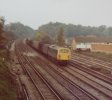
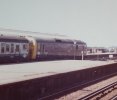
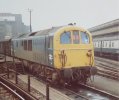
What happened to the bogies/ traction motors/ generators etc once scrapped?
Some booster sets survived for some time.
2 or 3 booster sets ex-74s were bolted to the ground at Strawberry Hill depot where the BR SR CM&EE testing bit was based. The sets were used inconjunction with DC chopper traction equipment testing and the need to test out a wide range of voltages. This is way before chopper 455s came into being, but before and during the period when the CM&EE test motor coaches "Romeo" and "Juliet" (DB975808 and DB975809) were used. I have no info when the boosters were removed, if they were, nor if they went on to be used with 457 prototype AC traction testing and 465 introduction, that also required a wide range of test traction voltage supplies.
_
Also a 74 on diesel was less powerful than a 73 on diesel, by quite a long way.
A 73 is 600 hp at the engine crankshaft, and a 74 650 hp likewise.
BUT.
A 73 (taking 73/1 as example) was maximum 420 hp at rail on diesel, but a 74 was only 315 hp, i.e. a diesel 74 was only 3/4 power of a diesel 73/1.
_
Re. the choice of Paxman 6YJ engine instead of EE 6SRKT, first Paxman came part of EE in 1966, just before 74s came about. Second, the YJ us part of the Ventura range, as used in D830 as well as 14s and the re-engined D6100s, and was itself a robust reliable peice of kit the BR engineers were impressed with and liked the YJ, third, it is a great deal more compact and lighter and 4th BR SR had an almost love affair with EE things (even if from the Paxman part of EE).
A 74 with a 6RKT would simply have been too heavy, they were 21 t 3 c on each axle as it was.
Must not be forgotten that SR CM&EE was no stranger to 1960s Paxman engines - the 07s were Paxman (of a different model).
_
On the subject of microprocessors, 8080 and 8088/8086 dating from 1974 and 1978/1979, and 68000 1979, is a bit of a simplistic view. It takes many years and much development to adopt into safety vital areas like traction control. Desktop computers do not go round hauling 1000 tons or 1000 passengers at 100 mph.
The first use of microprocessor (in ths case x86) in any safety vital GB traction application was in Class 319, something like 9-10 years later. Any previous use of microprocessors in GB trains was not on the safety vital elements. Electronics yes, microprocessors no. The potential use in possible refurbled 74s referred to here is safety vital. Given the more complex traction nature of a 74 compared to a 319, and as BoBo they are comparable, i.e. AC/DC changeover c.f. DC/diesel, I'd question unlikely that anything before 1990 would have been practical for a 74, and, by then, you were well into sectorisation from the operating view, and, specific to the Bomo line, 442s were on order from 1988, and class 457 three phase AC gubbins testing from 1989 ready for 465s already. No-one would have had a use for a 74 by then, you were well into the NSE "get rid of locos" scene by then, and, really, even for freight such as DC channel tunnel freight work with 46 92s on order what would you want 10 other non standard things for that had no 25 kV ? And, if by now, today, Freightliner STILL has no use for ED locos, no way would they have back then and Soton container traffic is not an answer.
_
If you can find it, BY FAR the best book on Class 71 and 74 simply called "Class 71/74 Locomotives" by Simon Lilley and John Wenyon isbn 9781909328686, part of the "Southern Way" series full title "The Southern Way Special No. 14 Class 71/74 Locomotive". There are other books on the subject, but they are nowhere near as accurate and comprehensive as that.