
-
Our new ticketing site is now live! Using either this or the original site (both powered by TrainSplit) helps support the running of the forum with every ticket purchase! Find out more and ask any questions/give us feedback in this thread!
You are using an out of date browser. It may not display this or other websites correctly.
You should upgrade or use an alternative browser.
You should upgrade or use an alternative browser.
Thameslink/ Class 700 Progress
- Thread starter fgwrich
- Start date
- Status
- Not open for further replies.
Sponsor Post - registered members do not see these adverts; click here to register, or click here to log in
R
RailUK Forums

spark001uk
Established Member
- Joined
- 20 Aug 2010
- Messages
- 2,385
Any news on tables?
I found an Evening Standard on the table in 1st class the other day if that counts??

I found an Evening Standard on the table in 1st class the other day if that counts??
Does that have any news in it?
Maybe more than Metro I suppose.
I found an Evening Standard on the table in 1st class the other day if that counts??
Probably the one I left.
samuelmorris
Established Member
Another out of date TfL status feed this morning, albeit only 8 hours behind - it has actually been quite a long time since I saw one with the correct information on it.
Aside from that, does anyone know what the heavy brake application on departing Blackfriars northbound is about? It doesn't seem to happen every time, but certainly very regularly, and nearly has me off my feet on occasions when I'm standing up.
Edit: I also notice the unit failed at the stop after where I got off, 1W82 this morning.
Edit 2: might not actually have been this train where the fault occurred.
Aside from that, does anyone know what the heavy brake application on departing Blackfriars northbound is about? It doesn't seem to happen every time, but certainly very regularly, and nearly has me off my feet on occasions when I'm standing up.
Edit: I also notice the unit failed at the stop after where I got off, 1W82 this morning.
Edit 2: might not actually have been this train where the fault occurred.
Last edited:

tsr
Established Member
Aside from that, does anyone know what the heavy brake application on departing Blackfriars northbound is about? It doesn't seem to happen every time, but certainly very regularly, and nearly has me off my feet on occasions when I'm standing up.
Quite possibly a relief driver doing a brake test, having just picked up the train. As the gradient is pretty steep on the north side of Blackfriars, it may be that some drivers are still getting used to achieving the desired result in that location and on that stock. However, I believe there will not be any routine driver changes on "through" Thameslink services at Blackfriars once the full TL timetable is in place.
samuelmorris
Established Member
Looking at RTT it looks like it may actually have been the 319s in front that failed, though two separate reasons for cancellation are given (safety systems on the 700, overhead power collection on the 319s), so not sure what that's about.
Yes that reasoning makes sense, there were two staff in the cab, however they were both present before the service arrived at Blackfriars...
Yes that reasoning makes sense, there were two staff in the cab, however they were both present before the service arrived at Blackfriars...
Quite possibly a relief driver doing a brake test, having just picked up the train. As the gradient is pretty steep on the north side of Blackfriars, it may be that some drivers are still getting used to achieving the desired result in that location and on that stock. However, I believe there will not be any routine driver changes on "through" Thameslink services at Blackfriars once the full TL timetable is in place.
and i think the rule is to do a running brake test before the next stopping location (when relieving a train) and before a steep gradient.....
and i think the rule is to do a running brake test before the next stopping location (when relieving a train) and before a steep gradient.....
And when changing ends. But not all companies ask drivers to do brake tests.
Deepgreen
Established Member
Deepgreen
Established Member
and i think the rule is to do a running brake test before the next stopping location (when relieving a train) and before a steep gradient.....
I've raised this before, but at Redhill, GWR drivers seem to do running brake tests even when just changing ends (i.e. not relieving) back up to Reigate. I've still not been able to establish what the rule actually is. Bizarrely, these tests seem to happen far more often when already running late, rather than when on time (and always when the driver has just changed ends rather than being 'new' to the train).
I can't understand the logic used - is it purely a matter of driver discretion?
I've raised this before, but at Redhill, GWR drivers seem to do running brake tests even when just changing ends (i.e. not relieving) back up to Reigate. I've still not been able to establish what the rule actually is. Bizarrely, these tests seem to happen far more often when already running late, rather than when on time (and always when the driver has just changed ends rather than being 'new' to the train).
I can't understand the logic used - is it purely a matter of driver discretion?
Just had a look in the rule book and it states that running brake test requirements on multiple unit trains are decided by the train operating company.
Southern follows the rule book for HST running brake tests:
"The driver must carry out a running brake test at the first opportunity, before approaching:
The first stopping place
A crossing place on a single line where a train has to stop
A steep falling gradient
A terminus or dead end platform"
...nothing specific about changing ends, but its an unwritten rule it seems.
Personally i would do the same as the GWR driver did even though it is the same "service" so to speak, we would do the same if we were changing ends at West Croydon, or Uckfield etc.
I guess it is possible for braking characteristics to be different from each cab
Last edited:
Deepgreen
Established Member
Just had a look in the rule book and it states that running brake test requirements on multiple unit trains are decided by the train operating company.
Southern follows the rule book for HST running brake tests:
"The driver must carry out a running brake test at the first opportunity, before approaching:
The first stopping place
A crossing place on a single line where a train has to stop
A steep falling gradient
A terminus or dead end platform"
...nothing specific about changing ends, but its an unwritten rule it seems.
Personally i would do the same as the GWR driver did even though it is the same "service" so to speak, we would do the same if we were changing ends at West Croydon, or Uckfield etc.
I guess it is possible for braking characteristics to be different from each cab
Many thanks for that. It's the randomness of the testing/not testing at the same location that gets me. Hey ho.
Looking at RTT it looks like it may actually have been the 319s in front that failed, though two separate reasons for cancellation are given (safety systems on the 700, overhead power collection on the 319s), so not sure what that's about.
It was the 319s that failed. Caused disruption for around an hour, and much confusion at St P as bi di was used to get round the failure (and the 700 in rear at St P itself).
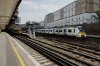
I was surprised to see a 700 at Victoria this morning - was this for driver training? See attached shot.
At least one TL train ex Sevenoaks was diverted to Vic.
We were told that the most critical brake test was after changing ends. I later asked the mechanical engineer why & got told that after shutting down one end & then opening up the other end was when any fault was most likely to happen. (although still incredibly rare) so that was the message I relayed to colleagues. I have also been told that brake gear can freeze up, if there is moisture in the system in very very cold weather. I believe the supermarket train crashed on the highland line for this reason. So a brake test also serves to stop it freezing up.
tsr
Established Member
At least one TL train ex Sevenoaks was diverted to Vic.
Think it was 2 in the end (or such was the plan). Apparently that was the maximum permitted in the circumstances, due to a lack of plans for the availability of crew to move the stock once it arrived.

bramling
Veteran Member
It was the 319s that failed. Caused disruption for around an hour, and much confusion at St P as bi di was used to get round the failure (and the 700 in rear at St P itself).
Oh dear. One train failure and an hour's disruption - yet again. Still, at least we can blame the 319s -- but not for much longer.
At least one TL train ex Sevenoaks was diverted to Vic.
TL used to send 319's into Victoria regularly, without passengers.
Oh dear. One train failure and an hour's disruption - yet again. Still, at least we can blame the 319s -- but not for much longer.
Quite - the sooner they go the better! I've been delayed more times by failed 319s than 700s in the last year. Besides - it has always been the case that a failed unit in the core causes disruption. Much like it does on any high capacity railway.
Last edited:
Think it was 2 in the end (or such was the plan). Apparently that was the maximum permitted in the circumstances, due to a lack of plans for the availability of crew to move the stock once it arrived.
2 was the plan, but only 2E71 was diverted. The next one went booked route.
Much confusion today when my train announced 'This train terminates here, all change', at West Hampstead Thameslink heading to Luton.
This was then followed by 'This station is St. Albans City' and the termination message for the rest of the journey... Surely issues like this shouldn't still be going on
This was then followed by 'This station is St. Albans City' and the termination message for the rest of the journey... Surely issues like this shouldn't still be going on
samuelmorris
Established Member
I think the TfL info was actually correct on the unit I was travelling on this morning, I couldn't see the time but the right lines seemed to be showing as disrupted. Could still potentially have been an hour or two out of course.
The A/C, however, was not working. It was pretty toasty with a full load of people on board, though I was standing somewhere I don't usually go, just outside the rear first class section (because it was full & standing, well aware I can still use it)
The A/C, however, was not working. It was pretty toasty with a full load of people on board, though I was standing somewhere I don't usually go, just outside the rear first class section (because it was full & standing, well aware I can still use it)
Much confusion today when my train announced 'This train terminates here, all change', at West Hampstead Thameslink heading to Luton.
This was then followed by 'This station is St. Albans City' and the termination message for the rest of the journey... Surely issues like this shouldn't still be going on
Did I read here that the system will still announce a station if the train stops and the doors are released? I assume that's how you get the oddity of it announcing stations 'as normal' while showing an incorrect service pattern or out of service message.
It was a clever idea if true to make it announce based on the doors, but perhaps the programmer needs to consider stopping the incorrect messages when detecting movement, or that a train is travelling the wrong way or elsewhere from the set up service pattern?
That said, the real solution is making sure the driver can easily set the service quickly in the first place.
Did I read here that the system will still announce a station if the train stops and the doors are released? I assume that's how you get the oddity of it announcing stations 'as normal' while showing an incorrect service pattern or out of service message.
It was a clever idea if true to make it announce based on the doors, but perhaps the programmer needs to consider stopping the incorrect messages when detecting movement, or that a train is travelling the wrong way or elsewhere from the set up service pattern?
That said, the real solution is making sure the driver can easily set the service quickly in the first place.
Sorry, just to clarify, it was announcing St Albans at every station northbound (it was a stopping train) from West Hampstead. When I got off I went to tell the driver who sighed heavily, told me he didn't know, and then made an announcement apologising for the incorrect information displayed
It's quite difficult to hear what the PA is announcing from the cab.
No, I can imagine. Not blaming the driver at all here. It's a shame there seems to be these niggles with the trains - I actually quite like them overall!
tsr
Established Member
2 was the plan, but only 2E71 was diverted. The next one went booked route.
Thanks for the clarification. I got a couple of garbled Control messages and that seemed to be the worst-case scenario they were trying to implement.
Did I read here that the system will still announce a station if the train stops and the doors are released? I assume that's how you get the oddity of it announcing stations 'as normal' while showing an incorrect service pattern or out of service message.
It was a clever idea if true to make it announce based on the doors, but perhaps the programmer needs to consider stopping the incorrect messages when detecting movement, or that a train is travelling the wrong way or elsewhere from the set up service pattern?
The 700s do have such a mode, which it seems the driver has to specifically activate. It has its own visual outputs, so I'm not sure if it would work audibly but with incorrect info still shown on the screens.
I'm not sure what the best way / trigger to wipe incorrect calling patterns would be, really. It's hard for an isolated onboard display system to interpret everything a driver or control room might need, though obviously frozen screens are no good anyway.
Sorry, just to clarify, it was announcing St Albans at every station northbound (it was a stopping train) from West Hampstead. When I got off I went to tell the driver who sighed heavily, told me he didn't know, and then made an announcement apologising for the incorrect information displayed
Ah. In which case that isn't clever at all!!
- Status
- Not open for further replies.