Our new ticketing site is now live! Using either this or the original site (both powered by TrainSplit) helps support the running of the forum with every ticket purchase! Find out more and ask any questions/give us feedback in this thread!
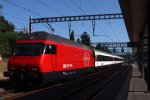
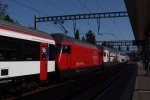
Had a trip on the Swiss railways recently and found them very interesting from an enthusiasts perspective. Some of the train formations are completely wild; I've seen trains with a DBSO type carriage at the front, hauling a rake of coaches, with a locomotive in the middle and a continuing trail of coaches. But most strangely, a loco pulling a few coaches and a dead double deck EMU as part of the rake with more coaches behind and a loco on the rear! This was Lausanne station this spring. Does anyone know what the train formations are so varied?
Because they can? If you’ve got that flexibility, then make use of it!
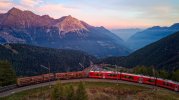
Over on the RhB system in the SE of Switzerland they get even wilder. Two examples I’ve travelled on:
Driving coach, normal coaches, loco, freight wagons;
Extra-powerful EMU hauling normal coaches with freight wagons on the back.
Those trains with locos or driving trailers in the middle are often lengthened trains for the peak hours. Actually a very effective way of having enough capacity whilst avoiding hassle with shunting.
For example: once had such a combination with driving trailer, coaches, driving trailer, more coaches and locomotive at the end from Zürich to Basel in the peak. After arrival in Basel, the first set of driving trailer and coaches was uncoupled and shunted away to the yard. The standard push-pull set remaining along the platform could immediately be used for another train. Whilst inserting the additional coaches between locomotive and the other carriages would have required a lot more shunting to get the locomotive back on the train.
Most trains in Switzerland are push-pull, but if you need extra capacity at peak hours, you stick what SBB calls a module on one end - a couple of extra coaches with a cab on the end. We don't really do gangway doors at the front of cabs anymore, so you can't get from the module to the rest of the train, but as a way of making the vessel temporarily a bit larger, it works.
RhB are special in that they happily mix passenger and goods wagons whenever there's a need to - some scheduled passenger trains regularly take an extra goods wagon or two for the local shops.
RhB freight does seem like a blast from the past. The good old days with local freight.
The losses are paid for the canton. A wise descision to keep trucks off mountain roads.
Mountain roads can easily shut for a week in winter due to avalanche danger - of course that can shut railways too, but if you have the road one side of the valley and the tracks the other, you have some resilience.
The Bernina line usually has freight Monday to Friday. During the tourist periods mainly in the morning and evening, during the day the trains are at capacity with passenger carriages.
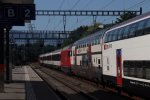
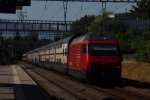
I enjoyed watching this set at Chambesy (near Geneve) in June 2022. Ironically I should have been back in London at work this day, but my flight was cancelled the previous evening and rescheduled to 14.30 the next day!
Three class 460 locos, all under power. The second two are top and tail on the double deck set and the front loco and single deck coaches is the added 'module'
They know how to grow the market and gain high market share for public transport, and they sure know how to run railways.
Railways are actually treated genuinely as a public service and, wherever practicable, supply is altered to meet demand.
Thanks to a member of this forum who works for Swiss railways, I am able to get discounted tickets for travel over there (when I'm not using an Interrail pass with a long period of validity) and my conclusion is there is absolutely no comparison when it comes to Swiss railways vs UK railways.
We would never ever be able to achieve anything like what they have over there; there is just no prospect of it.
Three class 460 locos, all under power. The second two are top and tail on the double deck set and the front loco and single deck coaches is the added 'module'
Our trains are cleaner internally in my experience.
Of the six trains (all SBB) I travelled on in Switzerland - 5 had filthy windows, 4 had rubbish on seats/window perch table/aisles/bins overflowing, 3 had vile toilets and 2 had no water.
Either I'm very lucky, but beyond the odd coffee cup or crisp packet I've not had those, admittedly mild, issues.
Dutch trains definitely had worse toilets.
Also, Swiss timekeeping not very good - 5 trains were 2 mins late, 1 was 4 down.
Hardly a paradigm of the oft-touted Swiss efficiency and cleanliness...
And yes, I still love Switzerland and want to go back soon - please don't think this is an anti-Swiss rant by any means
Just their railways are not that 100% perfect, 100% of the time example people suggest.
I also find fares for short distances are also relatively expensive compared to say an Off Peak Day Return for the equivalent distance here. (I'm talking about journeys of about an hour, for maybe 45-50 miles.)
Slight delays can happen due to the large amount of single track working in Switzerland.
Personally I found Swiss trains cleaner than anything GWR has.
I also find fares for short distances are also relatively expensive compared to say an Off Peak Day Return for the equivalent distance here. (I'm talking about journeys of about an hour, for maybe 45-50 miles.)
I'm not really quibbling over a minute or two here or there, it isn't important in that it didn't affect connections or plans; it was the fact that every train was late even if only just, that was my point.
Our trains are cleaner internally in my experience.
Of the six trains (all SBB) I travelled on in Switzerland - 5 had filthy windows, 4 had rubbish on seats/window perch table/aisles/bins overflowing, 3 had vile toilets and 2 had no water.
This is not consistent with my experience; I have travelled on many trains in Switzerland in the past 5 years; well into a three figure number and this isn't the norm
A few minutes here and there isn't particularly uncommon but where they excel is maintaining connections; they absolutely put us to shame in that respect.
I also find fares for short distances are also relatively expensive compared to say an Off Peak Day Return for the equivalent distance here. (I'm talking about journeys of about an hour, for maybe 45-50 miles.)
It's true that single-mode walk-up short distance off peak travel in the UK can be cheap, especially at super off peak times (though this is under threat from those who advocate 'simplification' which is another story) but other than that, Switzerland wins.
As a general rule, fares are very affordable for people based in Switzerland.
You will percieve them as expensive as you are considering the cost against a UK wage, rather than a Swiss salary, and of course being a non-local you don't have a discount card.
For urban areas, fares are zonal, with no penalty for using different modes (unlike the UK) and indeed 'splitting' is very much a thing when going from one urban area to another (e.g. you can get zonal tickets at each end and a point-to-point to bridge the 'gap').
If you compared the price from a Metrolink station to a Supertram station, including trams at either end and a train between Manchester and Sheffield, with equivalent prices for a similar journey in Switzerland, then adjust it for wages, the UK would be horrendously expensive.
I'm not really quibbling over a minute or two here or there, it isn't important in that it didn't affect connections or plans; it was the fact that every train was late even if only just, that was my point.
It's a myth that Swiss trains are consistently exactly on time, but they don't need to be! What really matters is that passenger journeys are rarely later than a few minutes here and there.
It is very different to the UK approach of desperately trying to get trains out of stations early (in Switzerland you can board at the advertised departure time; boarding is vastly more civilised than the UK approach), even to the detriment of connecting passengers, only to get held up at junctions.
It's a completely different outlook, and overall it's vastly better than the UK.
== Doublepost prevention - post automatically merged: ==
I also find fares for short distances are also relatively expensive compared to say an Off Peak Day Return for the equivalent distance here. (I'm talking about journeys of about an hour, for maybe 45-50 miles.)
The trouble with this comparison is that British fares are entirely market priced. At least that isn't the case with walk up fares in Switzerland, so we can quote a fare in confidence that it will be representative of the fare across the country. Brig to Martigny is about 75 km. The single fare with Half Fare card is 13.50 CHF (£12.15). That is valid anytime, peak or off-peak. Take Basingstoke to Waterloo as an example that is about the same distance. This costs £19.65 Off Peak Return with a Network Railcard (route Woking). So there's not much in it, especially if you consider the superior spending power of the average Swiss compared to the average Brit (even one living in Hampshire).
Obviously when looking at singles the comparison is much worse for the UK, as the Anytime Single with a Network Railcard is only a little less than the return and the morning peak fare at £28.30 (as Network Railcards are not valid) is outrageously expensive, more than double the Swiss equivalent with a Half Fare card which is valid at any time.
One must also consider that the Swiss have the GA annual season ticket, valid on all public transport in a year for roughly the cost of a Gold Card between Woking and London, so many Swiss never need to think about the cost of fares.
Online timetable and online ticket sales for Switzerland, Germany, Austria and France. Rail service updates in the event of disruptions. SBB’s service for you.
Not always, there are certain routes where two engines are required if the train is over a certain length. Also can be to transport an engine and save a light engine move. I've certainly had many tnt Re 460 trains.
The new Zurich underground Löwenstraße station requires top-and-tail when IC2000 are operated at full length, IIRC. Though nowadays the IC-Twindexx trains run on those services.
Not always, there are certain routes where two engines are required if the train is over a certain length. Also can be to transport an engine and save a light engine move. I've certainly had many tnt Re 460 trains.
I enjoyed watching this set at Chambesy (near Geneve) in June 2022. Ironically I should have been back in London at work this day, but my flight was cancelled the previous evening and rescheduled to 14.30 the next day!
Three class 460 locos, all under power. The second two are top and tail on the double deck set and the front loco and single deck coaches is the added 'module'
Another feature of Swiss working is the running, on mountain railways, of services in multiple separate portions. This looks very strange to those of us brought up on the principles of the block system.
Another feature of Swiss working is the running, on mountain railways, of services in multiple separate portions. This looks very strange to those of us brought up on the principles of the block system.
It's the train dispatch that's always fascinated me. The minute hand on the Swiss railway clocks doesn't move slowly throughout the duration of a minute, like ours does. The minute hand jumps forward one minute all in one go at the end of the minute. And that is when the trains due to depart at that time are dispatched, right on the full minute. So if you go to a busy station like Zurich HB you will see trains departing in waves. For example, trains due to depart at 1137 will all depart simultaneously exactly as the minute hand jumps forward to mark the completion of the minute. Then you might have a few minutes of no activity, then a few minutes later you'll get another wave of trains that all depart at exactly the same time. It's a sight to behold.
I wish that we did compile this statistic and considered connections when measuring delays. There's no point in a train departing right time with no one on it because they're all just arriving on the long distance train. A seven minute delay has turned into half an hour for the passenger (and hence Delay Repay) but everything made PPM so the beancounters are happy.
Another feature of Swiss working is the running, on mountain railways, of services in multiple separate portions. This looks very strange to those of us brought up on the principles of the block system.
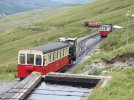
You do see that in the UK, the Snowdon Mountain Railway can run multiple trains as a line-of-sight tramroad. Used to be a regular occurrence but less so now that there are only six passenger carriages instead of eight.
I've got a picture of the Pilatus Bahn somewhere with a total of five railcars in section.
It's the train dispatch that's always fascinated me. The minute hand on the Swiss railway clocks doesn't move slowly throughout the duration of a minute, like ours does. The minute hand jumps forward one minute all in one go at the end of the minute. And that is when the trains due to depart at that time are dispatched, right on the full minute. So if you go to a busy station like Zurich HB you will see trains departing in waves. For example, trains due to depart at 1137 will all depart simultaneously exactly as the minute hand jumps forward to mark the completion of the minute. Then you might have a few minutes of no activity, then a few minutes later you'll get another wave of trains that all depart at exactly the same time. It's a sight to behold.
Once upon a time it was possible to buy a wrist watch which did the same thing with its minute and second hands. Great gift idea, but sadly not in quite the same price bracket as most stocking fillers!
Once upon a time it was possible to buy a wrist watch which did the same thing with its minute and second hands. Great gift idea, but sadly not in quite the same price bracket as most stocking fillers!
Once upon a time it was possible to buy a wrist watch which did the same thing with its minute and second hands. Great gift idea, but sadly not in quite the same price bracket as most stocking fillers!
There’s also an app (at least for iOS) that is considerably cheaper. It also has a couple of nice features: you can have two additional time zones on it and it goes into night/backlit mode when it goes dark outside. If I remember I’ll post a screenshot.
We are aware of an issue with emails from the Forum to Microsoft-based email accounts (hotmail/outlook/live.com email addresses). This is being looked into currently, thanks for your patience meanwhile.





 I presume you were being sarcastic there!