You’re correct it has been plain lined into Platform 1.Is Stranraer station capable of handling two trains at once? I thought all the points had been disconnected leaving just a single line in and out. Happy to be corrected!

-
Our new ticketing site is now live! Using either this or the original site (both powered by TrainSplit) helps support the running of the forum with every ticket purchase! Find out more and ask any questions/give us feedback in this thread!
You are using an out of date browser. It may not display this or other websites correctly.
You should upgrade or use an alternative browser.
You should upgrade or use an alternative browser.
Stranraer line engineering works: station and infrastructure works.
- Thread starter D6130
- Start date
Sponsor Post - registered members do not see these adverts; click here to register, or click here to log in
R
RailUK Forums
You’re correct it has been plain lined into Platform 1.
With thanks to the excellent RAILSCOT website and photographer Colin Miller here is a photo of the new layout;Is Stranraer station capable of handling two trains at once? I thought all the points had been disconnected leaving just a single line in and out. Happy to be corrected!
MadMac
Established Member
You could put two trains in the platform if what’s left of the box was “opened”. Some sort of “special arrangement“ would be needed due to the lack of signals.Is Stranraer station capable of handling two trains at once? I thought all the points had been disconnected leaving just a single line in and out. Happy to be corrected!
== Doublepost prevention - post automatically merged: ==
The crossing would become pedestrian only: there are convenient roads bypassing it.Dunragit box also operates the local level crossing.
To clarify re Stranraer itself, the plan I saw showed it getting a small “box” with, presumably, a workstation and some siding/run-round capability, part of which would be the remaining track in the current station.

Farigiraf
Established Member
While reassuring that 0.5tph is still possible post-rationalisation, I would be quite surprised if it actually happens. Maybe if there's a surplus of trains in the 156 replacement order. Would make the railway an actually useful service, since it'd match Citylink in frequency and speed while offering a potentially* more comfortable ride (with a bit of a price markup).
*Class 156 seats + 1 transfer is less comfortable overall than a direct Citylink coach but this could change with new rolling stock
Having space for a bus interchange at a relocated Stranraer station is also great, as it'd improve connectivity to Portpatrick and the Rhins of Galloway, both of which are places which (while they do have low demand) are very cut-off from civilisation in general.
Could anything be done with Barrhill station to increase ridership? A bus to/from Newton Stewart timed to connect with trains may have some potential, as it'd give a ~2h 45 journey time to Glasgow compared to the current ~4 hour connection options. Realistically running a rail-link bus to Newton Stewart is probably a lot more feasible from Stranraer than Barrhill if there's going to be a bus interchange there anyway, but there would be about a 40 minute penalty for northbound trips which is why Barrhill would be a more convenient location overall.
*Class 156 seats + 1 transfer is less comfortable overall than a direct Citylink coach but this could change with new rolling stock
Having space for a bus interchange at a relocated Stranraer station is also great, as it'd improve connectivity to Portpatrick and the Rhins of Galloway, both of which are places which (while they do have low demand) are very cut-off from civilisation in general.
Could anything be done with Barrhill station to increase ridership? A bus to/from Newton Stewart timed to connect with trains may have some potential, as it'd give a ~2h 45 journey time to Glasgow compared to the current ~4 hour connection options. Realistically running a rail-link bus to Newton Stewart is probably a lot more feasible from Stranraer than Barrhill if there's going to be a bus interchange there anyway, but there would be about a 40 minute penalty for northbound trips which is why Barrhill would be a more convenient location overall.
MadMac
Established Member
Distance/time from Newton Stewart to Barrhill and Stranraer is roughly the same. Remarkably, there’s a bus stop right outside Barrhill station, but it would have to reverse back to the main road from the station.Could anything be done with Barrhill station to increase ridership? A bus to/from Newton Stewart timed to connect with trains may have some potential, as it'd give a ~2h 45 journey time to Glasgow compared to the current ~4 hour connection options. Realistically running a rail-link bus to Newton Stewart is probably a lot more feasible from Stranraer than Barrhill if there's going to be a bus interchange there anyway, but there would be about a 40 minute penalty for northbound trips which is why Barrhill would be a more convenient location overall.

With thanks to the excellent RAILSCOT website and photographer Colin Miller here is a photo of the new layout;
By comparison, this is the old (photo from 2007)
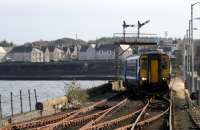
Stranraer - RAILSCOT
RailScot, a history of Railways with an emphasis on Scottish Railways. Photographs, maps, news, queries and more.
www.railscot.co.uk
Bletchleyite
Veteran Member
While reassuring that 0.5tph is still possible post-rationalisation, I would be quite surprised if it actually happens. Maybe if there's a surplus of trains in the 156 replacement order. Would make the railway an actually useful service, since it'd match Citylink in frequency and speed while offering a potentially* more comfortable ride (with a bit of a price markup).
Created a speculative thread: https://www.railforums.co.uk/thread...line-be-made-more-useful-less-useless.308146/

Source: https://www.railmagazine.com/news/r...ine-to-improve-resilience-argues-network-railPassing loops on the Stranraer line will be removed if a Network Rail (NR) proposal goes ahead.
Five services a day on a two-hourly timetable currently serve the line from Ayr, with journeys taking 80 minutes.
NR plans to remove loops at Barrhill station, Glenwhilly and Dunragit, resulting in a 38-mile stretch of plain single track between Girvan and Stranraer with a 60mph line speed. Semaphore signals and token machines would also be removed as part of the plans.
In a Network Change proposal, seen by RAIL, NR said: “We are identifying infrastructure that is no longer required, such as loops beyond Girvan, replacing much of the existing semaphore style signalling in this area replace with modern colour light LED signals, and exploring innovative technologies, such as train positioning systems, to improve safety and reliability.”
Signal boxes at Stranraer Harbour, Dunragit, Glenwhilly and Barrhill would also close.
NR has said the semaphores and token machines are “becoming increasingly difficult to maintain safely and reliably” with spare parts even sourced from museums.
It's not often that you see removal of passing loops being suggested in order to increase reliability and resilience.
When I mapped the route recently, I was surprised by how many completely unused loops it has. Was it still too busy for RETB when the other lines in Scotland got done?Source: https://www.railmagazine.com/news/r...ine-to-improve-resilience-argues-network-rail
It's not often that you see removal of passing loops being suggested in order to increase reliability and resilience.
It's got to be a challenge keeping that number of remote signal boxes staffed and working when the line has totally lost its main purpose.

Nym
Established Member
Might be a hot take, but is perhaps the only reason that spares are coming from museums because they can't be bothered making them?
Network Rail have rights to all the drawings for semaphore signals so surely, with all of the manufacturing capability we have today, it's not beyond the whit of man to make something we made 100 years ago without all this equipment?
Network Rail have rights to all the drawings for semaphore signals so surely, with all of the manufacturing capability we have today, it's not beyond the whit of man to make something we made 100 years ago without all this equipment?
Bletchleyite
Veteran Member
Might be a hot take, but is perhaps the only reason that spares are coming from museums because they can't be bothered making them?
Network Rail have rights to all the drawings for semaphore signals so surely, with all of the manufacturing capability we have today, it's not beyond the whit of man to make something we made 100 years ago without all this equipment?
I'm sure they could, but if trains never pass on this line what is the point? Single line, one engine in steam is simple and fine for this purpose, and will save a fortune, hopefully allowing the line to be retained.
Still amazes me they haven't plainlined Rufford to be honest - trains haven't passed there for ages.
Nym
Established Member
Oh no disagreement with plain lining it, just the implication that sourcing parts difficulty being a contributing factor is complete nonsense.
Taking a peek at what’s involved in becoming a supplier to NR explains why its supply chain is so expensive. I can only guess at how many zeros it would add to manufacturing penny numbers of customised signalling components.Might be a hot take, but is perhaps the only reason that spares are coming from museums because they can't be bothered making them?
On a line that must already have a huge subsidy, I can understand the cost of those parts being an unwelcome contributory factor.
Nym
Established Member
Taking a peek at what’s involved in becoming a supplier to NR explains why its supply chain is so expensive. I can only guess at how many zeros it would add to manufacturing penny numbers of customised signalling components.
There are plenty of suppliers on the books capable of making 1 off small components to drawing.
Bletchleyite
Veteran Member
On a line that must already have a huge subsidy, I can understand the cost of those parts being an unwelcome contributory factor.
If trains never pass on the line, even if they cost 50p they're a waste of money. Does anything ever pass at these loops e.g. in disruption? If not they bring nothing but maintenance cost.

Class15
Established Member
A track recording train is actually using Glenwhilly to pass the passenger service today!
Discussion in this thread should be confined to what is actually happening.
There is a parallel speculation thread which can be found here.
 www.railforums.co.uk
There is a parallel speculation thread which can be found here.
How can the Stranraer line be made more useful/less useless?
While reassuring that 0.5tph is still possible post-rationalisation, I would be quite surprised if it actually happens. Maybe if there's a surplus of trains in the 156 replacement order. Would make the railway an actually useful service, since it'd match Citylink in frequency and speed while...
www.railforums.co.uk

50010 Monarch
Member
- Joined
- 30 May 2010
- Messages
- 91
Probably not, but if the plan to remove all loops from Girvan onwards goes ahead you have got a 75 mile single line siding (there and back). A loop at Stranraer at least provides some degree of flexibility.

Not so self-contained operationally as the more northerly rural lines at the time, I think. Segregated from the nearest RETB instance on the wrong side of Glasgow. RETB can cater for as many loops as you desire. Each is still a maintenance and failure liability with turnouts, point indicators, TPWS etc.When I mapped the route recently, I was surprised by how many completely unused loops it has. Was it still too busy for RETB when the other lines in Scotland got done?
Agreed. And likely a long time to get a relief out to a site in the event of an unexpected absence. A long single line will be more reliable with less equipment to fail and it will cut the running time by avoiding token exchanges. If growth is required in the future, a Newquay-style remotely controlled passing loop might be inserted, likely around Glenwhilly, which could be longer and a bit more dynamic, with faster turnouts.It's got to be a challenge keeping that number of remote signal boxes staffed and working when the line has totally lost its main purpose.
Is there any confirmation in the Rail article of what the block method will be. I note colour light signals and that Stranraer SB will be closed along with the others from the summary above. This suggests TCB with axle counters. If so, one or more intermediate signals might be incorporated on the single line to allow a train to follow another more closely in the same direction, perhaps allowing a little peak strengthening.
The train positioning mentioned might be a system being trialled on the Central Wales Line. I understand this can update position via cheap track beacons and radio. Not securely enough for block occupancy, but good for crossing safety, particularly for footpaths and occupation crossings with telephones, as the signaller has more finely grained positioning data at hand. Very useful in a long block.
A means to handle a second train would be useful. This could be catered for by sidings beyond the new platform, with a trap point to prevent anything running out onto the single line. The sidings could have an internal run-round on handpoints if desired that could handle an excursion or engineering train. If the new working method is TCB, a starting signal will be required for reversing in the new platform. This could allow trains to split there, with one leaving first then the other once the first has arrived at Girvan. That could allow some peak strengthening. An incoming signal could provide a matching permissive joining facility.Probably not, but if the plan to remove all loops from Girvan onwards goes ahead you have got a 75 mile single line siding (there and back). A loop at Stranraer at least provides some degree of flexibility.
Last edited:
Might be a hot take, but is perhaps the only reason that spares are coming from museums because they can't be bothered making them?
The issue isn't necessarily being able to make spares as NR have suppliers that can make custom parts.
The issue when it comes to block/token instruments is more knowledge based, there are only so many staff that know how the internals of various block/token instruments work and how to fix them.
Quite exciting to see that system actually making it to a fuller rollout on the Central Wales line. It seems so hard to get a nice cheap system in place to make incremental improvements generall. If it gives you some flexibility to make lines like Stranraer affordable without disrupting the areas they are running through then it could be a real win.The train positioning mentioned might be a system being trialled on the Central Wales Line. I understand this can update position via cheap track beacons and radio. Not securely enough for block occupancy, but good for crossing safety, particularly for footpaths and occupation crossings with telephones, as the signaller has more finely grained positioning data at hand. Very useful in a long block.
MadMac
Established Member
From what I understand, it’ll be Key Token. New small “box” at Stranraer with, presumably, a “workstation” which could have a reinstated loop somewhere added relatively easily.Not so self-contained operationally as the more northerly rural lines at the time, I think. Segregated from the nearest RETB instance on the wrong side of Glasgow. RETB can cater for as many loops as you desire. Each is still a maintenance and failure liability with turnouts, point indicators, TPWS etc.
Agreed. And likely a long time to get a relief out to a site in the event of an unexpected absence. A long single line will be more reliable with less equipment to fail and it will cut the running time by avoiding token exchanges. If growth is required in the future, a Newquay-style remotely controlled passing loop might be inserted, likely around Glenwhilly, which could be longer and a bit more dynamic, with faster turnouts.
Is there any confirmation in the Rail article of what the block method will be. I note colour light signals and that Stranraer SB will be closed along with the others from the summary above. This suggests TCB with axle counters. If so, one or more intermediate signals might be incorporated on the single line to allow a train to follow another more closely in the same direction, perhaps allowing a little peak strengthening.
The train positioning mentioned might be a system being trialled on the Central Wales Line. I understand this can update position via cheap track beacons and radio. Not securely enough for block occupancy, but good for crossing safety, particularly for footpaths and occupation crossings with telephones, as the signaller has more finely grained positioning data at hand. Very useful in a long block.
A means to handle a second train would be useful. This could be catered for by sidings beyond the new platform, with a trap point to prevent anything running out onto the single line. The sidings could have an internal run-round on handpoints if desired that could handle an excursion or engineering train. If the new working method is TCB, a starting signal will be required for reversing in the new platform. This could allow trains to split there, with one leaving first then the other once the first has arrived at Girvan. That could allow some peak strengthening. An incoming signal could provide a matching permissive joining facility.
Falcon1200
Established Member
A loop at Stranraer at least provides some degree of flexibility.
Although, with no loops or signals between Girvan and Stranraer, Train 2 could not depart Girvan until Train 1 was clear at Stranraer, and Train 1 could not return north until Train 2 had arrived at Stranraer from Girvan. So still rather limiting!
If so, one or more intermediate signals might be incorporated on the single line to allow a train to follow another more closely in the same direction, perhaps allowing a little peak strengthening.
This could be catered for by sidings beyond the new platform, with a trap point to prevent anything running out onto the single line.
All that signalling would cost money! Presumably the method of working will be as simple (and cheap) as possible, eg OTW (One Train Working) with axle counters at Girvan to confirm that the train which entered the single line has returned complete and the line is clear.
The Pelican
Member
I wonder if a single loop half way could be retained? That seems the most useful for any future line growth. It would be more use than a loop at Stranraer as it could either be used for a regular service or used to store an excursion train while the regular train was using the end part of the line.