• Our new ticketing site is now live! Using either this or the original site (both powered by TrainSplit) helps support the running of the forum with every ticket purchase! Find out more and ask any questions/give us feedback in this thread!

SR mixed traction trains

Status
Not open for further replies.

Minerva05

Member
Joined
2 Sep 2022
Messages
9
Location
Bognor Regis
I have read on several occasions of a regular SR service made up of a class 33/1 leading followed by 1 or more TC units with a 4VEP at the rear. This was so that the train could divide en route and serve electrified/ un electrified destinations. Was it possible for the driver of a SR class 33/1 to control the equipment of S R EMUs in the same consist or was the EMU dragged unpowered?
I am curious as to how the driver in the ‘Crompton’ as able to control the VEP unit, as the diesel would have a notchless power controller whereas the EMU would have 4 step control.
Were the controls in the diesel modified in some way to achieve the 4 different power settings needed? Many thanks for any info…I’m just technically curious as to how it was done…
 
Sponsor Post - registered members do not see these adverts; click here to register, or click here to log in
R

RailUK Forums

hexagon789

Veteran Member
Joined
2 Sep 2016
Messages
18,324
Location
Glasgow
I have read on several occasions of a regular SR service made up of a class 33/1 leading followed by 1 or more TC units with a 4VEP at the rear. This was so that the train could divide en route and serve electrified/ un electrified destinations. Was it possible for the driver of a SR class 33/1 to control the equipment of S R EMUs in the same consist or was the EMU dragged unpowered?
I am curious as to how the driver in the ‘Crompton’ as able to control the VEP unit, as the diesel would have a notchless power controller whereas the EMU would have 4 step control.
Were the controls in the diesel modified in some way to achieve the 4 different power settings needed? Many thanks for any info…I’m just technically curious as to how it was done…
Push-pull fitted 33s had modified power controllers with fixed notches; it's detailed in a book I have how they corresponded with the controllers on the 3/4TCs, but I'll need to look it up.

The 33s so modified had FIVE power settings you see, not four, so I need to verify how it worked because I can't remember why there were five and what they each equated to.
 

Minerva05

Member
Joined
2 Sep 2022
Messages
9
Location
Bognor Regis
Push-pull fitted 33s had modified power controllers with fixed notches; it's detailed in a book I have how they corresponded with the controllers on the 3/4TCs, but I'll need to look it up.

The 33s so modified had FIVE power settings you see, not four, so I need to verify how it worked because I can't remember why there were five and what they each equated to.
Many thanks! That certainly clarifies things…It makes me wonder whether the modified locos then worked with fixed notches all the time, or just when in multiple with MUs. I have noticed on cab photos that the 33/1s seemed to have a row of extra switches where the engine start/stop buttons used to be. Any further info that comes to light would be greatly appreciated…thanks again…
 

norbitonflyer

Established Member
Joined
24 Mar 2020
Messages
5,796
Location
SW London
As i understand it a TC unit had exactly the same controls as any other EP unit, and the 33/1s (and 73s) were equipped to look like another EP unit when connected to one.

Although I often saw them, I only used one of the mixed traction trains once. What I noticed when I left the train at Woking was that, as the driver applied power to restart, the CEP coupled behind the TC unit started to move first, giving the TC a shove. This is presumably because a diesel electric takes time for the electric motors to get power as the revs increase when the driver opens the throttle, whereas the electric units behind take power from the rail immediately.

So yes, the electric units behind the TC were definitely under power. A 33 with twelve on and no assistance would have been very sluggish!
 

Western 52

Established Member
Joined
19 Jun 2020
Messages
1,672
Location
Burry Port
When the REP/TC stock on the Bournemouth line was being replaced by class 442 I remember seeing formations with two class 73s working with what appeared to be part of a REP set plus some TC sets. Were these trains using motors in the REPs as well as the locos?
 

hexagon789

Veteran Member
Joined
2 Sep 2016
Messages
18,324
Location
Glasgow
When the REP/TC stock on the Bournemouth line was being replaced by class 442 I remember seeing formations with two class 73s working with what appeared to be part of a REP set plus some TC sets. Were these trains using motors in the REPs as well as the locos?
Yes, usually the 73 replaced one motor coach in the REP which had two motor cars.

The motors were nominally the same on 73s and REPs, but the latter were rated at 320bhp continuous at 385A/675V.
 

Deepgreen

Established Member
Joined
12 Jun 2013
Messages
7,484
Location
Gomshall, Surrey
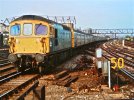
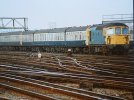
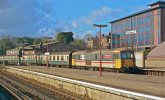
A few shots to illustrate. The 33+4TC+8VEP was the most powerful scheduled passenger working on SR metals at the time, at 3550hp, comfortably beating the REP+8TC rating.

== Doublepost prevention - post automatically merged: ==

Yes, usually the 73 replaced one motor coach in the REP which had two motor cars.

The motors were nominally the same on 73s and REPs, but the latter were rated at 320bhp continuous at 385A/675V.
I sometimes wondered if the formations ever had cause to use their built-in 'get me home' diesel engines in the event of a power failure. With 600hp it would have been a crawl, and I never heard of it happening.
 

Attachments

  • 6467954343_3fbd220586_o.jpg
    6467954343_3fbd220586_o.jpg
    3.4 MB · Views: 79
  • 6478372401_218f2e904a_o.jpg
    6478372401_218f2e904a_o.jpg
    5.5 MB · Views: 79
  • 7393538576_d45fa02aab_k.jpg
    7393538576_d45fa02aab_k.jpg
    835.6 KB · Views: 78

Minerva05

Member
Joined
2 Sep 2022
Messages
9
Location
Bognor Regis
As i understand it a TC unit had exactly the same controls as any other EP unit, and the 33/1s (and 73s) were equipped to look like another EP unit when connected to one.

Although I often saw them, I only used one of the mixed traction trains once. What I noticed when I left the train at Woking was that, as the driver applied power to restart, the CEP coupled behind the TC unit started to move first, giving the TC a shove. This is presumably because a diesel electric takes time for the electric motors to get power as the revs increase when the driver opens the throttle, whereas the electric units behind take power from the rail immediately.

So yes, the electric units behind the TC were definitely under power. A 33 with twelve on and no assistance would have been very sluggish!
Many thanks, it is interesting to hear about the experience of travelling on one of these..that would certainly clarify that it was a true mixed traction consist. The SR 27 way multiple working system certainly was remarkable in its versatility!
 

hexagon789

Veteran Member
Joined
2 Sep 2016
Messages
18,324
Location
Glasgow
Many thanks! That certainly clarifies things…It makes me wonder whether the modified locos then worked with fixed notches all the time, or just when in multiple with MUs. I have noticed on cab photos that the 33/1s seemed to have a row of extra switches where the engine start/stop buttons used to be. Any further info that comes to light would be greatly appreciated…thanks again…
I've found the control set-up information. There were actually 7 positions on the modified 33/1s:

OFF, RUN BACK, 1, 2, 3, 4 and FULL

When running solo or if the Diesel Control jumper was in use, "FULL" had to be used to obtain full power.

If running with the EMU Control jumper in use, then maximum power was obtained in Notch 4.
 

Taunton

Veteran Member
Joined
1 Aug 2013
Messages
12,313
The way in which it all worked together the same way was very clever, developed in 1951 for EPB suburban units and with further developments later. It would have done well for a BR standard control system, but being a Southern Region initiative didn't appeal to the BR board, same as when the Southern developed and trialled their Signal Repeating AWS 30 years (and various accidents) before TPWS. I believe the Class 33 could even have a VEP (air braked of course) controlling it in front, and vacuum braked stock behind it, and it all worked together.
 

Big Jumby 74

Established Member
Joined
12 Feb 2022
Messages
2,244
Location
UK
Presuming the 33/1 set up once converted for PP operation as above differed them from 33/0 (& /2?). Never had any dealings with 33/1's and my vague memories of 33/0's was that in starting a loco hauled train, the handle could simply be thrown in to full open position and the engine would gradually build up speed behind one's head/bulkhead, without any undue consequences (wheel slip etc, unless it was adverse weather of course). In complete contrast to say a Brush 4 or 50, when a notched approach had to be taken to avoid square wheel syndrome! I may be wrong, time elapsed and grey cell deterioration!
 

Taunton

Veteran Member
Joined
1 Aug 2013
Messages
12,313
I think Birmingham RCW were prepared to put in whatever proprietary equipment might be specified, and as the Class 33 was a Southern initiative they got what was asked for. Builders like Brush or English Electric were part of a larger manufacturing group, and had their own components to push. One of the upsides of this approach was when Birmingham went out of business shortly after the locos were built it didn't cause such problems with spare parts as the independent makers were still around - North British doing the same thing at the same time, who had made many of the components themselves, caused no end of such problems.
 

43096

On Moderation
Joined
23 Nov 2015
Messages
18,862
I think Birmingham RCW were prepared to put in whatever proprietary equipment might be specified, and as the Class 33 was a Southern initiative they got what was asked for. Builders like Brush or English Electric were part of a larger manufacturing group, and had their own components to push. One of the upsides of this approach was when Birmingham went out of business shortly after the locos were built it didn't cause such problems with spare parts as the independent makers were still around - North British doing the same thing at the same time, who had made many of the components themselves, caused no end of such problems.
Although English Electric had a virtual monopoly on SR traction equipment for many, many years - including the DEMUs. So if compatibility between locos and EMUs was the goal, then EE would have been a much better choice.
 

ac6000cw

Established Member
Joined
10 May 2014
Messages
3,914
Location
Cambridge, UK
I've found the control set-up information. There were actually 7 positions on the modified 33/1s:

OFF, RUN BACK, 1, 2, 3, 4 and FULL

When running solo or if the Diesel Control jumper was in use, "FULL" had to be used to obtain full power.

If running with the EMU Control jumper in use, then maximum power was obtained in Notch 4.
Out of interest, what did the 'RUN BACK' controller position do?
 

hexagon789

Veteran Member
Joined
2 Sep 2016
Messages
18,324
Location
Glasgow
Out of interest, what did the 'RUN BACK' controller position do?
RUN BACK presumably would relate to working in multiple with something like a 73 - RUN BACK on those would run the power settings back down from whatever state it was in, gradually reintroducing resistors back in circuit and so on and eventually cutting power off completely. (Equivalent to RUN DOWN on a tap changer loco.)

Presumably it did nothing when running with an EMU as with their camshaft control set up you couldn't reduce the power setting, only increase it sequentially or shut off.
 

ac6000cw

Established Member
Joined
10 May 2014
Messages
3,914
Location
Cambridge, UK
RUN BACK presumably would relate to working in multiple with something like a 73 - RUN BACK on those would run the power settings back down from whatever state it was in, gradually reintroducing resistors back in circuit and so on and eventually cutting power off completely. (Equivalent to RUN DOWN on a tap changer loco.)
Thanks - I suspected that was what it might do.
 

norbitonflyer

Established Member
Joined
24 Mar 2020
Messages
5,796
Location
SW London
Although English Electric had a virtual monopoly on SR traction equipment for many, many years - including the DEMUs. So if compatibility between locos and EMUs was the goal, then EE would have been a much better choice.
Indeed, but ETH was an SR requirement and there were no ETH fitted class 31s or 37s (the nearest EE-engined equivalents). (The 33s were basically class 27s with the boiler replaced by an extra 2 cylinders)
 

Taunton

Veteran Member
Joined
1 Aug 2013
Messages
12,313
The ETH-only approach of the Class 33, modern as it appears, was built well before steam locos, and thus steam heat, disappeared from the Southern Region. When they were first introduced on the Eastern section there were not enough ETH coaches, so early Class 24s were borrowed from the LMR to run double headed inside the 33 to provide steam heat. I don't know if the Southern ever did steam heat vans, like the LMR in early AC electrification days did.

It's a shame the Scottish Region didn't do the same, buying 33s instead of 26/27s.
 

Gloster

Veteran Member
Joined
4 Sep 2020
Messages
13,036
Location
Up the creek
The SR had seven steam heating vans. Two converted from former Special Cattle Vans in 1962 were intended to operate between Bournemouth and Weymouth, but they didn’t normally leave Weymouth. Five were built on the chassis of four-wheel mineral wagons at the same time and were intended for use with boat trains in Southampton Docks once diesels took over shunting. They had to be very short because otherwise they wouldn’t fit on the lines occupied by a full-length boat train.

Annoyingly, I can’t find my notes on the subject, so the above is from memory.
 

43096

On Moderation
Joined
23 Nov 2015
Messages
18,862
Indeed, but ETH was an SR requirement and there were no ETH fitted class 31s or 37s (the nearest EE-engined equivalents). (The 33s were basically class 27s with the boiler replaced by an extra 2 cylinders)
I was more commenting on the Class 33 being something of an outlier for the Southern. With EE equipment almost universal on the EMU and DEMU fleets it does seem strange they went for a Crompton Parkinson/Sulzer loco, rather than an ETH fitted EE loco.
 

Magdalia

Established Member
Joined
1 Jan 2022
Messages
7,409
Location
The Fens
The ETH-only approach of the Class 33, modern as it appears, was built well before steam locos, and thus steam heat, disappeared from the Southern Region.
Steam heat lasted on the Bournemouth/Weymouth line until electrification in 1967.

The SR had seven steam heating vans. Two converted from former Special Cattle Vans in 1962 were intended to operate between Bournemouth and Weymouth, but they didn’t normally leave Weymouth. Five were built on the chassis of four-wheel mineral wagons at the same time and were intended for use with boat trains in Southampton Docks once diesels took over shunting. They had to be very short because otherwise they wouldn’t fit on the lines occupied by a full-length boat train.

Annoyingly, I can’t find my notes on the subject, so the above is from memory.
Your memory is good!

I don't know if the Southern ever did steam heat vans, like the LMR in early AC electrification days did.
In the mid 1960s the Southern briefly used LMR steam heat vans on the East Grinstead commuters.
 

Harpo

Established Member
Joined
21 Aug 2024
Messages
3,908
Location
Newport
RUN BACK presumably would relate to working in multiple with something like a 73 - RUN BACK on those would run the power settings back down from whatever state it was in, gradually reintroducing resistors back in circuit and so on and eventually cutting power off completely. (Equivalent to RUN DOWN on a tap changer loco.)
Interesting to have run back on it’s own as tap changer locos also had run up, plus tap up/down and hold. A way of driving that I assume no longer exists outside of ‘preserved’ locos?
 

norbitonflyer

Established Member
Joined
24 Mar 2020
Messages
5,796
Location
SW London
I was more commenting on the Class 33 being something of an outlier for the Southern. With EE equipment almost universal on the EMU and DEMU fleets it does seem strange they went for a Crompton Parkinson/Sulzer loco, rather than an ETH fitted EE loco.
I think that was my point. At the time there were no ETH-fitted EE locos, and maybe no way of creating one easily. (It would be a long time before the 37/4s were created)
 

Minerva05

Member
Joined
2 Sep 2022
Messages
9
Location
Bognor Regis
I've found the control set-up information. There were actually 7 positions on the modified 33/1s:

OFF, RUN BACK, 1, 2, 3, 4 and FULL

When running solo or if the Diesel Control jumper was in use, "FULL" had to be used to obtain full power.

If running with the EMU Control jumper in use, then maximum power was obtained in Notch 4.
That exactly answers my original query, thanks again for looking into this. I don’t believe it has been detailed in any books covering the 33/1 conversions, even the more technical ones. It also answers my other query in that they controlled the engine speed using EP control when working in multi with emus but used the traditional notchless power control otherwise…it makes sense now!
 
Last edited:

Taunton

Veteran Member
Joined
1 Aug 2013
Messages
12,313
As I understand it, the Class 33 have a generator on the end of the engine crankshaft with one "box" but three separate windings inside it, for traction, ETH, and auxiliaries. It's quite capable of putting full power into traction if there's no ETH demand, and the way they were driven in winter on Salisbury to Exeter when they handled the service there was to turn the ETH off on the uphills, to get maximum traction, then heat back on once over the top.
 

43096

On Moderation
Joined
23 Nov 2015
Messages
18,862
I think that was my point. At the time there were no ETH-fitted EE locos, and maybe no way of creating one easily. (It would be a long time before the 37/4s were created)
Presumably because that was the specification BR wanted for those locos. Had EE been successful with the bid for what became Class 33, no doubt EE would have delivered something ETH fitted. Given the amount of electrical equipment EE supplied to BR, they must have been able to provide something with ETH had it been required.
 

Snow1964

Established Member
Joined
7 Oct 2019
Messages
11,205
Location
West Wiltshire
I was more commenting on the Class 33 being something of an outlier for the Southern. With EE equipment almost universal on the EMU and DEMU fleets it does seem strange they went for a Crompton Parkinson/Sulzer loco, rather than an ETH fitted EE loco.
From memory, were two factors, one was build slot availability, and the second was length.

I cannot remember any of the details regarding length, or where, but there was something about fitting into engine release roads designed for certain tank locos. 65 years ago there were still some loco hauled secondary services, and wanted a universal design for the type 2 and type 3 diesel workings.

Think I have read somewhere that the Boat trains and West of England Expresses weren't high priority for new locos at the time, as the Bulleid Pacific's were only just over decade old, so a type 4 or type 5 diesel was not urgent unlike replacing many medium size steam locos which on the Southern included many pre grouping ones.
 

norbitonflyer

Established Member
Joined
24 Mar 2020
Messages
5,796
Location
SW London
From memory, were two factors, one was build slot availability, and the second was length.

I cannot remember any of the details regarding length, or where, but there was something about fitting into engine release roads designed for certain tank locos. 65 years ago there were still some loco hauled secondary services, and wanted a universal design for the type 2 and type 3 diesel workings.
Were any Type 2scever allocated to, or used on, the Southern other than for a short period before steam heat was eliminated.
 
Status
Not open for further replies.

Top