Our new ticketing site is now live! Using either this or the original site (both powered by TrainSplit) helps support the running of the forum with every ticket purchase! Find out more and ask any questions/give us feedback in this thread!
Mind you the majority of these services were fast-line* for some/all of the way between Waterloo and Surbiton, at least in the 82/3 and 83/4 timetables: was there also a 60mph limit on the fast lines?
Definitely VEP/EPB was the norm in 82/3 and 83/4 for the peak. I would guess 81/2 as well, as that timetable was extremely similar to the two following it. The EPBs were found on services terminating at Guildford from around 1600 onwards. [...] it looks like in 82/83 there was an 8VEP + 4EPB combo on the 0852 Waterloo to Woking in 1982/3. This would probably have gone fast-line to Surbiton. I do remember there being some slightly 'funky' combinations at Guildford around the 0900-1000 period at this time.
Presumably there would have been an inward peak working too , which formed this train out. I'm likely to find this out in due course.
Subtle but The angling on the cab ends are closer in to the route code boxes on SR units whereas on BR units the angling is much further out towards the cab windows.
Weren't BR EPBs built to MK1 coach standards? After all, CEPs were essentially CORs but with MK1 bodies and 507 motors
I beleive it was something to do with chassis length. I will use the 2EPB as an example
Ex Tyneside units. Built on BR underframes (63' 11½ New). BR Profile. Main differences from a standard EPB where the bigger guards compt (for tyneside), and a dedicated 1st class (later declassified) and merged in 416/2 classification
416/2 BR Units. Built on BR Underframes (63' 11½ New). BR Profile.
416/1 Built by BR but to southern profile. Used recycled 2NOL underframes (62ft)
My 1960 Ian Allan combined volume shows that the SR type 2EPB units were originally classified as 2NOP (i.e. 2NOL with electro-pneumatic brakes). They must have been redesignated as 2EPB at a later date.
My 1960 Ian Allan combined volume shows that the SR type 2EPB units were originally classified as 2NOP (i.e 2NOL with electro-pneumatic brakes). They must have been redesignated as 2EPB at a later date.
Yes that is what i understand on that. There was also
416/3 - southern profile facelift unit
416/4 - BR profile facelift unit as well.
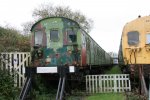
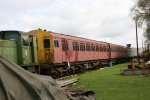
Here is pics of the SERA's two units. They have ex tyneside variant and ex southern profile facelift. Tyneside is at the Battlefield, Southern profile is at a private site.
While we're on the topic of the Cobham services, a cursorily-related thing is the headways on the fast out of Waterloo in the 80s, which has come up before in a different thread. There were several instances in the peak in which a fast (straight through Surbiton) train left Waterloo just two minutes after a Surbiton stopper (fast Waterloo-Surbiton). I presume the Surbiton-stopper switched to the slows somewhere like New Malden, which would have been easy to accommodate as only the half hourly Hampton Court services otherwise used the slows?
When you reminisce about the Waterloo peak in the 80s, the variety of stock seen, and the impressive pathing such as that above, it seems very sad that the prevailing trend is to make the peak - arguably the most interesting time of day on the ex-Southern Region or NSE area - a thing of the past.
While we're on the topic of the Cobham services, a cursorily-related thing is the headways on the fast out of Waterloo in the 80s, which has come up before in a different thread. There were several instances in the peak in which a fast (straight through Surbiton) train left Waterloo just two minutes after a Surbiton stopper (fast Waterloo-Surbiton). I presume the Surbiton-stopper switched to the slows somewhere like New Malden, which would have been easy to accommodate as only the half hourly Hampton Court services otherwise used the slows?
I remember in the early 1990s there was a 1740 MF Waterloo to Reading formed of 4CIG+2HAP+2HAP calling at CJ, Hounslow, Virginia Water, Sunningdale and all stations.
I remember in the early 1990s there was a 1740 MF Waterloo to Reading formed of 4CIG+2HAP+2HAP calling at CJ, Hounslow, Virginia Water, Sunningdale and all stations.
I remember the existence of that service, it was the only Reading train to go via Hounslow, presumably due to congestion on the main Richmond line. I remember noting it as 8CIG on a 1985 Reading CWN I once had, but stock allocations for this kind of service (which could get CIGs, VEPs, HAPs or any combination of such) typically changed every three years or so.
== Doublepost prevention - post automatically merged: ==
Mind you, you'd presumably want the Surbiton stopper switching lines while still at full speed, as if it switched while slowing it would likely delay the non-stop train just 2 mins behind it leaving Waterloo. (Examples from the May 1981 to May 1984 period included 1702 Guildford via Cobham/1704 Eastleigh [to May 1983], 1722 Guildford via Cobham/1724 Eastleigh, 1736 Farnham slow/1738 Alton [to May 1983] or Exeter [from May 1983], 1742 Guildford via Cobham/1744 Bournemouth semi-fast [REP+TC, though presumably subject to speed limit], 1752 Guildford via Cobham/1754 Eastleigh, and 1756 Farnham slow/1758 Alton).
Can't remember when the Cobhams switched to the slow lines. I know 455s were introduced on most services (with some exceptions in the peak) in May 1984, but I think the timetable remained the same so presumably they'd still be running on the fast lines.
I remember the existence of that service, it was the only Reading train to go via Hounslow, presumably due to congestion on the main Richmond line. I remember noting it as 8CIG on a 1985 Reading CWN I once had, but stock allocations for this kind of service (which could get CIGs, VEPs, HAPs or any combination of such) typically changed every three years or so.
== Doublepost prevention - post automatically merged: ==
Ah right, yes I was assuming only Hounslow stoppers would run that way. Bit like the Catford diversion on the Chatham line I guess, which typically saw no stops by the main-line trains sent that way.
Ah right, yes I was assuming only Hounslow stoppers would run that way. Bit like the Catford diversion on the Chatham line I guess, which typically saw no stops by the main-line trains sent that way.
Indeed, and the stock allocations were - to put it mildly - interesting in 1982/83, to take one example year (see the other thread) with the Riverside branch seeing mostly CIGs and VEPs off peak (something I had been in blissful ignorance of until now) and EPBs in the peak.
The above 1740 service was there in 82/83 too, as the 1734, and as in 1985 was operated with 8CIG.
Mind you there still is quite a variety of stock (though sadly you don't get 444s up the Windsor lines in the way you got CIGs in the 80s). The main problem from an enthusiast POV these days is the lack of a peak, though (up to 2019 at least) there was still some interesting diagramming going on at Waterloo. For me, the main interest of a commuter railway has always been the interesting diagramming and stock variety necessary to provide peak services with the optimal capacity, and it's sad that this could become a thing of the past.
Trains normally took the local line immediately approaching Surbiton. In the 1970s and early 1980s there were 2 minute headways on the main lines, with the peak service pattern including trains (mostly at xxx2) to the Guildford new line and xxx6 for local stations to Woking (all fast to Surbiton via main line) and beyond. Trains continuing down the main were generally xxx0 for Portsmouth line, xxx4 to Basingstoke route and three xxx8 to Alton (leaving a few spare pathways)
== Doublepost prevention - post automatically merged: ==
Almost to this day (but not in the Covid timetables) some Reading up trains ran via Hounslow. Down services are rarely timetabled to do this because of the junction conflicts.
Indeed, and the stock allocations were - to put it mildly - interesting in 1982/83, to take one example year (see the other thread) with the Riverside branch seeing mostly CIGs and VEPs off peak (something I had been in blissful ignorance of until now) and EPBs in the peak.
The above 1740 service was there in 82/83 too, as the 1734, and as in 1985 was operated with 8CIG.
Mind you there still is quite a variety of stock (though sadly you don't get 444s up the Windsor lines in the way you got CIGs in the 80s). The main problem from an enthusiast POV these days is the lack of a peak, though (up to 2019 at least) there was still some interesting diagramming going on at Waterloo. For me, the main interest of a commuter railway has always been the interesting diagramming and stock variety necessary to provide peak services with the optimal capacity, and it's sad that this could become a thing of the past.
As you say much of the oddball stuff ahs gone, even more so now the peak additionals have been abolished. Two odd stopping pattern changes that remain on weekdays are the first two up from Reading calling at Putney (nothing else to/from Reading does) and the 1750 Waterloo-Reading calling at Whitton; again nothing else up or down on the Reading service calls.
An interesting formation towards the end of 1991 was a "unique" 4 CAP unit numbered 3333 formed of 1951 type 2 HAP 4201 and 1957 type 2 HAP 4322 in mixed livery. 4201 was originally 6013 in blue/grey livery whilst 4322, originally 6141 was in Network SouthEast livery. By my understanding, this unit didn't last very long - about 2 months?
Mind you, you'd presumably want the Surbiton stopper switching lines while still at full speed, as if it switched while slowing it would likely delay the non-stop train just 2 mins behind it leaving Waterloo.
That wasn't an option - I don't have an old Sectional Appendix to hand, but Fast to Slow at New Malden wasn't/isn't 60mph. The following non-stopping trains must simply have had a bit of slack in the timings
(Examples from the May 1981 to May 1984 period included 1702 Guildford via Cobham/1704 Eastleigh [to May 1983], 1722 Guildford via Cobham/1724 Eastleigh, 1736 Farnham slow/1738 Alton [to May 1983] or Exeter [from May 1983], 1742 Guildford via Cobham/1744 Bournemouth semi-fast [REP+TC, though presumably subject to speed limit], 1752 Guildford via Cobham/1754 Eastleigh, and 1756 Farnham slow/1758 Alton).
I've just glanced at 78-79 which is essentially the same - and you commonly had 2 fasts behind a stopper.
Everything ran to the same timings as far as Hampton Court Jn, the line speed limit to New Malden was the decisive factor!
I remember in the early 1990s there was a 1740 MF Waterloo to Reading formed of 4CIG+2HAP+2HAP calling at CJ, Hounslow, Virginia Water, Sunningdale and all stations.
Between 1980 and 1983 I was a student at the old Borough Road College in Isleworth and I commuted from Earley. In the evenings I would get a Loop stopper from Isleworth and go one station to Hounslow where I could change onto the Reading service just behind it which stopped there. In 3 years that connection never failed! It was the only Reading train in either direction which called at Hounslow although some others were indeed routed that way without stopping. (In the morning there was one train from Windsor which called at Hounslow with an easy connection from Reading at Staines.)
Almost to this day (but not in the Covid timetables) some Reading up trains ran via Hounslow. Down services are rarely timetabled to do this because of the junction conflicts.
Running up peak Reading services via Hounslow ended for morning peak services in the December 2004 timetable (although there were some up counter-flow trains that went that way in the evening peak when some empty stock workings were more recently 'warmed up').
An interesting formation towards the end of 1991 was a "unique" 4 CAP unit numbered 3333 formed of 1951 type 2 HAP 4201 and 1957 type 2 HAP 4322 in mixed livery. 4201 was originally 6013 in blue/grey livery whilst 4322, originally 6141 was in Network SouthEast livery. By my understanding, this unit didn't last very long - about 2 months?
Trains normally took the local line immediately approaching Surbiton. In the 1970s and early 1980s there were 2 minute headways on the main lines, with the peak service pattern including trains (mostly at xxx2) to the Guildford new line and xxx6 for local stations to Woking (all fast to Surbiton via main line) and beyond. Trains continuing down the main were generally xxx0 for Portsmouth line, xxx4 to Basingstoke route and three xxx8 to Alton (leaving a few spare pathways)
Interesting that was a long-lasting pattern. I remember it first-hand from 1982/3 to 1984/5 and noted the same pattern in the 1981/2 timetable from timetableworld.com, so interesting it appeared to have been in place many years before then. I did once have an old 1972 timetable and the pattern was different (more irregular) then, and in 1985 there were cuts on the Alton route leaving it with just a half-hourly frequency in the peak, a cut which have been in place ever since (though the xxx8 paths were retained as 1718, 1748 but then - somewhat randomly - 1813). In fact I think 1985 was something of a 'cuts' timetable all around IIRC, but the Altons were the only SWML services affected.
(1991 was the other 'cuts' timetable of the late-BR era, when the Portsmouth Direct lost its long-standing peak 6tph, reduced to just 4 - two fast, two stopping - again the 6tph is something which has never been restored since, although the original SWR proposals for Dec 2018 did see it back again).
We are aware of an issue with emails from the Forum to Microsoft-based email accounts (hotmail/outlook/live.com email addresses). This is being looked into currently, thanks for your patience meanwhile.