
• Our new ticketing site is now live! Using either this or the original site (both powered by TrainSplit) helps support the running of the forum with every ticket purchase! Find out more and ask any questions/give us feedback in this thread!

South Yorkshire bus franchising gets go ahead

mattb7tl

Member
Joined
1 Jan 2022
Messages
267
Location
Huddersfield
In Brighton, the partnership certainly helped in having a progressive bus company...and a progressive local authority who were prepared to make some decisions. It helped that the local authority (and the local politics generally) are more progressive, greener and left leaning. That's what makes a good partnership.

As for Leicester.... sub-par? On who's measure? And of course, there is a lot of "stuff" at the start... You're criticising rapid improvements and initiatives - that is what is needed because investment in electrification and infrastructure has to come at the start. Yes, it gets rather boring as time goes on because you're embedding behavioural changes.

I have seen what they are actually delivering in Portsmouth. In fact, you might consider it amazing that despite the parlous level of frequencies that you seem to think exist, people have moved back on the bus faster than virtually anywhere in the country. Load factors are, of course, a key consideration. If there's a load factor of 65% and it increases to 70%, then why would the frequency increase. However, if it moves to 75%...then the commercial dynamics change and you might.

West Yorkshire - so the bus companies asked for everything, got everything they wanted from the local authorities, and you think that there were no issues on the LA side. I mean, if the operators request X and the authority acquiesces, and then the "results don't hold" (whatever that means) then you have to ask what assurances were in place from the authority to ensure that the results did hold? Or what would happen if they didn't hold? Is that not an indication that the partnership wasn't well constructed?

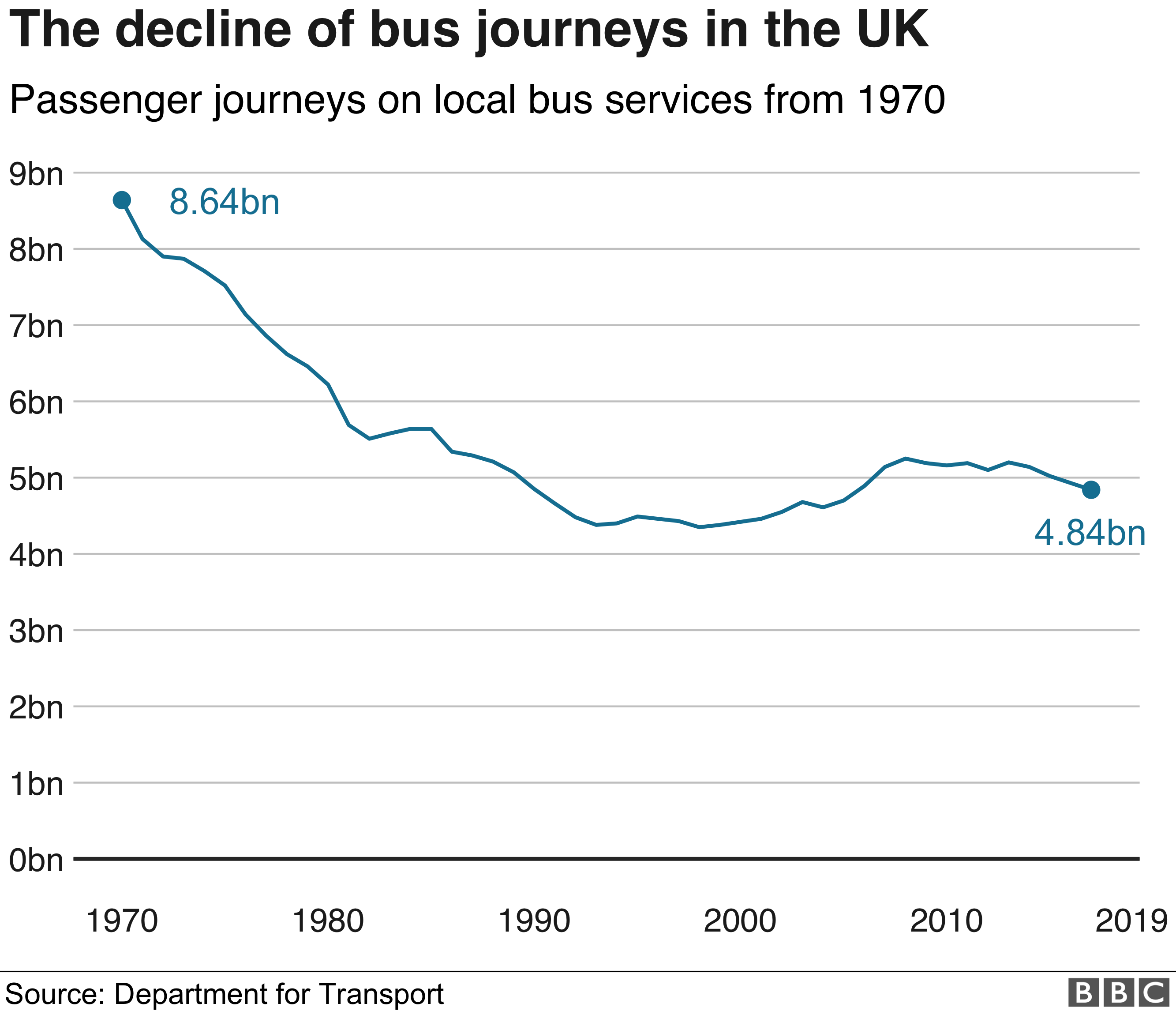
So did bus companies build our networks? Of course they bought them but networks and the design of them are only ever the product of demand. Bus services don't exist in a vacuum and nor should they be pickled in aspic. That was part of the issue in the 1950s and 1960s when they didn't react to societal changes. By the time we reached the 1970s and 1980s, bus patronage was collapsing - that is absolute historic fact. There was a total shock with deregulation but that stabilised and we saw a levelling out until 2010. You might argue that it was because we reached rock bottom but as we saw, austerity proved that wasn't the case. And, as I say, you can't look at bus patronage in isolation and just blame Arriva (tempting as that is). I was back in the North East late last year and in the flesh pot of Bishop Auckland - bus services are a shadow of what they were when OK and United (and others) operated depots there, and yes, there is culpability from Arriva. However, I looked at the Blade Runner-esque Newgate Street... the closed pubs, the closed shops, the desolation of a town whose heart has been ripped out from deindustrialisation and then the creation of a huge out of town development with plentiful shopping and perhaps it explains some of what has happened.

I actually think that Go Ahead and Stagecoach have broadly been reasonably good in developing their businesses (though it isn't uniform). Covid did turn some things on its head (and I have concerns about Stagecoach and it's path) but if you look at their provincial operations... some were basket cases when they bought them, and had been in freefall for years.


I am always keen to ensure that comparisons are accurate otherwise the high patronage growth was, I think, somewhere odd like Rutland.
However, even within an area, there are huge disparities. After all, Manchester (the city) is growing like topsy, and the financial health reflects that. Then you have Bolton, Bury and Rochdale - outwardly very similar and yet they are very different and nothing like Manchester. Manchester - happy, vibrant and affluent with busy nightlife and strong retail and employment (and with a strong western bias in terms of growth and affluence) compared with Rochdale - darkness, vape shops and nail bars.

I'm not certain anyone is comparing Manchester with Wiltshire so not sure where these inappropriate benchmarks are coming from.
Most urban authorities are progressive, but they are typically stuck with whatever bus company happens to operate in their area, and under deregulation there is no mechanism to remove an underperforming operator. It is a lottery, and most areas have lost it.

Leicester the pace of improvement is not as impressive as it appears, give it a decade and little of it will last. The deeper problem is where investment is directed. Partnerships consistently focus on strengthening already viable corridors, making a turn up and go service slightly more frequent, while evening frequencies and extended hours of operation remain an afterthought. Under deregulation this is structurally inevitable operators will not sacrifice margins to run a decent evening network, even where it might eventually become commercially sustainable.

This also produces artificial modal shift. Improving daytime frequencies between 6am and 6pm attracts occasional car users onto buses, which flatters the headline numbers, but it does not build the kind of network that either prevents people from acquiring cars in the first place, or gives existing car owners a genuine reason to get rid of them. That requires high frequencies across extended and off-peak hours, Reading and London being the obvious models. Once turn up and go is achieved on core routes, the focus must shift to the off peaks. Deregulation cannot deliver this because no commercial operator will cross-subsidise those margins without being compelled to through franchising.

On West Yorkshire: the local authority implemented bus priority measures and real-time information at the specific locations operators requested. That is precisely the problem, operators ask, the authority delivers, and yet outcomes still disappointed. Leicester is largely replicating improvements West Yorkshire made decades ago, not blazing a new trail, and it attracts a remarkable amount of attention for achieving the bare minimum. I suspect bus operators push this via articles to try and deter people from franchising.

On Manchester, my point was precisely that benchmarking against the national average is misleading given Manchester is a major metropolitan county. Your most accurate reference points as used by professionals is other metropolitan counties.
 
Sponsor Post - registered members do not see these adverts; click here to register, or click here to log in
R

RailUK Forums

AdamWW

Established Member
Joined
6 Nov 2012
Messages
6,022
I'd like to say that as someone with reasonably strong opinions on this topic and very little knowledge to back them up, I'm finding this discussion fascinating.
 

TheGrandWazoo

Veteran Member
Joined
18 Feb 2013
Messages
23,023
Location
Somerset with international travel (e.g. across th
Most urban authorities are progressive, but they are typically stuck with whatever bus company happens to operate in their area, and under deregulation there is no mechanism to remove an underperforming operator. It is a lottery, and most areas have lost it.
Not as progressive as you might think. After all, let's look at Sheffield as they are part of South Yorkshire. They introduced a Clean Air Zone that specifically excluded the private individual, choosing to target "the most polluting vehicles". We all know that's rubbish on a per capita basis, and we know why - it was politics. Pure and simple. And, of course, whilst there was help for operators to retrofit their fleets, it didn't cover all costs and nor the ongoing cost - that was passed onto the passenger. Of course, the same applies for Newcastle and Gateshead, and close to you, Bradford. We might also mention Manchester who decided against a clean air zone, and who could forget Liverpool and honest Joe Anderson who removed most of the bus lanes.

The truly progressive ones are Nottingham, West Midlands, Portsmouth, Leicester, Bristol and Brighton, not the ones in the north of England. They are taking a balanced view - improving the network, working with operators, improving bus priority and lightly penalising drivers through measures such as red routes.
Leicester the pace of improvement is not as impressive as it appears, give it a decade and little of it will last. The deeper problem is where investment is directed. Partnerships consistently focus on strengthening already viable corridors, making a turn up and go service slightly more frequent, while evening frequencies and extended hours of operation remain an afterthought. Under deregulation this is structurally inevitable operators will not sacrifice margins to run a decent evening network, even where it might eventually become commercially sustainable.

This also produces artificial modal shift. Improving daytime frequencies between 6am and 6pm attracts occasional car users onto buses, which flatters the headline numbers, but it does not build the kind of network that either prevents people from acquiring cars in the first place, or gives existing car owners a genuine reason to get rid of them. That requires high frequencies across extended and off-peak hours, Reading and London being the obvious models. Once turn up and go is achieved on core routes, the focus must shift to the off peaks. Deregulation cannot deliver this because no commercial operator will cross-subsidise those margins without being compelled to through franchising.
They strengthen already viable corridors because that's where the passenger flows are. All too often, we hear enthusiasts talking about tertiary links and circulars. We've been there before - sacrificing the strongest services (that actually generate revenue) for a burgeoning hinterland of poorly used but "socially desirable" links. It's what did for the bus industry in the 1970s. Cross subsidy is seen as a silver bullet - what it has historically led to is funds being diverted to prop up unremunerative work and using the good routes as a cash cow; a cow that isn't fed as much, yields drop and then what happens.

As for operators not running into evenings... Operators often will operate into the early evening e.g. about 8pm because they understand the economics of a shoulder timetable. That doesn't mean running til midnight, and this is another societal thing. The great evening economy is much reduced - a quarter of pubs have closed since 1990. I was out on Friday after a cinema trip and a town centre that used to be busy is much, much quieter and that is replicated across the country.

On West Yorkshire: the local authority implemented bus priority measures and real-time information at the specific locations operators requested. That is precisely the problem, operators ask, the authority delivers, and yet outcomes still disappointed. Leicester is largely replicating improvements West Yorkshire made decades ago, not blazing a new trail, and it attracts a remarkable amount of attention for achieving the bare minimum. I suspect bus operators push this via articles to try and deter people from franchising.
I notice that you didn't respond to the point. If this was such a well constructed partnership from the local authority, where were the legal assurances demanded of the operators to ensure that they kept their side of the bargain?

And if you want to see who's pushing Leicester as an example.... It's Leicester City Council. Perhaps they've taken what West Yorkshire did and are actually achieving better outcomes?
On Manchester, my point was precisely that benchmarking against the national average is misleading given Manchester is a major metropolitan county. Your most accurate reference points as used by professionals is other metropolitan counties.
Whilst I understand the point, I'm still unsure what you're trying to say. Perhaps that comparing a metropolitan county like South Yorkshire with a more provincial one like Derbyshire would be unfair, but that comparing a high density conurbation like Leicester or Brighton or Bristol against Sheffield doesn't seem a great stretch.
 

AdamWW

Established Member
Joined
6 Nov 2012
Messages
6,022
Cross subsidy is seen as a silver bullet - what it has historically led to is funds being diverted to prop up unremunerative work and using the good routes as a cash cow; a cow that isn't fed as much, yields drop and then what happens.

This one puzzles me.

Why does using profitable services to cross-subsidise other ones lead to worse outcomes than if the profits are retained by a private company?

Does history show that private companies would rather invest than pay out shareholders but public companies take the money and use it for operational costs?
 

TheGrandWazoo

Veteran Member
Joined
18 Feb 2013
Messages
23,023
Location
Somerset with international travel (e.g. across th
This one puzzles me.

Why does using profitable services to cross-subsidise other ones lead to worse outcomes than if the profits are retained by a private company?

Does history show that private companies would rather invest than pay out shareholders but public companies take the money and use it for operational costs?
So you're a private company that looks to achieve good returns so you invest in your most profitable routes with regular fleet investment (excludes the DB owned era of Arriva) and good headways to maximise patronage which also acts as a deterrent from anyone else getting involved. The profit returned to shareholders is a product of good business.

In a world of pure cross subsidy, you don't invest as regularly as some of those funds are instead diverted to supporting other non-commercial services. Therefore, you can't invest as much as you did in your best services and they then don't make as much money. Of course, you're still propping up those non-commercial routes - they don't change and it gets compounded.

Now for balance, here are two examples from both the private and public sector world...

When First decided to have their ill advised purchase of Laidlaw, they did this by taking out large borrowings. Funds were diverted from the main UK bus operation, and it led to limited capital investment in anywhere outside of London. Such was the paucity of investment and the ruinous impact on revenue that they had to have a rights issue to raise the funds from shareholders in order to fund fleet replacement to meet DDA deadlines.

When the National Bus Company was in existence in the regulated world, there was an understanding that certain unremunerative services would be maintained as it was politically expedient and they would be afforded protection from any potential new licenses. However, they then ended up with an increasing burden on core routes to make the money to support basket case operations elsewhere. The most celebrated example was Midland Red when they lost their Black Country routes to West Midlands PTE in 1973. They had been cross-subsidising the wider network and it was no surprise when they ended up cutting lots of rural and semi-rural routes in Herefordshire, Shropshire and Worcestershire in the late 1970s.

As I said earlier on, First South Yorkshire only made £5m last year so the idea that there's a great value in the margin reduction and cross subsidy is not as great as some would have you believe.
 

stevieinselby

Established Member
Joined
6 Jan 2013
Messages
1,724
Location
Selby
This one puzzles me.

Why does using profitable services to cross-subsidise other ones lead to worse outcomes than if the profits are retained by a private company?

Does history show that private companies would rather invest than pay out shareholders but public companies take the money and use it for operational costs?
I think the problem has been where there is insufficient investment in the core network – profitable routes only getting a bog standard service, rather than a premium service that could grow ridership, in a flawed attempt to keep costs down, but instead just turning off the tap that would give them the income to better cross-subsidise the weaker services.

This isn't a universal or intrinsic problem, but I suspect is more down to the mentality of British nationalised industries in the 1970s.
 

Teapot42

Member
Joined
12 Jan 2022
Messages
1,142
After all, let's look at Sheffield as they are part of South Yorkshire. They introduced a Clean Air Zone that specifically excluded the private individual, choosing to target "the most polluting vehicles".
It sometimes feel like there is a lack of joined up thinking when it comes to vehicle pollution.

When I bought my current car I intentionally stretched my budget to buy one new enough to be Euro VI, partly because I didn't want to be limited where I could take it for the longest time possible. As it turns out, the only place I've driven where I did need a Euro 6 car was Antwerp. I had imagined by now - 9 years later - the places you could take older, more polluting cars without some additional cost would be much reduced. Instead, up until this year I was paying no VED at all - for a 2l diesel! - and places where older private cars are restricted are few and far between.

Of course there would be massive political problems with introducing such restrictions, but they could be mitigated by heavy front-loaded investment in public transport, park and ride schemes and so on, to give cost effective alternatives which minimised inconvenience while maximising the benefits of less traffic in our towns and cities. There simply does not seem to be the political will in this country to achieve this - maybe it isn't even possible, with out voting system preventing true change in how the country is run.
As for operators not running into evenings... Operators often will operate into the early evening e.g. about 8pm because they understand the economics of a shoulder timetable.
It's interesting that here in Chesterfield commercial services pretty much stop around 6pm. On all but a few core routes the provision after then is subsidised. This can be a problem for anyone wanting to commute to work by bus. Coming from Sheffield out to us you actually need to leave before 5pm to catch the last 'regular' bus out, and as delays to the peak X17 are far from uncommon you really need to be on the one before 4:30. Even if you work in Chesterfield itself, retail and so on often stays open later or you have end of day duties taking you up to around that time before you can get off work.

I almost wonder if it wouldn't work better to have another hour of a regular timetable, then switch to considerably revised services which cover wider areas to keep some provision, even if it's less frequent. Certainly what evening services there are should be better coordinated.
 

TheGrandWazoo

Veteran Member
Joined
18 Feb 2013
Messages
23,023
Location
Somerset with international travel (e.g. across th
I think the problem has been where there is insufficient investment in the core network – profitable routes only getting a bog standard service, rather than a premium service that could grow ridership, in a flawed attempt to keep costs down, but instead just turning off the tap that would give them the income to better cross-subsidise the weaker services.

This isn't a universal or intrinsic problem, but I suspect is more down to the mentality of British nationalised industries in the 1970s.
As I pointed out with my two examples, it isn't confined to the 1970s and however and whyever you "rob Peter to pay Paul", it rarely ends well.

I've seen too many enthusiasts post that if they took redirected resources from route A (5 vehicles every 15 mins to be 4 every 20 mins) and use the vehicle released to provide dead duck route B, it's fine because net resources are the same.
It sometimes feel like there is a lack of joined up thinking when it comes to vehicle pollution.
It's not - it's politics, as you acknowledge below.
Of course there would be massive political problems with introducing such restrictions, but they could be mitigated by heavy front-loaded investment in public transport, park and ride schemes and so on, to give cost effective alternatives which minimised inconvenience while maximising the benefits of less traffic in our towns and cities. There simply does not seem to be the political will in this country to achieve this - maybe it isn't even possible, with out voting system preventing true change in how the country is run.
There would be political issues and in Greater Manchester, that front loading was promised with the congestion charge with the funds ringfenced for public transport. However, they didn't have the political will/courage to just implement it... it went to a referendum where, not surprisingly, 80% of people said no.

In West Midlands, Andy Street was a bit cannier (even for a Tory) where they brought in red routes on key arterial roads.
t's interesting that here in Chesterfield commercial services pretty much stop around 6pm. On all but a few core routes the provision after then is subsidised. This can be a problem for anyone wanting to commute to work by bus. Coming from Sheffield out to us you actually need to leave before 5pm to catch the last 'regular' bus out, and as delays to the peak X17 are far from uncommon you really need to be on the one before 4:30. Even if you work in Chesterfield itself, retail and so on often stays open later or you have end of day duties taking you up to around that time before you can get off work.
You're mixing your drinks here.

There are plenty of later buses on the X17 - delays are not an issue of provision but insufficient bus priority.

As for commercial services in Chesterfield finishing about 1800... I did a quick check of retailers in Chesterfield (the joys of google maps) so this was phone shops, Boots, TG Jones, CEX, Pandora, Clarks, Waterstones etc. They all close about 1700/1730. The only exceptions were Sports Direct (1800), Greggs (1900) and Tesco Express (2200) so pretty limited traffic and not atypical for a market town and very much as it always has been. Of course, head to the retail parks and they're open later but we know the challenge for operators in serving those places.

Evening services were always dependent on two main groups - drinkers and leisure. There are much fewer of the former these days.
 

Teapot42

Member
Joined
12 Jan 2022
Messages
1,142
There would be political issues and in Greater Manchester, that front loading was promised with the congestion charge with the funds ringfenced for public transport. However, they didn't have the political will/courage to just implement it... it went to a referendum where, not surprisingly, 80% of people said no.
I lived in Stockport at the time the congestion charge was first mooted. In hindsight it was probably a precursor to things such as Brexit, where the merits of the argument were lost to who could make the most emotive points.

It's a fine line, but sometimes you need to ignore what people think they want and give then what's best overall.

Greater Manchester probably has the worst traffic I've experienced outside of the south, where even in to the late evening roads can still be busy, but also has much better transport provision in terms of rail, road and tram. I was just commenting the other day that Sheffield pretty much doesn't have an urban rail network, and the extent of the tram is fairly limited. Compare that to Manchester and also look at the amount of development that has gone on there in the last 20 years and the difference is stark.
There are plenty of later buses on the X17 - delays are not an issue of provision but insufficient bus priority.
I think you missed my point there. It's not getting to Chesterfield from Sheffield that's the problem - you can get to the town centre no problem. It's getting out to where you live. There are some fairly large sections with either no evening service or one which is only hourly. Coupled with buses just missing connections even when on time it's not very attractive to even consider travelling by bus.

A perfect example here - the 17:20 X17 gets in to Chesterfield at 18:11. The last 90 out to us leaves at 18:08, then sits for 10 minutes on Walton Back Lane before coming back as a (tendered) 91. Delaying that last 90 by those 10 minutes (or running it off the X17) would cause little if any inconvenience to most, but would offer a later connection opportunity for anyone working in Sheffield. As it stands, you have to wait until 19:17 for the next bus.

In a way, it feels like there is an expectation that people from better off areas will / can drive, so we don't need to make provision. And this tends to be self-fulfilling, despite there often being an open-ness to consider alternatives.
As for commercial services in Chesterfield finishing about 1800... I did a quick check of retailers in Chesterfield (the joys of google maps) so this was phone shops, Boots, TG Jones, CEX, Pandora, Clarks, Waterstones etc. They all close about 1700/1730. The only exceptions were Sports Direct (1800), Greggs (1900) and Tesco Express (2200) so pretty limited traffic and not atypical for a market town and very much as it always has been. Of course, head to the retail parks and they're open later but we know the challenge for operators in serving those places.
Ravenside Retail Park is adjacent to the town centre, and closer to New Beetwell Street (where many services originate) than parts of the town centre. Most retailers there open much later.

Also, as I mentioned, just because a store closes at 17:30 doesn't mean staff can leave then. While cashing up isn't such a thing these days, often cleaning, restocking etc takes place outside trading hours.
 

sytransport

Member
Joined
15 Dec 2023
Messages
79
Location
Sheffield
Also, as I mentioned, just because a store closes at 17:30 doesn't mean staff can leave then. While cashing up isn't such a thing these days, often cleaning, restocking etc takes place outside trading hours.
But that tends to be a very small number of people and an even smaller number who would actually be willing to catch the bus even if it was more frequent later.

Buses might be a service but the business running them can’t be expected to cater for every individuals need, as fortunate or unfortunate that may be. There simply isn’t enough demand, it comes down to the old phrase… use it or lose it.
 

TheGrandWazoo

Veteran Member
Joined
18 Feb 2013
Messages
23,023
Location
Somerset with international travel (e.g. across th
It's a fine line, but sometimes you need to ignore what people think they want and give then what's best overall.
It's politics. They've done something in Bristol where older private cars are penalised so it's euro VI for everyone! However, most politicians are not that brave!
I think you missed my point there. It's not getting to Chesterfield from Sheffield that's the problem - you can get to the town centre no problem. It's getting out to where you live. There are some fairly large sections with either no evening service or one which is only hourly. Coupled with buses just missing connections even when on time it's not very attractive to even consider travelling by bus.
Apologies - I hadn't read that as referring to onward travel. The comment about delayed vehicles is still appropriate.

The fact is that how many of those passengers who would travel on an X17 into Chesterfield and then transfer onto a selection of local services that would accommodate them.
Ravenside Retail Park is adjacent to the town centre, and closer to New Beetwell Street (where many services originate) than parts of the town centre. Most retailers there open much later.

Also, as I mentioned, just because a store closes at 17:30 doesn't mean staff can leave then. While cashing up isn't such a thing these days, often cleaning, restocking etc takes place outside trading hours.
I did mention retail parks specifically and with Ravenside in mind. However, I think you're overestimating the demand for workers from those stores. How many people does a B&M or a Dreams actually employ? Even the larger ones like M&S and TK Maxx aren't massive employers. In fact, it would be interesting to see how many workers from those sites who are lucky enough to have existing evening bus services actually use them. I suspect not many.

As for after hours working... that doesn't really happen these days. Go into a store from 1600 and you'll see that they're busy stocking shelves for the next day.
 

Teapot42

Member
Joined
12 Jan 2022
Messages
1,142
The fact is that how many of those passengers who would travel on an X17 into Chesterfield and then transfer onto a selection of local services that would accommodate them.
It's very much chicken and egg though - how many more would use the bus if they had a reasonable expectation of getting a connection in decent time?

To bring this back vaguely to the discussion on franchising, I'd hope that when the 'Enhanced Partnership' happens in Derbyshire that such socially beneficial but commercially unviable services are given more priority. However, they are much more likely to happen under franchising where a more direct link can be made between feeding passengers on to 'backbone' services, even if that's on a journey that doesn't in itself cover costs.
I did mention retail parks specifically and with Ravenside in mind. However, I think you're overestimating the demand for workers from those stores.
In a way, this comes back to the socially beneficial argument. Commercially you are right, there is no way these services can cover costs. Socially however, it opens employment opportunities to those without their own transport, and entices those with to change mode. While it's only one person, I was chatting to someone who worked in Jysk (before it closed) who was very keen to finish dead on time to make sure she got her bus, otherwise it would be an hour waiting in frankly somewhere not very inviting.

I should emphasise I'm not expecting day time frequencies until well in to the evening, just another journey (or two, depending on the route) to bridge the gap between commercial services ending around 6 and tendered services starting after 7. I'm not sure if this was intentional or not, but the tendered 84 which replaced Hulleys provision actually does run until 7:30pm.
 

aron2smith

Member
Joined
20 Jan 2025
Messages
699
Location
London
The fundamental issue is this bus companies did not build our networks, they bought them. They have no meaningful track record of growing patronage, developing markets, or constructing genuinely competitive services from the ground up. Yet somehow they continue to be treated as the experts in the room when they are obviously not.
Strongly agree on this. I'd even go as far as saying private bus company reliance on councils as well as government support, shows it shouldn't be run privately as it fragments the delivery of these services. All privatising services did was complicate every aspect of running buses, complex non-interchangeable tickets, inconsistency of routes, bus stops, information provision and accessibility. Funding also seems a mess under a deregulated system, with complex grants, developers contributions etc. The money literally can't get to where its most needed.
On the metropolitan comparison this is a point that keeps getting glossed over and it matters enormously. Professionals separate metropolitan and non metropolitan regions in analysis for good reason. The density, trip patterns, commercial viability, and baseline recovery trajectories are categorically different environments. Applying Manchester benchmarks to a non metropolitan context and drawing conclusions about what franchising or partnership can or cannot deliver here is is comparing instruments that are not measuring the same thing. Manchester is the fastest growing metropolitan county for reference.
What I think is long overdue is a redefinition of what is metropolitan and what isn't. Here in the Home Counties, garden cities, then new towns and now more and more housing densification and suburban development means the population is highly urbanised. Look at the size of the economy and population in counties like Hertfordshire, Essex or Surrey and they are closer to the traditional metropolitan counties but with the added benefit of being next to London (they are nothing like traditional shires with the 1 or 2 market towns like Wiltshire, Shropshire, Lincolnshire etc), road and rail transport is tied into that but more integration and coordination is needed. I'm glad the north of England seems to be working together in this way, especially Greater Manchester, West Yorkshire and South Yorkshire. In fact the size, population and spread of urban areas of South Yorkshire is not massively different to Herts, just South Yorkshire has a full sized city and fewer but bigger towns. I agree with what you are saying but also think the definition's are outdated in places which only holds things back.

== Doublepost prevention - post automatically merged: ==

But then at the other extreme, changing timetables and routes every few months chasing improved profitability isn't necessarily all that helpful to passengers, though I suppose it's bit less of an issue nowadays with easy up to date information on phones etc.

But even so I think there's quite a lot to be said for stability.
I'd say that's grown more important in recent times since enhanced partnerships. I thought a number of counties decided to limit changes to a handful of days a year, with 2 of these dates being specifically on the same day as rail timetable changes.

== Doublepost prevention - post automatically merged: ==

Sorry that you don't buy that but it is the reality. As I said, most passengers are literally getting the same bus every day, into school, work or town and they then return home; they aren't making multi-leg journeys. Yes, in certain tourist hotspots, like Lake District or Isle of Wight, it is different. And rather interestingly, you mention the Lake District which in regulated days had a much poorer service than it does now with those evil commercially minded people.

Corridor19822026
Workington to Keswick60 mins (no evening, 2 journeys Sun)30 mins (60 eve/Sun)
Keswick to Penrith120 mins (1 evening, 4 journeys Sun)30 mins (60 eve/Sun
Keswick to Carlisle4 journeys (M-F only to Wigton only)6-7 journeys (all days)
Keswick to Borrowdale70 mins (6 journeys Sun)30/40 mins (all days)
Keswick to ButtermereDid not exist60 mins (all days)

It is one of the best examples of the deregulated industry actually growing the market and network but it is an outlier in so many ways.
The Lake District is one of a handful of places where it's a success story, I'd say because they linked it to the trains and tourism so well. Having 1 dominant operator really really helps. So ironically competition didn't cause this, it was the commercial side of things that did. So why can't public authorities do the same? Just obviously with the benefit of accountability, higher purchasing power and economies of scale to boot.

I think this is also where geography plays its role. Where I live, no one town is dominant over the others, journey patterns overlap and are quite complex (just like in London), so a single bus doesn't and can't cover a lot of journeys, changes are required. Not all counties are a single market town with conveniently distanced small towns and villages to build a network out of it. It seems like all the places that lost out from deregulation are polycentric in nature.
I'm not wishing to doxx anyone but do you pay tax? It's really easy to say that there should be more taxation but people seldom think it should be them; always the fat cats or faceless corporations. Don't get me wrong - I think Amazon should pay their dues, and I take a perverse joy in seeing Isobel Oakeshott scurrying from Shaheds but we also need to be realistic and not blinding by ideological wishes. It was interesting when George Osborne, that well known anti-capitalist and social engineer, first volunteered this legislation. Call me a cynic but did he really have some Damascene conversion in relation to bus services? Especially as he was the architect of austerity and had been instrumental in reducing central government grants to local authorities. Or was it that they had decided that it was another way in reducing central government funding and, as we're seeing in London, they are now struggling to actually fund buses.
I point out the 70% figure because it's a percentage many transport authorities around the world (especially in Europe and even much of Asia outside Japan and Hong Kong) can only dream of. Trains/ metros in nearly all cases cover their costs in these places, but the buses do not. I accept London is in a hard place currently but it's not the end of the world either.

Also I have worked but not now if that's what you mean. But look at from this, I grew up in a time when cuts were happening all over with no thought given to the consequences. Even people a year younger than me, got noticeably less funding in school. I finished at just the right time for that stage, but then was amongst the first for higher tuition fees, closures of youth and other council services, libraries etc. As an adult, I've only seen the deep running consequences of these ill-thought out policies and the dysfunction that has caused. I'm not just saying it, I'm actually willing to pay higher taxes because I want the functional country I remember back. And that feeling is only more so since visiting countries noticeably more functional than us. Transport is amongst one of my biggest barriers to work in the first place.
Every time I say that London is spending a £1bn on supporting its bus services, it's because it is a demonstrable fact. As are the falling passenger numbers, which are now contrary to the rest of the country. Having a shortfall of 30% of your costs is not exactly something to be giving credit for.

And remember that the Thatcher government increased central control on revenue raising via the Rates Act as local spending was getting out of hand.

Franchising is here to stay and expanding. I have my doubts but it will be interesting to see how it all pans out. However, it is dependant on local authorities grasping the nettle of increasing congestion and consistent financing and those are important irrespective of the usual statements on network benefits and unified branding that some enthusiasts always espouse.
I'm mildly optimistic myself. I think in some places (Cornwall etc), buying the company outright if possible would make more sense as it's one company basically running everything. Where it's more split between operators, franchising should happen first. Franchising is the right approach in South Yorkshire.
 
Last edited:

Djgr

Established Member
Joined
30 Jul 2018
Messages
3,431
Strongly agree on this. I'd even go as far as saying private bus company reliance on councils as well as government support, shows it shouldn't be run privately as it fragments the delivery of these services. All privatising services did was complicate every aspect of running buses, complex non-interchangeable tickets, inconsistency of routes, bus stops, information provision and accessibility. Funding also seems a mess under a deregulated system, with complex grants, developers contributions etc. The money literally can't get to where its most needed.

What I think is long overdue is a redefinition of what is metropolitan and what isn't. Here in the Home Counties, garden cities, then new towns and now more and more housing densification and suburban development means the population is highly urbanised. Look at the size of the economy and population in counties like Hertfordshire, Essex or Surrey and they are closer to the traditional metropolitan counties but with the added benefit of being next to London (they are nothing like traditional shires with the 1 or 2 market towns like Wiltshire, Shropshire, Lincolnshire etc), road and rail transport is tied into that but more integration and coordination is needed. I'm glad the north of England seems to be working together in this way, especially Greater Manchester, West Yorkshire and South Yorkshire. In fact the size, population and spread of urban areas of South Yorkshire is not massively different to Herts, just South Yorkshire has a full sized city and fewer but bigger towns. I agree with what you are saying but also think the definition's are outdated in places which only holds things back.

== Doublepost prevention - post automatically merged: ==


I'd say that's grown more important in recent times since enhanced partnerships. I thought a number of counties decided to limit changes to a handful of days a year, with 2 of these dates being specifically on the same day as rail timetable changes.

== Doublepost prevention - post automatically merged: ==


The Lake District is one of a handful of places where it's a success story, I'd say because they linked it to the trains and tourism so well. Having 1 dominant operator really really helps. So ironically competition didn't cause this, it was the commercial side of things that did. So why can't public authorities do the same? Just obviously with the benefit of accountability, higher purchasing power and economies of scale to boot.

I think this is also where geography plays its role. Where I live, no one town is dominant over the others, journey patterns overlap and are quite complex (just like in London), so a single bus doesn't and can't cover a lot of journeys, changes are required. Not all counties are a single market town with conveniently distanced small towns and villages to build a network out of it. It seems like all the places that lost out from deregulation are polycentric in nature.

I point out the 70% figure because it's a percentage many transport authorities around the world (especially in Europe and even much of Asia outside Japan and Hong Kong) can only dream of. Trains/ metros in nearly all cases cover their costs in these places, but the buses do not. I accept London is in a hard place currently but it's not the end of the world either.

Also I have worked but not now if that's what you mean. But look at from this, I grew up in a time when cuts were happening all over with no thought given to the consequences. Even people a year younger than me, got noticeably less funding in school. I finished at just the right time for that stage, but then was amongst the first for higher tuition fees, closures of youth and other council services, libraries etc. As an adult, I've only seen the deep running consequences of these ill-thought out policies and the dysfunction that has caused. I'm not just saying it, I'm actually willing to pay higher taxes because I want the functional country I remember back. And that feeling is only more so since visiting countries noticeably more functional than us. Transport is amongst one of my biggest barriers to work in the first place.


I'm mildly optimistic myself. I think in some places (Cornwall etc), buying the company outright if possible would make more sense as it's one company basically running everything. Where it's more split between operators, franchising should happen first. Franchising is the right approach in South Yorkshire.
Just to say that this is an excellent post. You are spot on throughout.
 

TheGrandWazoo

Veteran Member
Joined
18 Feb 2013
Messages
23,023
Location
Somerset with international travel (e.g. across th
It's very much chicken and egg though - how many more would use the bus if they had a reasonable expectation of getting a connection in decent time?
Ah yes... build it and they will come! The services that we're talking about finishing between 1700 and 1800 are the lower frequency ones so that probably indicates the amount of latent demand of people travelling to/from Sheffield.

BSIP funding and schemes before, such as Kickstart, have been good at pump priming services where the financial risk for operators was too great but that doesn't mean every services is a potential goldmine. That person at Jysk... if they're the only person getting that journey or just a couple of others, you're looking at a big loss. There are instances around the UK where support for evening services was pulled and operators could justify running those shoulder journeys to 1900/2000.

Strongly agree on this. I'd even go as far as saying private bus company reliance on councils as well as government support, shows it shouldn't be run privately as it fragments the delivery of these services. All privatising services did was complicate every aspect of running buses, complex non-interchangeable tickets, inconsistency of routes, bus stops, information provision and accessibility. Funding also seems a mess under a deregulated system, with complex grants, developers contributions etc. The money literally can't get to where its most needed.
Let's see what private bus company reliance on councils and government support actually is. Well there's obviously BSOG... that's a subsidy that's paid to operators to keep bus fares down. So it's actually subsidising the passenger. There's the money for ENCTS which is derisory in many places and the operator is worse off...and is a subsidy for the passenger. Then there's money for providing schools and socially necessary services - that's a payment for providing a service, much like paying a person to do a job. Then you've money for operators to buy electric vehicles in order to reduce emissions... except it's only funding the difference between a new diesel and a new electric. People seem to think that bus companies get free money from the public purse... It seldom is.

Now for the main bit - let us once and for all forget this myth that all the ills of the world were created by deregulation and privatisation. Not wishing to sound like a Vietnam veteran (you don't know - you weren't there, man) but some of us can actually remember.

First of all, patronage was falling sharply and had been since the mid 1950s. Frankly, there were major economic and societal changes and that is still happening today. In the 1950s, evening services declined as people stopped going to the cinema and started watching TV; now they're staying in with a cheap supermarket bottle of wine and not going to the pub (if they drink at all). Refrigerators meant that people went shopping less often as food stayed fresher... now they can order online. Bus services are a reflection of the society and the demand that it creates.


_109361087_busjourney-nc.png


Getting into more detail, and the "inconsistency of routes" and the provision of information. You might think that bus services never changed before deregulation. In my home area, there were the occasional tweaks and the like, and granted it was a little less frequent but you would still often see notices posted onto windows advising of a change. You did have periods of relative calm and then massive changes - in North East England, there were fairly substantial reductions in routes in late 1978, 1981 and 1984 (and that's aside from anything to do with the Metro in T&W).

Information provision... You might have had a timetable case at key town/city centre stops or perhaps one in the market place of a small town or attached to a village pub but at the general roadside... I don't recall them in the North East and definitely not in Co Durham or North Yorkshire. I think that TWPTE began rolling them out (with the Metro?) but elsewhere... It's a relatively modern thing. As for timetables themselves... both Durham and Northumberland published comprehensive timetable booklets (and Northumberland continued into the 1990s) but in Teesside, you had individual leaflets and they were printed by individual firms. In North Yorkshire, you had area booklets so United would publish their Richmond and Ripon area that might include West Yorkshire's Boroughbridge service but otherwise, they were very much in individual company areas. And yes, they published train times but

In respect of integrated ticketing... again, very polarised. In the North East, we had T&W with Travelcard and Transfare tickets so yes, that was multi-operator but only for journeys wholly within Tyne and Wear. Go over the county boundary - you paid again. Darlington Transport and United accept each others tickets over common sections of route? Nope. Could you use an NBC Explorer on other operators - no (not even, I think, on joint services with Eastern Scottish), and not for journeys wholly within T&W. Bus/Train ticket inter-availability was, ahem, limited.

Basically, when people talk about the good old days of bus operation before deregulation, you would think it was peerless and the land of milk and honey. Yet the cold hard facts is that passenger numbers were falling, sharply, and that was despite schemes like the new bus grant where the government were paying for 50% of the cost of a new bus plus huge amounts of other subsidy. Deregulation did bring further fragmentation but to think that it was some homogenous world of inter-availability and everyone working together etc is simply not true.

What I think is long overdue is a redefinition of what is metropolitan and what isn't. Here in the Home Counties, garden cities, then new towns and now more and more housing densification and suburban development means the population is highly urbanised. Look at the size of the economy and population in counties like Hertfordshire, Essex or Surrey and they are closer to the traditional metropolitan counties but with the added benefit of being next to London (they are nothing like traditional shires with the 1 or 2 market towns like Wiltshire, Shropshire, Lincolnshire etc), road and rail transport is tied into that but more integration and coordination is needed. I'm glad the north of England seems to be working together in this way, especially Greater Manchester, West Yorkshire and South Yorkshire. In fact the size, population and spread of urban areas of South Yorkshire is not massively different to Herts, just South Yorkshire has a full sized city and fewer but bigger towns. I agree with what you are saying but also think the definition's are outdated in places which only holds things back.
You do keep saying this - I think we've got the message but you're wrong if you think that boundaries don't exist in the North. We've seen that it with Bee Network and perhaps even more so with the new LCRA schemes. How about the Co Durham day ticket that does allow you to travel into Darlington but not within it. Moreover, the equivalent Tees Valley ticket doesn't stretch over the border but then again, that's a commercial initiative from the operators - it's not even mentioned by TVCA on their pages!

The Lake District is one of a handful of places where it's a success story, I'd say because they linked it to the trains and tourism so well. Having 1 dominant operator really really helps. So ironically competition didn't cause this, it was the commercial side of things that did. So why can't public authorities do the same? Just obviously with the benefit of accountability, higher purchasing power and economies of scale to boot.
It's a very good question - why don't public authorities do the same? Because frankly, not all public authorities prioritise public transport. Whisper it quietly but... some councils are better than others, some have other priorities, and let's be honest, local authorities are not designed to be good at marketing etc.

Cumbria County Council (as was) had the usual mandatory and legal obligations to provide services like social care and education. They didn't especially get involved when they had the money and when austerity hit, they withdrew ALL funding for tendered services. I mean, they could have cut housing budgets or adult education or other things. They chose to cut buses.

Also I have worked but not now if that's what you mean. But look at from this, I grew up in a time when cuts were happening all over with no thought given to the consequences. Even people a year younger than me, got noticeably less funding in school. I finished at just the right time for that stage, but then was amongst the first for higher tuition fees, closures of youth and other council services, libraries etc. As an adult, I've only seen the deep running consequences of these ill-thought out policies and the dysfunction that has caused. I'm not just saying it, I'm actually willing to pay higher taxes because I want the functional country I remember back. And that feeling is only more so since visiting countries noticeably more functional than us. Transport is amongst one of my biggest barriers to work in the first place.
There is a real reason I ask. People are always very happy to see more expenditure and more taxation... as long as it doesn't impact them. We're happy for the "fat cats" to be taxed but the reality is that taxation usually falls on the average person and, as a nation, we have a long history of not voting for it. The criticism of Labour is that they're just red tories... So let's look at how the proper reds did (though it is difficult as they tend to have a history of Life of Brian fracturing). The Trade Union and Socialist Coalition at the 2024 election (the one where people were p****d off with the ineptitude of the Tories) polled 0.04% of the popular vote. Whenever we're asked if we want to pay more tax, the vast, vast majority vote no. It happened in Bristol when they put it to the people, it happened with the 1992 General Election, it happened with the Manchester congestion charge, and in 2024, Labour fudged it because they knew they had if they said they would increase taxes, they'd be dead with the electorate.

I read a piece about how people become increasingly right wing as they age (and more gammon-esque) which partly explains why the core vote of Reform and the Tories (and the Brexit vote) is also people over 40. So why is it that this change happens? The upshot is when you're younger and you don't have children, a mortgage, etc etc, then you have less to lose so yeah, redistribution of wealth and increase in taxation are not threats to what you have (cos you have less). So yes, it's much easier to say tax more when it doesn't impact you.

I would also always caution against the "when I visited X" as being a realistic interpretation of what life is actually like. If we had created a sovereign wealth fund in the 1970s to use the oil money, we might be more like the Scandi countries but that was 50 years ago. When you speak to someone from France or Holland or Poland, there's actually a lot of underlying issues. Our national debt is 96% as a proportion of GDP - France is 113% and will approach 120% by c.2028 - Katya Adler's series on Europe covered it the other day. Germany is still two countries economically which is why AfD (the German Reform) is so strong in the old East. So as ever, exercise caution.
 

Teapot42

Member
Joined
12 Jan 2022
Messages
1,142
Strongly agree on this. I'd even go as far as saying private bus company reliance on councils as well as government support, shows it shouldn't be run privately as it fragments the delivery of these services. All privatising services did was complicate every aspect of running buses, complex non-interchangeable tickets, inconsistency of routes, bus stops, information provision and accessibility. Funding also seems a mess under a deregulated system, with complex grants, developers contributions etc. The money literally can't get to where its most needed.
While I broadly agree with what you are saying, there is an important caveat which is relevant at least to the South Yorkshire case (and this thread).

How well ticketing, funding and timetabling done at a local authority level works depends on where boundaries are drawn. I'm not sure about other parts of South Yorkshire, but in Sheffield, having Stagecoach as the dominant operator near and across the Derbyshire boundary bring benefits to us in Chesterfield (and places like Dronfield) as they offer a ticket where boundaries don't follow those of the local authority.

We can get in to Sheffield itself and across town on a single ticket. Indeed, until fairly recently we could travel in to Sheffield then use the tram to get to where we needed to be on the same ticket.

We still have no clarity what ticketing arrangements will be come franchising, and are dependent on neighbouring authorities cooperating to retain or even come close to the cost and service provision we have at the moment.

And this isn't a tiny town we are talking about - Chesterfield is about the same size as Rotherham, larger than Barnsley and has very strong links with Sheffield both for leisure and employment. It's not just one way either - Chesterfield has a decent amount of industry and a decent flow of workers from the southern side of Sheffield in to jobs here.

It's hard to argue that things need to move up a level as there is no way central government can reflect the needs of every town, city or village in the nation. But drawing arbitrary boundaries has drawbacks as well. FWIW, Chesterfield (and several other areas in North Derbyshire) were going to join SYMCA - something which made a lot of sense due to the geographical and economic links. However, a campaign with an irrelevant but emotive slogan arose and they had to submit to the nonsensical pressure and withdraw. And that just shows the issues with relying on neighbouring authorities cooperating - it's not guaranteed, and if someone decides they have a point to prove it doesn't matter what is in the best interests of the residents.

Which EMCCA is promising an 'enhanced partnership' (whatever that means) no-one seems prepared to tackle the cross border question and a change in political leadership could easily derail things anyway.

You can also consider the alternative most people would use - the car. I don't get charged more to drive across the border. Parking is Sheffield costs the same no matter where I live. I don't get banned from entering because I don't pay tax to Sheffield council. We seem intent on making cross border travel by bus less accessible as an alternative to driving then wonder why few people use it.
 

TheGrandWazoo

Veteran Member
Joined
18 Feb 2013
Messages
23,023
Location
Somerset with international travel (e.g. across th
While I broadly agree with what you are saying, there is an important caveat which is relevant at least to the South Yorkshire case (and this thread).

How well ticketing, funding and timetabling done at a local authority level works depends on where boundaries are drawn. I'm not sure about other parts of South Yorkshire, but in Sheffield, having Stagecoach as the dominant operator near and across the Derbyshire boundary bring benefits to us in Chesterfield (and places like Dronfield) as they offer a ticket where boundaries don't follow those of the local authority.

We can get in to Sheffield itself and across town on a single ticket. Indeed, until fairly recently we could travel in to Sheffield then use the tram to get to where we needed to be on the same ticket.
Lord - you'll get Aron going again about boundaries and how it's unfair that red buses don't head far enough into Hertfordshire (repeat ad nauseum on several forums, blogs, youtube etc).

We just need a single bus ticket that allows us to travel the length of Britain for less than a Costa Coffee, and the rich can pay for it :lol:

Sad fact is that public transport is just one consideration amongst many for local politicians (it is far from the most important) and shock horror... Not only do we not like paying taxes, local politicians don't really worry people in neighbouring areas that don't vote for them. If there's a major flow of Sheffield residents heading to Chesterfield, it would be prudent to have some ticket availability. However, do I think there's a major flow of Rotherham residents heading to Worksop... perhaps less so.
 

Numpt33

Member
Joined
30 Jul 2023
Messages
77
Location
Scotland
SPT in Scotland phoned, they want their Red back....

They also said something about "they" are the people....
 

RT4038

Established Member
Joined
22 Feb 2014
Messages
5,462
Also I have worked but not now if that's what you mean. But look at from this, I grew up in a time when cuts were happening all over with no thought given to the consequences. Even people a year younger than me, got noticeably less funding in school. I finished at just the right time for that stage, but then was amongst the first for higher tuition fees, closures of youth and other council services, libraries etc. As an adult, I've only seen the deep running consequences of these ill-thought out policies and the dysfunction that has caused. I'm not just saying it, I'm actually willing to pay higher taxes because I want the functional country I remember back. And that feeling is only more so since visiting countries noticeably more functional than us. Transport is amongst one of my biggest barriers to work in the first place.
But there are lots of people who have no use for lower tuition fees, youth and other council services, libraries, bus services etc., who would rather pay lower taxes and use that money to pay for the services they do require and/or want. Obviously there are some public services that absolutely need to be funded from taxation, but where the line is will always be an argument, most likely dependent on how much each individual gives and takes.

Lord - you'll get Aron going again about boundaries and how it's unfair that red buses don't head far enough into Hertfordshire (repeat ad nauseum on several forums, blogs, youtube etc).

We just need a single bus ticket that allows us to travel the length of Britain for less than a Costa Coffee, and the rich can pay for it :lol:

Sad fact is that public transport is just one consideration amongst many for local politicians (it is far from the most important) and shock horror... Not only do we not like paying taxes, local politicians don't really worry people in neighbouring areas that don't vote for them. If there's a major flow of Sheffield residents heading to Chesterfield, it would be prudent to have some ticket availability. However, do I think there's a major flow of Rotherham residents heading to Worksop... perhaps less so.
This same issue plays itself out around most of the major conurbations - Hertfordshire to London, Derbyshire to Sheffield, Warwickshire and Worcestershire to the West Midlands. People want to distance themselves from living in the Metropolitan area but want the cheap fares and comprehensive services of the Metropolitan area without paying for them - There were reasons why Coventry Corporation fares were lower and services more frequent and comprehensive than that of the Midland "Red" when buses first started in the 1920s and 30s, and are as valid (if not more so) today as they were then.

If Derbyshire people want cheap fares to Sheffield then Derbyshire people will have to pay for them through their taxes - it would not be right for Sheffield people to be paying over the odds to subsidise them.
 

Teapot42

Member
Joined
12 Jan 2022
Messages
1,142
But there are lots of people who have no use for lower tuition fees, youth and other council services, libraries, bus services etc., who would rather pay lower taxes and use that money to pay for the services they do require and/or want. Obviously there are some public services that absolutely need to be funded from taxation, but where the line is will always be an argument, most likely dependent on how much each individual gives and takes.
A lot of people don't understand or can't visualise consequences. Remove all bus subsidy and cost elsewhere go up. Whether it's families needing a (extra) car, roads being more congested, hard to find parking spaces so you are pushed to more expensive options and so on. Worse health outcomes pushing up spending on the NHS. These are all things hard to see from an individual level, but easy to spot and counter when you have an overview of the wider area.

I may have no use for youth services, but it may be the youth who is using them would otherwise be harassing me on the street, vandalising my car or breaking in to my house.
People want to distance themselves from living in the Metropolitan area but want the cheap fares and comprehensive services of the Metropolitan area without paying for them
...
If Derbyshire people want cheap fares to Sheffield then Derbyshire people will have to pay for them through their taxes - it would not be right for Sheffield people to be paying over the odds to subsidise them.
It's not as simple as you make it sound. We moved to Chesterfield as my job was there. Subsequently my wife got a job in Sheffield, which is why she commutes there. It's not like we chose Chesterfield to not be urban - it was chosen for practical reasons. We've looked to move to Sheffield a few times since, but house prices don't make sense. Also, boundaries that were fixed centuries ago have little relevance to modern life. Chesterfield is better linked to Sheffield than to Derbyshire, and is more part of the 'metropolitan area' than say Penistone. It's no more than few minutes drive from the top of Chesterfield to the bottom of Sheffield. If you were drawing county boundaries from scratch there would be no sensible reason to not have Sheffield and Chesterfield in the same county.

My point also isn't about having our buses subsidised by Sheffield, it's about maintaining the existing level of access we have. One day ticket will currently take us in to Chesterfield, on to Sheffield and then out to our final destination. If that becomes two or even three tickets then how many will actually pay that, and how many will start to drive or move jobs? The economies of both areas are mutually dependent, so forcing a split like this is good for neither.

I hope someone is looking in to the stats of how many people do commute across the border, what the impacts would be of policies that impacted that and what the overall outcomes would be, rather than 'We are Derbyshire not Yorkshire'
 

TheGrandWazoo

Veteran Member
Joined
18 Feb 2013
Messages
23,023
Location
Somerset with international travel (e.g. across th
A lot of people don't understand or can't visualise consequences. Remove all bus subsidy and cost elsewhere go up. Whether it's families needing a (extra) car, roads being more congested, hard to find parking spaces so you are pushed to more expensive options and so on. Worse health outcomes pushing up spending on the NHS. These are all things hard to see from an individual level, but easy to spot and counter when you have an overview of the wider area.

I may have no use for youth services, but it may be the youth who is using them would otherwise be harassing me on the street, vandalising my car or breaking in to my house.
Such is democracy. People will often think about what directly impacts them, not what might have a convoluted and delayed influence, and that's what borne out by experience.

It's not as simple as you make it sound. We moved to Chesterfield as my job was there. Subsequently my wife got a job in Sheffield, which is why she commutes there. It's not like we chose Chesterfield to not be urban - it was chosen for practical reasons. We've looked to move to Sheffield a few times since, but house prices don't make sense. Also, boundaries that were fixed centuries ago have little relevance to modern life. Chesterfield is better linked to Sheffield than to Derbyshire, and is more part of the 'metropolitan area' than say Penistone. It's no more than few minutes drive from the top of Chesterfield to the bottom of Sheffield. If you were drawing county boundaries from scratch there would be no sensible reason to not have Sheffield and Chesterfield in the same county.

This is the problem... wherever you have a boundary, some people will always complain that they're the wrong side. If you moved the boundary to Chesterfield...what about Wingerworth and Staveley? What about Clay Cross? What about much of the Peak District whose regional centre is Chessie?

And dare I say it, if you proposed a referendum on moving Chesterfield into Yorkshire, I can imagine what the result would be. That's before people realised that their council tax will be higher.

Perhaps we can just abolish Derbyshire.... Glossop and Hayfield into GM, Swad and Ashbourne into Staffs as it's next to Burton/Uttoxeter, Chesterfield and Clowne and probably Bakewell into Yorkshire, Buxton and the other High Peak into Cheshire, and then the rest folded into Notts - job done. Job done
 

Teapot42

Member
Joined
12 Jan 2022
Messages
1,142
Such is democracy. People will often think about what directly impacts them, not what might have a convoluted and delayed influence, and that's what borne out by experience.
Modern democracy especially, where the voice of agitators is much more widely amplified than in the past.
This is the problem... wherever you have a boundary, some people will always complain that they're the wrong side. If you moved the boundary to Chesterfield...what about Wingerworth and Staveley? What about Clay Cross? What about much of the Peak District whose regional centre is Chessie?
Of course the fact I'm being loose with my definitions and just mentioning Chesterfield doesn't help the argument here. I'd actually aim for most of North East Derbyshire to be included. Indeed, pretty much what was agreed when SYMCA was first mooted, before the Tory party got their hands on the plans.

I'm not sure much of the Peak District uses Chesterfield as a regional centre, at least not in public transport terms. Links other than to Bakewell are poor to non existent - they are far better to Sheffield. It's another thing I'd like to see improved, but is outwith the scope of this thread - which has already veered so far off topic I'm amazed (but pleased) the discussion is being allowed to continue.
Perhaps we can just abolish Derbyshire.... Glossop and Hayfield into GM, Swad and Ashbourne into Staffs as it's next to Burton/Uttoxeter, Chesterfield and Clowne and probably Bakewell into Yorkshire, Buxton and the other High Peak into Cheshire, and then the rest folded into Notts - job done. Job done
This is why I commented a few posts up that it really needs addressing at a level higher than county council. Until we get a nationwide ticketing system which charges per journey (i.e. start to finish, not per leg as at present) then many journeys which could be undertaken by public transport will either not happen or will use other means. How to fund it is of course always the difficult question, but cross border travel is always going to be necessary - and usually it is for a reason. I go to Sheffield, I support Sheffield businesses, Sheffield employers and so on. I may not pay council tax to Sheffield, but I spend money in Sheffield, so if I'm priced out then that money gets spent elsewhere.
 

TheGrandWazoo

Veteran Member
Joined
18 Feb 2013
Messages
23,023
Location
Somerset with international travel (e.g. across th
I'm not sure much of the Peak District uses Chesterfield as a regional centre, at least not in public transport terms. Links other than to Bakewell are poor to non existent - they are far better to Sheffield. It's another thing I'd like to see improved, but is outwith the scope of this thread - which has already veered so far off topic I'm amazed (but pleased) the discussion is being allowed to continue.
I was thinking far away from just public transport.
This is why I commented a few posts up that it really needs addressing at a level higher than county council. Until we get a nationwide ticketing system which charges per journey (i.e. start to finish, not per leg as at present) then many journeys which could be undertaken by public transport will either not happen or will use other means. How to fund it is of course always the difficult question, but cross border travel is always going to be necessary - and usually it is for a reason. I go to Sheffield, I support Sheffield businesses, Sheffield employers and so on. I may not pay council tax to Sheffield, but I spend money in Sheffield, so if I'm priced out then that money gets spent elsewhere.
Yes but you don't vote for the mayor. Sorry but they will really focus on what THEIR electorate wants - I hate to be brutal but that is their main (and possibly sole) consideration.

National ticketing... More chance of Nigel Farage becoming leader of the Green Party
 

aron2smith

Member
Joined
20 Jan 2025
Messages
699
Location
London
You do keep saying this - I think we've got the message but you're wrong if you think that boundaries don't exist in the North. We've seen that it with Bee Network and perhaps even more so with the new LCRA schemes. How about the Co Durham day ticket that does allow you to travel into Darlington but not within it. Moreover, the equivalent Tees Valley ticket doesn't stretch over the border but then again, that's a commercial initiative from the operators - it's not even mentioned by TVCA on their pages!
I didn't actually mention boundaries, I was saying the way we define some counties/ regions is really outdated, and it's not just the South East where the government is behind the times on this. Especially West of England, West Midlands, the North West are all ill-defined. Not least Derbyshire, which is clearly split between the North and the Midlands in its outlook. We are seeing a lot of changes coming in local government/ combined authorities and it does bother me they can't define places as they actually are, yet alone try to align the structures with economic geography. Would you believe Hertfordshire's population is as urbanised as Australia is (both 89%) from how politicians talk about it?, but it is and policies need to reflect that reality. That's higher than anywhere in Yorkshire.

I think @Teapot42 illustrated quite well how keeping Sheffield and Chesterfield apart will only hurt both areas. Hopefully South Yorkshire will have the same attitude as Greater Manchester has to neighbouring authorities. The north is stronger together. Rather amazingly, we are seeing the Treasury actually entertain fiscal devolution, something that would never have happened had we not seen various cities and towns come together, imperfect as it is.
I read a piece about how people become increasingly right wing as they age (and more gammon-esque) which partly explains why the core vote of Reform and the Tories (and the Brexit vote) is also people over 40. So why is it that this change happens? The upshot is when you're younger and you don't have children, a mortgage, etc etc, then you have less to lose so yeah, redistribution of wealth and increase in taxation are not threats to what you have (cos you have less). So yes, it's much easier to say tax more when it doesn't impact you.
This used to be true, but rather ironically as people can't afford houses, this right-ward shift as you get older isn't happening anymore. The 'gammon' vote is only a clear majority in over 65s, visibly seen in any Tories or whatever other right wing splinter groups exist now. But as I say I want a well functioning society and after seeing the alternative, would happily pay more taxes proportionate to the rich. We would be a wealthier, more productive country for it.

== Doublepost prevention - post automatically merged: ==

Lord - you'll get Aron going again about boundaries and how it's unfair that red buses don't head far enough into Hertfordshire (repeat ad nauseum on several forums, blogs, youtube etc).
I was thinking far away from just public transport.

Yes but you don't vote for the mayor. Sorry but they will really focus on what THEIR electorate wants - I hate to be brutal but that is their main (and possibly sole) consideration.

National ticketing... More chance of Nigel Farage becoming leader of the Green Party
This dismissive attitude only hurts everyone and it's not one any elected official should take. Whether it's me near London or teapot near Sheffield. This is why government structures should align more with economic realities like commuting, where people work and spend their money and travel patterns.

Regardless of what city or region, it's really short-sighted to not consider the needs of those neighbouring your patch.

== Doublepost prevention - post automatically merged: ==

But there are lots of people who have no use for lower tuition fees, youth and other council services, libraries, bus services etc., who would rather pay lower taxes and use that money to pay for the services they do require and/or want. Obviously there are some public services that absolutely need to be funded from taxation, but where the line is will always be an argument, most likely dependent on how much each individual gives and takes.
I could be as short-sighted though and say what do I need an army or prisons for? I will never use them! It's frankly a stupid way of looking at things. No one knows when they'll need any public service or public transport. I thankfully don't need the NHS very often, but it's reassuring and takes a lot of stress off, knowing it's there should I need it.
This same issue plays itself out around most of the major conurbations - Hertfordshire to London, Derbyshire to Sheffield, Warwickshire and Worcestershire to the West Midlands. People want to distance themselves from living in the Metropolitan area but want the cheap fares and comprehensive services of the Metropolitan area without paying for them - There were reasons why Coventry Corporation fares were lower and services more frequent and comprehensive than that of the Midland "Red" when buses first started in the 1920s and 30s, and are as valid (if not more so) today as they were then.

If Derbyshire people want cheap fares to Sheffield then Derbyshire people will have to pay for them through their taxes - it would not be right for Sheffield people to be paying over the odds to subsidise them.
You forget a lot of us don't get a choice in the matter, we move where we can afford or if we're in a council flat, simply where it's available. If it were up to me, I would've stayed where I was.

That last sentence is why authorities need to align better with travel patterns. If Sheffielders mutually go to Chesterfield, then it's of benefit to fund such connections. I thought the tram was being considered to extend to Chesterfield anyway, showing the strong connection between the 2.

== Doublepost prevention - post automatically merged: ==

Just to say that this is an excellent post. You are spot on throughout.
Thank you.
 
Last edited:

RT4038

Established Member
Joined
22 Feb 2014
Messages
5,462
Regardless of what city or region, it's really short-sighted to not consider the needs of those neighbouring your patch.
Yes, but that patch is going to need to pay for their share of the consideration, or they won't be considered.

I could be as short-sighted though and say what do I need an army or prisons for? I will never use them! It's frankly a stupid way of looking at things. No one knows when they'll need any public service or public transport. I thankfully don't need the NHS very often, but it's reassuring and takes a lot of stress off, knowing it's there should I need it.
Army and prisons would come under my comment of 'Obviously there are some public services that absolutely need to be funded from taxation' I don't think public transport is in the same category - most people's journeys do not involve (local) public transport and if they need transport (i.e. car is unavailable) are more likely to use an uber or taxi, or get a lift, than use the bus service. Taxation should be used to underwrite a minimum of service for regular users unable to use a car, but this has to be in line with likely use, rather than spending lots of tax money providing little used comprehensive services at low prices which would still not offer a viable alternative to the majority of private car travel.


But as I say I want a well functioning society and after seeing the alternative, would happily pay more taxes proportionate to the rich. We would be a wealthier, more productive country for it.
I don't quite know what that means, but I am guessing that it is not you who would be paying any/much more in taxes for this 'well functioning society' (your definition)?

I didn't actually mention boundaries, I was saying the way we define some counties/ regions is really outdated, and it's not just the South East where the government is behind the times on this. Especially West of England, West Midlands, the North West are all ill-defined. Not least Derbyshire, which is clearly split between the North and the Midlands in its outlook. We are seeing a lot of changes coming in local government/ combined authorities and it does bother me they can't define places as they actually are, yet alone try to align the structures with economic geography. Would you believe Hertfordshire's population is as urbanised as Australia is (both 89%) from how politicians talk about it?, but it is and policies need to reflect that reality. That's higher than anywhere in Yorkshire.

I think @Teapot42 illustrated quite well how keeping Sheffield and Chesterfield apart will only hurt both areas. Hopefully South Yorkshire will have the same attitude as Greater Manchester has to neighbouring authorities. The north is stronger together. Rather amazingly, we are seeing the Treasury actually entertain fiscal devolution, something that would never have happened had we not seen various cities and towns come together, imperfect as it is.


This dismissive attitude only hurts everyone and it's not one any elected official should take. Whether it's me near London or teapot near Sheffield. This is why government structures should align more with economic realities like commuting, where people work and spend their money and travel patterns.
Will the people living outside of the Metropolitan counties vote to be included within them? I rather suspect not. @Teapot42 alludes to the likely reaction in post #106.
This is why I commented a few posts up that it really needs addressing at a level higher than county council. Until we get a nationwide ticketing system which charges per journey (i.e. start to finish, not per leg as at present) then many journeys which could be undertaken by public transport will either not happen or will use other means. How to fund it is of course always the difficult question, but cross border travel is always going to be necessary - and usually it is for a reason. I go to Sheffield, I support Sheffield businesses, Sheffield employers and so on. I may not pay council tax to Sheffield, but I spend money in Sheffield, so if I'm priced out then that money gets spent elsewhere.
So you've got to convince your fellow Derbyshire taxpayers to subsidise your travel into South Yorkshire. Good luck with that. If not, then it won't happen, or it means South Yorkshire taxpayers would subsidise you, which will be a hard sell. The current ticketing arrangement favours you because of the recent history of a particular bus company in the deregulated environment; it may well be collateral damage in moving to a franchised system.
 

ChrisC

Established Member
Joined
7 Oct 2018
Messages
2,267
Location
Nottinghamshire
So you've got to convince your fellow Derbyshire taxpayers to subsidise your travel into South Yorkshire. Good luck with that. If not, then it won't happen, or it means South Yorkshire taxpayers would subsidise you, which will be a hard sell. The current ticketing arrangement favours you because of the recent history of a particular bus company in the deregulated environment; it may well be collateral damage in moving to a franchised system.
Without including the current £3 single fares, passengers in the Chesterfield area of Derbyshire have quite reasonably priced day tickets from Stagecoach which allow travel into Sheffield and beyond. The Silver Dayrider is priced at just £6.50.

The same unfortunately cannot be said for cross boundary travel from Nottinghamshire. There are numerous routes from the Worksop and Retford area into South Yorkshire. These are nowhere as heavily used as between Chesterfield and Sheffield but there are a good number of cross boundary journeys made from Worksop and Retford into Doncaster. The Silver Dayrider is not available into Nottinghamshire and the cheapest day ticket is the Gold Dayrider at the much more expensive price of £10.50. The Gold Dayrider was priced at just £7.90 before the £2 single fares were introduced so that’s quite an increase during the last few years.

It will be interesting to see what happens to the Stagecoach Silver and Gold Dayriders after the South Yorkshire Bus franchising happens.
 

TheGrandWazoo

Veteran Member
Joined
18 Feb 2013
Messages
23,023
Location
Somerset with international travel (e.g. across th
I won't respond to the rest of your comments as @RT4038 has already done so, so in response to the others...

I didn't actually mention boundaries, I was saying the way we define some counties/ regions is really outdated, and it's not just the South East where the government is behind the times on this. Especially West of England, West Midlands, the North West are all ill-defined. Not least Derbyshire, which is clearly split between the North and the Midlands in its outlook. We are seeing a lot of changes coming in local government/ combined authorities and it does bother me they can't define places as they actually are, yet alone try to align the structures with economic geography. Would you believe Hertfordshire's population is as urbanised as Australia is (both 89%) from how politicians talk about it?, but it is and policies need to reflect that reality. That's higher than anywhere in Yorkshire.
You didn't have to mention boundaries. In what other way would you be "redefining" counties? The reality is that the government is forever redefining counties - we have another slew of local government reorganisations coming as more unitaries get created. Of course, public transport is one area where this split may be negative but that's only if your only reference point or concern is public transport.

For most people, transport (and public transport particularly) is so far down the list of concerns. It may be of interest to people on this forum, and perhaps like minded friends, but speak to the average person, it isn't (and the research backs that up).

This used to be true, but rather ironically as people can't afford houses, this right-ward shift as you get older isn't happening anymore. The 'gammon' vote is only a clear majority in over 65s, visibly seen in any Tories or whatever other right wing splinter groups exist now. But as I say I want a well functioning society and after seeing the alternative, would happily pay more taxes proportionate to the rich. We would be a wealthier, more productive country for it.
This used to be true? The right ward shift isn't happening? I don't know if you're not politically switched on or just ideologically blind but the rise of Reform seems to have passed you by?

You'd happily pay more taxes proportionate to the rich... Firstly, that's always the problem... it's always the bloody rich who should be paying, Comrade. I don't believe in trickledown economics but similarly, the idea that the burden of taxation is somehow going to fall only on millionaires is not backed by history.
This dismissive attitude only hurts everyone and it's not one any elected official should take. Whether it's me near London or teapot near Sheffield. This is why government structures should align more with economic realities like commuting, where people work and spend their money and travel patterns.
You may feel that politicians shouldn't be dismissive but why would any politician not focus on those people who are likely to vote for them rather than people who have no influence on their potential re-election? That makes no sense.
 

Teapot42

Member
Joined
12 Jan 2022
Messages
1,142
Will the people living outside of the Metropolitan counties vote to be included within them? I rather suspect not. @Teapot42 alludes to the likely reaction in post #106.
I suspect you are misinterpreting my comments. Chesterfield and other surrounding areas were all set to join SYMCA. The Derbyshire Tory county council decided they didn't like the idea so did their best to kybosh it - in the end the councils withdrew rather than being forced out.

In terms of an actual vote, well it would depend how detailed the proposals were and how well they were articulated. It took legal action to force the withdrawal, suggesting the outcome of a vote was not considered certain.

Also worth considering in terms of the whole debate, that Chesterfield - and several other authorities - are non-constituent members of SYMCA.
So you've got to convince your fellow Derbyshire taxpayers to subsidise your travel into South Yorkshire. Good luck with that. If not, then it won't happen, or it means South Yorkshire taxpayers would subsidise you, which will be a hard sell. The current ticketing arrangement favours you because of the recent history of a particular bus company in the deregulated environment; it may well be collateral damage in moving to a franchised system.
You do know that council tax isn't the only revenue stream for councils? And as I mentioned, there is a fairly significant stream of commuters out of Sheffield in to Chesterfield and northern Derbyshire, plus tourist services to the Hope Valley, Chatsworth etc that won't be part of the franchised network.

SYMCA need to do the sums and balance reduced ticket revenue, reduced business income and increased road traffic volumes against what losses they'd actually suffer to facilitate at least a decent percentage of the existing traffic flows to continue unhindered. It's also worth considering the impact on SYMCA of excluding some members, even if they aren't full members of the authority.
 

AdamWW

Established Member
Joined
6 Nov 2012
Messages
6,022
I think the problem has been where there is insufficient investment in the core network – profitable routes only getting a bog standard service, rather than a premium service that could grow ridership

i think there are plenty of examples of commercial services that have gone for the first of those two options.

Hasn't Stagecoach got rid of their "Stageocach Gold" concept?
 

RT4038

Established Member
Joined
22 Feb 2014
Messages
5,462
I suspect you are misinterpreting my comments. Chesterfield and other surrounding areas were all set to join SYMCA. The Derbyshire Tory county council decided they didn't like the idea so did their best to kybosh it - in the end the councils withdrew rather than being forced out.

In terms of an actual vote, well it would depend how detailed the proposals were and how well they were articulated. It took legal action to force the withdrawal, suggesting the outcome of a vote was not considered certain.

Also worth considering in terms of the whole debate, that Chesterfield - and several other authorities - are non-constituent members of SYMCA.
I was merely indicating the difficulties likely to be encountered in merging the administrations of rural hinterlands with the adjoining Metropolitan Counties; your County being similar to many others. It is not certain either way how a vote would go in any particular location, but the general view would be that there would be a big fight. Its effect on public transport, if any, would come very far down the list of priority for most people.

You do know that council tax isn't the only revenue stream for councils? And as I mentioned, there is a fairly significant stream of commuters out of Sheffield in to Chesterfield and northern Derbyshire, plus tourist services to the Hope Valley, Chatsworth etc that won't be part of the franchised network.

SYMCA need to do the sums and balance reduced ticket revenue, reduced business income and increased road traffic volumes against what losses they'd actually suffer to facilitate at least a decent percentage of the existing traffic flows to continue unhindered. It's also worth considering the impact on SYMCA of excluding some members, even if they aren't full members of the authority.
These seems to be a roundabout way of saying that residents in the surrounding, wealthier and more pleasant, County areas are doing the Metropolitan Area a big favour by living there and commuting - I think it is unlikely to be seen as a good argument to subsidise their public transport. The Metropolitan Areas (former Passenger Transport Executive areas) have powers of Council Tax precept in their areas for public transport (which they take up) - I believe it is by no means clear that these can be extended to an expanded Combined Authority area. The residents of the Metropolitan Area are unlikely to be happy in using their taxes to subsidise those not contributing, or not contributing enough to take into account the longer average journeys and lower load factors of 'county area' passengers.

I am sure SYMCA will do the sums and balance - but the bills have to be paid and surrounding area passengers will have to pay their share ( in fares and/ or subsidies).
 

Top