My mind has a correlation that semaphore signalling based tracks are still stuck on lower speeds since that has been impressed upon me via my country's railways where semaphore signalling has been associated with old. Do such routes also suffer from low average speeds in the UK?
There are many factors that affect the maximum line speed. From a signalling perspective, it's the distance between the distant signal / caution aspect and the stop signal that is important. Normally this distance must be equal or greater than the service braking distance for trains with the worst braking capacity that may use the line. Sighting of signals is also a factor. Where there are junctions, the design of the points is a factor. You can have much higher speed turnouts if they are power operated.
This might stir up a hornet's nest and I understand everyone will have different opinions, but in your purview, has privatization of rail helped increase the quality of service?
The government that carried out privatisation broke the national railway (British Railways that owned and operated everything) up into more than one hundred different companies. There were multiple train operating companies (TOCs), freight operating companies (FOCs), and multiple rolling stock companies (ROSCOs). Additionally, a new private infrastructure company was formed: Railtrack. But this company didn't include any maintenance staff, what was BR maintenance was split off and sold to multiple private companies, all of which had contracts to carry out routine maintenance. Plus others that were used for major works (renewals or alterations).
It was a mess and a nightmare. Under BR for the most part, staff helped each other where safe and practical. That all stopped and you were told, you ONLY carry work as directed by your manager.
Railtrack really messed up with carrying out the infrastructure maintenance and there were widespread speed restrictions all over the network. But the trains were all painted nice. As were most of the stations. So the train looked good as you trundled through a temporary speed restriction at 50MPH...
Railtrack (the part that owned the network infrastructure previously owned by BR) in a court hearing was placed into administration. The government set up a new 'not for profit' company called Network Rail. It owned itself rather than having shareholders. In later changes, it was classified as a state owned company. All maintenance was still actually carried out by the private contract companies. But eventually, most routine maintenance was taken "in house" rather than contracted out.
Anyway, in some areas, the service did improve. But it's a matter of debate if BR would have improved the service. BRs new station / reopening closed stations programme died a death in many areas for example (well, until years later).
The other problem was that the former BR train builders gradually closed. Either due to a lack or orders (it took a while before the private companies placed orders for new trains hence a large gap in time when there were no new orders) or because the private companies went elsewhere. This has had a lasting effect. Rather than national orders for new trains being the normal way of doing things, each TOC did it's own thing. Hence we have a miss-match of trains now.
Working in the industry (until recently) I personally think there was more disadvantages than advantages in the way that the government carried out privatisation.
Only if you complain, then you get good service. No matter how good something is, unless it's perfect, complaining isn't bad, IMO. It might be more prevalent in the UK but it's not a bad thing per se.
I don't think passengers / customers complain enough. At least, not formally.
Okay, this question might come off as noobish to you folks, but are ordinary British stations walled off as well?
As said earlier, it's a mixture. And it has changed over time. It's only been about four or five years since my local station got ticket barriers/gates. Prior to that it was an open station even though its a manned station.
And at some large stations, not all platforms have ticket barriers/gates.
At some stations, the ticket barriers/gates are only in use during part of the day ("rush hour").
A slight digression from the topic since you are obviously informed about signaling, is multi aspect color light signalling more advanced in a sense than semaphore signaling? The former is standard in my country and I could hardly find any info about the modern in-cab signalling system in place, if anywhere in my country.
Semaphore signalling various in it's complexity. There are "simple" signal boxes and complex signal boxes. The latter may actually have a mixture of manual mechanical signalling and electrical signalling.
Multi aspect colour (MAS) light signalling is normally controlled by either route relay interlocking (RRI) via a panel (with a route entrance button or switch and an exit button) or via a computer based interlocking (the first by BR was called SSI - solid state interlocking). The computer based interlocking can either be controlled by a panel or by an IECC (Integrated Electronic Control Centre) - a VDU (visual display unit) and tracker ball or mouse system. All power operated points in one of these systems are automaticity motored to the correct position when the signaller calls a signal route. And the signaller doesn’t have direct control of the signal aspect. The interlocking handles the aspect control. The interlocking detecting where the trains are via continuous track circuiting (or nowadays that could also be axle counters).
The RRI was built using thousands of electro-mechanical relays. Some allowed automatic selection of one of multiple routes at busy junctions. Signals were either controlled (can only be cleared by the signaller) or automatic (used on straight line with no points, junctions or manually controlled level crossings) which needed no input from the signaller. At some junctions, some controlled signal were provided with an automatic mode for the higher importance route.
With MAS for low capacity lines you will find two aspect signals, for each signal block section (which can be more than three miles) you have one distant signal (that can show yellow or green) and one stop signal (that can show red or green). A bit like semaphore signalling except there is no home signal, starting signal or station limits.
Hence the sequence is Y/G -- R/G --- Y/G -- R/G --- Y/G -- R/G --- Y/G -- R/G --- Y/G -- R/G etc.
Where the train service is more frequent, three aspect signals are used. Each signal can show red, yellow or green. The length of the sections is shorter compared to a two aspect area. Typically between 1 and 2 miles apart.
For higher capacity, we have four aspect signals. Each signal can show red, yellow, double yellow (two yellow lights) or green.
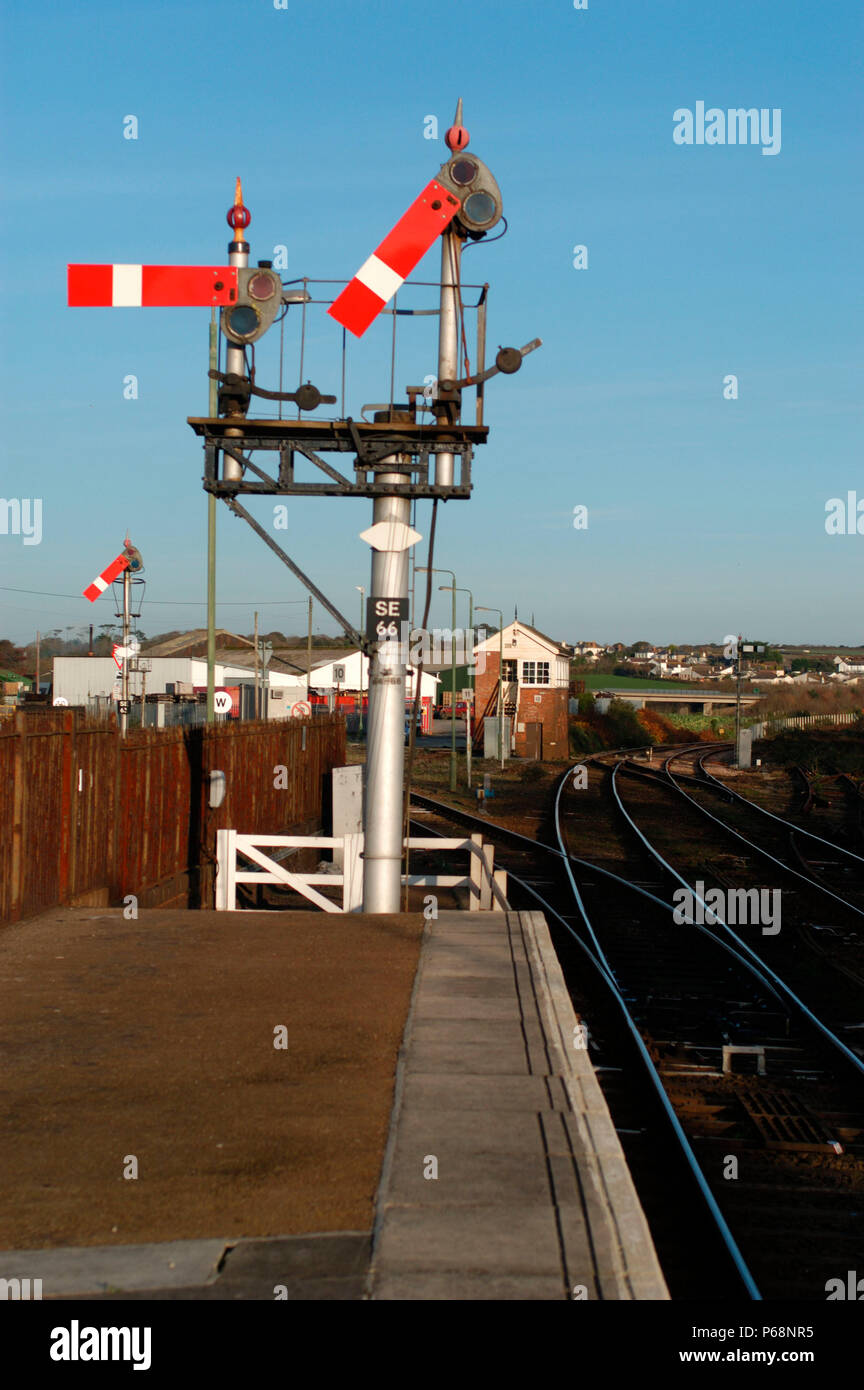
As can be seen from these pictures, the "clear" aspect may be above or below the horizontal, (dating back to differing practices in the pre-nationalisation (1948) companies) but "stop" is always horizontal.
The Great Western Railway (and later, BR Western Region) used "lower quadrant", most other companies used "upper quadrant". This even extended to banner signals where BR Western used "lower quadrant" types even for new or replacements in the 1980s.



 ], would you say rail transport is more expensive vis a vis taking your own car instead? The local trains in India are incredibly cheap, though many times not on time. Though if someone decides to travel in First AC the peak class of travel with personal coupes, the cost can shoot up quite high here as well. Then there are the luxury trains usually aimed at foreigners with the most famous being Maharaja Express, which is crazily expensive, even from a UK/US perspective.

