• Our new ticketing site is now live! Using either this or the original site (both powered by TrainSplit) helps support the running of the forum with every ticket purchase! Find out more and ask any questions/give us feedback in this thread!

Some questions regarding UK railways

Status
Not open for further replies.

norbitonflyer

Established Member
Joined
24 Mar 2020
Messages
5,742
Location
SW London
Do any passenger trains run from Glasgow to Edinburgh via Springburn and Stepps? If not, it seems a bit of a stretch to describe it as an additional route.
They did for a while, but since COVID they've been cut back to Falkirk

== Doublepost prevention - post automatically merged: ==

A slight digression from the topic since you are obviously informed about signaling, is multi aspect color light signalling more advanced in a sense than semaphore signaling?
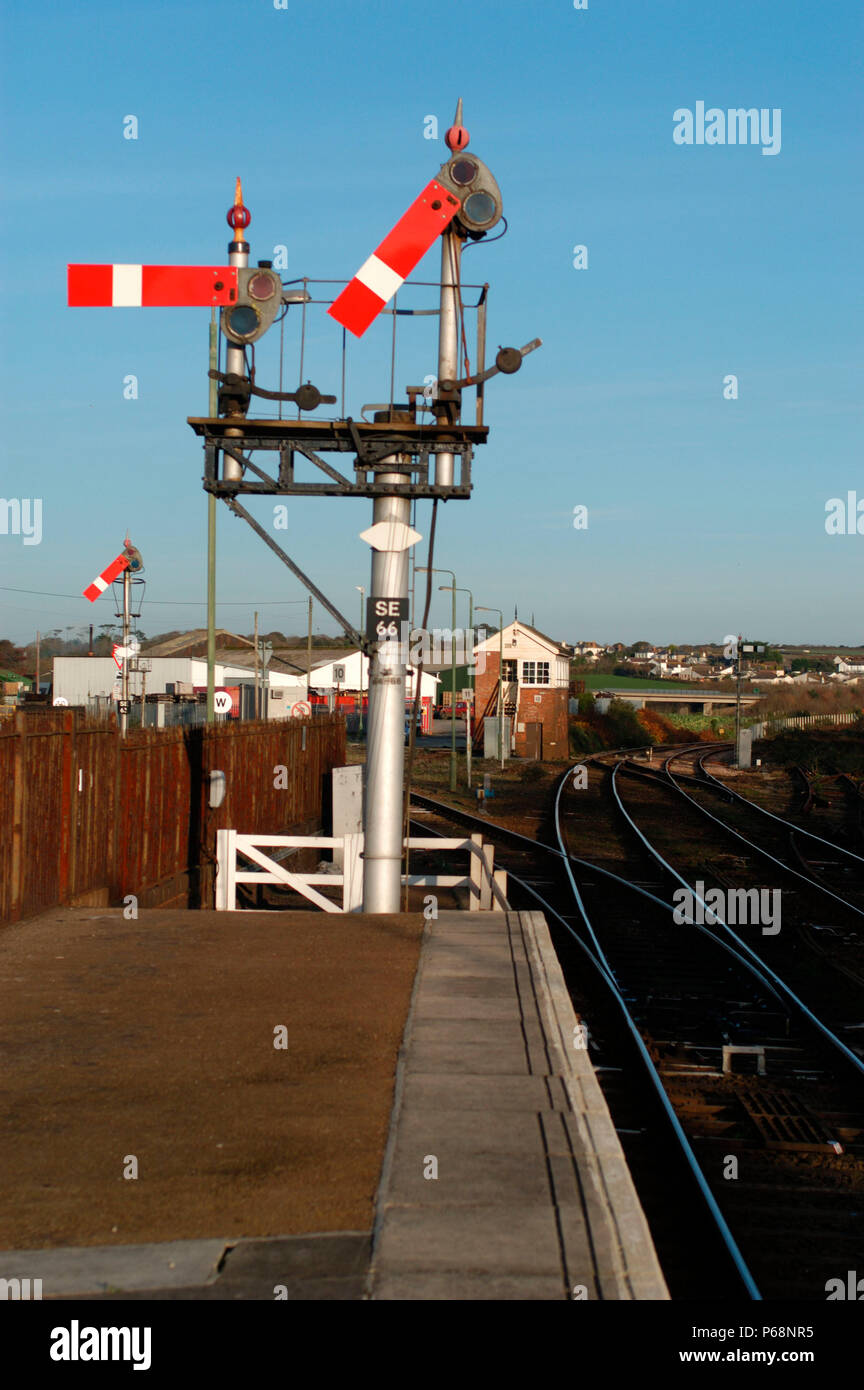
Semaphore signalling only has stop signals (red - known as home or starter depending on whether they control entrance to or exit from station limits) and distant or caution signals (yellow), which only give an indication of the state of the next stop signal. The signals also have a "spectacle plate" co-acting with the semaphore arm, with coloured lenses that move in front of a lamp to project a light of the appropriate colour. A distant signal may be on its own post or, as in this picture, shared with a stop signal - in this picture the stop signal is in the clear position and the distant in the caution position, indicating that the next stop signal is not in the clear position.
Railway semaphore signal - Wikipedia

Junctions are signalled by having separate posts for each route, the branch line being on a shorter post than the main. As can be seen from these pictures, the "clear" aspect may be above or below the horizontal, (dating back to differing practices in the pre-nationalisation (1948) companies) but "stop" is always horizontal.
the-great-western-railway-view-from-up-platform-of-st-erth-station-showing-line-diverging-left-to-branch-and-branch-signal-set-for-exit-from-bay-plat-P68NR5.jpg


Multi-aspect signaling may be 3-aspect, with a yellow light displayed if the next signal is red, so essentially a colour-light analogue of the semaphore (or, if you want to look at it that way, just like the spoectacle plate of a semaphore signal, but it may be 4-aspect, with an additional "double yellow" aspect indicating the next signal is yellow, essentially allowing the driver to see two blocks ahead instead of just one, and at some locations there are also extra flashing aspects to indicate a route is clear, but over a diverging route with a lower speed limit.
OIP.CVpBj9reN0IgVHqeywhhzQHaLw

The red light is always at the bottom*, closest to the driver's eye line and also so that there is no lens hood below it on which snow, birds, or other obstructions can collect and obscure the light. This signal also shows a row of five lights at an angle above the main body - when illuninated these indicate a route is set diverging from the main line.

* except in rare instances where there is no green aspect, for example the penultimate signal before a terminus, where the red light is in the middle, in order to maintain sufficient separation between the two yellow ones.
 
Last edited:
Sponsor Post - registered members do not see these adverts; click here to register, or click here to log in
R

RailUK Forums

Annetts key

Established Member
Joined
13 Feb 2021
Messages
3,807
Location
West is best
My mind has a correlation that semaphore signalling based tracks are still stuck on lower speeds since that has been impressed upon me via my country's railways where semaphore signalling has been associated with old. Do such routes also suffer from low average speeds in the UK?

There are many factors that affect the maximum line speed. From a signalling perspective, it's the distance between the distant signal / caution aspect and the stop signal that is important. Normally this distance must be equal or greater than the service braking distance for trains with the worst braking capacity that may use the line. Sighting of signals is also a factor. Where there are junctions, the design of the points is a factor. You can have much higher speed turnouts if they are power operated.

This might stir up a hornet's nest and I understand everyone will have different opinions, but in your purview, has privatization of rail helped increase the quality of service?
The government that carried out privatisation broke the national railway (British Railways that owned and operated everything) up into more than one hundred different companies. There were multiple train operating companies (TOCs), freight operating companies (FOCs), and multiple rolling stock companies (ROSCOs). Additionally, a new private infrastructure company was formed: Railtrack. But this company didn't include any maintenance staff, what was BR maintenance was split off and sold to multiple private companies, all of which had contracts to carry out routine maintenance. Plus others that were used for major works (renewals or alterations).

It was a mess and a nightmare. Under BR for the most part, staff helped each other where safe and practical. That all stopped and you were told, you ONLY carry work as directed by your manager.

Railtrack really messed up with carrying out the infrastructure maintenance and there were widespread speed restrictions all over the network. But the trains were all painted nice. As were most of the stations. So the train looked good as you trundled through a temporary speed restriction at 50MPH...

Railtrack (the part that owned the network infrastructure previously owned by BR) in a court hearing was placed into administration. The government set up a new 'not for profit' company called Network Rail. It owned itself rather than having shareholders. In later changes, it was classified as a state owned company. All maintenance was still actually carried out by the private contract companies. But eventually, most routine maintenance was taken "in house" rather than contracted out.

Anyway, in some areas, the service did improve. But it's a matter of debate if BR would have improved the service. BRs new station / reopening closed stations programme died a death in many areas for example (well, until years later).

The other problem was that the former BR train builders gradually closed. Either due to a lack or orders (it took a while before the private companies placed orders for new trains hence a large gap in time when there were no new orders) or because the private companies went elsewhere. This has had a lasting effect. Rather than national orders for new trains being the normal way of doing things, each TOC did it's own thing. Hence we have a miss-match of trains now.

Working in the industry (until recently) I personally think there was more disadvantages than advantages in the way that the government carried out privatisation.

Only if you complain, then you get good service. No matter how good something is, unless it's perfect, complaining isn't bad, IMO. It might be more prevalent in the UK but it's not a bad thing per se.
I don't think passengers / customers complain enough. At least, not formally.

Okay, this question might come off as noobish to you folks, but are ordinary British stations walled off as well?
As said earlier, it's a mixture. And it has changed over time. It's only been about four or five years since my local station got ticket barriers/gates. Prior to that it was an open station even though its a manned station.

And at some large stations, not all platforms have ticket barriers/gates.

At some stations, the ticket barriers/gates are only in use during part of the day ("rush hour").

A slight digression from the topic since you are obviously informed about signaling, is multi aspect color light signalling more advanced in a sense than semaphore signaling? The former is standard in my country and I could hardly find any info about the modern in-cab signalling system in place, if anywhere in my country.

Semaphore signalling various in it's complexity. There are "simple" signal boxes and complex signal boxes. The latter may actually have a mixture of manual mechanical signalling and electrical signalling.

Multi aspect colour (MAS) light signalling is normally controlled by either route relay interlocking (RRI) via a panel (with a route entrance button or switch and an exit button) or via a computer based interlocking (the first by BR was called SSI - solid state interlocking). The computer based interlocking can either be controlled by a panel or by an IECC (Integrated Electronic Control Centre) - a VDU (visual display unit) and tracker ball or mouse system. All power operated points in one of these systems are automaticity motored to the correct position when the signaller calls a signal route. And the signaller doesn’t have direct control of the signal aspect. The interlocking handles the aspect control. The interlocking detecting where the trains are via continuous track circuiting (or nowadays that could also be axle counters).

The RRI was built using thousands of electro-mechanical relays. Some allowed automatic selection of one of multiple routes at busy junctions. Signals were either controlled (can only be cleared by the signaller) or automatic (used on straight line with no points, junctions or manually controlled level crossings) which needed no input from the signaller. At some junctions, some controlled signal were provided with an automatic mode for the higher importance route.

With MAS for low capacity lines you will find two aspect signals, for each signal block section (which can be more than three miles) you have one distant signal (that can show yellow or green) and one stop signal (that can show red or green). A bit like semaphore signalling except there is no home signal, starting signal or station limits.

Hence the sequence is Y/G -- R/G --- Y/G -- R/G --- Y/G -- R/G --- Y/G -- R/G --- Y/G -- R/G etc.

Where the train service is more frequent, three aspect signals are used. Each signal can show red, yellow or green. The length of the sections is shorter compared to a two aspect area. Typically between 1 and 2 miles apart.

For higher capacity, we have four aspect signals. Each signal can show red, yellow, double yellow (two yellow lights) or green.

As can be seen from these pictures, the "clear" aspect may be above or below the horizontal, (dating back to differing practices in the pre-nationalisation (1948) companies) but "stop" is always horizontal.
The Great Western Railway (and later, BR Western Region) used "lower quadrant", most other companies used "upper quadrant". This even extended to banner signals where BR Western used "lower quadrant" types even for new or replacements in the 1980s.

 

Ziggiesden

On Moderation
Joined
4 Jun 2024
Messages
107
Location
Edrom
Do any passenger trains run from Glasgow to Edinburgh via Springburn and Stepps? If not, it seems a bit of a stretch to describe it as an additional route.
It is used as a backup route when there are issues on the main Edinburgh - Glasgow Route via Falkirk High. I use the line daily and now and then I get a wee blast from the past and go that way. I used to be a Signalman at Cumbernauld Absolute Block signalling from Greenfaulds to me (https://en.wikipedia.org/wiki/Absolute_block_signalling) and then what we called Track Circuit Block Signalling (https://en.wikipedia.org/wiki/Automatic_block_signaling) to Greenhill Junction.


I used to pull the points (switches) and semaphore signals and utilise a Block too as well as a Panel for passing trains from one system to another. It was good exercise on a busy day when trains were diverted from the mainline. Other than that it was the regular Cumbernauld Service, that turned at me, Freight, Light Engines, Sleeper Services, Engineering Trains and the odd Royal Train when Queen Elizabeth went past to / from Balmoral.


We worked the Signalbox under the rules of The Caledonian Railway even after the rules were changed to operate under British Rail, unofficially, of course.

It was fun in the winter - not - especially on the night shift (we used to use old coats to put on the Frame (https://signalbox.org/lever-frames/) to stop the wind howling through - you could never get warm!
 
Joined
5 Aug 2015
Messages
907
Location
Norfolk
@kirk781
Lots of good comments made already and I fear you're getting swamped in required reading now haha, but I would add:
Things I hear about GB rail network is apparently good at:
  • Intercity services: generally high capacity trains at decent frequencies on the mainlines towards London with pretty good journey times
  • (Relatedly) average speeds are quite high, especially for those intercity lines, but even local and rural train services have pretty good speeds. I didn't realise this until I started watching videos American commuter rail trains which are often achingly slow for no obvious reason.
  • Passenger rights: when a catastrophic meltdown occurs, railway companies will try to keep you informed on what's going on and maybe sort out alternative transport in emergency buses/cabs/hotel stays if the route affected is nationally important. You can claim your money back for this as well. As far as I understand, this is not always the case in other parts of the world, especially the communication bit - although most of it is done via Twitter hilariously. The railway companies' corporate Twitter accounts are honestly one of the best ways to find out what's happening during disruption, kinda funny to me.
The most glaring problems in my opinion as rail user:
  • Ticket prices: hilariously expensive. People will give lots of interesting reasons on why this is, but honestly at the large scale I believe it comes down to the fact that over the last 100 years the amount of railway has decreased while the demand to travel has only ever gone up - not only population growth but also each individual's need to travel growing in frequency and distance. There is no way to cut that pie up without tickets getting more expensive.
  • Suburban lines: while we have decent service on intercity trains out of London, and also on rural lines oddly, we lag behind a lot on suburban provision.
    • Other European countries often have dedicated electrified suburban networks with some kind of separation to the intercity/regional/freight services. Not so much in Britain. Only Liverpool and Newcastle have something like this and both could do with expansion.
    • Almost all of London & the South East's suburban network is shared with other trains to varying degrees - it only does well through shear volume of infrastructure. That being said, the municipally owned "London Overground" train operator delivers a generally better service compared to the private operating companies it shares tracks with, and the whole system is backed up by the London Underground and a very strong bus network.
    • Other than London, Glasgow has quite a few suburban lines, while Manchester and Birmingham have a vague smattering of suburban services that aren't really good enough for the quite major urban areas they serve
    • Below them, the rest of the major urban areas that would demand some kind of suburban provision on the continent have barely anything: Leeds, Sheffield, Middlesborough/Teeside, Southampton/Portsmouth, Nottingham/Derby, Edinburgh, Bristol, etc
  • Centralisation: everything is about going to London
    • I live in a fairly minor city (Norwich) that basically has two main train services out of it. The one to London, and the one that connects it to multiple other major urban areas across the country.
      • The train to London is 12 carriages, runs twice an hour until about 11pm, has been fully electric since 1987, runs at top speeds between 80 and 100mph, is rarely overcrowded, gained new rolling stock a few years ago, is a reasonable price off-peak.
      • The train that goes towards Nottingham/Sheffield/Manchester is 2 carriages, runs just about once an hour until 8pm, is diesel throughout, is achingly slow and the route is quite indirect, is always full since 2 carriages is not enough for the demand, uses rolling stock built back in the nationalisation era, is always more expensive than the London train
    • This singular example may or may not be a fair comparison but this is generally the scene across the country: if the train goes to London, it'll probably be a pretty good service, if not it will most likely not have anywhere near enough carriages for the demand it has.
    • If you look at a map (say openrailwaymap) you'll notice not many lines go left to right, the network generally favours going to London only. Of the few that do exist, they are generally slow local routes with un-modernised infrastructure.
      • Once you leave the mesh of lines in London, the only electrified east-west route is at the other end of the country in Scotland!!
  • Refusing to build anything
    • While other countries like France, Italy and Japan became world leaders in high speed rail construction, Britain became (for a short while) global innovators in signalling technology. This, I believe, is indicative of the focus on squeezing as much as possible out of the existing lines and having to juggle intercity, local, suburban and freight all on the same lines making traffic control a complex affair.
    • Running different service types on the same infrastructure always ends up harming local/stopping trains since long distance intercity trains have to clear a large empty space in front of them to keep up to speed. No other trains can run in that speed so local and freight capacity is quite limited.
    • Most major trunk routes are at the limit of what can be run on them without removing fast trains, or effectively closing local stations - further computerised signalling systems and line speed upgrades won't meaningfully alter this. At some point, one has to build new tracks to run more trains on. But for **politics** reasons, this hasn't happened at any point in the post-war era.
Bonus: I greatly admire how India has just decided to electrify everything. At its peak, it was wiring the entire track distance of the UK every few months. Just look at the crazyness of these two maps (same zoom level).

1739152340703.png1739152379409.png
 

mike57

Established Member
Joined
13 Mar 2015
Messages
2,394
Location
East coast of Yorkshire
A quick skim read of the answers and I see no one has really mentioned is average speeds, so to give a flavour of the range of speeds here are a few examples:

The ECML and WCML are the fastest long distance main lines within the UK (Excluding HS1, whose main purpose is channel tunnel traffic, but used by local services within Kent). On the ECML London - York has a pretty much hourly 'fast' services taking ~1h 55m with a few quicker ones shaving a few more minutes. 188 miles. So very close to or just over 100mph average, and interestingly this route has been acheiving these speeds for around 40 years even when diesel powered using HSTs, The London York route has long sections of 125mph running. If you carry on to Edinburgh, 398 miles, then average speeds drop to typically 85mph for most trains with a few slightly quicker, this is because north of Newcastle speeds are lower. Other journeys using the southern end of the ECML (south of Darlington) acheive 100mph or very close to it. A similar WCML service, London - Warrington, carrying on to Glasgow takes 1h 45m for 181 miles so 103mph avarage, but this requires the use of 'tilt' because of the twisty nature of the route compared to the ECML.

None of the other UK main lines manage 100mph average, MML London - Leicester is 99 miles, 68 minutes typical, 87mph, GWML London Bristol TM is ~80mph and Brisol Parkway is slightly better at 85mph even although there is a significant amount of 125mph running, this route has actually slowed down due to more frequent stops. The GEML which is 100mph maximum manages typically 65mph average between London and Norwich. and 60mph average would be typical of the faster cross counrty services.

A route with I use frequently, Leeds - Manchester is 43 miles, takes around 53 minutes on the fastest services so 48mph average. This is a congested 2 track route through hilly terrain, and there is currently a program to 4 track some sections, but current works will only shave minutes of the times. Considering these are two of the most significant cities in the North of England its seen as poor by many.

A typical branch line service, going to use my home example, Bempton - Hull with 4 stops along the way, takes 50 minutes to cover 34 miles so 40mph average, line speed is 70mph for some of the route, but some rural branch lines are much slower, for example Middlesbrough - Whitby takes 94 minutes to cover 35 miles so ~20 mph, but there are a lot of stops, and its single track most of the way with a reversal at Battersby as well.

'Metro' services, a good example that I grew up with, London Victoria - East Croydon, all stations (8 stops), takes 35 minutes to cover 10 miles, so 17mph average.

Note to 'trivia' hunters, I realise there may be one or two journeys per day on some routes that are faster, I have tried to pick some examples where there are multiple services per day acheiving the timings I have given.
 
Last edited:

norbitonflyer

Established Member
Joined
24 Mar 2020
Messages
5,742
Location
SW London
The Great Western Railway (and later, BR Western Region) used "lower quadrant", most other companies used "upper quadrant". This even extended to banner signals where BR Western used "lower quadrant" types even for new or replacements in the 1980s.
Pre-grouping in 1923, several other railways used lower quadrant signals. Here is a Great Northern Railway "somersault" signal
3027138_a6da78e0.jpg
 

The exile

Established Member
Joined
31 Mar 2010
Messages
9,390
Location
Somerset
OIP.CVpBj9reN0IgVHqeywhhzQHaLw

The red light is always at the bottom*, closest to the driver's eye line and also so that there is no lens hood below it on which snow, birds, or other obstructions can collect and obscure the light. This signal also shows a row of five lights at an angle above the main body - when illuninated these indicate a route is set diverging from the main line.

* except in rare instances where there is no green aspect, for example the penultimate signal before a terminus, where the red light is in the middle, in order to maintain sufficient separation between the two yellow ones.
Is it not the case that the prime consideration is that the red aspect is closest to the driver’s eye line- which means that under normal circumstances it is at the bottom but where special circumstances dictate it may be elsewhere. ISTR there is the odd horizontal set of colour lights (to get under canopies at Birmingham new Street?) - or have these anomalies now disappeared?
Incidentally - wasn’t there a short-lived attempt (by the GWR?) to introduce 3-aspect semaphores before they went for colour lights instead?
 

Tester

Established Member
Joined
5 Jul 2020
Messages
1,697
Location
Watford
Is it not the case that the prime consideration is that the red aspect is closest to the driver’s eye line- which means that under normal circumstances it is at the bottom but where special circumstances dictate it may be elsewhere.
Yes that is correct. Ground mounted main signals generally have red at the top.
 

norbitonflyer

Established Member
Joined
24 Mar 2020
Messages
5,742
Location
SW London
Is it not the case that the prime consideration is that the red aspect is closest to the driver’s eye line- which means that under normal circumstances it is at the bottom but where special circumstances dictate it may be elsewhere. ISTR there is the odd horizontal set of colour lights (to get under canopies at Birmingham new Street?) - or have these anomalies now disappeared?
There certainly used to be horizontal ones at City Thameslink - I haven't been there for several years though..

It is, I imagine, a combination of factors. Have the red at the bottom to avoid the dirt on the lens hood issue, and mount the signal head at the appropriate height that the red light is at the driver's eye-line.

Modern LED lights only have the one "lens" anyway, that can show different colours (a second lens if a double-yellow aspect is to be available)
 

kirk781

Member
Joined
2 Feb 2025
Messages
32
Location
India
one hundred different companies
Wow, I had imagine it would be err, tough to manage at start. Did it or does it somehow resemble [in a partial way even] the American railway setup [in terms of operation; US was a world leader upto WW II in railways but basically decided to shoot themselves in the feet instead]?

Ticket prices: hilariously expensive.
For going from say, London to Manchester [I have just taken two cities name from UK :p], would you say rail transport is more expensive vis a vis taking your own car instead? The local trains in India are incredibly cheap, though many times not on time. Though if someone decides to travel in First AC the peak class of travel with personal coupes, the cost can shoot up quite high here as well. Then there are the luxury trains usually aimed at foreigners with the most famous being Maharaja Express, which is crazily expensive, even from a UK/US perspective.
Bonus: I greatly admire how India has just decided to electrify everything. At its peak, it was wiring the entire track distance of the UK every few months. Just look at the crazyness of these two maps (same zoom level).
Electrification is the only good thing they are doing. It's at ~90% now, ahead even of China though it will never touch 100 because sporadic Meter Gauge routes exist which won't be touched. Same goes for Narrow Gauge routes, some of which are UNESCO heritage sites, which obviously lose their sheen if electrified.

I once saw a video about a place in UK being accessible only via train, it was called something like the most remote station in UK or what not; I forget exactly the name.
 

Krokodil

Established Member
Joined
23 Jan 2023
Messages
6,566
Location
Wales
Pre-grouping in 1923, several other railways used lower quadrant signals. Here is a Great Northern Railway "somersault" signal
Lower-quadrant used to be the norm (like it used to be normal for locomotives to be driven on the right, a practice perpetuated by the GWR long after everyone else abolished it). I believe that the last Midland Railway lower quadrant signal has only recently been removed from the national network.
 
Joined
4 Sep 2015
Messages
236
Location
Lehigh Valley PA USA
Wow, I had imagine it would be err, tough to manage at start. Did it or does it somehow resemble [in a partial way even] the American railway setup [in terms of operation; US was a world leader upto WW II in railways but basically decided to shoot themselves in the feet instead]?
Not really like the US, because Britain still had the common infrastructure (track and stations) initially private but then taken over by a government entity Network Rail. In the US for the most part the railroad companies have always owned and maintained their own tracks, although in many cases other companies have negotiated trackage rights to be able to operate over them, or companies have shared operations in some instances. The only area in which they somewhat resemble UK operation is the Northeast Corridor (Boston to Washington DC) where government owned Amtrak owns, maintains, and dispatches the track and gives access to freight operators.

As an aside, I think the US can still be considered a world leader in terms of freight train operation. It did go through a period of decline starting in the 1950s but rebounded after deregulation in the late 1970s (plus the formation of Conrail which received government loans to put various absorbed northeastern private railroads back on their feet after much rationalisation of duplicative trackage). This is not the case for Passenger operation unfortunately.
 

6Gman

Established Member
Joined
1 May 2012
Messages
9,201
I once saw a video about a place in UK being accessible only via train, it was called something like the most remote station in UK or what not; I forget exactly the name.
Probably Berney Arms in East Anglia - public house (currently closed I believe), a railway platform and footpaths.

There are a few other stations which have poor access by other means such as Dyfi Junction in Wales (long rough trackway to the nearest road). In the past there were also some stations which existed only for changing trains such as Afonwen (which I used!) and Bala Junction, both also in Wales.
 
Joined
5 Aug 2015
Messages
907
Location
Norfolk
As an aside, I think the US can still be considered a world leader in terms of freight train operation
I'm starting to hear these days that this is probably unlikely. I think it stems from america having a crazy high total of tonnage miles, but a lot of that is because of aggregates and coal and pure size of the place.

US class 1s can be seriously inefficient operationally because of weaponised 'precision scheduled railroading', which causes trains to be extended beyond the length that infrastructure can handle. Combine that with continual cutting of track infrastructure means trains spend a long time waiting around to use single tracks and can't use the passing loops because the trains are too long. This also has terrible staff utilisation consequences because they'll time out while waiting needing relief.

The only countries in the world where an item of goods is more likely to go by rail than road, is russia and ukraine. (Maybe not in the last few years tho)

Switzerland also has insanely effective and localised freight operations.

== Doublepost prevention - post automatically merged: ==

For going from say, London to Manchester [I have just taken two cities name from UK :p], would you say rail transport is more expensive vis a vis taking your own car instead?
almost always cheaper to drive for that journey, unless you find yourself making the trip reguarly. Also the personal economics of having a car may lose out if you don't use it all the time
Electrification is the only good thing they are doing. It's at ~90% now, ahead even of China though it will never touch 100 because sporadic Meter Gauge routes exist which won't be touched. Same goes for Narrow Gauge routes, some of which are UNESCO heritage sites, which obviously lose their sheen if electrified.
That's totally fair enough, and still a crazy good achievement. We're unfathomably bad at (the government) pledging to actually build electrification, and as a result very much kinda unable to deliver it cost effectively because the industry cannot adequately size itself around the multi-decade long famine periods.

India is also seemingly quite good at new build metro systems.
 
Last edited:

pokemonsuper9

Established Member
Joined
20 Dec 2022
Messages
4,612
Location
Greater Manchester
For going from say, London to Manchester [I have just taken two cities name from UK :p], would you say rail transport is more expensive vis a vis taking your own car instead?
Manchester - London off peak return is £109, but there are other flexible tickets but with limits on which companies you can use for as low as £43, and I'd be very suprised if the car still wins against that.

There are also "Advanced" (fixed train, no refunds, if you miss the train your ticket is worthless) single tickets that are apparently as low as £14 on that route, but that is for the very slowest trains.

UK Train tickets have a mountain of options, especially between the big city pairs, if you want to see all the tickets in the data for any two locations, you can use https://www.brfares.com/.
almost always cheaper to drive for that journey, unless you find yourself making the trip reguarly. Also the personal economics of having a car may lose out if you don't use it all the time
Although if going City Centre Manchester - City Centre London the train wins on time MASSIVELY assuming you use the fastest trains.
And if using the car you'd probably park and then get a train closer to London.
 
Joined
5 Aug 2015
Messages
907
Location
Norfolk
Manchester - London off peak return is £109, but there are other flexible tickets but with limits on which companies you can use for as low as £43, and I'd be very suprised if the car still wins against that.
for the about 200mile journey by road on an average miles per gallon of 36 would apparently cost you £35 in fuel. Obviously, one's mileage may vary especially with the fuel efficiency so that is competitive with the cheapest rail fare. However, the cheapness of that fair will be locking you into all sorts inflexibilities which you may not be able to accommodate especially when the flexibility of the car does not affect that fuel price. Also secondly, if you're taking other people with you, rail and public transport in general massively over-inflate in cost when your fuel cost will change negligibly.

You do raise a very good point though, that London's internal public transport along with small inner city streets and heavy congestion/vehicle pollution charges mean that very many people just drive to an outer-suburban unofficial park & ride spot. Even before ULEZ and congestion charge, the reputation of bad inner city traffic was enough for people to mostly drive to zone 6 or so. That's very often how my family used to go to London, park in Cockfosters or Redbridge tube station car park and get on the tube rather than paying for four of us to get the train the whole way.

Still, if you make the journey regularly and you know you will, that's when the efficiencies of public transport options can come into play. And depending on exactly where you live, it still is often cheaper to not bother owning a car if you don't need it for work.
 

181

Member
Joined
12 Feb 2013
Messages
942
I once saw a video about a place in UK being accessible only via train, it was called something like the most remote station in UK or what not; I forget exactly the name.

Probably Berney Arms in East Anglia - public house (currently closed I believe), a railway platform and footpaths.
See https://en.wikipedia.org/wiki/Berney_Arms_railway_station for Berney Arms, but I suspect the video may have been about Corrour: https://en.wikipedia.org/wiki/Corrour_railway_station.
 

norbitonflyer

Established Member
Joined
24 Mar 2020
Messages
5,742
Location
SW London
Smallbrook Junction is only accessible by train - not even on foot. It exists to provide interchange between the Isle of Wight Steam Railway and the "main" line from Ryde.
 
Joined
11 Jan 2015
Messages
969
And everyone forgets that the cost of driving is not just fuel. A car must be taxed, maintained, insured and depreciates. The fuel cost is not the true cost.
 

Harpo

Established Member
Joined
21 Aug 2024
Messages
3,859
Location
Newport
And everyone forgets that the cost of driving is not just fuel. A car must be taxed, maintained, insured and depreciates. The fuel cost is not the true cost.
Pro-road/anti-rail folk will only ever quote the marginal cost (fuel) for a car journey, which is less than a third of the 45p/mile tax-free allowance for business use of a car.

I doubt that those same folk will only claim the fuel cost from their employer or in their tax returns though.
 

mike57

Established Member
Joined
13 Mar 2015
Messages
2,394
Location
East coast of Yorkshire
A car must be taxed, maintained, insured and depreciates. The fuel cost is not the true cost.
And the HMRC approved rate is 45p for the first 10,000 miles pa, and 25p after that, and depending upon the age and sort of car you drive these could be low. On this basis according to the HMRC a 200 mile trip is 'costing' £90 assuming your annual milage is in the 10,000 mile range which is typical.
 

The exile

Established Member
Joined
31 Mar 2010
Messages
9,390
Location
Somerset
And everyone forgets that the cost of driving is not just fuel. A car must be taxed, maintained, insured and depreciates. The fuel cost is not the true cost.
But most of the other costs are irrelevant if the car is already on the drive and you’re thinking “how shall I travel to xyz today”. Where they are relevant is “is it worth me buying / keeping a car?”. This from the perspective of someone who usually commutes by train despite driving being quicker and (fuel wise) cheaper.
 
Last edited:

Dr Hoo

Established Member
Joined
10 Nov 2015
Messages
5,652
Location
Hope Valley
But most of the other costs are irrelevant if the car is already on the drive and you’re thinking “how shall I travel to xyz today”. Where they are relevant is “is it worth me buying / keeping a car?”. This from the perspective who commutes by train despite driving being quicker and (fuel wise) cheaper.
And for many people they have to spend money on accessing the station to even catch the train at whatever cheap fare they can find at a sub-optimal time of day. For example, I have to sensibly allow an hour to drive to Chesterfield or Macclesfield to catch a train to London and then pay to park at the station. Day rates of around £12-15, at least before 10:00, are common for this kind of thing. Very few people live just round the corner from the Euston Road or wherever.
 
Joined
5 Aug 2015
Messages
907
Location
Norfolk
And everyone forgets that the cost of driving is not just fuel. A car must be taxed, maintained, insured and depreciates. The fuel cost is not the true cost.
To be clear, i am in no way pro-road or forgetting these costs - i did (altho with no elaboration) mention that the long-term personal finance implications of owning a car may mean it's not worth owning one. But if you already have the car, it's hard to convince those passengers onto rail. This is unfortunately the perspective of most people in the country who own a car and so find themselves making use of it often - this is of course down to bad long-term planning decisions where housing/employment gets built with only road access instead of being centred around public transport nodes, but that's been going on for the best part of century.
 
Last edited:

norbitonflyer

Established Member
Joined
24 Mar 2020
Messages
5,742
Location
SW London
I have a car, but will often use the train if it is convenmient (even if I have to drive toi the station) because looking for somewhere to park at the far end, and then paying for it, is likely to be more expensive in time and money. Indeed, in many city centres it is now cheaper to drive round the one-way system a few times whilst your partner does the shopping than it is to park - and they wonder why our city centres are so congested.
 
Status
Not open for further replies.

Top