Please don't do that. You've attributed words to me which I didn't say. If you wish to say something you can quite easily do that without misquoting someone else.
Can you please amend your post so it no longer misquotes me? Thank you.
Fair enough.

Please don't do that. You've attributed words to me which I didn't say. If you wish to say something you can quite easily do that without misquoting someone else.
Can you please amend your post so it no longer misquotes me? Thank you.
The underground is only different because it’s environment allows different (and sufficient) safety controls to make it ALARP on extensions.The Underground is different because there's no other choice on the Northern Line,
Well, since large amounts of third rail electrification was done after 1974, the act itself is not the blocker here. I remember hearing a lot about new regulations about electricity introduced in the 1990s that were pointed to as the main blocker.‘Health & Safety at Work’ is misunderstood.
The legislation is the ‘Health and Safety at Work etc. Act 1974’
The word “etc.” is crucial.
The act places a duty of care on an organisation not only on a employees, but also on members of the public. The relevant risk assessments must take that into account.
Nevertheless, there are still incidents caused to rail workers by coming into contact with the con rail. Most recently last week. Simple maths will show that if there is more con rail, there will be more incidents. Again, any proposal to introduce more conductor rail will need to have a detailed risk assessment that identifies that increased level of incidents, value it, and explain why the risk remains tolerable as far as is reasonably practical compared to alternatives. And that risk assessment will have to be of sufficient quality to stand up to detailed examination in a criminal court.
Those would be the Electricity at Work Regulations [https://www.legislation.gov.uk/uksi/1989/635/contents], made under the 1974 legislation.Well, since large amounts of third rail electrification was done after 1974, the act itself is not the blocker here. I remember hearing a lot about new regulations about electricity introduced in the 1990s that were pointed to as the main blocker.
OHLE does have it's problems, hence the rebuilding of every parapet for bridges over new schemes to 1.8m height, and the quite extensive standards around clearance from the electrified parts (or ways to gain access to them).The other key question is why OHLE seems to have no problems, seeing as it's unambiguously introducing a new risk that isn't present on unelectrified lines.

4.—(1) All systems shall at all times be of such construction as to prevent, so far as is reasonably practicable, danger.
My question was more that since OHLE introduces new risks, mitigated though they might be, what method is there for the railway to justify itself regarding the installation of OHLE? What prevents someone from saying "you haven't made the risks as low as reasonably practical, because it's perfectly possible to have an unelectrified railway"?OHLE does have it's problems, hence the rebuilding of every parapet for bridges over new schemes to 1.8m height, and the quite extensive standards around clearance from the electrified parts (or ways to gain access to them).
However the live parts of OHLE are normally 5m in the air, and therefore are much harder for a person to accidentally come into contact with than a rail at ankle height. The rebuilding of parapets and station canopies mitigates the risk where it is more present, as seen in theNR guide to overhead electrification when it addresses access from an overbridge:
I know it would be difficult to implement on curves, but would wooden protection panelling not mitigate the risk somewhat? Common to see it at places like Waterloo and London Bridge.Where Third Rail can manage the risk appropriately, it is permitted - see the East London Line. The RSSB have published risk mitigation approaches to new third rail systems. The problem for third rail is that because it is so much more accessible, it is very difficult to reduce the risk to an acceptable level. Especially as the regulations require:
Well, since large amounts of third rail electrification was done after 1974, the act itself is not the blocker here.
The other key question is why OHLE seems to have no problems, seeing as it's unambiguously introducing a new risk that isn't present on unelectrified lines.

alsoExamples on the underground too - Northern extension, Jubilee extension, T5 extension etc.
The underground is less safe. IMHO, than NR because the stations have centre live (well above touch voltage) rails running along the middle of the suicide pit. It would be difficult to miss if you fell off. The platform heights are also lower so customers are nearer...
WAO

Not without completely redesigning the third rail shoes on every current unit.Wonder if you could at least convert from top contact to side contact a la the old Bury Line? That way you'd be able to put shrouding around the conductor rail on all but one side, and at that point if you manage to come into contact with that, not only were you stupid enough to trespass onto a railway, you were then stupid enough to be standing in the four-foot, before managing to get electrocuted, at which point (callous as it sounds) Darwin has a thing or two to say at this point.
Not without completely redesigning the third rail shoes on every current unit.
Well I sort of took that as read in the suggestion!and the third rail!
Or adopt a different 3rd rail type as the new build standard and the required sub-fleet becomes a dual pickup EMU instead of a BEMU?Wonder if you could at least convert from top contact to side contact a la the old Bury Line?
That's an example which uses very short trains going very slowly. And due to be upgraded to 1.5kV too. That sort of wiring will not power a 12 car train doing 100mphHere is an example of how 750V DC electrification can look like.
My understanding is that the underground isn't referenced to physical earth (outside of where it shares with SWR) so that you need to touch both live rails to get a shockThe underground is less safe. IMHO, than NR because the stations have centre live (well above touch voltage) rails running along the middle of the suicide pit. It would be difficult to miss if you fell off. The platform heights are also lower so customers are nearer...
WAO
My understanding is that the underground isn't referenced to physical earth (outside of where it shares with SWR) so that you need to touch both live rails to get a shock
My understanding is that the underground isn't referenced to physical earth (outside of where it shares with SWR) so that you need to touch both live rails to get a shock
I remember seeing that suggested in a railway magazine around 2013, not for safety reasons but to lessen the impact of snow and ice.Wonder if you could at least convert from top contact to side contact a la the old Bury Line? That way you'd be able to put shrouding around the conductor rail on all but one side, and at that point if you manage to come into contact with that, not only were you stupid enough to trespass onto a railway, you were then stupid enough to be standing in the four-foot, before managing to get electrocuted, at which point (callous as it sounds) Darwin has a thing or two to say at this point.
I remember seeing that suggested in a railway magazine around 2013, not for safety reasons but to lessen the impact of snow and ice.
Absolutely agree with this.Absolutely 100 percent agree with this.
If the DfT and ORR actually cared about safety on transport, there would be a blanket ban on road building until significant road safety reforms took place, surrounding the highway code, driving tests, etc. Thousands more deaths take place on the roads than on the railways, yet nobody seems to care about the former. It's always the media proclaiming the railways to be unsafe, when a much less preventable rail accident takes place.
Specifically on 3rd rail, as you said, most fatalities are caused by idiots ignoring all the warning signs. Yet, somehow, it's often railway organisations, such as Network Rail, who are blamed for such incidents of pure stupidity, despite all the warning signs on clear display. Compare this to the roads, where several innocent pedestrians minding their own business are knocked over every year.
In my opinion, the 3rd rail "ban" is a perfect example of government officials making it up as they go along.
A bit, but probably not by enough given how little third rail was introduced after the early 90s when traction batteries weren't a viable option.Would the third rail option look better if traction batteries in the UK were not deemed safe?
Cheap vape batteries are not the same as traction batteries.Would the third rail option look better if traction batteries in the UK were not deemed safe?
It seems that the Glasgow fire may have been uncontrollable because of Lithium batteries going up in the small vape shop.
Closing Glasgow Central for days may be the first railway triumph for the Lithium battery?
WAO
Fire risk from electric vehicles (EVs) has been a persistent concern since the early days of modern EVs, fueled by online and mainstream media misinformation.
However, current research indicates that the chance of an electric vehicle catching fire is considerably lower than for an internal combustion engine (ICE) vehicle which uses petrol or diesel.
- There is only a 0.0012% chance of an EV catching fire, compared to a 0.1% chance of a petrol or diesel vehicle catching fire.
- Between 2010 and 2024, there were 511 fires involving high voltage batteries worldwide.
- The most effective way to put out an EV battery fire is water.
I’d not draw any linkage at all between vape batteries of highly dubious quality and highly engineered products that are rigorously tested for safety.Would the third rail option look better if traction batteries in the UK were not deemed safe?
It seems that the Glasgow fire may have been uncontrollable because of Lithium batteries going up in the small vape shop
I wholeheartedly agree. Unfortunately, in a lawsuit-happy world where everyone wants to blame anyone except for the idiot responsible, I doubt we'll get any extensions of third rail ever again, and yet the roads get a free pass despite the disproportionately higher number of casualties and fatalities per year on the road, and that's before you even bring up gridlock, environmental concerns, road rage, etc.Absolutely 100 percent agree with this.
If the DfT and ORR actually cared about safety on transport, there would be a blanket ban on road building until significant road safety reforms took place, surrounding the highway code, driving tests, etc. Thousands more deaths take place on the roads than on the railways, yet nobody seems to care about the former. It's always the media proclaiming the railways to be unsafe, when a much less preventable rail accident takes place.
Specifically on 3rd rail, as you said, most fatalities are caused by idiots ignoring all the warning signs. Yet, somehow, it's often railway organisations, such as Network Rail, who are blamed for such incidents of pure stupidity, despite all the warning signs on clear display. Compare this to the roads, where several innocent pedestrians minding their own business are knocked over every year.
In my opinion, the 3rd rail "ban" is a perfect example of government officials making it up as they go along.
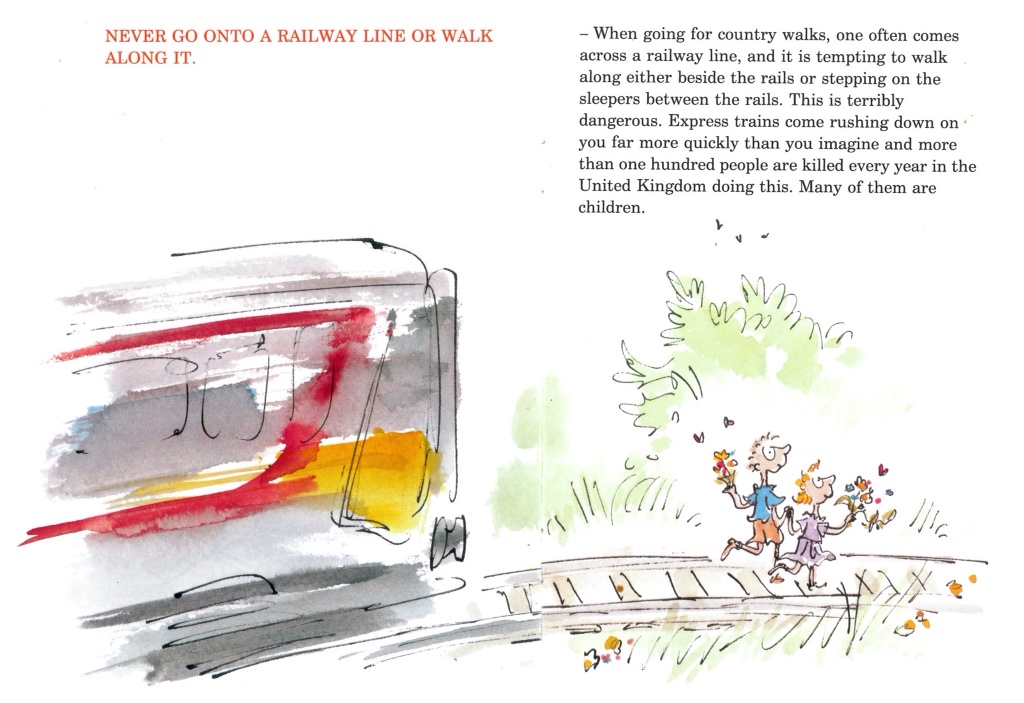
As tragic as his injury/death may be, I'm sorry but even at 6 years old (and about 8-9 years before I developed any interest in railways outside of Thomas and Friends), I knew full well that going onto a railway track was a bad idea. Heck, even Roald Dahl was writing about this as far back as '91. At some point, a parent must take responsibility for their own failings to supervise their gremlin and/or instilling of an understanding that trespass is bad, instead of just "passing the buck" on to Network Rail/GBR.There wasn’t that much time between that incident and a curious nine-year old boy being instantly electrocuted after exploring a hole in fence made by rail staff as a shortcut. I attended the inquest. Unfortunately of course there were no signs for the ‘idiot’ to ‘ignore’.
Tbf even with existing 3rd rail, 100mph is about the top speed they'll achieve iirc. A Class 444 on 750V DC has a top speed of 100mph, and the record is currently just shy of 110 atm.That's an example which uses very short trains going very slowly. And due to be upgraded to 1.5kV too. That sort of wiring will not power a 12 car train doing 100mph
The foresight in that comment against the backdrop of Lewisham only 5 years later is... interesting to say the least.I remember seeing that suggested in a railway magazine around 2013, not for safety reasons but to lessen the impact of snow and ice.
I'd wager that the batteries involved in vapes are, shall we say, rather poor quality compared to what goes into trains; this probably impacts how likely they are to "go up" in the first place.Would the third rail option look better if traction batteries in the UK were not deemed safe?
It seems that the Glasgow fire may have been uncontrollable because of Lithium batteries going up in the small vape shop.
Closing Glasgow Central for days may be the first railway triumph for the Lithium battery?
WAO

