• Our new ticketing site is now live! Using either this or the original site (both powered by TrainSplit) helps support the running of the forum with every ticket purchase! Find out more and ask any questions/give us feedback in this thread!

Should a Severn Rail Bridge Be Built?

Status
Not open for further replies.

zwk500

Veteran Member
Joined
20 Jan 2020
Messages
18,401
Location
Northampton
I assume that the required clearance would be somewhere between 100ft (Saltash) and 150ft (Forth), so it would have to go up about the same distance as the tunnel goes down, so with the same gradient on the inclines you end up with the same overall length. A good deal of that you'd want to be viaduct in any case, to cross the intertidal areas.
The M4/PoW bridge has a navigation clearance of 37m (121ft) above MHW. To go lower than that would require either approval from or to override the Gloucester Harbour Trustees and possibly Canal & River Trust, due to the impact on navigation to Sharpness docks.

Given the approach viaducts for the POW bridge are c.2km each side, if the railway followed the M4, it would need to 'launch' from each bank at c.17m elevation, and even then is still requiring a continuous 1:100 gradient from the bank to the summit.
This is marginally easier on the English side than the Welsh side, but on both sides would have extreme financial, environmental and political ramifications.
 
Sponsor Post - registered members do not see these adverts; click here to register, or click here to log in
R

RailUK Forums

The exile

Established Member
Joined
31 Mar 2010
Messages
9,303
Location
Somerset
Then only a couple of years after the tunnel, the Forth bridge was opened. To cross the Severn from rock-shelf to rock-shelf doesn't require that much more of a maximum span than the Forth bridge, so I don't think doing something similar across the Severn would have been too much of a stretch.
It would, however, have needed massive earthworks or an alternative on either side to get the line up to navigational clearance. Not so much of a problem at the Queensferries (haven’t been anywhere near the Tay for years!)
 

GRALISTAIR

Established Member
Joined
11 Apr 2012
Messages
10,452
Location
Preston Lancs
———-For the small benefits through, the cost would be huge so it's probably not worth it. An alternative which is likely to be more affordable would be to upgrade the diversion via Gloucester to allow better services during closures particularly if these are becoming more frequent.
I like this idea. Fully upgraded and electrified and line speed improvements then when/if traffic improve, build a second crossing later ( probably a bridge)
 

FGWHST43009

Member
Joined
3 Nov 2020
Messages
253
That makes no sense, if you build a new crossing you make it as fast and short as possible. You aren't going to build a new crossing as a secondary route.
I'd probably design for 300 or 320kmh but open at 250kmh, depending on whether HSLs have been built either side
 
Last edited:

Topological

Established Member
Joined
20 Feb 2023
Messages
4,253
Location
Swansea
I like this idea. Fully upgraded and electrified and line speed improvements then when/if traffic improve, build a second crossing later ( probably a bridge)
I suspect there are a few places where electrification would not be super easy. Chepstow maybe. I am not sure about the Swindon to Gloucester part.

In theory, electrification of Severn Tunnel Junction to Gloucester could support battery on the Birmingham-Cardiff as well as allowing TfW to switch to electric traction on an amended Cardiff-Gloucester service.

I still favour a tunnel from south of Bristol to Cardiff designed around a higher speed alignment and potential HS to London (see the various threads on routes for such). The advantage of that being that trains can serve Bristol Temple Meads and Cardiff, leaving the existing tunnel route for the local Bristol-Cardiff traffic.
 

Mikey C

Established Member
Joined
11 Feb 2013
Messages
8,228
The situation is rather different, in that the Second Severn Crossing is already approaching its design capacity and I believe traffic is still growing.

Significant numbers of vehicles (15000+/day) still pass over the old bridge, if it was to (functionally) close like the Forth Bridge they'd be creating a substantial overload on the new crossing.

I think its more likely that a new crossing will be required.
With the massive bottleneck on the M4 through the Brynglas Tunnel near Newport, and the M4 relief road cancelled, no way would they want to increase capacity across the Severn, as that would overload the Newport section even more.

At some point, a new tunnel will surely be dug, as the connection between Cardiff/Newport and Bristol is too important, and the route via Gloucester too long.
 

brad465

Veteran Member
Joined
11 Aug 2010
Messages
11,377
Location
Taunton or Kent
Having a look at the area on satellite, a bridge route would probably need to diverge east of Pilning, then gain enough elevation to cross over the M4 just east of Jct 22, before crossing the estuary either parallel to the PoW bridge, or for a straighter alignment, further away on the left bank but parallel on the right bank (Welsh side). If it did this it may then be possible to run next to Caldicot station, which could be expanded to serve both routes, which may even allow Severn Tunnel Jct to close (or at least have a scaled-back service), as an expanded Caldicot would duplicate the purpose and serves a larger urban area.

There would be challenges though in needing grade separation for having the fast/main running lines back on the north side west of this area, plus the pylon grids occupying the land between the M4 and the railway would have to be moved or converted to underground cables.
 

mmh

Established Member
Joined
13 Aug 2016
Messages
4,244
There'd be no point increasing the road capacity to get into Wales while it's policy to not increase capacity within Wales. All you'd be doing with another Severn crossing is getting traffic to a jam quicker.
 

zwk500

Veteran Member
Joined
20 Jan 2020
Messages
18,401
Location
Northampton
Having a look at the area on satellite, a bridge route would probably need to diverge east of Pilning,
then gain enough elevation to cross over the M4 just east of Jct 22, before crossing the estuary either parallel to the PoW bridge, or for a straighter alignment, further away on the left bank but parallel on the right bank (Welsh side). If it did this it may then be possible to run next to Caldicot station, which could be expanded to serve both routes, which may even allow Severn Tunnel Jct to close (or at least have a scaled-back service), as an expanded Caldicot would duplicate the purpose and serves a larger urban area.

There would be challenges though in needing grade separation for having the fast/main running lines back on the north side west of this area, plus the pylon grids occupying the land between the M4 and the railway would have to be moved or converted to underground cables.
The route would need to look something like this: 1775127884949.png
Approaches of that length would allow for the railway to be at the appropriate height to match the POW bridge, but there's an argument you could negotiate with Sharpness docks to agree a lower clearance if necessary.

Note the quite sharp wiggle coming off the welsh side to avoid Subbrook. You might be able to ease that if you relocated the Solar farms.
 

35B

Established Member
Joined
19 Dec 2011
Messages
5,362
I reckon they should have binned the whole project at that point, or earlier, ie. instead of reviving the derelict works. Nearly all the previous schemes for crossing the Severn estuary had been bridges, and the first scheme to succeed was a bridge, authorised in the same session as the tunnel but opening something like 9 years earlier at about the time the spring broke in. Then only a couple of years after the tunnel, the Forth bridge was opened. To cross the Severn from rock-shelf to rock-shelf doesn't require that much more of a maximum span than the Forth bridge, so I don't think doing something similar across the Severn would have been too much of a stretch.
Given the speed and weight restrictions on the major bridges of the era*, I think the GWR did absolutely right by continuing with the tunnel and maximising all-weather capacity on the route - even with the need for heavier locomotives. The ability to build long and high viaducts capable of taking high speeds and/or heavy loads is a more modern capability.

* - As well as the aforementioned Forth and Tay bridges, I'd add the original Severn rail bridge, the Royal Albert bridge and the iron viaducts at Belah, Deepdale, Meldon, and Crumlin.
 

Sir Felix Pole

Established Member
Joined
21 Oct 2012
Messages
2,151
Location
Wilmslow
The London & South Wales Rly. of 1895 proposed a bridge at the same site as the current M48 road one, with a new line to London via Thornbury, Malmesbury, Lechlade and joining the Met. Rly. at Great Missenden. In reality this was a device by dissatisfied South Wales coal owners to get the GWR to build the Badminton cut-off - which they succeded in doing.
 

PTR 444

Established Member
Joined
22 Aug 2019
Messages
2,647
Location
Wimborne
That makes no sense, if you build a new crossing you make it as fast and short as possible. You aren't going to build a new crossing as a secondary route.
But linking Lydney and Chepstow to Bristol by rail might have economic benefits in itself.

If not, then surely your best bet for a Second Severn Rail Crossing would be to build a tunnel between Avonmouth and Magor, utilising some of the Henbury Line on the eastern approach.
 

35B

Established Member
Joined
19 Dec 2011
Messages
5,362
But linking Lydney and Chepstow to Bristol by rail might have economic benefits in itself.

If not, then surely your best bet for a Second Severn Rail Crossing would be to build a tunnel between Avonmouth and Magor, utilising some of the Henbury Line on the eastern approach.
What scale of benefits, and how does that compare to the cost of serving them?
 

zwk500

Veteran Member
Joined
20 Jan 2020
Messages
18,401
Location
Northampton
But linking Lydney and Chepstow to Bristol by rail might have economic benefits in itself.

If not, then surely your best bet for a Second Severn Rail Crossing would be to build a tunnel between Avonmouth and Magor, utilising some of the Henbury Line on the eastern approach.
What gradient would you need from the Henbury Line to keep the tunnel in appropriate rock/clear navigation depth?
 

HSTEd

Veteran Member
Joined
14 Jul 2011
Messages
20,262
With the massive bottleneck on the M4 through the Brynglas Tunnel near Newport, and the M4 relief road cancelled, no way would they want to increase capacity across the Severn, as that would overload the Newport section even more.

At some point, a new tunnel will surely be dug, as the connection between Cardiff/Newport and Bristol is too important, and the route via Gloucester too long.
We shall see how long the M4 relief road remains cancelled....... I think it will be back.

But one bottleneck is not going to make accepting another bottleneck any more palatable.

== Doublepost prevention - post automatically merged: ==

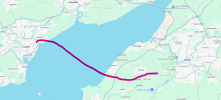
Here's my suggestion for a new Severn Rail crossing:

Route diverges from the Severn Beach Avonmouth Docks Branch line and uses the remaining open ground at Filton to dive into a tunnel. That tunnel then passes under the M5 and emerges from the side of the hillside at about 40m above sea level, probably as high as can be done and still get under the M5. That goes onto a large approach viaduct that then passes over the M48 and the dockland industrial estates onto the bridge. The shipping channel there is biased to the south side of the Channel, so there would be a main cable stay span of ~1100m, then a long gentle slope of approach viaduct down to rejoin the SWML near Magor.

~21km of new route, replacing outright ~17km of route between Patchway and Severn Tunnel Junction. The line between Magor and Severn Tunnel Junction just becomes part of the line to Gloucester.

This leaves us with the potential for a straight-through route from London to South Wales allowing trains to run fast if desired.
If you wanted I'm sure you could work out a road junction to make a combined road-rail bridge, but fitting in an appropriate road junction might lead ot impressive engineering, either from the M5 or (more extremely) from the M49 with spiral slip roads.
1775139116179.png

EDIT: Got the names of the branches mixed up, its the Avonmouth Dock Branch....
 
Last edited:

MarkyT

Established Member
Joined
20 May 2012
Messages
7,546
Location
Torbay
Note the quite sharp wiggle coming off the welsh side to avoid Subbrook. You might be able to ease that if you relocated the Solar farms.
If this section was already on an approach ramp bridge, then perhaps pillars would only need a few panels removed for each one while the remainder of the array could continue in situ with just the directly affected ones relocated nearby. As long as the new bridge doesn't throw a significant part of the array into permanent shadow.
 

zwk500

Veteran Member
Joined
20 Jan 2020
Messages
18,401
Location
Northampton
This leaves us with the potential for a straight-through route from London to South Wales allowing trains to run fast if desired.
If you wanted I'm sure you could work out a road junction to make a combined road-rail bridge, but fitting in an appropriate road junction might lead ot impressive engineering, either from the M5 or (more extremely) from the M49 with spiral slip roads.
Sandbox mode on:
1775140092063.png
- Allows for XC terminating at Bristol to be extended to Cardiff,
- Allows for local services from Cardiff via Bath,
- Allows for Clevedon station as short spur
- Allows for diversion of Portsmouth-Cardiff services to run direct,
- Allows freight to bypass Newport tunnel and the gauging restrictions,
- Allows for West Wales - Bristol services to run direct, or continue on to London

Of course this could never be built in todays Britain....
(Relief map included for some important context)
 

Attachments

  • 1775139778184.png
    1775139778184.png
    498.3 KB · Views: 40

Benjwri

Established Member
Joined
16 Jan 2022
Messages
3,260
Location
Bath
Of course this could never be built in todays Britain....
Well no, chiefly because being generous with a straight line measurement that's over 16km long. Thats a similar length to the Pingtan Strait Rail-Road Bridge, which cost around £1.6billion in 2020. That's the majority without covid effects, and being built in China which is significantly cheaper. For that money you're cutting the journey time to Bristol a bit maybe, but increasing it to London, while cutting Newport's trains. Building that will cost at least on par with, if not more than a new tunnel, while carrying all the disadvantages of a bridge in a very exposed area.
 

35B

Established Member
Joined
19 Dec 2011
Messages
5,362
Well no, chiefly because being generous with a straight line measurement that's over 16km long. Thats a similar length to the Pingtan Strait Rail-Road Bridge, which cost around £1.6billion in 2020. That's the majority without covid effects, and being built in China which is significantly cheaper. For that money you're cutting the journey time to Bristol a bit maybe, but increasing it to London, while cutting Newport's trains. Building that will cost at least on par with, if not more than a new tunnel, while carrying all the disadvantages of a bridge in a very exposed area.
All true, but if you could just combine it with the Severn Barrage...
 

zwk500

Veteran Member
Joined
20 Jan 2020
Messages
18,401
Location
Northampton
Well no, chiefly because being generous with a straight line measurement that's over 16km long. Thats a similar length to the Pingtan Strait Rail-Road Bridge, which cost around £1.6billion in 2020. That's the majority without covid effects, and being built in China which is significantly cheaper.
As I said, Sanbox mode was very much on.
For that money you're cutting the journey time to Bristol a bit maybe, but increasing it to London,
You'd be reducing the journey time to London by getting rid of capacity constraints.
while cutting Newport's trains.
You'd backfill Newport's trains, but Cardiff and Bristol are each twice the size of Newport so getting passengers heading directly between those cities off the trains stopping at places between Bristol and Cardiff is good for everybody, no?
Building that will cost at least on par with, if not more than a new tunnel, while carrying all the disadvantages of a bridge in a very exposed area.
This would be a tunnel, if ever built, not a bridge.
 

Topological

Established Member
Joined
20 Feb 2023
Messages
4,253
Location
Swansea
As I said, Sanbox mode was very much on.

You'd be reducing the journey time to London by getting rid of capacity constraints.

You'd backfill Newport's trains, but Cardiff and Bristol are each twice the size of Newport so getting passengers heading directly between those cities off the trains stopping at places between Bristol and Cardiff is good for everybody, no?

This would be a tunnel, if ever built, not a bridge.
It is definitely the best solution.

You then have Cardiff to Temple Meads running regularly and serving the new stations. You also have the potential to still have faster trains between Newport and Bristol that way.

I would consider a 387 service Paddington - Newport as well. That would give you a London train which was empty for passengers at Newport (instead of being already mostly full from Cardiff) and perfectly good for 2 hours to London. I think London is the only big miss from Newport IF the mainline was diverted.

You could also add an EMU from Cardiff to Bristol Parkway on the other half hour to the 387 service. That would allow connections into CrossCountry to be maintained from Newport.
 

Mgameing123

Member
Joined
29 Apr 2023
Messages
1,031
Location
Denmark
Looks like another thread where I can refer to my HS3 proposal: https://www.railforums.co.uk/threads/hs3-paddington-to-newport.271688/

I know it’s too early for it but how could a potential HS3 to the West look like. Currently the Great Western Mainline is at capacity between Reading and Paddington mainly because of the Elizabeth Line is hopefully this new line could divert existing GWR trains on the new line.

My vision would look like Paddington - Old Oak Common - Heathrow Central - Reading - New Bristol Cental Station? - Newport.

To cross the river Severn we will need to build a tunnel between Portishead and somewhere near the coast of Newport.

The most realistic way this would be built is by starting with Phase 1 between Paddington and Reading just to help alleviate capacity. Then Phase 2 between Newport and Bristol then Phase 3 between Reading and Bristol.

Benefits of HS3:

- Possibility to send GWR trains between Paddington and South Wales via Bristol which is a high demand destination.

- More capacity on the GWML so possibility to run additional Elizabeth Line trains, freight trains and even some more semi fast trains.

- Direct train connections between West England, South Wales and Heathrow Airport.

Report
 

brad465

Veteran Member
Joined
11 Aug 2010
Messages
11,377
Location
Taunton or Kent
We shall see how long the M4 relief road remains cancelled....... I think it will be back.

But one bottleneck is not going to make accepting another bottleneck any more palatable.

== Doublepost prevention - post automatically merged: ==

Here's my suggestion for a new Severn Rail crossing:

Route diverges from the Severn Beach Avonmouth Docks Branch line and uses the remaining open ground at Filton to dive into a tunnel. That tunnel then passes under the M5 and emerges from the side of the hillside at about 40m above sea level, probably as high as can be done and still get under the M5. That goes onto a large approach viaduct that then passes over the M48 and the dockland industrial estates onto the bridge. The shipping channel there is biased to the south side of the Channel, so there would be a main cable stay span of ~1100m, then a long gentle slope of approach viaduct down to rejoin the SWML near Magor.

~21km of new route, replacing outright ~17km of route between Patchway and Severn Tunnel Junction. The line between Magor and Severn Tunnel Junction just becomes part of the line to Gloucester.

This leaves us with the potential for a straight-through route from London to South Wales allowing trains to run fast if desired.
If you wanted I'm sure you could work out a road junction to make a combined road-rail bridge, but fitting in an appropriate road junction might lead ot impressive engineering, either from the M5 or (more extremely) from the M49 with spiral slip roads.

EDIT: Got the names of the branches mixed up, its the Avonmouth Dock Branch....
This proposal looks good IMO, although I do wonder if the remaining open land at Filton is enough to allow this. If that ever happened I think it should be 125mph all the way through the new alignment and the existing route into Newport, with provision for faster than this. Patchway would probably also have to become a northern terminus for some local services, and there would also need to be separation of the new crossing route from the Docks' line, so the latter never has to conflict with the former.
 

The Planner

Veteran Member
Joined
15 Apr 2008
Messages
19,624
But linking Lydney and Chepstow to Bristol by rail might have economic benefits in itself.

If not, then surely your best bet for a Second Severn Rail Crossing would be to build a tunnel between Avonmouth and Magor, utilising some of the Henbury Line on the eastern approach.
Give them better connections at Tunnel Jn. Its a sledgehammer to crack a nut.
 

Pigeon

Member
Joined
8 Apr 2015
Messages
1,123
The M4/PoW bridge has a navigation clearance of 37m (121ft) above MHW. To go lower than that would require either approval from or to override the Gloucester Harbour Trustees and possibly Canal & River Trust, due to the impact on navigation to Sharpness docks.

Given the approach viaducts for the POW bridge are c.2km each side, if the railway followed the M4, it would need to 'launch' from each bank at c.17m elevation, and even then is still requiring a continuous 1:100 gradient from the bank to the summit.
This is marginally easier on the English side than the Welsh side, but on both sides would have extreme financial, environmental and political ramifications.

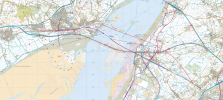
Ah, I was imagining a scenario from quite a while before the M4 existed :) But never mind, 37m is within my anticipated range, so here's a diagram of it based on the OS 1:25000 map. I've tried to overlay your route on the map as well; it needs a bit of tweaking to make it match up and I haven't got it spot on so I've left some of the motorways represented on the image to give an idea of the remaining inaccuracies.

The only part that needs the 37m clearance is the span crossing The Shoots. We can found two piers, one either side, on rock shelves exposed at part tide (rather more easily than some lighthouses were built). We can then mark two arcs at 3.7km radius from those piers, indicating where a straight line on a 1:100 gradient would get back to zero.

It turns out to be possible to join the South Wales main line in the same place and by a route very little different to that which the tunnel takes underneath, without exceeding 1:100, and with scope to vary the route to reduce it still further (given that most of the buildings weren't there at the time), mostly by building more embankment. The curve on the sketch is the same radius as that in the tunnel. On the English side things are even easier; I've taken the route in the sketch right back to Pilning station simply to show that if it starts going up at the same point that the tunnel route descends into cutting, you can do a lot better than 1:100.

The tricky bit is the main span needing to be 50% longer than the Forth bridge maximum span. On the other hand you only need one of them, so the "serious ironmongery" section of the bridge is shorter than that of the Forth bridge. I get the impression that while the Forth bridge was unprecedentedly large, it still wasn't approaching the limits of what the structural method was capable of. The problems of a Severn bridge are not all the same so a different design would be needed; I reckon it would have been tricky, but not impossibly so by then.

Given the speed and weight restrictions on the major bridges of the era*, I think the GWR did absolutely right by continuing with the tunnel and maximising all-weather capacity on the route - even with the need for heavier locomotives. The ability to build long and high viaducts capable of taking high speeds and/or heavy loads is a more modern capability.

* - As well as the aforementioned Forth and Tay bridges, I'd add the original Severn rail bridge, the Royal Albert bridge and the iron viaducts at Belah, Deepdale, Meldon, and Crumlin.

Oh - I'd exclude most of those on the grounds of predating steel and/or being minimalist in order to save money. I keep referring to the Forth bridge not just because of its length of span, but because it was built in steel, and built jolly strong (in reaction to the Tay bridge collapse). It seems to achieve about the same capacity as the tunnel. It may be a problem in high winds, but then the tunnel is vulnerable to high tides and storm surges. I admit I haven't tried to estimate how often a Severn bridge would be out of action compared to the tunnel; I don't think data for the road bridge is much use, and anything better would require too much digging for a casual thought!

I'm not sure that the tunnel did give the GWR more capacity than a bridge would have done; it was a considerable bottleneck. Freight trains would take a good fifteen minutes to get through the section, on top of which there was all the messing about with bankers. There were often queues.

It has to be said I am also more concerned than the GWR were about the utterly vile working conditions in the tunnel for both footplate and maintenance crews. A bridge may be more exposed but at least it doesn't suffocate you...

The tunnel scheme had originally lost out to a bridge scheme, but due to the GWR being skint at the time nothing was actually done and the powers lapsed. But Charles Richardson, the promoter of the tunnel scheme, kept re-submitting it and eventually did get it authorised, whereupon the GWR seem to have adopted it as much because it was there as anything, and then still proceeded with a distinct lack of enthusiasm for some years; it seems to have been as much the persistence of particular individuals that carried it through, and the desire not to abandon what had been put into it already, as any strong corporate will. Even when it was finally opened it took them a few years to really start using it.

To be sure some of the specific obstacles they encountered could not have been foreseen, but some could, and the operating restrictions and maintenance difficulties are inseparable from the design. Of course a bridge has its own difficulties and limitations, but it's not clear to me that had the GWR weighed the one against the other rather than simply taking what was offered to them at the time, they would have decisively found in favour of a tunnel.

 

Attachments

  • 14.png
    14.png
    2.6 MB · Views: 50

Smwrff

Member
Joined
27 Dec 2023
Messages
250
Location
Cymru Fawr
I believe that a tidal barrage should be built near the existing tunnel - the Shoots barrage proposal - with locks to allow the limited shipping to Gloucester (how much shipping actually passes this point?)

But the trick is to build the rail track into the barrage itself - use precast concrete caissons to form the structure of the barrage - with a 'tunnel' cast into the caissons. The barrage tunnel would not need to be as deep as existing tunnel - deepest section would be under the locks - so approach lengths would be reduced. Feasible??
 

JamesT

Established Member
Joined
25 Feb 2015
Messages
4,824
I believe that a tidal barrage should be built near the existing tunnel - the Shoots barrage proposal - with locks to allow the limited shipping to Gloucester (how much shipping actually passes this point?)

But the trick is to build the rail track into the barrage itself - use precast concrete caissons to form the structure of the barrage - with a 'tunnel' cast into the caissons. The barrage tunnel would not need to be as deep as existing tunnel - deepest section would be under the locks - so approach lengths would be reduced. Feasible??
Combining a barrage with a rail link has been suggested before.
Unfortunately the environmental damage and the effect on the shipping channel a barrage would cause almost certainly mean one will never be built.
 
Status
Not open for further replies.

Top