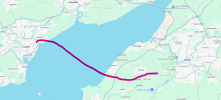
The M4/PoW bridge has a navigation clearance of 37m (121ft) above MHW. To go lower than that would require either approval from or to override the Gloucester Harbour Trustees and possibly Canal & River Trust, due to the impact on navigation to Sharpness docks.
Given the approach viaducts for the POW bridge are c.2km each side, if the railway followed the M4, it would need to 'launch' from each bank at c.17m elevation, and even then is still requiring a continuous 1:100 gradient from the bank to the summit.
This is marginally easier on the English side than the Welsh side, but on both sides would have extreme financial, environmental and political ramifications.
Ah, I was imagining a scenario from quite a while before the M4 existed

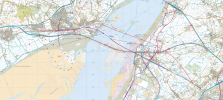
But never mind, 37m is within my anticipated range, so here's a diagram of it based on the OS 1:25000 map. I've tried to overlay your route on the map as well; it needs a bit of tweaking to make it match up and I haven't got it spot on so I've left some of the motorways represented on the image to give an idea of the remaining inaccuracies.
The only part that needs the 37m clearance is the span crossing The Shoots. We can found two piers, one either side, on rock shelves exposed at part tide (rather more easily than some lighthouses were built). We can then mark two arcs at 3.7km radius from those piers, indicating where a straight line on a 1:100 gradient would get back to zero.
It turns out to be possible to join the South Wales main line in the same place and by a route very little different to that which the tunnel takes underneath, without exceeding 1:100, and with scope to vary the route to reduce it still further (given that most of the buildings weren't there at the time), mostly by building more embankment. The curve on the sketch is the same radius as that in the tunnel. On the English side things are even easier; I've taken the route in the sketch right back to Pilning station simply to show that if it starts going up at the same point that the tunnel route descends into cutting, you can do a lot better than 1:100.
The tricky bit is the main span needing to be 50% longer than the Forth bridge maximum span. On the other hand you only need one of them, so the "serious ironmongery" section of the bridge is shorter than that of the Forth bridge. I get the impression that while the Forth bridge was unprecedentedly large, it still wasn't approaching the limits of what the structural method was capable of. The problems of a Severn bridge are not all the same so a different design would be needed; I reckon it would have been tricky, but not impossibly so by then.
Given the speed and weight restrictions on the major bridges of the era*, I think the GWR did absolutely right by continuing with the tunnel and maximising all-weather capacity on the route - even with the need for heavier locomotives. The ability to build long and high viaducts capable of taking high speeds and/or heavy loads is a more modern capability.
* - As well as the aforementioned Forth and Tay bridges, I'd add the original Severn rail bridge, the Royal Albert bridge and the iron viaducts at Belah, Deepdale, Meldon, and Crumlin.
Oh - I'd exclude most of those on the grounds of predating steel and/or being minimalist in order to save money. I keep referring to the Forth bridge not just because of its length of span, but because it was built in steel, and built jolly strong (in reaction to the Tay bridge collapse). It seems to achieve about the same capacity as the tunnel. It may be a problem in high winds, but then the tunnel is vulnerable to high tides and storm surges. I admit I haven't tried to estimate how often a Severn bridge would be out of action compared to the tunnel; I don't think data for the road bridge is much use, and anything better would require too much digging for a casual thought!
I'm not sure that the tunnel did give the GWR more capacity than a bridge would have done; it was a considerable bottleneck. Freight trains would take a good fifteen minutes to get through the section, on top of which there was all the messing about with bankers. There were often queues.
It has to be said I am also more concerned than the GWR were about the utterly vile working conditions in the tunnel for both footplate and maintenance crews. A bridge may be more exposed but at least it doesn't suffocate you...
The tunnel scheme had originally lost out to a bridge scheme, but due to the GWR being skint at the time nothing was actually done and the powers lapsed. But Charles Richardson, the promoter of the tunnel scheme, kept re-submitting it and eventually did get it authorised, whereupon the GWR seem to have adopted it as much because it was there as anything, and then still proceeded with a distinct lack of enthusiasm for some years; it seems to have been as much the persistence of particular individuals that carried it through, and the desire not to abandon what had been put into it already, as any strong corporate will. Even when it was finally opened it took them a few years to really start using it.
To be sure some of the specific obstacles they encountered could not have been foreseen, but some could, and the operating restrictions and maintenance difficulties are inseparable from the design. Of course a bridge has its own difficulties and limitations, but it's not clear to me that had the GWR weighed the one against the other rather than simply taking what was offered to them at the time, they would have decisively found in favour of a tunnel.