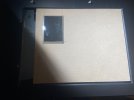
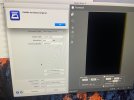
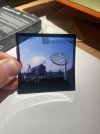
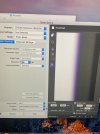
I think that if you are going to use a conventional* flatbed scanner to scan a transparency then you are unlikely to get good results. Despite what was said earlier, if there are paper prints available, these will probably be a better choice.
First: Transparencies really need to have a light shone
through them, rather than
at them. They aren't intended to reflect light back the way it came, they are intended to modulate the (even) amount of light as it passes through. (Think about looking at slides with the naked eye; you can't see them clearly unless you hold them up to the light and look through them; your basic scanner can't do that and will see something like what you see if you try and view a slide on a piece of paper on a desk).
If you try to correct this by (say) scanning against a white background the light source will pass through the film to the background and then back again. In so doing , it will "project" an image onto the white background. The "projected" image on the background will form part of the scanned file and, especially if that background is not right next to the film, may appear like double/ghost image.
Second: if there is any kind of frame for the transparency then it won't be right on the scanner glass.. Many scanners do not have any depth of field meaning that anything that is not right on the glass will be "out of focus".
Had these been conventional film sizes then there are some pretty good flatbed scanners out there (mine's a Canon) which are designed for scanning transparencies/films. They (a) have very good depth of field, meaning that the scan is in focus when away from the glass by a few mm. and (b) have a light source in the lid as well as under the glass and when scanning transparency it is the lid light (only) that is lit, thus shining through, not at, the film. My Canon's lid light source does not, however extend the whole bed; it's only wide enough to do up to something like 120 roll film negatives. If I were scanning plates like these, I'd have to do each one in narrow strips and then stitch them together manually (eg in Photoshop). There are also dedicated film scanners, but again these are typically limited to conventional film sizes.
I have no knowledge of any transparency ("through") scanners suitable for direct and complete scan of larger plates. I guess there will be some, somewhere.
=================================================================================
* by conventional, I mean one where the light source and the scanning sensor are on the same side of the material being scanned
=================================================================================
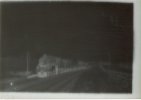
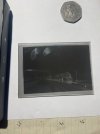
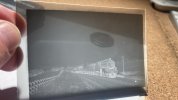
To illustrate what is "wrong" with using a conventional scanner, I have taken your first direct scan and inverted it both to positive and laterally and briefly tweaked the contrast so you can see how indistinct and flawed it is. And done the same positive and contrast tweaks with your direct photograph (fingerprints and all) for comparison. At the very least, the blurring should be evident.





 ) so I think want the photos preserved for prosperity somehow. I've already purchased a 2TB external SSD in anticipation of the a the large volume of data - seems like .Tiff would be the way to go. I don't about the particular scanner he has I'll have to consult with my sister who help him purchase it. Thanks so much for your advice gentlemen