Outside Georgia's parliament, Yevgeny Lyamin heaves boxes of clothes and food parcels on to a waiting truck bound for Ukraine.
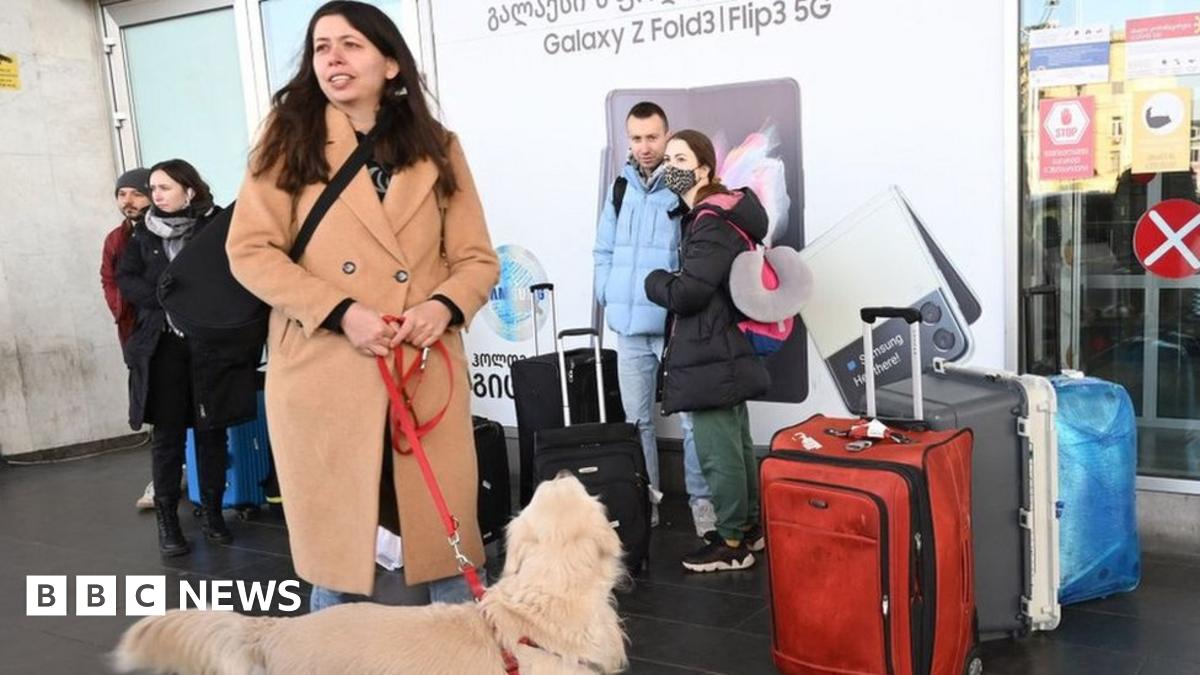
He is one of more than 25,000 Russians to have arrived in Georgia since Russia's invasion of Ukraine. Russians have been struggling to find affordable accommodation in all the major cities. Many can be seen wandering around the capital, Tbilisi, with their suitcases and often even their pets.
A blue-and-yellow ribbon is attached to the lapel of Yevgeny's trench-coat - the colours of the Ukrainian flag. It was these ribbons that got him arrested at an anti-war protest in Russia, a day after it launched its war on Ukraine.
"I understood the best way to act against Putin's regime would be my emigration from Russia," says the 23-year old politics graduate. "It's my responsibility to do anything I can to help the Ukrainians."
The exodus does not stop at Georgia. The EU, US, UK and Canada have closed their airspace to Russian flights, so they are heading for countries where flights are still permitted and where visas are not required, such as Turkey, Central Asia and the South Caucasus. Many have fled to Armenia.
According to one estimate by a Russian economist, as many as 200,000 Russians have left their country since the start of the war.
Belarusians are on the move too, fleeing repression and the Western sanctions imposed on authoritarian leader Alexander Lukashenko's government for collaborating with Russia's Vladimir Putin.
That has prompted prices to surge on last-minute flights and rental accommodation in the main host cities, such as Istanbul and Armenia's capital, Yerevan.
"A one-way flight to Istanbul cost me and my husband more than our combined monthly income," said Anya, who did not want to give her surname.
For her the moment of decision came with a new "state betrayal" law that has come into force in Russia. Anyone expressing support for Ukraine could face jail sentences of up to 20 years and Anya believed she could be a target.
"Fear of closed borders, political repression and forced military service is in our DNA. I remember my grandmother telling me stories about the state of fear they lived in during Stalin's time, and now we are experiencing it," she said.