Baxenden Bank
Established Member
- Joined
- 23 Oct 2013
- Messages
- 4,748
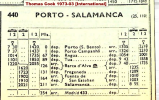
Finally, for the period being discussed, the March 1973 Thomas Cook International timetable. As per previous available on timetableworld.com.

Finally, for the period being discussed, the March 1973 Thomas Cook International timetable. As per previous available on timetableworld.com.
The Sud Express certainly did have coaches running across the break of gauge - in the form of Paris-Lisbon and Paris-Porto couchettes.
The O in Oporto is the definite article "the" in the masculine singular. O Porto or Oporto means " the Port". More than one port would be Os Portos. The feminine equivalents are A and As.And they shortened Oporto to Porto.
Looking at my Nov 1974 Cooks, while table 28 (the Sud Express) doesn't show a through coach from Porto, it does have a connecting train #302 16.40 from Porto.So that's almost identical to February 1972 except that in 1972 on two days a week the 7:50 from Porto continued to Salamanca, and the 22:18 arrival came from Salamanca.
And they shortened Oporto to Porto.
So I have read, but if it was doing it in the Winter of 1972 then the Thomas Cook would appear to be in error.
It shows seated coaches only between Paris and Hendaye/Irun and couchettes from the border to Madrid and sleepers to Lisbon.
But in any case there are other examples where this timetable shows timings in a fashion that would indicate a through train in a modern issue but can't have been, e.g. London to Moscow.
So I'm a bit wary of concluding that something is a through train unless it actually lists it as having through coaches.
I hadn't realised the Norte main line was already electrified by that time! Wow, that's some achievment in poor, war-torn Spain. The wires can't have gone all the way to Madrid, surely?Franco met Hitler at Hendaye in France in 1940 - there is rather chilling newsreel footage (can't link as on mobile) for the station has hardly changed since. Franco overplayed his hand with his 'demands' - Hitler famously said he would rather have teeth extracted than meet him again. Franco's train was interesting - hauled by a Norte 'crocodile' electric loco. On leaving the coaches snatched causing him to nearly fall over which gave Charlie Chaplin inspiration for the scene in the 'Great Dictator'!

You know, I knew the O was the definite article in Portuguese, but I never twigged that that was the reason for the English version of the city of Porto. But it's got me thinking ... I'll have to start another thread.The O in Oporto is the definite article "the" in the masculine singular. O Porto or Oporto means " the Port". More than one port would be Os Portos. The feminine equivalents are A and As.
The Norte electrification only reached Alsasua from Hendaye / Irun by the start of the Civil War - a long gruelling climb for steam previously. It was at 1500V DC which it remained at until the '70s when it was converted to the Spanish standard of 3000V DC.I hadn't realised the Norte main line was already electrified by that time! Wow, that's some achievment in poor, war-torn Spain. The wires can't have gone all the way to Madrid, surely?
Here's another shot from 73 - from the (very) 'far' end of the Douro Valley.
View attachment 200107
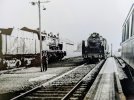
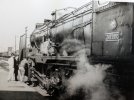
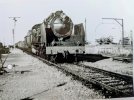
An oil-fired RENFE 141F swings westerwards from Salamanca towards the Portugues border one sunny afternon in, I think, June 1973. It was almost certainly heading on the main line to Portugal, not the Douro Valley via Barca D'Alva. Copyright IronDuke
The 141Fs felt like the Black 5 of Spain, and I would guess they were the last working steam locos on the main line system. There weren't many about even when this pic was taken.
I've begun to remember I was still using an Exakta VX1000 camera at this time. Not only that, but on the first of my two trips to Portugal that month, it fell over on a tripod and knacked the bayonet fitting. Fearing problems, I returned to Iberia with a friend's Praktika SLR (I forget the exact marque), so this pic might have been with the Exakta, Praktika or Canon FTb. Lens looks to be my old Soligor 135mm ft 2.8 manual that I'd picked up in Derby for about £18. Not a bad piece of glass for that price back in the day, if one didn't mind the manual stop down.
As for the Exakta and it's dodgy mount, I just twisted the mount back with the leverage of a telephoto lens and bob's yer uncle, it continued in use with no problems for a few more years. I sold it on in the early 80s, who knows, might still be in use.
Fascinating. And amazing that a railway in Spain began eletrfication like that so early, given its miserable economy and highly unstable political situation. Yes, I remember that the line from San Sebastian to Alsasua involved one mighty climb. I'd always assumed that's what they'd built the 242Fs to tackle.The Norte electrification only reached Alsasua from Hendaye / Irun by the start of the Civil War - a long gruelling climb for steam previously. It was at 1500V DC which it remained at until the '70s when it was converted to the Spanish standard of 3000V DC.
 )
) 

Looking at my Nov 1974 Cooks, while table 28 (the Sud Express) doesn't show a through coach from Porto, it does have a connecting train #302 16.40 from Porto.
However table 421 shows that train in 2 almost identical columns, that in column marked S having 2nd class seats Lisbon and Porto to Hendaye and 2nd class couchettes (French) Porto to Paris.
The Norte was reasonably prosperous serving the industrial North , plus Barcelona and Valencia, rather than the impoverished South as served by the MZA. It also received state aid for electrification prior to 1931 - there had been severe coal shortages during WW1 (like Switzerland) highlighting Spain's vulnerability. British capital had originally built the lines - they still have left-hand running to this dayFascinating. And amazing that a railway in Spain began eletrfication like that so early, given its miserable economy and highly unstable political situation. Yes, I remember that the line from San Sebastian to Alsasua involved one mighty climb. I'd always assumed that's what they'd built the 242Fs to tackle.
Alsasua had a sweet cantina, if I rmember properly. Funny thing, about a year back, I met a young Spanish woman who said she came from Pamplona. I told her how I remembered the strange rock formations on the train to Pamploua from Alsasua. Her face lit up - "That's my home town!" she said, amazed that a Brit should know of the place. (I guess it's like meeting a Turk who says he knows Woodford Halse
I saw my first workiing RENFE steam there in 1971 - a 141F, of course. Not that it seemed to be doing anything to earn any revenue.
.....and miles became kilometres!BTW it was J H Price who decided to 'enter the modern world' and dispense with 'obsolete' anglicised place names in the Cooks timetable (known as 'CTT' to staff and others 'in the know') in the late 1970s, hence the last s was dropped off 'Lyons' and 'Marseilles', Vienna became Wien, Geneva became Geneve - etc

BTW it was J H Price who decided to 'enter the modern world' and dispense with 'obsolete' anglicised place names in the Cooks timetable (known as 'CTT' to staff and others 'in the know') in the late 1970s, hence the last s was dropped off 'Lyons' and 'Marseilles', Vienna became Wien, Geneva became Geneve - etc
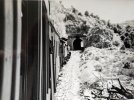
Rooting through my photos I found this shot I took on my 1968 trip. I was leaning out of the window somewhere between Barca d'Alva and Fregeneda but I don't know whether at this point I was in Portugal or Spain. I do recall passing a weather battered sign saying EspañaThere were never many passengers. The border region was striking in its barreness. I was only ever there in summer, but the overriding impression was of brown-yellow baked rocks for miles and miles. It felt as if it hadn't rained for a year or more. I suppose this wilderness went on for maybe 12-14 miles, then there were occasional hamlets, but nothing very serious until we joined the 'main line' from Salamanca into Portugal.
I thnk the entire line east of Regua, certainly east of Tua, would have given Richard Beeching a heart attack.