• Our new ticketing site is now live! Using either this or the original site (both powered by TrainSplit) helps support the running of the forum with every ticket purchase! Find out more and ask any questions/give us feedback in this thread!

Plans to curb 'rip off' rail fares.

Status
Not open for further replies.

bb21

Emeritus Moderator
Joined
4 Feb 2010
Messages
24,469
I don't think splitting can ever be eliminated, so should not be barred.

 
Sponsor Post - registered members do not see these adverts; click here to register, or click here to log in
R

RailUK Forums

bb21

Emeritus Moderator
Joined
4 Feb 2010
Messages
24,469
It is an extremely anti-customer practice as it goes against common sense.
 

wellhouse

Member
Joined
4 Oct 2009
Messages
659
Location
West Yorkshire
I can't work out if this is just an RDG initiative on non-regulated fares, or if the DfT has given them a green light to propose something radical across the board....
I'd like to hear from DfT what scope of change they will allow, and on what timescale.
.

DFT's 'Connecting People - A Strategic Vision For Rail' (November 2017) has this to say about Fares Reform;

3.11 We are working with the rail industry to develop and test potential reforms, and we will review rail ticketing with the aim of removing complexity and perverse pricing. We want to find the right solutions to simplify fares structures, and improve passenger satisfaction and confidence that the price they pay is fair.
3.12 We recognise that working and commuting patterns have changed, and therefore in all recent franchise competitions we have included a requirement to offer part-time commuters alternative products that reflect how often they use the network. We will continue to require bidders to offer similar products as franchises are re-let.
3.13 We will also work with industry to extend the benefits of discounted rail travel to ensure those aged 16 to 30 can access appropriate concessions. This will include the introduction of a new railcard for ages 26-30, which we anticipate will increase the number of journeys taken. Further details will be announced in agreement with the industry and will be implemented from Spring 2018.

Two of the virtues of the British Rail ticketing system are options for connectivity and flexibility, without the need to commit to a particular service; the possibility of through ticketing a journey embracing long distance and local rail services.sometimes with PlusBus connections at each end, or alternatively, ticketing multiple journeys on a single ticket over a period of time (Seasons/Rovers/Rangers). It is challenging to contemplate how such a system can be a simple one. What must be improved is transparency for typical travellers, and Trainsplit is a splendid example of how this can be acheived.

Pricing strategies, while often presented as devices to smooth demand, are generally more focussed on maximising revenue; googling 'Airline Fare Algorithim Impossible' throws up a number of informative sites on Pricing and Ticketing strategies. It should be noted that Air Travel (especially with Low Cost Operators) lacks the flexibility and connectivity of Rail Travel. Ryanair, for example, do not ever offer through booking for their own connecting flights.
 

AlterEgo

Verified Rep - Wingin' It! Paul Lucas
Joined
30 Dec 2008
Messages
29,608
Location
LBK
Pricing strategies, while often presented as devices to smooth demand, are generally more focussed on maximising revenue; googling 'Airline Fare Algorithim Impossible' throws up a number of informative sites on Pricing and Ticketing strategies. It should be noted that Air Travel (especially with Low Cost Operators) lacks the flexibility and connectivity of Rail Travel. Ryanair, for example, do not ever offer through booking for their own connecting flights.

That's because you can't stand in the aisle on a plane. The most fundamental principle of railway ticketing in this country is one level below what you (correctly) outline as flexibility - it's actually the principle that you may need to stand to get to where you're going, even on long distance trains.

Air travel ticketing is extraordinarily complex with many more permutations for loopholes than rail travel, but it is a very niche pursuit. The important thing is that from a layperson's perspective the purchasing and decision process is intuitive and simple, even if below the surface it is horrendously complex to the academic mind.
 

LAX54

Established Member
Joined
15 Jan 2008
Messages
3,906
Single
Return valid one month / anytime
Day Return (after 10.00 return anytime)
Cheap Day Return (after 1030, no return 1530 to 1930) valid all day at weekends / bank holidays
 

squizzler

Established Member
Joined
4 Jan 2017
Messages
1,912
Location
Jersey, Channel Islands
Why does there have to be one national fare structure? With the rise of various online ticketing agents, let me suggest an alternative:
  1. Each big online ticket agent (i.e. Thetrainline, Nationalrail) contributes a share of the running cost of the trains and is rewarded with a proportionate number of own branded seats (i.e. with their logo on the antimacassars) on every train on the network (or those routes they choose to be agents for).
  2. People who brought their tickets from a ticketing agency are required to sit on the seats that have their agent's antimacassars attached.
  3. It is up to the agent to run their own pricing model to maximise revenue and seat occupation. This will enable the individual agents to experiment with new ways of paying for your journeys.
  4. Obviously there will remain seats with unbranded antimacassars for those who have walk up fares or use an independent ticketing agent not affiliated with the big operators.
  5. When the system becomes more established the agent does not just get antimacassar with their logo on it, but gets to fully furbish certain lengths of train upholstered in their logo. Those agents that invest in the more comfy seats and careful alignment with windows get more business!
I think stagecoach did something similar in attaching their own coaches to service trains just before rail privatisation, but maybe its now time to revisit the idea?
 

Tetchytyke

Veteran Member
Joined
12 Sep 2013
Messages
17,635
Location
Isle of Man
It is an extremely anti-customer practice as it goes against common sense.

IE are daft as hell though.

I completely agree. But I fear that neither of those points would stop RDG from trying. Look at Virgin's restrictions in North Wales and at Preston, for instance.

Pricing strategies, while often presented as devices to smooth demand, are generally more focussed on maximising revenue

Indeed. It's often said on here that Advances are about "filling empty seats", but it is often the exact opposite. It's certainly clear with peak trains out of London that the pricing strategy is about maximising revenue: it is better for the TOC to sell one seat at £120 than it is to sell three seats at £39 or two seats at £59, which is why peak trains are often only half-filled. It only changes at the end of the peak period, which are some of the busiest trains ex-London, because the regulated fare acts as a ceiling to the prices that can be charged.

If that regulated ceiling is weakened or scrapped, I think we all know what will happen.
 
Last edited:

Dai Corner

Established Member
Joined
20 Jul 2015
Messages
6,998
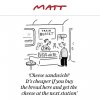
The Daily Telegraph cartoonist's take on the subject.

A customer in a railway buffet asks for a cheese sandwich and is advised that it's cheaper to buy the bread there and the cheese at the next station.
 

Attachments

  • IMG_1028.JPG
    IMG_1028.JPG
    84.7 KB · Views: 55

whhistle

Established Member
Joined
30 Dec 2010
Messages
2,636
I’d start with harmonising all off peak restrictions - every single one.
This is a good one.
Different off-peak times depending on where you're travelling from and where you're travelling to.
Blanket every station 5am - 9am and 4pm - 8pm or whatever. It'll be easier for everyone to understand if you join a train within those times, it's peak, albeit more expensive for some.

I guess this then brings up the whole "peak train going off-peak during a journey" thing for longer journeys, which then encourages split ticketing.

But how do you solve the problem? And it is a problem that London has different restrictions than Birmingham, hell, even different London stations have different peak restrictions!
 

cuccir

Established Member
Joined
18 Nov 2009
Messages
3,695
I don't think splitting can ever be eliminated, so should not be barred.

A PAYG smart card system could prevent most splitting, or at least splitting without taking an extended break, quite easily. It would simply calculate your fare based over a whole day or possibly even over a period of days, however was appropriate within the system. I'm not advocating this, but it cold be possible.

I’d start with harmonising all off peak restrictions - every single one.
This is a good one.
Different off-peak times depending on where you're travelling from and where you're travelling to.
Blanket every station 5am - 9am and 4pm - 8pm or whatever. It'll be easier for everyone to understand if you join a train within those times, it's peak, albeit more expensive for some.

I guess this then brings up the whole "peak train going off-peak during a journey" thing for longer journeys, which then encourages split ticketing.

But how do you solve the problem? And it is a problem that London has different restrictions than Birmingham, hell, even different London stations have different peak restrictions!

This is quite a nice example of the complexities of the problem though. At the moment, (AFAIK) there are no evening peak restrictions for any journeys which are contained entirely in the North-East of England. It's hard to argue that adding peak restrictions will make train tickets 'simpler', never mind easier, fairer or cheaper. It would also leave empty trains in the 'late peak' in particular, lead to overcrowding on services 15:00-16:00 etc etc.

I'm sure we can simplify the range of off-peak restrictions, but I do come back to the point I've already made - any answer which simplifies to the extent of "get rid of all of x" or "merge all tickets to be like x" will not be the right answer, it may not even really 'simplify' matters.
 

Bletchleyite

Veteran Member
Joined
20 Oct 2014
Messages
113,762
Location
"Marston Vale mafia"
That's easier to understand, but it still promotes splitting - you split at the point where the time goes past 9am / 8pm. The evening peak causes most anomalies.

The least anomaly-causing system I can see is one based on *the train you are on* arriving in a set of specified major locations (morning) or departing from them (evening). Or as an alternative, the train itself being specified as peak or off-peak within a particular area.

But really, the only way to avoid anomalies from off-peak walk-ups is to abolish them entirely.
 

AlterEgo

Verified Rep - Wingin' It! Paul Lucas
Joined
30 Dec 2008
Messages
29,608
Location
LBK
Why? Why not have both?

I don't mean to scrap seasons, but a carnet at a fixed price pro-rated to the season would be much more useful for most people, if offered on a smart card/device.
 

bb21

Emeritus Moderator
Joined
4 Feb 2010
Messages
24,469
A PAYG smart card system could prevent most splitting, or at least splitting without taking an extended break, quite easily. It would simply calculate your fare based over a whole day or possibly even over a period of days, however was appropriate within the system. I'm not advocating this, but it cold be possible.
Yes, but that relies on getting rid of paper tickets completely, which I doubt will happen any time soon.
 

cuccir

Established Member
Joined
18 Nov 2009
Messages
3,695
But really, the only way to avoid anomalies from off-peak walk-ups is to abolish them entirely.

Exactly.

FWIW if I were simplifying off-peak fares, I'd try to cut the current restrictions down to a range of options. I don't know how many that number is - far fewer than the current range but also more than 1. Even 2 options: 'morning only'; 'morning-afternoon' would be better than a 1 size fits all scheme. Could complicate that by having 'long morning' and 'long afternoon' variations: with all combinations that would create 8 variations which is far fewer than the current system but might better reflect the wide range of travel needs across the country.
 

LAX54

Established Member
Joined
15 Jan 2008
Messages
3,906
This is a good one.
Different off-peak times depending on where you're travelling from and where you're travelling to.
Blanket every station 5am - 9am and 4pm - 8pm or whatever. It'll be easier for everyone to understand if you join a train within those times, it's peak, albeit more expensive for some.

I guess this then brings up the whole "peak train going off-peak during a journey" thing for longer journeys, which then encourages split ticketing.

But how do you solve the problem? And it is a problem that London has different restrictions than Birmingham, hell, even different London stations have different peak restrictions!

Could the 'peak going off peak' be resolved by stating 'start of journey' (peak / off peak) ?
 

Starmill

Veteran Member
Joined
18 May 2012
Messages
27,337
Location
Bolton
The choice is not necessarily between those two extremes and it is misleading to frame the question like that.
Erm, no. You framed the question as a zero sum game by claiming that everyone has a vested interest in the current system.

I've pointed out that that's not true at least three times now. Most of us would much rather have a railway for all. But instead you prefer to go with this line.
 

Tetchytyke

Veteran Member
Joined
12 Sep 2013
Messages
17,635
Location
Isle of Man
Could the 'peak going off peak' be resolved by stating 'start of journey' (peak / off peak) ?

That's what XC do, defining peak on the time where you start your ticket. Which means that, for most long-distance journeys, it is significantly cheaper to split tickets at the first station where the off-peak starts. XC have ended up defining journeys as peak time which don't arrive at the destination until well into the mid-afternoon. It's simple, sure, but is that really what we want?

A simpler solution might be defining peak by when you *arrive* at your destination, though you'd still have split-ticketing opportunities they'd be reduced.
 

Gareth Marston

Established Member
Joined
26 Jun 2010
Messages
6,231
Location
Newtown Montgomeryshire
I wrote this for my local RUG recently-

From http://sarpa.info/pdf archive/sarpa75.pdf
are Reform: some simple steps

Service Quality Weighted Regional Fares
Returning to a national mileage based rate per distance travelled is a non-starter due to the
huge spatial variation in earnings across the UK that exist now. It would also cause of lot of
mass upheaval with many winners and many losers. However, we can use the regional Gross
Added Value (GVA) figures as a basis: this is the average income per adult in the regions.
Clearly this means that as a base line the affluent South-East pays more than the depressed
North-East. Service Quality can also be a determining factor, with weightings for things like
train frequency, journey time/speed, age of rolling stock, electric or diesel propulsion and
Punctuality/Reliability figures being factored in. Newly electrified Reading to London with
very high frequency services including quick InterCity ones with brand new stock in the
affluent South-East will clearly be entitled to charge a lot more than a rural line in Wales
with a less than hourly frequency service using 30 year old DMU’s that crawl along at
average speeds of less than 30 mph.
●
Inter Region fares should be determined by the lower destination/start point.
●
Passenger Transport Executives, Transport for London and other Devolved Govern-
ment can all have say as well on fare levels within their boundaries.
Page 18 SARPA Newsletter No.75
●
Where competition between different types of service exist, price differentials are al-
lowed, i.e. InterCity and Regional Express trains between destinations like Birmingham
and London.

A fair and consistent national peak policy
We must recognise that peak trains into major centres can be very busy but also cost to
provide. Most of the UK Rail’s operational and maintenance cost base is in providing peak
hour trains into/out of London, despite attempts over the years to persuade the public that
it all pours down the drain as regional subsidy. The price differential between Off Peak and
Peak fares must be reasonable and not extortionate: say plus 33% in the regions and plus
70% for London. Restrictions should be as follows:
Into London from the major Metropolitan areas* (
except Newcastle & Scotland) applies to
all weekday arrivals into central London between 0730 & 0944 and departures from Central
London between 1615 & 1844.
Into London from non-Metropolitan areas
– applies to weekday arrivals into central
London between 0730 & 0944 and departures from Central London between 1615 & 1844.
●
On InterCity/ Regional Express services less than 135 minutes travel time.
●
On Regional/Metro services less than 90 minutes travel time.
Into major Metropolitan Areas* from elsewhere
- applies to weekday arrivals into central
areas between 0730 & 0929 and departures from Central Areas between 1630 & 1829.
●
On all services less than 90 minutes travel time.
*Major Metropolitan areas outside London: Glasgow, Edinburgh, Cardiff. Newcastle, Leeds,
Sheffield, Manchester, Liverpool, Nottingham/Derby, Birmingham, Bristol & South
Hampshire (Portsmouth/Southampton).
●
Restrictions apply to the service in question, so even if you’re alighting short of the
major conurbation they apply as you’re using peak capacity.
●
Note that the restrictions apply into in the morning peak and out of in the evening
peak for major conurbations only. There are no contra flow restrictions.
●
There are no peak restrictions outside of commuting times into/out of major conurba-
tions.
●
The limit is set by journey time, the 135 minutes for InterCity trains matches the cur-
rent journey times from the major conurbations excluding Newcastle/Scotland to Lon-
don. Places with slow services to London i.e. Shrewsbury & Hereford are not harshly
penalised. 90 minutes is the beyond the break point for commuters, so people having
to travel long distance for non-commuting purposes are not penalised.

Single Leg Pricing
Singles should be half the price of a return. If you travel at a peak time one way and off peak
another you’re not penalised. Nor are you penalised for staying overnight even if you travel
at off peak times. There will be three types of fares only, the Peak Single and Off-Peak Single
for journeys involving peak fare zones and an Anytime Single for those that don’t.
SARPA Newsletter No.75 Page 19
A National Rail Card for all
Simply put there should be two types of Railcard a Standard one and a Peak Zone one. The
Standard one should be similarly priced to today’s national railcards and give discount on
non-peak travel in Peak Zones and at all times elsewhere for everyone over 16. The Peak
Zone card should be premium priced and give people like part time workers who are non-
season ticket holders and regular peak InterCity travellers like business travellers who are
regular customers that travel in peak zones a discount.
There should also be “Plus” versions for an additional fee. This will allow discount for up
to 2 Adults and up to 4 Children travelling after 0930 on weekdays/all day weekends. You do
not need to have children travelling with
 

WelshBluebird

Established Member
Joined
14 Jan 2010
Messages
5,612
The very fact the RDG are trying to turn this into a bonfire of regulations that protect passengers says it all. I heavily believe anyone who genuinely expects this to work out in the passengers favour will be very disappointed.
 

AlterEgo

Verified Rep - Wingin' It! Paul Lucas
Joined
30 Dec 2008
Messages
29,608
Location
LBK
Erm, no. You framed the question as a zero sum game by claiming that everyone has a vested interest in the current system.

Do you realise that if you claim that all parties have a vested interest, this doesn't equate to a claim or even an assumption that whatever is being discussed is a zero-sum game? I'm not sure how you've arrived at that conclusion.

I have not suggested at all that it is a zero sum game, in fact I am suggesting it is the opposite. I have outlined that rationalising fares will lead to the actual reinstatement of some passenger rights, perhaps at the expense of others. It will lead to a trade-off between simplicity and the railway's broad-church appeal, but I don't agree that it is a zero sum game, quite the opposite. Not everyone will be a winner but it is naïve to think that any change won't see some winners and losers.

However, it is true that every stakeholder affected by this suggested shake-up has a vested interest. Me, you, Government, TOCs, ticket agencies, whoever.

I've pointed out that that's not true at least three times now. Most of us would much rather have a railway for all. But instead you prefer to go with this line.

I'm not "going with a line", a term that implies that perhaps I'm not being sincere.

The fact of the matter is this. The people who post in this area of the forum are experts at working the current system. They would challenge the competence of anyone currently working in the industry in terms of knowledge of the system. The system is very, very complicated and it took me a long time to understand it. On this basis, I respect and value the contributors here. This is one of the parts of the forum with the most favourable signal to noise ratio and nearly all the posts in this thread alone are of good quality. So I hope that people won't read my comments as a criticism, rather as an observation. To effect the best change, I do think it pays to be self-aware.

Over the years, discussions about simplifying fares have come and gone, with a solid consensus that:

a) You can't trust TOCs because they've got a vested interest in the system,
b) Anyone who touches the system will make it more expensive so don't bother,
c) If you bother to learn the rules then it's very rewarding for you.

I don't disagree with any of the above points there, but offers of solutions from people who benefit significantly from a fragmented and complex fares system should be open to the same scrutiny as those from TOCs or Government.

I genuinely feel the best thing for Government to do is to rationalise fares in a very radical manner and live with the consequences. The current system is neither transparent nor fair to the uninitiated, is overly complex, and is impossible to regulate due to its size and complexity.

The causes of this are basically:

1) The bedrock of fares regulation dates from the 1990s when the railway was very different,
2) Continued political drive to ensure that the railway tries to serve everybody, despite the fact that the majority of the British public don't actually use them with any regularity, leading to more and more products being introduced and more and more easements/negative easements,
3) Misconceived ideals about TOCs competing against each other on some local flows,
4) Continued public perception that the railway should operate as a single entity with a fare structure to match,
5) A lack of political will to fix the problems.


I note that you, like me, would be happy to pay a little more for a fairer and more transparent system. But my observations weren't aimed at you personally. My general perception of this area of the board is that quite a few posters bring up a number of objections to fares reform. Generally I find these objections to stem from their own personal wishes to continue to avail from cheaper travel. I don't criticise this but - I'll repeat - only make the observation that this should be treated with the same intellectual rigour that other people give to solutions proferred by Government or TOCs.

None of this detracts from the overall competence and skill of any poster here, which is generally very high.
 

AlterEgo

Verified Rep - Wingin' It! Paul Lucas
Joined
30 Dec 2008
Messages
29,608
Location
LBK
The very fact the RDG are trying to turn this into a bonfire of regulations that protect passengers says it all. I heavily believe anyone who genuinely expects this to work out in the passengers favour will be very disappointed.

Some of that regulation doesn't actually protect consumers at all though, and rather acts in their detriment. It's not been updated for a very long time.
 

tbtc

Veteran Member
Joined
16 Dec 2008
Messages
18,061
Location
Reston City Centre
Single leg pricing keeps getting mentioned, but at the moment the marginal difference between a single/return means passengers have little incentive to chance it with a single if they think that they can do the return journey without seeing a Guard.

Maybe it's different in places like London (where you need to go through ticket barriers at both ends of your journey), but a combination of no ticket barriers at stations like Sheffield and Guards generally sticking to the rear coach (e.g. to operate the doors) means that the small difference between single/return tickets is at least one way of encouraging people to actually buy a ticket.

Maybe it would be better if TOCs no longer set fares?

Interesting idea.

I'm genuinely curious about how it'd work if we just let all fares increase at (say) RPI each year, with nothing going up by more/less.

One of the changes I think would be a good idea would be to have a ticket that allows you to use it for a set number of journeys. For instance bring able to buy a minimum of 10 journeys for use over a month period for the same journey cost as a weekly season ticket and then a minimum of 40 journeys for use over a 6 month period for the same journey cost as a monthly season ticket. Each journey used can be in either direction between the two named stations

It's a nice idea and would fit better with modern working practices, but it also means that a lot of passengers around these parts would be able to stretch their "ten journey" ticket over two or three weeks, even if they were taking five return journeys a week - since it'd be less about "ten journeys" and more about "ten journeys where the Guard actually gets round the whole train".

At least limiting a weekly season ticket to just seven days means that the railway gets the revenue regardless of whether your ticket gets checked (since you can't roll the unused journeys forward into subsequent weeks).

why does an off-peak return cost more than an off-peak day return? Why are people penalised for coming back another day?

Very different markets - the day return and the period return - especially as you can then potentially use the return portion several times if you manage to avoid a Guard.

I would strongly dispute the idea that offers such as rovers, rangers and groupsave constitute complications. I would say that they are good products that normal people find comparatively easy to use

They are good products, but they do cause complications (given that I can use a Derbyshire Wayfarer from Burton-on-Trent to Sheffield, there are then examples where it's cheaper to split tickets if doing a journey like Tamworth to Sheffield or Burton to Rotherham).

But then, are we looking for a "simple" system (where passengers won't need to split tickets or have huge knowledge in order to be able to access the best fares) or a system that has some very good value fares (that may not be apparently obvious to average passengers). I don't know which system is better, but I do know that we need to make up our mind about what question we are asking before we start coming up with an answer.

This is a good one.
Different off-peak times depending on where you're travelling from and where you're travelling to.
Blanket every station 5am - 9am and 4pm - 8pm or whatever. It'll be easier for everyone to understand if you join a train within those times, it's peak, albeit more expensive for some.

I guess this then brings up the whole "peak train going off-peak during a journey" thing for longer journeys, which then encourages split ticketing.

But how do you solve the problem? And it is a problem that London has different restrictions than Birmingham, hell, even different London stations have different peak restrictions!

Is this a huge problem? Different stations have different markets, even in London (given that some stations do longer distance trains and some like Fenchurch Street/ Marylebone don't).

If I am going from London to Sheffield then the fact that Canon Street has a different definition of "peak" doesn't really affect me.

And then some places don't have significant "peaks" in passenger demand - should we be applying "peak" fares to the 08:34 from Thurso to Inverness because it departs in the national morning rush hour (even though Thurso doesn't have much of a rush hour, and the next train to Inverness isn't until 13:06)?

This is quite a nice example of the complexities of the problem though. At the moment, (AFAIK) there are no evening peak restrictions for any journeys which are contained entirely in the North-East of England. It's hard to argue that adding peak restrictions will make train tickets 'simpler', never mind easier, fairer or cheaper. It would also leave empty trains in the 'late peak' in particular, lead to overcrowding on services 15:00-16:00 etc etc.

I'm sure we can simplify the range of off-peak restrictions, but I do come back to the point I've already made - any answer which simplifies to the extent of "get rid of all of x" or "merge all tickets to be like x" will not be the right answer, it may not even really 'simplify' matters.

Agreed.

Also worth pointing out that (on the other side of the coin) we don't necessarily have the spare capacity to remove a lot of "peak" restrictions. For example, if we say that the "peak" at Euston must be 16:30-18:00 to bring it in line with a notional nationwide definition of "peak" then passengers would no longer have to wait for 19:00 to head back to Manchester - will the 16:20 or 18:00 be able to cope with a scrum of people (who currently cannot travel between the 15:00 and the 19:00)?

"simpler" fares could easily mean a huge spike in demand at times when the railway cannot cope and significantly quieter services at off-peak times, when there's currently an incentive to travel (to avoid the current four hour "peak").

I'm not saying that the current situation is great, just that it's maybe not so simple to move away from where we are (unless we can deal with the consequences).
 

WelshBluebird

Established Member
Joined
14 Jan 2010
Messages
5,612
Also just a thought - the fare system being complicated isn't itself a problem if you actually have systems in place that hide that from the passenger. Allow the passenger to use a friendly front end and the complexity can be hidden away.
 

Starmill

Veteran Member
Joined
18 May 2012
Messages
27,337
Location
Bolton
"simpler" fares could easily mean a huge spike in demand at times when the railway cannot cope and significantly quieter services at off-peak times, when there's currently an incentive to travel (to avoid the current four hour "peak").
I'm not sure you're familiar with the way Euston works in the evening at present.

People are standing, in some cases for more than two hours, leaving Euston in the evening on the 1857 / 1900 departures. There are available seats on the ones just before.
 

WelshBluebird

Established Member
Joined
14 Jan 2010
Messages
5,612
Some of that regulation doesn't actually protect consumers at all though, and rather acts in their detriment. It's not been updated for a very long time.

True, but do you really trust the very same people who will benefit from higher fares to make the right choices? I certainly don't.
 
Status
Not open for further replies.

Top