
I found this article written a few months ago advocating for passing loops on the Elizabeth line to allow trains to overtake interesting. I have tried to trim the article down for my quote, but I had to keep a fair bit of it to not omit important information.
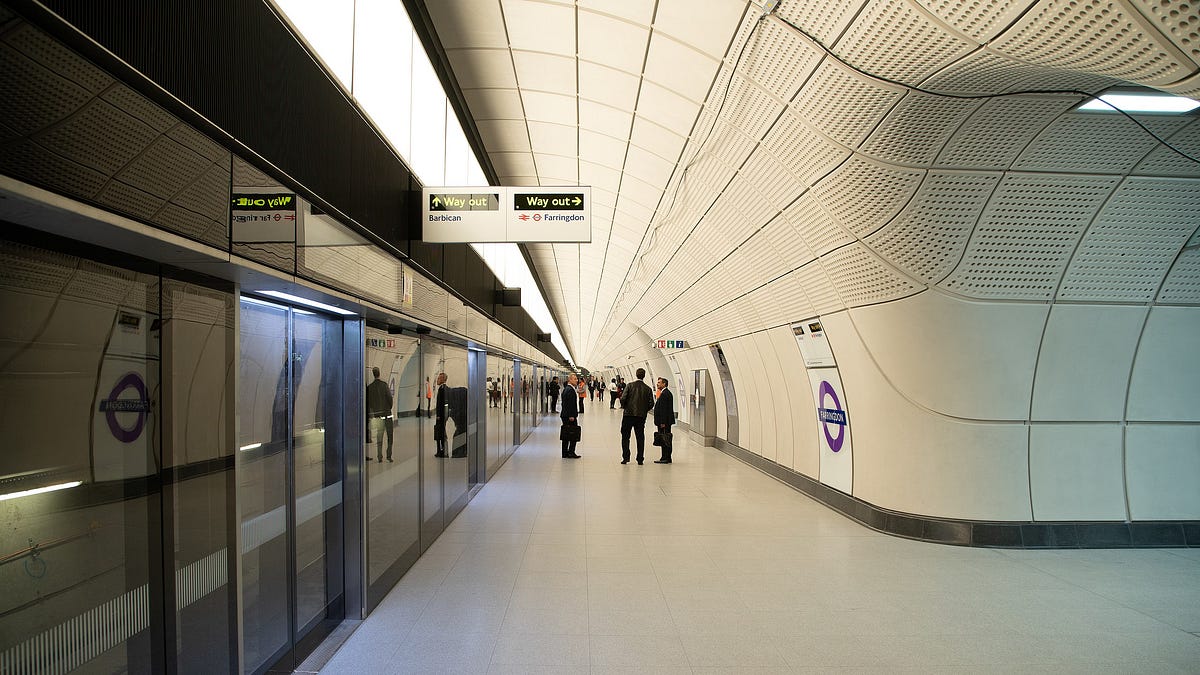
 springbett.substack.com
How to improve the Elizabeth Line
Learning from how Japan runs the most reliable trains in the world
springbett.substack.com
The Elizabeth Line is already overcrowded: it operates 16 trains per hour (tph) in the off-peak, and 24 tph in the peak. This gives it a maximum capacity of only 36,000 passengers per hour per direction (pphpd), which is less than the Victoria Line’s 40,608 pphpd, even though Victoria Line trains are smaller. Anecdotally, the Elizabeth Line is close to being full in the peak.
The crowding is worsened by the fact the Elizabeth Line awkwardly splits in the east, so that half the trains go to Canary Wharf and half to Stratford. Even though both of these are very important destinations, each only gets a half service.
[...]
There is a fundamental problem with the Elizabeth Line: it is trying to operate a service pattern much more complex than most metro lines, and is trying to do so at high train frequencies. This will inevitably constrain the line’s ability to run a reliable service.
[...]
All railways face a trilemma between three desirable things: reliability, frequency, and complexity. ‘Complexity’ means express services, branches, and sharing tracks with other services. Railways can, essentially, pick two of these things.
The reason for this is straightforward. A more complex line has more points of failure, so it is easier for delays to cascade from one service to another. This is less of a problem if the line is not busy, as there is recovery time built into the timetable. But operating a complex service pattern at high frequencies will lead to delays.
The eastern side of the Elizabeth Line is not especially complex: it has two branches, and every train stops at every station. The western half, however, is much more complex. In the peak, the 24 tph break down as follows:
14 tph terminating at Paddington.
4 tph to Heathrow Terminal 4, stopping at all stations.
2 tph to Heathrow Terminal 5, skipping some stations.
4 tph to Reading, skipping a different group of stations from the Terminal 5 trains.
Furthermore, west of Slough it has to share tracks with trains to Didcot, and on much of the line there are freight trains as well, which can lead to cascading delays.
Reading is 63 km by rail from Farringdon, so it needs fast services to ensure competitive journey times. On any railway, there are two ways to run fast services: using a separate pair of tracks for the expresses, and skip-stop service patterns. Although there are express tracks between London and Reading, they are already taken by the services from London to Bristol and Cardiff. Skip-stop operation is therefore the only way to ensure competitive journey times on the western branch. Skip-stop operation would also be useful on the Shenfield branch: it currently takes 45 minutes to travel 35 km from Shenfield to Farringdon.
Skip-stop services, however, have a big disadvantage: they make it easy for delays to cascade. Imagine a stopping train with a skip-stop service behind it. The stopping train is running late. Because the skip-stop train cannot overtake it, the skip-stop train has to go as slow as the stopping train. As a result, everything behind the skip-stop train gets delayed as well.
[...]
To find a way around this problem, we need to learn from Japan.
It is common among westerners to assume that Japan’s railways are punctual because of cultural values. The Japanese, the story goes, prize obedience and hierarchy, which means they dutifully run their trains punctually. There might be something in this, but I think it has at best a marginal impact. Japanese trains run reliably because they have better infrastructure and better operating practices.
[...]
Only six commuter lines in Japan have four tracks: the JR West line that goes Kyoto – Osaka – Kobe, and five lines radiating from Tokyo.
The rest of Japan’s lines have to make do with just two tracks, but owing to the size of Japanese cities, a mixture of stopping and semifast services is required so that everywhere gets quick journey times to the city centre. This is a very similar problem to one faced by the Elizabeth Line.
Japan manages to run these complex services reliably with passing loops. Rather than four-tracking an entire line, particular stations get four tracks, which merge back down to two shortly after the station. This allows the fast trains to overtake the slow ones while they wait in the platform at that station.
A typical example is the Hanshin Main Line, one of the lines between Osaka and Kobe. It runs for 32 km, with a station every kilometre.
West of Amagasaki, a major junction, eight stations have passing loops, with one roughly spaced every third station.
The passing loops mean that Hanshin can operate a very complicated, intense service pattern reliably. In the evening peak, there are 21 tph heading west from Amagasaki, with five different stopping patterns. This is much more complicated than the Elizabeth Line, which only runs 8 tph west of Paddington with three stopping patterns.
The current timetable only uses the passing loops at two stations, Nishinomiya and Mikage. But the line has eight stations with passing loops rather than just these two. The big advantage of a high density of passing loops is flexibility and redundancy to the timetable: if a fast train is delayed, then a local train can wait around in a different passing loop. In turn, this means that trains can very quickly recover from delays.
(The downside is that the slow trains do have to wait around for the fast trains to pass. This is unavoidable: the only way to eliminate this trade-off entirely would be to quadruple the whole line, which would be very expensive.)
Passing loops are how Japan can operate services that are reliable, frequent and complex. Nearly every Japanese railway company uses passing loops, because they are the right way to operate a reliable, frequent service with skip-stop operation.
It is worth noting that no railways in Great Britain are run like Hanshin. As far as I am aware, the operating practice is unknown. We do sometimes use passing loops for freight trains, and there are one or two stations that are set up nicely for late-running expresses to overtake local trains, but this is certainly not a regularly timetabled practice. The reason for this is probably historical. In the past, British railways have responded to the problem of running a mixture of fast and slow services by four-tracking a line for its entire length.
[...]
The Elizabeth Line, however, is a Hanshin-shaped problem. It should rebuilt some of its stations so they can act as passing loops. This means the physical area of the station is expanded to have four Elizabeth Line tracks and two island platforms, 6 in addition to two tracks on the adjoining fast line without platforms.
In some cases, there is room to do this: at Gidea Park, the fast lines could be moved a little bit to the south, to run where the station building currently is. I think this would require only demolishing one other building.
(To be clear, I am not advocating for putting a passing loop at Gidea Park specifically: it is merely illustrative of a station where it would be less complex to add one than in other places.)
In other places, it would be much more complicated.
[...]
To be clear, passing loops are expensive, disruptive and time-consuming to retrofit. But they are necessary to run an intensive skip-stop service reliably. The alternative would be either running the Elizabeth Line at lower frequencies, or withdrawing the skip-stop service altogether, both of which are non-starters.
Passing loops should be combined with stations every 1.0–1.5 km within the London urban area, which is roughly the optimal distance for suburban stations.
[...]
Choosing where to put in passing loops is essentially a pragmatic decision on the basis of where it is easiest to add them, and they do not need to be built all at once. Every new passing loop is useful, because it gives more options as to where slow trains can be overtaken. A programme of upgrading the Elizabeth Line through passing loops can and should be incremental.
A theme of this Substack is that there are a lot of underrated ideas to improve Britain’s railway services that come from abroad. The railway industry does not appear to be particularly curious about the rest of the world, which is a shame. We should be learning from Japanese passing loops, Swiss timetabling and German tram-metro systems.


