
-
Our new ticketing site is now live! Using either this or the original site (both powered by TrainSplit) helps support the running of the forum with every ticket purchase! Find out more and ask any questions/give us feedback in this thread!
You are using an out of date browser. It may not display this or other websites correctly.
You should upgrade or use an alternative browser.
You should upgrade or use an alternative browser.
One Headlight vs Two
- Thread starter meepmeep
- Start date
- Status
- Not open for further replies.
Sponsor Post - registered members do not see these adverts; click here to register, or click here to log in
R
RailUK Forums

pokemonsuper9
Established Member
The 777s have 5! (two main lights, but 3 smaller yellow ones).
Older trains only need one headlight, the secondmans side during the day and the drivers side at night.Probably a dumb question, but why do some trains only have one headlight on the non-drivers side, and some a headlights in use on each side?
Do newer trains have both headlights on?

Buzby
Established Member
I noticed in the USA they use two, but they cycle between sides. Is that ever a thing in the UK for the newer engines which have two?
Older trains only need one headlight, the secondmans side during the day and the drivers side at night.
Why is this? I'd have thought both at night?

MCR247
Established Member
- Joined
- 7 Nov 2008
- Messages
- 10,290
I think to avoid dazzling drivers in the opposite direction. And I don’t think train drivers use their lights in the same way as car drivers to see the road in front of themWhy is this? I'd have thought both at night?

What I don't get is why some trains have unsymmetrical headlights. As seen here on this 465 and 165.
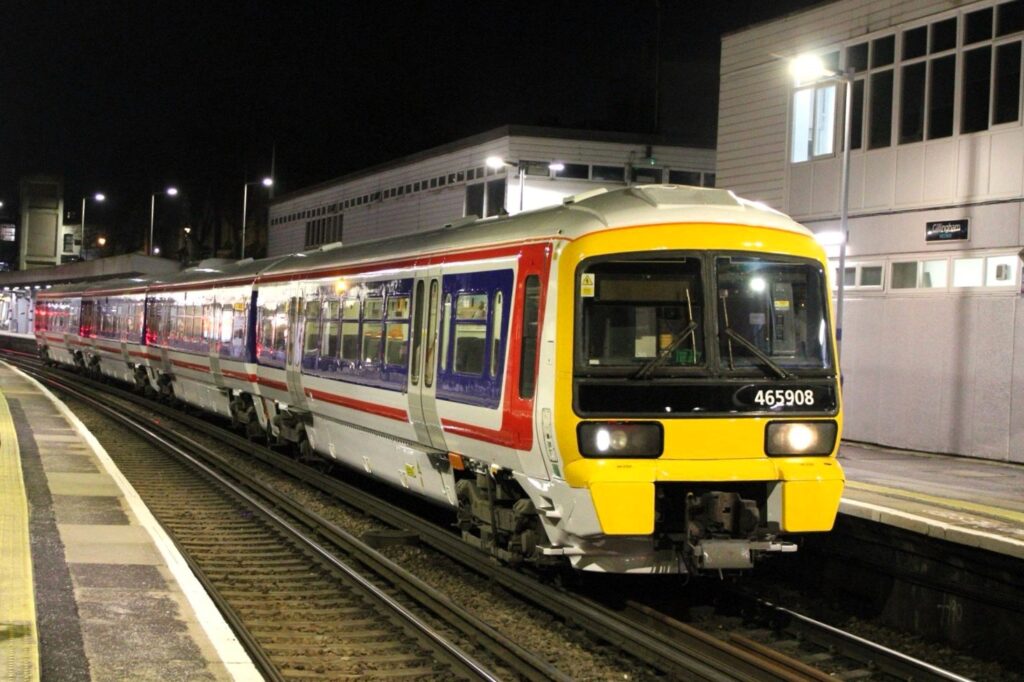

I think to avoid dazzling drivers in the opposite direction. And I don’t think train drivers use their lights in the same way as car drivers to see the road in front of them
Do newer trains turn one light off at night?
No, they use dimmer headlights at night.Do newer trains turn one light off at night?
It's the same with a lot of modern (ish) trains. Javelins are a good example with one headlight and one marker light.Older trains only need one headlight, the secondmans side during the day and the drivers side at night.

trainmania100
Established Member
73s have one central light in the middle front.
Doubt it does much good from a driver perspective I don't think they're very bright.
Doubt it does much good from a driver perspective I don't think they're very bright.
pokemonsuper9
Established Member
They aren't used to see, they're to be seen.Doubt it does much good from a driver perspective I don't think they're very bright.
There's no point lighting the few metres of track in front of you at 100mph, but having lights on you allows you to be seen.

Kneedown
Established Member
I believe they are known as "Ditch Lights", and only flash alternately to give warning when approaching level crossings. Prior to this they used a "Marrs Light", which was a single light that pivoted in a figure of eight pattern. There are some YouTube videos demonstrating their action.I noticed in the USA they use two, but they cycle between sides. Is that ever a thing in the UK for the newer engines which have two?
Ditch lights aren't used in the UK, but later stock has the ability to flash the headlights to provide a warning to oncoming trains.
Bit harsh to say that train drivers aren’t very bright! [Sorry73s have one central light in the middle front.
Doubt it does much good from a driver perspective I don't think they're very bright.
 ]
]That central lamp is the BR-era ‘high intensity’ headlamp which started to be fitted to trains that previously didn’t have lights, sometime around the late 80s I believe. Back then they presumably would have been considered pretty bright in comparison to what drivers had previously!
Many locomotives and multiple units had these lamps fitted, nowadays they’re becoming rare but you’ll still see them on things like class 37s for example.

Unobrow
Member
As far as I’m aware, all trains had marker lights fitted by the time the high intensity light came into use. They were purely to be seen from a greater distance for safety of track workers and the public using smaller level crossings.Bit harsh to say that train drivers aren’t very bright! [Sorry
That central lamp is the BR-era ‘high intensity’ headlamp which started to be fitted to trains that previously didn’t have lights, sometime around the late 80s I believe. Back then they presumably would have been considered pretty bright in comparison to what drivers had previously!
Many locomotives and multiple units had these lamps fitted, nowadays they’re becoming rare but you’ll still see them on things like class 37s for example.
The current “headlights”, be them one or two lights, have a day and night setting. The night beam being a lower power setting so as not to dazzle oncoming drivers and track workers in the dark hours, and is also on the near side/drivers side to illuminate any trackside signs that aren’t normally lit.


ac6000cw
Established Member
The 73s are a bit unusual for locos, in that they have BR Southern Region EMU style 'route indicator' blinds in the centre of the window area, which act as marker lights when set to all white (and tail lights when set to red).73s have one central light in the middle front.
That central lamp is the BR-era ‘high intensity’ headlamp which started to be fitted to trains that previously didn’t have lights, sometime around the late 80s I believe. Back then they presumably would have been considered pretty bright in comparison to what drivers had previously!
As far as I’m aware, all trains had marker lights fitted by the time the high intensity light came into use. They were purely to be seen from a greater distance for safety of track workers and the public using smaller level crossings.
Before the era of 4-character headcode displays, 1950s/early 60s BR locos and MUs were built with white marker lights (and sometimes white discs) which could mimic the headlight arrangements of steam locos (which also indicated the class of train).
A few photos below to illustrate the evolution from steam-age marker lights to the single high-intensity headlight era:
An early build class 40 loco with a full set of four white marker lights and discs:

(from Wikipedia - By Jim - 40104 - Ayr, CC BY 2.0, https://commons.wikimedia.org/w/index.php?curid=31955613)
...then on later builds replaced with 4-character headcode displays and no marker lights (the small low-down lights are red tail lights, used when running light engine or on the rear of a train e.g. as a banker):

(from Wikipedia - Hugh Llewellyn https://www.flickr.com/photos/camperdown/, CC BY-SA 2.0 <https://creativecommons.org/licenses/by-sa/2.0>, via Wikimedia Commons)
...then the headcode display was converted to a different form of marker lights:

(from Wikipedia - Phil Scott (Our Phellap), CC BY-SA 3.0 <http://creativecommons.org/licenses/by-sa/3.0/>, via Wikimedia Commons)
...and finally a single high-intensity headlight was added (after preservation) below the headcode display box (the single headcode box was the last as-built variant of the cl. 40 nose design):

(from Wikipedia - Phil Scott (Our Phellap), CC BY-SA 3.0 <http://creativecommons.org/licenses/by-sa/3.0/>, via Wikimedia Commons)
Last edited:
Surreytraveller
On Moderation
- Joined
- 21 Oct 2009
- Messages
- 3,905
On the 465 the offside light is a marker light (similar to a sidelight on a car), not a headlamp. Don't know about the 168, as I don't deal with those.What I don't get is why some trains have unsymmetrical headlights. As seen here on this 465 and 165.
Surreytraveller
On Moderation
- Joined
- 21 Oct 2009
- Messages
- 3,905
No. A headlight on a train is for the purposes of alerting trackside staff, and for reflecting signs and HVVs.Why is this? I'd have thought both at night?

D1537
Established Member
In general it was where it was fitted and powered most easily. Not all were fitted off-centre, for example Class 45/1s were between the marker lights.Something I've always wondered, why was the high intensity light fitted just right of centre instead of centre? The asymmetry has always annoyed my slightly lol
Ok thanks, was referring to a class 47 (though rather unhelpfully omitted that from my post! (edited now))In general it was where it was fitted and powered most easily. Not all were fitted off-centre, for example Class 45/1s were between the marker lights.
ac6000cw
Established Member
I noticed in the USA they use two, but they cycle between sides. Is that ever a thing in the UK for the newer engines which have two?
Correct for the low-level pair of lights in the USA - when they are alternately flashing the loco bell rings as well normally. The headlight is the closely spaced pair of very bright high-level lights in the centre:I believe they are known as "Ditch Lights", and only flash alternately to give warning when approaching level crossings. Prior to this they used a "Marrs Light", which was a single light that pivoted in a figure of eight pattern.

(A westbound SD70ACe near the summit of Sandpatch Grade, PA - my photo)
Last edited:
furnessvale
Established Member
- Joined
- 14 Jul 2015
- Messages
- 4,897
A train should be fitted with bright headlights, polarised in one plane.
The loco cab windscreen, or a screen available to the driver, should be fitted with glass polarised in a different plane.
Result, The driver sees a much reduced intensity headlight on an oncoming train. Everyone else sees a fully bright warning headlight approaching.
Job sorted.
The loco cab windscreen, or a screen available to the driver, should be fitted with glass polarised in a different plane.
Result, The driver sees a much reduced intensity headlight on an oncoming train. Everyone else sees a fully bright warning headlight approaching.
Job sorted.
MCR247
Established Member
- Joined
- 7 Nov 2008
- Messages
- 10,290
But what is it that’s been solved/sorted?A train should be fitted with bright headlights, polarised in one plane.
The loco cab windscreen, or a screen available to the driver, should be fitted with glass polarised in a different plane.
Result, The driver sees a much reduced intensity headlight on an oncoming train. Everyone else sees a fully bright warning headlight approaching.
Job sorted.
A train should be fitted with bright headlights, polarised in one plane.
The loco cab windscreen, or a screen available to the driver, should be fitted with glass polarised in a different plane.
Result, The driver sees a much reduced intensity headlight on an oncoming train. Everyone else sees a fully bright warning headlight approaching.
Job sorted.
But also means someone using a foot crossing wearing polarised glasses cant see said headlight, a driver may not see an approaching train at night (say, if dealing with an emergency from the cab), or the polarised windscreen may cause issues with signal colouration (thus why drivers aren't allowed polarised glasses).
Aside from being a solution without a problem, its also got a fair few unintended consequences!
Unobrow
Member
I wore polarised glasses for years as a lorry driver and still do in my car. In my experience, non have ever given any issues with colours, nor for anyone else I know that wears them.But also means someone using a foot crossing wearing polarised glasses cant see said headlight, a driver may not see an approaching train at night (say, if dealing with an emergency from the cab), or the polarised windscreen may cause issues with signal colouration (thus why drivers aren't allowed polarised glasses).
Aside from being a solution without a problem, its also got a fair few unintended consequences!
I wore polarised glasses for years as a lorry driver and still do in my car. In my experience, non have ever given any issues with colours, nor for anyone else I know that wears them.
Unfortunately the regulations that govern the rail industry say otherwise - polarised glasses have always been a big no-no.
furnessvale
Established Member
- Joined
- 14 Jul 2015
- Messages
- 4,897
Polarised glasses have both layers of polarised glass combined at a suitable angle, not 90 degrees, to reduce light, not eliminate it. The same would apply to two separate planes of polarised glass.But also means someone using a foot crossing wearing polarised glasses cant see said headlight, a driver may not see an approaching train at night (say, if dealing with an emergency from the cab), or the polarised windscreen may cause issues with signal colouration (thus why drivers aren't allowed polarised glasses).
Aside from being a solution without a problem, its also got a fair few unintended consequences!
As for being a solution without a problem, I contend that the need to reduce headlight power to avoid blinding drivers IS a problem for all other rail users and staff.
As for being a solution without a problem, I contend that the need to reduce headlight power to avoid blinding drivers IS a problem for all other rail users and staff.
On what basis? The only traction that ever dazzles me is the 80x units when drivers use the full intensity headlights at night. Otherwise I have had very little issues with units headlights. As far as I'm aware, theres been no safety incidents as a result of headlights dazzling someone in my career?

Sun Chariot
Established Member
Spot on. There was also the Pyle Light, with one lens above the other and alternating light pulses.I believe they are known as "Ditch Lights", and only flash alternately to give warning when approaching level crossings. Prior to this they used a "Marrs Light", which was a single light that pivoted in a figure of eight pattern. There are some YouTube videos demonstrating their action.
Ditch lights aren't used in the UK, but later stock has the ability to flash the headlights to provide a warning to oncoming trains.
- Status
- Not open for further replies.