• Our new ticketing site is now live! Using either this or the original site (both powered by TrainSplit) helps support the running of the forum with every ticket purchase! Find out more and ask any questions/give us feedback in this thread!

Northumberland Line reopening: progress updates

Status
Not open for further replies.

Dr Hoo

Established Member
Joined
10 Nov 2015
Messages
5,642
Location
Hope Valley
Indeed - a new one on me, too. What is evident is that Beeching was commissioned by Ernest Marples, who had a very clear interest in road building.
Well; slightly nearer the mark. But seeing that for all intents and purposes the whole 'Blyth & Tyne' area remained very busy with freight for many years and I doubt that the total rail passenger usage needed more than about one bus per hour to take it on, I'm not sure how much of an orgy of road building was triggered by the withdrawal.
 
Sponsor Post - registered members do not see these adverts; click here to register, or click here to log in
R

RailUK Forums

Killingworth

Established Member
Joined
30 May 2018
Messages
6,464
Location
Sheffield
Well; slightly nearer the mark. But seeing that for all intents and purposes the whole 'Blyth & Tyne' area remained very busy with freight for many years and I doubt that the total rail passenger usage needed more than about one bus per hour to take it on, I'm not sure how much of an orgy of road building was triggered by the withdrawal.

I remember very well how south-east Northumberland was in the 1950s and early 60s. Coal.mines and miners everywhere and not many cars. Ship building and engineering along the Tyne valley. Corporation yellow buses in Newcastle. Red United buses out towards Blyth and Ashington. Northern running to Co Durham. The Tyneside electrics taken for granteud and at 11 I was cycling 30 miles on relatively empty roads.

By 1965 the writing was clearly on the wall. The old Blyth and Tyne steam hauled trains that I'd seen every morning on my way to junior school had been replaced by DMUs and soon they replaced the electrics. Everyone had to have a car, including me. Mines and shopyards were declining. Unemployment was rising. Lord Hailsham renounced his peerage and as Quintin Hogg was given the task of championing employment in the north-east. He waved a hand bell.

As compensation for loss of mining jobs we got new roads, mine buildings cleared, landscaped pit heaps and Wilkinson sword built a razor blade factory at Cramington new town and there was a perfume factory immortalised in the play "Close the coal house door."

For one who cycled round that area from an early age and then drove round it in his first car, a 1952 Morris Minor, it's almost unrecognisable today. New roads, Newcastle bypassed to west and east by the A1 and A19, new factories and masses of new housing. The smouldering pit heaps have gone and so has the spiders web of colliery railway lines that went with them.

As that web of lines contracted the road network has expanded and the entire nature of the area has changed. In the days when there were still passenger trains to Manors they were infrequent. Why would miners want to use them or for that matter why would anyone else? They didn't. Somehow United's bus routes have mostly survived, with different names and colours but still far more frequent than the passenger rail line ever was.

At the time of Beeching's report mining in Northumberland was already in terminal decline and most of the railway infrastructure that went with it. I watch the reopening with great interest and hope it does well. It's going to be operating in an almost totally different environment.

 
Last edited:

Trestrol

Member
Joined
12 Apr 2022
Messages
273
Location
Newcastle
With the push towards MGR trains and more intense working you wonder if passenger trains got in the way. Blyth power station,Alcan works and power station, Ellington, Bates, Lyemouth plus other collieries, import/exports from Blyth docks. It was all about freight and the opportunity to reduce the probability loss making passenger traffic was a no brainer. We are lucky the line never shut completely after the millennium when all the industry shut. It would probably have been an impossible uphill task to reinstate it.
 

WesternBiker

Member
Joined
26 Aug 2020
Messages
692
Location
South Cambridgeshire
Well; slightly nearer the mark. But seeing that for all intents and purposes the whole 'Blyth & Tyne' area remained very busy with freight for many years and I doubt that the total rail passenger usage needed more than about one bus per hour to take it on, I'm not sure how much of an orgy of road building was triggered by the withdrawal.
Indeed - though I was only commenting on the personalities and their conflicts of interest, not on whether this specific case was at all influenced. Many lines would have closed in any case, regardless of Beeching or Marples.
 

androdas

Member
Joined
3 Aug 2011
Messages
310
Location
The Winning
With the push towards MGR trains and more intense working you wonder if passenger trains got in the way. Blyth power station,Alcan works and power station, Ellington, Bates, Lyemouth plus other collieries, import/exports from Blyth docks. It was all about freight and the opportunity to reduce the probability loss making passenger traffic was a no brainer. We are lucky the line never shut completely after the millennium when all the industry shut. It would probably have been an impossible uphill task to reinstate it.
I think it was luck more than anything that kept what we have left of the Blyth and Tyne open, after the pits, power station and smelter closed. The two main users of the line were Lynemouth Power Station for Coal / Biomass from Tyne Dock and Blyth Docks for Alumina to Scotland and a little coal to Yorkshire. All these flows happened to be at the extremities of the line as it is now so kept it open however there are some tales tell it wasn't kept in the best condition. Even after the pits closed it was heavily rationalised losing the lines to Butterwell and the ECML to the north, the branches to South Blyth docks and the extensive Depot / sidings area at Cambois as well as lots of single track sections that have had to be addressed between Blyth and Backworth to allow passenger trains to return. No doubt if the alumina traffic and Lynemouth power station had gone at the same time as the smelter the whole thing would have been left to rot or ripped up and reopening to passengers would have either been much harder or off the cards completely.
 

ainsworth74

Forum Staff
Staff Member
Global Moderator
Joined
16 Nov 2009
Messages
31,091
Location
Redcar
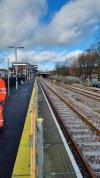
I've been sent the following photo of Ashington station taken very recently (apologise for the slightly rubbish resolution, blame Facebook Messenger!):

ashington.jpg

(Original credit: Greg Walker, AECOM)


Looks to be coming along very nicely, all it needs now is a train!
 

swt_passenger

Veteran Member
Joined
7 Apr 2010
Messages
34,270
I've been sent the following photo of Ashington station taken very recently (apologise for the slightly rubbish resolution, blame Facebook Messenger!):
[…]
Looks to be coming along very nicely, all it needs now is a train!
Interesting that there’s still an ancient 25 mph speed restriction sign for the upcoming curve, that must have survived recent track works.
 

edwin_m

Veteran Member
Joined
21 Apr 2013
Messages
28,648
Location
Nottingham
I remember very well how south-east Northumberland was in the 1950s and early 60s. Coal.mines and miners everywhere and not many cars. Ship building and engineering along the Tyne valley. Corporation yellow buses in Newcastle. Red United buses out towards Blyth and Ashington. Northern running to Co Durham. The Tyneside electrics taken for granteud and at 11 I was cycling 30 miles on relatively empty roads.

By 1965 the writing was clearly on the wall. The old Blyth and Tyne steam hauled trains that I'd seen every morning on my way to junior school had been replaced by DMUs and soon they replaced the electrics. Everyone had to have a car, including me. Mines and shopyards were declining. Unemployment was rising. Lord Hailsham renounced his peerage and as Quintin Hogg was given the task of championing employment in the north-east. He waved a hand bell.

As compensation for loss of mining jobs we got new roads, mine buildings cleared, landscaped pit heaps and Wilkinson sword built a razor blade factory at Cramington new town and there was a perfume factory immortalised in the play "Close the coal house door."

For one who cycled round that area from an early age and then drove round it in his first car, a 1952 Morris Minor, it's almost unrecognisable today. New roads, Newcastle bypassed to west and east by the A1 and A19, new factories and masses of new housing. The smouldering pit heaps have gone and so has the spiders web of colliery railway lines that went with them.

As that web of lines contracted the road network has expanded and the entire nature of the area has changed. In the days when there were still passenger trains to Manors they were infrequent. Why would miners want to use them or for that matter why would anyone else? They didn't. Somehow United's bus routes have mostly survived, with different names and colours but still far more frequent than the passenger rail line ever was.

At the time of Beeching's report mining in Northumberland was already in terminal decline and most of the railway infrastructure that went with it. I watch the reopening with great interest and hope it does well. It's going to be operating in an almost totally different environment.
It's probably also fair to say that in that era most people living in the Blyth/Ashington area worked locally, and the bus into Newcastle was probably much quicker than it is today. Loss of local jobs and increase in commuting and traffic congestion has created the conditions for re-opening that did not exist when it was closed.
 

Killingworth

Established Member
Joined
30 May 2018
Messages
6,464
Location
Sheffield
It's probably also fair to say that in that era most people living in the Blyth/Ashington area worked locally, and the bus into Newcastle was probably much quicker than it is today. Loss of local jobs and increase in commuting and traffic congestion has created the conditions for re-opening that did not exist when it was closed.
But there was "the Ministry" at Longbenton!
 

edwin_m

Veteran Member
Joined
21 Apr 2013
Messages
28,648
Location
Nottingham
But there was "the Ministry" at Longbenton!
Would many people living in Ashington and Blyth have worked there in the era when there was a passenger train service? If so then I assume a bus would have been provided, considering it's near one of the main roads from Blyth area into Newcastle. The new rail service will allow commuting by interchange with the Metro at Northumberland Park when that opens, but according to Wikipedia the government site is closing in 2027 and remaining jobs moving into central Newcastle.
 

Killingworth

Established Member
Joined
30 May 2018
Messages
6,464
Location
Sheffield
Would many people living in Ashington and Blyth have worked there in the era when there was a passenger train service? If so then I assume a bus would have been provided, considering it's near one of the main roads from Blyth area into Newcastle. The new rail service will allow commuting by interchange with the Metro at Northumberland Park when that opens, but according to Wikipedia the government site is closing in 2027 and remaining jobs moving into central Newcastle.
They probably did but the passenger service of that time didn't go near. There were fleets of dedicated buses lined up outside to all parts of Tyneside timed to leave within minutes of finishing time, usually a few minutes earlier on Fridays. A site full of clock watchers because if you didn't catch the special buses to places like Winlaton or Spennymoor it would be a very long trek home.

1_JS205544544.jpg
 

Killingworth

Established Member
Joined
30 May 2018
Messages
6,464
Location
Sheffield
What is/was that place?

Ministry of Pensions later including National Insurance. Built immediately after WW2 it was a vast sprawl of H block type buildings reputedly intended to have been used as hospitals but for 50 years was The Ministry where large numbers started their careers in the civil service. It was probably the largest non industrial employer in the north east and relied heavily on a dedicated web of bus routes. Longbenton station on the North Tyneside electric loop line was built near it.

I'm no longer local to the area but if the site hadn't been used for the Ministry pre WW2 it had been well placed for housing development
 

androdas

Member
Joined
3 Aug 2011
Messages
310
Location
The Winning
Ministry of Pensions later including National Insurance. Built immediately after WW2 it was a vast sprawl of H block type buildings reputedly intended to have been used as hospitals but for 50 years was The Ministry where large numbers started their careers in the civil service. It was probably the largest non industrial employer in the north east and relied heavily on a dedicated web of bus routes. Longbenton station on the North Tyneside electric loop line was built near it.

I'm no longer local to the area but if the site hadn't been used for the Ministry pre WW2 it had been well placed for housing development
Its still in use in fact I used to work there. Mostly by HMRC & DWP but there are other government departments present. HMRC intend to move out in 2027 to the city centre and DWP have not made their plans known but the future of the site looks uncertain.
 

Requeststop

Member
Joined
21 Jan 2012
Messages
1,001
Location
Carbis Bay, St Ives, Cornwall
Yes, I've thought that too.

Some interesting stuff there. I'd never heard it claimed that ICI was Britain's biggest tarmac producer before. In fact I wasn't even aware that ICI produced tarmac, asphalt and so on at all. There is no mention of the material on the wikipedia entry for ICI. (I am aware though that in a quirk of corporate restructuring history over the past sixty years some assets that were formerly owned by Buxton Lime Industries, which was part of ICI, have ended up with the company that we now commonly know at 'Tarmac'.)

Given that the overwhelming traffic around the North East was coal and Dr B expected BR to continue moving no less that 23,000,000 tons per year of the stuff from numerous production points to the various shipment facilities and the recently-constructed Blyth Power Stations I'm not sure that there was much scope for rationalisation of the network at the time. The passenger service to Blyth in 1962 consisted mainly of a local shuttle from Newsham, connecting to/from a slightly irregular but roughly hourly local service from Monkseaton where it connected with the North Tyneside electrics. I'm not sure that a typical 45-50 minute journey to Newcastle City Centre with two changes was really very competitive with the through bus.

I'm also unclear how much scope there was for 'the tarmac interest' to make money out the transfer of what I suspect were very modest numbers of rail passengers to road in the area.

(I'm not sure that the tasks of winding up the British Transport Commission and running BR for a few years would be regarded as a 'sabbatical' either.)
At one time, the Teesside Oil Refinery was owned by ICI. One of the fractions of Crude Oil is Asphalt and Bitumen.
The Refinery that was once Mobil, and then then BP's in Coryton in Essex sent Asphalt to Frome in Somerset by rail. I know, In the 1970's I used to load and weigh the wagons.
 

busesrusuk

Member
Joined
19 May 2020
Messages
418
Location
London
Its still in use in fact I used to work there. Mostly by HMRC & DWP but there are other government departments present. HMRC intend to move out in 2027 to the city centre and DWP have not made their plans known but the future of the site looks uncertain.
Thanks for the replies. It doesn't look anything like that now based on Google - it looks considerably smaller and presumably some of the site has now been developed into housing...
 

androdas

Member
Joined
3 Aug 2011
Messages
310
Location
The Winning
Thanks for the replies. It doesn't look anything like that now based on Google - it looks considerably smaller and presumably some of the site has now been developed into housing...

Yes the only part that survived the early 2000s remodelling was the base of the flagpole, and that's no longer used for a flag but the centrepiece of an outdoor seating area. The areas of housing either side of the driveway used to be part of the site.

== Doublepost prevention - post automatically merged: ==

Back on the topic of the Northumberland line. The project posted an article today on the track renewals that have been taking place including some short but interesting aerial shots of renewals at West Sleekburn and Bedlington taken over last summer.

 
Last edited:

swt_passenger

Veteran Member
Joined
7 Apr 2010
Messages
34,270
Its still in use in fact I used to work there. Mostly by HMRC & DWP but there are other government departments present. HMRC intend to move out in 2027 to the city centre and DWP have not made their plans known but the future of the site looks uncertain.
My dad spent almost his entire working life there, other than a few years in the RN just after the war. In the late 40s he lived in a single men’s hostel somewhere on the site, and travelled home to Alnwick at weekends.
 
Joined
18 Sep 2018
Messages
90
The new HMRC 5-10 storey new and refurbished office blocks in Pilgrim Street, central Newcastle have their frames complete, so looks on course for opening in 2027. When all complete they will accommodate 9,000 staff. Of course if there is hot desking, these days the number of desks will be considerably less.

Ideally located less than 10 mins walk from Central Station and 5mins from Monument Metro. The Metro and new Northumberland Line well placed to transport workers who lived near the old 'Ministry' site.

Will massively increase trade in the City Centre.
A massive NE employer, every Tyneside district has people who work or worked there.
 

Snex

Member
Joined
20 Jun 2018
Messages
449
The Park and Ride section showed a total 37% increase in 2023 over the 2022 figures, with only two of those sites showing a reduction.

It's very deceptive using percentages considing the large car parks are running at around 10% and the ones with around 30 spaces are running at around 50%.

Not to mention, unless things have changed, people park at Four Lane Ends and walk to the ministry.

Talk about manipulative data.
 

norbitonflyer

Established Member
Joined
24 Mar 2020
Messages
5,723
Location
SW London
Been another update for the opening of this today. It's now been announced that it's now:

Ashington, Newsham, Seaton Delaval - Summer 2024
Bedlington, Bebside, Northumberland Park - Delayed, no date but possibly 2025
Q paths now showing in Real Time Trains. No distivction made between those stations due to open in summer and those that are delayed.

Departures from Ashington on the hour and half hour, from Newcastle a little variable (presumably for pathing reasons), but usually just after the quarters. End to end journey time 36 minutes.
 

geoffk

On Moderation
Joined
4 Aug 2010
Messages
3,931
Location
Exeter
Alternate trains shown as calling at Manors. Is that a change from the original plan?
 

Killingworth

Established Member
Joined
30 May 2018
Messages
6,464
Location
Sheffield
Alternate trains shown as calling at Manors. Is that a change from the original plan?

Maybe necessary to define 'original' plan it was so long ago and there've been various changes along the way. Manors was one of my old train spotting haunts so I've been saddened to see it sinking into oblivion.

My recollection is that trains were to stop at Manors with no note of how frequently. More recently that was starting to look doubtful. A year ago at the Transport for the North conference in Newcastle I directly asked Jamie Driscoll, metro mayor of the North of Tyne Combined Authority, if trains were to stop at Manors and he said they were.

The caveat has always been pathing on the corridor from Benton into Central.
 

geoffk

On Moderation
Joined
4 Aug 2010
Messages
3,931
Location
Exeter
Maybe necessary to define 'original' plan it was so long ago and there've been various changes along the way. Manors was one of my old train spotting haunts so I've been saddened to see it sinking into oblivion.

My recollection is that trains were to stop at Manors with no note of how frequently. More recently that was starting to look doubtful. A year ago at the Transport for the North conference in Newcastle I directly asked Jamie Driscoll, metro mayor of the North of Tyne Combined Authority, if trains were to stop at Manors and he said they were.

The caveat has always been pathing on the corridor from Benton into Central.
Thanks. I lived and worked in Durham 1975-80, all a long time ago. More recently I struggled to find Manors National Rail station from the Metro station - perhaps signing has been improved now, although interchange with the Ashington trains will be at Northumberland Park.
 

Killingworth

Established Member
Joined
30 May 2018
Messages
6,464
Location
Sheffield
Thanks. I lived and worked in Durham 1975-80, all a long time ago. More recently I struggled to find Manors National Rail station from the Metro station - perhaps signing has been improved now, although interchange with the Ashington trains will be at Northumberland Park.
Manors station is badly in need of resuscitation, but it was running down in the early 1960s. It could be an interchange point for a small number coming from the North Shields direction going to or from the Northumberland line. It's a bleak place to do that today, although I note Google maps give the time to walk between the two stations as 2 minutes for 0.1 miles. The immediate vicinity has been very much improved in recent years.
 

androdas

Member
Joined
3 Aug 2011
Messages
310
Location
The Winning
Q paths now showing in Real Time Trains. No distivction made between those stations due to open in summer and those that are delayed.

Departures from Ashington on the hour and half hour, from Newcastle a little variable (presumably for pathing reasons), but usually just after the quarters. End to end journey time 36 minutes.
I do note though that the Freight (Biomass/Alumina0 trains that use the line are not in the timetable so these will need to be woven in. The alumina will be pretty fixed timings I would imagine as retiming it will have lots of knock on effects especially between Glasgow and Ft William but I would imagine there will now be potential to run some of the biomass overnight once the line is resignalled and not having to work around signal box closure times.

There are a couple of other 'Q' freight paths on the Blyth and Tyne that never run to Port of Blyth, 6D82 a coal train to Doncaster to a power station that I think is closed and 6M80/6E80 stone from Shap which was for the stalled gigafactory development at Cambois which look unlikely to start anytime soon.
 
Status
Not open for further replies.

Top