• Our new ticketing site is now live! Using either this or the original site (both powered by TrainSplit) helps support the running of the forum with every ticket purchase! Find out more and ask any questions/give us feedback in this thread!

Northampton historical services

Status
Not open for further replies.
Sponsor Post - registered members do not see these adverts; click here to register, or click here to log in
R

RailUK Forums

nw1

Established Member
Joined
9 Aug 2013
Messages
9,414
Timetables for 1981, 1982 and 1996 are available on timetableworld.com. From there:

In the early 80s there was incredibly just the one train an hour: the Euston-Birmingham semi-fast. In the peak there were 2 to 3 trains per hour.

Even by 1996 there were only 2tph from Euston: an xx54 semi-fast to Birmingham (similar to the 80s semi-fast) and an xx20 express terminating at Northampton and calling Milton Keynes only. The latter almost caught up with the former. In the peak there were two fasts at xx20 and xx50 (with the occasional overtaken stopper), with the xx54 terminating further up the line towards London.

I do seem to remember a long standing 24/54 (semi-fast) and 34/04 (stopping) pattern on the "NSE/Silverlink" services out of Euston in the late 80s and 90s, but cannot personally recall whether both the 24 and the 54 went to Northampton at any point.
 
Last edited:

Magdalia

Established Member
Joined
1 Jan 2022
Messages
7,348
Location
The Fens
Northampton first got a half hourly off peak service in 1988, with xx22 Euston-Northampton trains calling at Leighton Buzzard, Bletchley and Milton Keynes Central.

One of the features of the 1980s was the peak hour "Master Cobbler" loco hauled services.
 

RT4038

Established Member
Joined
22 Feb 2014
Messages
5,454
What was the Northampton service pattern in the 1990’s and 1980’s and was the amount of bay platforms because of the Northampton to Market Harborough line?

The north facing bay platforms would have been for both the Market Harborough (-Nottingham) trains and locals to Rugby. As this would not have used more than two, I expect the others were for parcel traffic as well. The south facing bay platforms (under the bridge, long demolished and turned into car parking) were for Bedford, Wellingborough and Peterborough trains).
 

SargeNpton

Established Member
Joined
19 Nov 2018
Messages
1,717
In the 1970s, and up until the end of BR's parcels business, the north-facing bay platforms were all dedicated to parcels traffic - with only limited passenger train use during engineering works. At that time, the bays had no platform numbers.

Spent many a cold winter's day (or night) in that area of the station making up the next day's parcels delivery sheets for the van drivers.
 

nw1

Established Member
Joined
9 Aug 2013
Messages
9,414
I’m sorry but they seem to make me want to purchase them

They do have the full BR timetables for purchase, but if you go to "Timetables" and "Timetable Search", and select either 1981, 1982 or 1996, you will see the free ones.

For 1982 it's the full BR timetable, for 1981 and 1996 it's the ABC/OAG Rail Guide for the "NSE" area.
 

Big Jumby 74

Established Member
Joined
12 Feb 2022
Messages
2,224
Location
UK
In the 1970s, and up until the end of BR's parcels business, the north-facing bay platforms were all dedicated to parcels traffic
That rings bell. About 1979/80 I was in the habit of visiting a GF who had family connections in Northampton, and use to travel there on the Euston services formed of AM10 (310)'s IIRC? The Northern bay platforms were often full of vans, CCT's, GUVs etc as I recall.
 

Big Jumby 74

Established Member
Joined
12 Feb 2022
Messages
2,224
Location
UK
In my time there were no bay platforms at the South end of Northampton station, just the remnants of the LNW line to Wellingborough which came in from the East, just to the South of Northampton station.

EDITED: just taken a look a googly earth, and I see what you mean, oops :oops: ! There obviously was something there, branching off the LNW Wellingborough line. Your best bet is the Middleton Press series of books, if they have produced one covering Northampton. Being outside my area of railway interest, I do not have any such detailed books.
 
Last edited:

Taunton

Veteran Member
Joined
1 Aug 2013
Messages
12,235
In the early 80s there was incredibly just the one train an hour: the Euston-Birmingham semi-fast. In the peak there were 2 to 3 trains per hour.
15 years before, in 1965, the daytime departures from Euston for Northampton were 0845-1153-1500. About one every three hours. And it wasn't the electrification works restricting things, the 1950s were much the same. The hourly service introduced in 1966 was a revelation!
 

Big Jumby 74

Established Member
Joined
12 Feb 2022
Messages
2,224
Location
UK
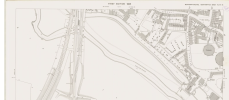
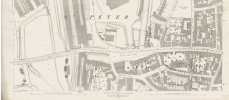
Have just borrowed these from the nlsmap site. Sheet2 shows the platform/dock detail, sheet1 should tag on below, if these attachments work! Looking at the layout/platforms (and canopies - dark shade) these must have been the original terminal platforms for LNW services from Wellingborough I would guess?
 

Attachments

  • Northampton1.png
    Northampton1.png
    1.4 MB · Views: 41
  • Northampton2.png
    Northampton2.png
    1.9 MB · Views: 41

Intercity110

On Moderation
Joined
31 Jul 2022
Messages
569
Location
64Mi 64Ch (Approximately)
Have just borrowed these from the nlsmap site. Sheet2 shows the platform/dock detail, sheet1 should tag on below, if these attachments work! Looking at the layout/platforms (and canopies - dark shade) these must have been the original terminal platforms for LNW services from Wellingborough I would guess?
Thanks
 

Big Jumby 74

Established Member
Joined
12 Feb 2022
Messages
2,224
Location
UK
Those maps were dated 1885. There was Bridge Street station, but that was further East on the Wellingborough line. Not sure about those two bays running North to South now, or what their original use was? Middleton Press has published a book which should cover that area, which would be my 'go to' read for any more info.
 

nw1

Established Member
Joined
9 Aug 2013
Messages
9,414
15 years before, in 1965, the daytime departures from Euston for Northampton were 0845-1153-1500. About one every three hours. And it wasn't the electrification works restricting things, the 1950s were much the same. The hourly service introduced in 1966 was a revelation!

Incredible, particularly given in 1965 of shortly before, there were clockface hourly, or better, services on now-closed lines (north of Bury, and Hayfield, spring to mind). I presume Northampton was a sizeable place in the 1950s and early 60s?
 

Andy R. A.

Member
Joined
25 Aug 2019
Messages
221
Location
Hastings, East Sussex.
The Signalling diagram for Northampton dated 1973, although the layout remained basically unaltered for many years afterwards. The line to Northampton Bridge Street remained in operation to the MOD sidings at Piddington on the former Bedford branch until February 1981. There were a number of Parcels workings which were booked to spend up to half an hour shunting and attaching vans from the north bays during the mid to late evenings in both directions through the 1970s and into the 1980s.
Northampton 1 May 1973.JPGNorthampton 2 May 1973.JPGNorthampton 3 May 1973.JPGNorthampton 4 May 1973.JPGNorthampton 5 May 1973.JPG
 

Merle Haggard

Established Member
Joined
20 Oct 2019
Messages
3,888
Location
Northampton
Working clockwise from the North-West; platform numbers used are the present ones.
The 'Riverside' siding nearest to Platform 3 was originally a loop, connected at the South end underneath West Bridge. This enabled the loco to run round terminaters from the South, and also to recess freight trains waiting acceptance into the Down Yard.
There was an inset platform (sort of half a bay) at the North end of the present platform 2 - a platform face to a line that was parallel and to the West of the through line. When the station was rebuilt ca 1964 this was filled in and Platform 2 extended. I think that this was used for trains towards Rugby, but I don't ever remember it being used in my spotting days.
The present two Northbound tracks in a bay on the Up side were used for trains to the North, which included the service to Nottingham via the L.N.W.R./G.N.Joint Line, later cut back to Market Harborough. As has been said these were used for parcels traffic after the closure to passenger traffic of the line. In my day, there was a very large amount of parcels traffic with originating trains for the North. Always short of coaching stock vans, recourse was made to Vanfits, bouncing along behind an AL at a bit more than 45. A big component of this was 'Play-balls' (the original plastic footballs) from Mettoy Playcraft (factory on Harlestone Road) and was the subject of theft.The present cladding between Platforms 3 and 4 was put up ca 1973 to protect Parcels traffic although by the time the work was done that traffic was on the wane.
Platform 1 only extended to underneath West Bridge, ending in a ramp to the running line side of a pier supporting the bridge. On the other side of the pier was access to the bay platforms, two tracks; these were used by the Peterborough (and Summer Yarmouth), Blisworth, Wellingborough and Bedford/Hitchin trains. The platform on the West side had a face along the Up Blisworth, but this was fenced. On the East side of this bay was the office block housing the District Civil Engineer, demolished 1969/70. Trains from the Bedford direction had perviously run into St. Johns; closed just before the war but was still standing, pretty much in the condition at closure, until about 1960.
There was a carriage shed just South of the station on the East side of the line towards Bridge St. /Blisworth. Evening terminating trains were stabled there, cleaned, and emerged in the morning.

The services hit a nadir after privatisation. Central trains ran a basic, hourly Birmingham service which routinely, in my experience, was turned back at Rugby because of late running (r/a engineering work with the 'Upgrade'). Silverlink also ran a very limited service to Birmingham (about 3 trains a day) and, rather dishonestly I thought, provided departure posters which showed only the Silverlink departures; all the service to Euston but only those 3 trains to Birmingham - this included the lists by destination station giving the strong impression that the service was very limited. There was a Central Trains departure sheet somewhere, possibly - perhaps they hadn't paid Silverlink to put it up...

Before WW2, and I think until Blisworth station (on the Old Line) closed ca 1960, a push-pull ran between there and Northampton to provide a connection into fast trains on the Old Line. Looking at the prewar 'Circuit Working of Coaching Stock' these trains had an interesting life. They reversed at Blisworth, ran Old Line to Weedon and thence to Leamington, returning via Rugby. In L.N.W.R. days coaches were slipped at Blisworth off trains from Euston, but obviously slip coaches can only provide a service 'from', not 'to', a basic flaw. Also, before WW2 the successors to the 'Sunny South Express' were re-marshalled at Northampton so as to have through coaches between all the routes. Must have been hectic.

I have seen in an old publication that the L.N.W.R. regarded Northampton as an important freight centre at the junction of routes and regarded running passenger trains as interfering with the 'core business', as we'd say now.
 

nw1

Established Member
Joined
9 Aug 2013
Messages
9,414
The services hit a nadir after privatisation. Central trains ran a basic, hourly Birmingham service which routinely, in my experience, was turned back at Rugby because of late running (r/a engineering work with the 'Upgrade'). Silverlink also ran a very limited service to Birmingham (about 3 trains a day) and, rather dishonestly I thought, provided departure posters which showed only the Silverlink departures; all the service to Euston but only those 3 trains to Birmingham - this included the lists by destination station giving the strong impression that the service was very limited. There was a Central Trains departure sheet somewhere, possibly - perhaps they hadn't paid Silverlink to put it up...
I wonder why they separated it in this way, rather than Silverlink continuing to operate the traditional London-Northampton-Birmingham hourly service?

This must have happened post-1996 as the timetable mentioned above still shows the through service.
 

Taunton

Veteran Member
Joined
1 Aug 2013
Messages
12,235
Incredible, particularly given in 1965 of shortly before, there were clockface hourly, or better, services on now-closed lines (north of Bury, and Hayfield, spring to mind). I presume Northampton was a sizeable place in the 1950s and early 60s?
Although Northampton was indeed a significant town, particularly for shoe manufacture, that sort of service was not unusual for the distance it was from London. People organised their lives around it, and daily commuting to London was pretty much unknown - the boundary for that at the time would have been Tring. In 1965 the Northampton trains would be hauled by Class 24 and could take over two hours. A couple of the trains per day were main line ones that went round that way, often as much for parcels and mail as for passengers.
 

ChiefPlanner

Established Member
Joined
6 Sep 2011
Messages
8,313
Location
Herts
I wonder why they separated it in this way, rather than Silverlink continuing to operate the traditional London-Northampton-Birmingham hourly service?

This must have happened post-1996 as the timetable mentioned above still shows the through service.

One of the developments of the "321" services post 1996 was the establishment of a 2 tph service Euston to New St , pretty much all day - intially some of them were turned at Inernational due to RT not being sure they could handle them . Of course they could , particularly after the Proof House works.

The dreaded Track Access agreement allowed for "fast" Northamton trains to run addionally - mainly off peak , which was implemented as there were spare sets and marginal extra crews needed. This was done , with decent results. Northampton despite this , always felt a bit hard done by, and to be fair they kept the pressure on in the early WCML upgrades where it was perceived that Virgin would be the king of the WCML. Some of the early scuffles post 1999 when OPRAF and late the SRA were involved , were to provide NPTN with at least that level of service (plus consideration of freight traffics) - along with many other issues elsewhere.

The Sunday service was a slow 2 tph to Euston which really was not fit for purpose , - but apart from WCML upgrade considerations , there were quite serious issues with the condition of the route generally , hence upgrades to the functionality of such important junctions as Hanslope - which did not go down very well or perform very well , hence a tendancy to worry a bit more on the Monday - Friday service offerings.
 

SargeNpton

Established Member
Joined
19 Nov 2018
Messages
1,717
How large were the southern bay platforms and does anyone have any pictures? Or trackplans
If you go to Google Maps and switch to satellite view, then that area south of the road bridge now visible as the staff car park is what was the south bay platforms.

South of the car park you can see the bridge spans that took the lines across the river and the flood relief channel.
 

Bletchleyite

Veteran Member
Joined
20 Oct 2014
Messages
113,091
Location
"Marston Vale mafia"
I wonder why they separated it in this way, rather than Silverlink continuing to operate the traditional London-Northampton-Birmingham hourly service?

I believe it was because of West Coast Route Modernisation works.

The upside of it was an improvement in the punctuality of Silverlink services south of Northampton. Though if I recall some services did run through on an unadvertised basis.
 

Merle Haggard

Established Member
Joined
20 Oct 2019
Messages
3,888
Location
Northampton
It's worth pointing out that the 'Sunday Rail Replacement Bus' has been a continuous feature of Northampton services since, to my certain knowledge, the early 1960s.

Taunton mentioned Cl 24-hauled trains taking over 2 hours; try interrogating N.R.E.S. for Northampton to Euston this coming Sunday.

Sunday 19-3-2023: Northampton depart 09.30., Euston arrive 11.29. (bus to Milton Keynes Central)
By comparison; Winter 1963-4 T.T. Northampton depart 09.30, Euston arrive 11.20 - probably a Black 5 if the Sulzer 2s were still frost-damaged.

Edited for un-noticed auto-correct
 

RT4038

Established Member
Joined
22 Feb 2014
Messages
5,454
I believe it was because of West Coast Route Modernisation works.

The upside of it was an improvement in the punctuality of Silverlink services south of Northampton. Though if I recall some services did run through on an unadvertised basis.
In particular it was the rebuilding and modernising of Rugby Station - it was a two track bottleneck while the two new platforms were built (reducing capacity, hence the only hourly service), and the bridge by the old former Clifton Road Junction was rebuilt. I think that the times of the two parts of the service did not mesh well with each other at Northampton and the opportunity of delays through Rugby were too great.
 

A0

On Moderation
Joined
19 Jan 2008
Messages
7,751
I wonder why they separated it in this way, rather than Silverlink continuing to operate the traditional London-Northampton-Birmingham hourly service?

This must have happened post-1996 as the timetable mentioned above still shows the through service.

I moved to Northampton in 2001 and my recollection is by that time it was 2tph Silverlink to Euston and 2tph to Birmingham (stopping at Long Buckby, Rugby, Coventry, International IIRC).

In about 2004, tied up with the West Coast modernisation, it was split again and Central ran the Northampton - Birmingham stretch as an hourly service. It changed as the WCRM came to an end and Siverlink and Central were replaced by London Midland and through working returned, but the Birmingham services picked up additional stops such as Canley, Tile Hill, Berkswell, Hampton in Arden and Marston Green.
 

6Gman

Established Member
Joined
1 May 2012
Messages
9,192
I have seen in an old publication that the L.N.W.R. regarded Northampton as an important freight centre at the junction of routes and regarded running passenger trains as interfering with the 'core business', as we'd say now.
Bit later than LNWR days, but in 1950 Northampton had an allocation of 37 locos.

24 were freight engines (6 Stanier 8Fs, 9 Super-D 7Fs, and 9 0-6-0s of 2F to 4F power ranges). 6 2P 4-4-0s for local passenger work (M Harborough and Wellingborough?), 3 tank engines for the Blisworth shuttle etc and 4 Black 5s (for the Euston trains?).

Shows the bias toward freight use.
 

Ken H

Established Member
Joined
11 Nov 2018
Messages
6,718
Location
N Yorks
What was all this van traffic. I know Barclaycard were in Northampton and that probably made a lot of mail. But was there a catalogue warehouse there - someone like GUS?
Or were the vans full of boots? !!!
 

Merle Haggard

Established Member
Joined
20 Oct 2019
Messages
3,888
Location
Northampton
Bit later than LNWR days, but in 1950 Northampton had an allocation of 37 locos.

24 were freight engines (6 Stanier 8Fs, 9 Super-D 7Fs, and 9 0-6-0s of 2F to 4F power ranges). 6 2P 4-4-0s for local passenger work (M Harborough and Wellingborough?), 3 tank engines for the Blisworth shuttle etc and 4 Black 5s (for the Euston trains?).

Shows the bias toward freight use.
Interesting, thanks.

I think that the 2Ps were for the Nottingham (via the Joint Line) service plus 1 for the District Civil Engineer's inspection train - in LNWR/early LMS days, there had been an 'Engineer Northampton' loco for this duty.

I personally didn't take a detailed interest until late 1950s but by then the Peterborough service was mainly worked by Eastern Region locos, latterly from March shed. I recollect that there was just one Peterborough turn for Northampton - usually a Black 5. The Wellingborough and Bedford motor trains were all worked by the shed at the other end; Northampton - Blisworth etc trains in 1950 were the only work for Northampton's motor fitted locos - still Webb LNWR tanks then, replaced by the Ivatt 2-6-2Ts soon after. The latter had a much shorter life than the locos they replaced, as the services they worked closed in 1958-9.

When I first took an interest, the 08.05 Euston, for instance, was worked by a loco presumably on a cyclical diagram. It was usually 10000/1 or 10201/2/3, sometimes a Sulzer 2 but could be almost anything when the diesels were all poorly, the extremes being a 'Princess' and a 'V2" (!) - of course, none of these were on Northampton's allocation. I don't remember Northampton locos on the other main line trains, either, but that's perhaps because the ordinary didn't get retained in my memory - unlike the still-vivd joy of, for example, a 24L Jubilee.

As an aside; the 4 2P 4-4-0s of Midland Railway design either punted an inspection coach around one day a week, or ambled along to Nottingham with 3 coaches in tow. There's references to ex Midland Railway locos being cheaper to maintain than L.N.W.R. ones; but, by comparison with the 2Ps easy life, after Grouping one of the 'expensive to maintain' L.N.W.R. 'George V' 4-4-0 would be working flat out on a Euston-New St '2hour' express. Wonder if they took that into account..
 

SargeNpton

Established Member
Joined
19 Nov 2018
Messages
1,717
What was all this van traffic. I know Barclaycard were in Northampton and that probably made a lot of mail. But was there a catalogue warehouse there - someone like GUS?
Or were the vans full of boots? !!!
I worked in the parcels office between 1976-1980. In that time there was no appreciable Barclaycard traffic (perhaps the odd Red Star parcel). Incoming traffic was heavily biased towards mail order deliveries to houses; topped up with small consignments to businesses.

The largest outgoing flow was thousands of plastic footballs a week from Mettoy. Other consignments being such as mail order fulfilments from Northamptonshire-based manufacturers to go to domestic addresses in other parts of the country (venetian blinds were a particularly notable item). Several local businesses also used to send out small consignments - such as Pianoforte Supplies, which manufactured radiator grills and metal trims for the car industry.
 
Status
Not open for further replies.

Top