Our new ticketing site is now live! Using either this or the original site (both powered by TrainSplit) helps support the running of the forum with every ticket purchase! Find out more and ask any questions/give us feedback in this thread!
Sure. And a battery EMU with a diesel range extender only needs a tiny diesel engine (about the size and weight used in a family car), as it can run at full power for the whole time that the train is away from the wires.
Sure. And a battery EMU with a diesel range extender only needs a tiny diesel engine (about the size and weight used in a family car), as it can run at full power for the whole time that the train is away from the wires.
Although if possible it would be better to avoid the need for any form of diesel (or even anything involving a fuel tank) because of the additional costs associated with having a fuel supply chain - transporting, storing, and handling fuel are all a big fire risk and subject to environmental controls.
Although if possible it would be better to avoid the need for any form of diesel (or even anything involving a fuel tank) because of the additional costs associated with having a fuel supply chain - transporting, storing, and handling fuel are all a big fire risk and subject to environmental controls.
Exactly. There must be a relatively simple way to work out how many additional kWh battery storage you can get for the weight of the engine, alternator, fuel tank, cooling system, exhaust system etc.
I often think about that for the now ‘not so new’ London Black Cabs; their range extender system must weigh about 200kg all up, and that’s about 30kWh which is enough for 100+ miles in London traffic, ie double their current elecric only range. Cant imagine there’s many black cabs doing more than 200 miles a day without being a break sufficient for a charge.
With the wires nearly complete north of Kettering, do we expect to see the return of the DATS train? Which was used extensively for testing the wires between Bedford and Corby not sure if it can be reformed. I'll assume they will have to test the OHLE somehow. Sorry if this has already been posted before.
With the wires nearly complete north of Kettering, do we expect to see the return of the DATS train? Which was used extensively for testing the wires between Bedford and Corby not sure if it can be reformed. I'll assume they will have to test the OHLE somehow. Sorry if this has already been posted before.
Exactly. There must be a relatively simple way to work out how many additional kWh battery storage you can get for the weight of the engine, alternator, fuel tank, cooling system, exhaust system etc.
I often think about that for the now ‘not so new’ London Black Cabs; their range extender system must weigh about 200kg all up, and that’s about 30kWh which is enough for 100+ miles in London traffic, ie double their current elecric only range. Cant imagine there’s many black cabs doing more than 200 miles a day without being a break sufficient for a charge.
I understand the LEVC TX electric only range is 78 miles. With the extender, the combined range goes up to 333 miles. That sounds a bargain to me. That 200kg to give you 250 miles of extra range will weigh much less than the batteries that gave you the first 78 miles on electric only.
By all means size the batteries of a BEMU to allow electric-only operation in normal service. But to cover cases where a line gets blocked and the train has to return to origin, or to take a non-electrified diversion, then you need twice that "normal" range. The cheapest and lightest way to achieve that extra capability is a diesel range extender.
Once MML electrification is completed, I'd expect that all passenger services out of Nottingham could be EMU or BEMU. But routes to Cleethorpes and Cardiff would need range extenders in everyday use; trains to Norwich and Skegness would need that capability for emergencies; and trains to London would still need diesel capability for diversions.
Off topic (sorry mods!) it’s 78 WLTP, but 101 miles in city driving, which is what most of the black cabs do.
Back to rail applications, a typical gen set on an 810 will weigh, what, 8 tonnes? But I’m reasonably sure the wires will be put up throughout to Sheffiled without the need for batteries or diesel engines to cross the gaps.
I think it's a fair assumption that the wires will get all the way to Sheffield - eventually. Despite the rotten economics, which only deliver a financial return if the OHLE is used also for recharging BEMUs on other services.
(And rather makes four 1000HP diesel engines on an 810 a bit of overkill, especially given all the extra costs incurred redesigning the underfloor layout to accommodate four engines in a space planned for three.)
A reminder that this thread is for the discussion of progress updates regarding MML electrification, please.
If anyone wants to discuss anything else, such as rolling stock updates, or anything speculative in nature, please either start a new thread or find an existing one.
Although Network Rail did gain prior approval to replace the bridge with a similar structure (as they've done elsewhere for the scheme), I think it is now simply being demolished
Although Network Rail did gain prior approval to replace the bridge with a similar structure (as they've done elsewhere for the scheme), I think it is now simply being demolished
Although Network Rail did gain prior approval to replace the bridge with a similar structure (as they've done elsewhere for the scheme), I think it is now simply being demolished
Presumably this is just an accommodation bridge to connect the land on each side of the railway. And since that land now belongs to National Grid or NR, who also built a separate access road, there is no legal requirement to reinstate the bridge.
I don't believe the demolition will take place before the 18/19 May possession. (There's also a possession due on 8/9 June - would allow for a replacement bridge if that's still planned).
Road and footpath closures often seem to be agreed for much longer than needed, it probably saves having to go back to the local authority if there are delays.
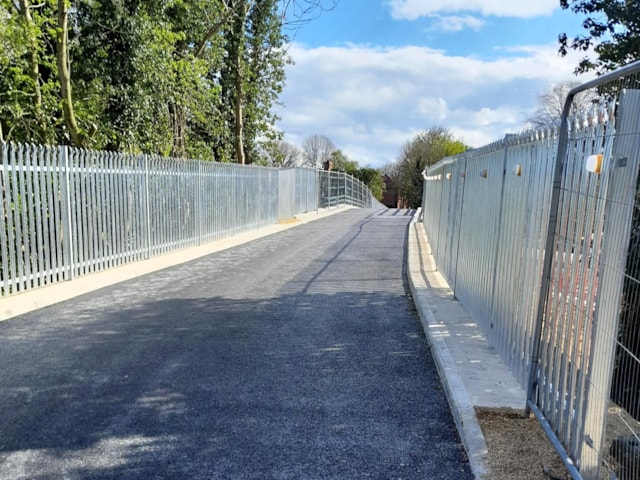
A new footbridge over the railway line in Kibworth has opened which will allow Network Rail engineers to continue to electrify the Midland Main Line.
www.networkrailmediacentre.co.uk
A new footbridge over the railway line in Kibworth has opened which will allow Network Rail engineers to continue to electrify the Midland Main Line.
Engineers have installed a new footbridge on School Road in Kibworth to enable overhead wires to pass underneath, resulting in a greener, quieter, and faster railway for passengers.
The original School Road bridge had to be demolished as it was not tall enough for electric wires to safely pass underneath, with its new replacement now at the required height.
The wires will eventually power East Midlands Railway’s new bi-mode trains through the area as part of the Midland Main Line upgrade.
A temporary footbridge was installed to make sure residents could access shops and local schools safely whilst the work on the permanent bridge was ongoing.
Network Rail has also successfully completed work at Wistow Road bridge in Newton Harcourt, however Leicestershire County Council has retained the road closure at the site while work is completed in other areas.
Work is continuing at Newton Lane Bridge in Newton Harcourt to rebuild the structure to a height where overhead wires can pass underneath with an estimated completion date of mid-June.
Gavin Crook, Principal Programme Sponsor for Network Rail’s East Midlands Route, said: “I am delighted that work has been completed on the installation of a new footbridge in Kibworth. This is a vital link in the village and this new structure will provide safe access across the Midland Main Line for years to come.
“The work we have completed at School Road bridge and at other sites in the area will allow overhead wires to pass underneath the bridge, leading to smoother, greener journeys for passengers along our East Midlands route.
“I would like to thank local residents for their patience and understanding while the work was ongoing.”
== Doublepost prevention - post automatically merged: ==
The May Modern Railways has a third of a page on MML on page 11. Beginning with what may be the same parliamentary answer mentioned in #6996 back in February it says electrification to Sheffield and Nottingham "could" be completed "in the early 2030s".
The upgrades to the equipment south of Bedford are due to be completed in 2025.
It goes on to say "Network Rail is continuing funded design and pre-construction work between Wigston Junction north towards Trent Junction, a further 28.4 miles."
"Design work as far as Trent Junction is largely complete, and it is understood that this has shown it will be possible to install continuous overhead wires through Leicester station. The low height of the bridge on which on which the station building stands, coupled with the presence of sewers limiting the ability to lower the tracks, had raised fears installing wires here would not be possible, but these have proved unfounded, though space is tight. The MML scheme is aiming to learn lessons from previous wiring programmes and to harness technologies which enable more efficient delivery, such as the use of voltage control clearances. As an example, on GW electrification 37% of bridges were rebuilt (some of which are on stretches where electrification was subsequently cancelled), but designs for the MML north of Market Harborough suggest just 13% of structures would require similar interventions."
As an example, on GW electrification 37% of bridges were rebuilt (some of which are on stretches where electrification was subsequently cancelled), but designs for the MML north of Market Harborough suggest just 13% of structures would require similar interventions."
Does this take into account any bridges which were rebuilt before the MML electrification was cancelled? Ie: bridges which were rebuilt then, so don't need to be rebuilt this time around
Does this take into account any bridges which were rebuilt before the MML electrification was cancelled? Ie: bridges which were rebuilt then, so don't need to be rebuilt this time around
"Design work as far as Trent Junction is largely complete, and it is understood that this has shown it will be possible to install continuous overhead wires through Leicester station. The low height of the bridge on which on which the station building stands, coupled with the presence of sewers limiting the ability to lower the tracks, had raised fears installing wires here would not be possible, but these have proved unfounded, though space is tight. The MML scheme is aiming to learn lessons from previous wiring programmes and to harness technologies which enable more efficient delivery, such as the use of voltage control clearances.
I think the Swiss have done fair bit of work developing bar conductors instead of overhead wires where clearances are limited
They can effectively be composite, with conductor at bottom, and upper part insulating, including 'wings' sticking out each side to avoid drips and ice shorting. I suspect the development of these slim fixed systems has become option for locations like Leicester.
The link has various photos of these kind of systems for those not familiar with them (examples, doesn't mean they are being used)
I think the Swiss have done fair bit of work developing bar conductors instead of overhead wires where clearances are limited
They can effectively be composite, with conductor at bottom, and upper part insulating, including 'wings' sticking out each side to avoid drips and ice shorting. I suspect the development of these slim fixed systems has become option for locations like Leicester.
The link has various photos of these kind of systems for those not familiar with them (examples, doesn't mean they are being used)
"Design work as far as Trent Junction is largely complete, and it is understood that this has shown it will be possible to install continuous overhead wires through Leicester station. The low height of the bridge on which on which the station building stands, coupled with the presence of sewers limiting the ability to lower the tracks, had raised fears installing wires here would not be possible, but these have proved unfounded, though space is tight.
I’m fairly sure this positive view has been reported in Modern Railways before, but it regularly gets highlighted as a major issue in forum posts. So maybe they’ll wire through Leicester in a logical sequence without leaving a gap after all…
I’m fairly sure this positive view has been reported in Modern Railways before, but it regularly gets highlighted as a major issue in forum posts. So maybe they’ll wire through Leicester in a logical sequence without leaving a gap after all…
I’m fairly sure this positive view has been reported in Modern Railways before, but it regularly gets highlighted as a major issue in forum posts. So maybe they’ll wire through Leicester in a logical sequence without leaving a gap after all…
I wonder if they could do the same thing in the tunnel between Moor Street and Snow Hill were that ever to be electrified. Looks very tight from the Moor St platforms.
I think the Swiss have done fair bit of work developing bar conductors instead of overhead wires where clearances are limited
They can effectively be composite, with conductor at bottom, and upper part insulating, including 'wings' sticking out each side to avoid drips and ice shorting. I suspect the development of these slim fixed systems has become option for locations like Leicester.
The link has various photos of these kind of systems for those not familiar with them (examples, doesn't mean they are being used)
NR also have plenty of experience with fibreglass rods for support arms for short challenging sections e.g. Thameslink core available from at least two manufacturers via Unipart
Yes, you can use Google Street View to work it out in most cases, because this was done around 2015-ish and most locations have imagery before and after that date
Planning Portals can also help you find them as Network Rail do need to show the local planning authority that their proposal is within their permitted development powers.
They definitely rebuilt a bridge at Sutton Bonington.
I’m fairly sure this positive view has been reported in Modern Railways before, but it regularly gets highlighted as a major issue in forum posts. So maybe they’ll wire through Leicester in a logical sequence without leaving a gap after all…
I think the reason for skipping Leicester was also about a Syston-Wigston capacity scheme which was being talked about
I don't that's progressed since the pandemic, except any bits that are part of Midlands Connect projects