• Our new ticketing site is now live! Using either this or the original site (both powered by TrainSplit) helps support the running of the forum with every ticket purchase! Find out more and ask any questions/give us feedback in this thread!

LSWR Lower Quadrants

Status
Not open for further replies.

Chiltern 165

Member
Joined
11 Aug 2024
Messages
91
Location
London
I have a few questions about LSWR Lower Quadrants.
Does anyone know when the last one was removed/if any still exist on the mainline?
Does anyone have a photo of an LSWR Lower Quadrant distant - I cant seem to find any.
 
Sponsor Post - registered members do not see these adverts; click here to register, or click here to log in
R

RailUK Forums

Gloster

Veteran Member
Joined
4 Sep 2020
Messages
12,977
Location
Up the creek
I very much doubt that any still exist on the main line as just about everything is controllled by panels (Portsmouth Direct excluded) and was converted to upper quadrants or colour light long ago. One possibility, although it may have been newer bits and pieces, was the Down Starter at Exeter Central.
 

Sun Chariot

Established Member
Joined
16 Mar 2009
Messages
6,629
Location
2 miles and 50 years away from the Longmoor Milita
Even the venerable signals on the erstwhile Hythe and Fawley branch - operates only as far as MoD Marchwood - are upper quadrants; a variety of Southern Railway rail-mounted and of SR/BR hybrids. I don't think any date to LSWR. Examples are in post #1 of this linked thread:
 

Snow1964

Established Member
Joined
7 Oct 2019
Messages
11,107
Location
West Wiltshire
The low pressure pneumatic semi automatic signals between Woking and Basingstoke were replaced as part of the electrification in 1965-66

The Southern replaced a number of signals, and installed colour light signals (and built the power boxes at Portsmouth, Woking etc) when electrification and capacity improvements and were done Surbiton-Portsmouth in 1936-37.

There were a number of scattered lower quadrants west of Exeter (they appear in photos of north Devon lines), but I don't know when they went (although most of these lines closed 50-60 years ago).

Although areas of semaphore signals existed after the Bournemouth line electrification, most of these dated from Southern Railway widenings, eg Southampton-Millbrook area and Pokesdown area, and the partial rebuild of Brockenhurst in late 1930s. The Southern railway often installed upper quadrant signals on existing posts (and was very economical, even making new posts from two scrap bullhead rails bolted together)

The new large signalling centres in late 1970s and 1980s (Feltham, Eastleigh, and smaller installations eg Salisbury, Brockenhurst etc) killed off virtually all remaining semaphore signals on South Western. Probably the last to go on a South Western passenger line were those in Fareham area which were added to Eastleigh box (forget the date, but was around 1987-89)

 

Gloster

Veteran Member
Joined
4 Sep 2020
Messages
12,977
Location
Up the creek
Even the venerable signals on the erstwhile Hythe and Fawley branch - operates only as far as MoD Marchwood - are upper quadrants; a variety of Southern Railway rail-mounted and of SR/BR hybrids. I don't think any date to LSWR. Examples are in post #1 of this linked thread:

It would be highly unlikely that any dated from LSWR days as the line only opened in 1925.

The signal at Exeter Central was apparently an LSWR lattice post to the end and was lower quadrant. However, it incorporated a lot of newer bits including a Western-style arm; it had to be lower quadrant as it was under the station awning.
 

Sir Felix Pole

Established Member
Joined
21 Oct 2012
Messages
2,165
Location
Wilmslow
Some lower quadrant signals remained at Gunnislake and Calstock in Cornwall until all signalling was removed in 1968. Strictly speaking this wasn't a LSWR line, but signalling was of a similar pattern.
 

Sun Chariot

Established Member
Joined
16 Mar 2009
Messages
6,629
Location
2 miles and 50 years away from the Longmoor Milita
The signal at Exeter Central was apparently an LSWR lattice post to the end and was lower quadrant. However, it incorporated a lot of newer bits including a Western-style arm; it had to be lower quadrant as it was under the station awning.
If I still had my old 110 format photos of 1983 and 1984, which included that very location, I'd be looking at those photos right now. 8-)
 

Chiltern 165

Member
Joined
11 Aug 2024
Messages
91
Location
London
I have found this photo, does anyone know what happened to that signal/if the caption is even correct?


== Doublepost prevention - post automatically merged: ==

1751618656481.png


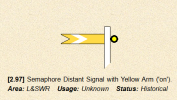
Also according to railsigns.uk there were LSWR distants with white chevrons? Do any photos of these exist?
 

Gloster

Veteran Member
Joined
4 Sep 2020
Messages
12,977
Location
Up the creek

30907

Veteran Member
Joined
30 Sep 2012
Messages
21,949
Location
Airedale
Barnstaple Town Up Starter was L/Q when I photographed it in 1970.

The only other L/Q I remember on the SR by then was at Mitcham, which was ex LBSC.

BTW didn't the SR continue to install L/Q signals for a year or two? This would account for the Torrington signals, assuming that the area was resignalled in 1925.

EDIT: at Shortlands the Down Local became a turnback for Catford Loop trains on electrification (1926), and the Up Starter on that platform was a L/Q until 1959 which must have been a SR installation.
 
Last edited:

Rescars

Established Member
Joined
25 May 2021
Messages
2,542
Location
Surrey
I think I read somewhere that most of the LSWR's signalling was supplied by Stevens and Son(s). So a related query to the OP is do any L/Q signals manufactured by Stevens still exist?
 
Last edited by a moderator:

Gloster

Veteran Member
Joined
4 Sep 2020
Messages
12,977
Location
Up the creek
The history of signal posts is not my area of interest, but I think that by the early part of the last century the LSWR and other companies were producing the actual signals. As far as the large railway companies were concerned, the contractors increasingly only provided items such as lever frames and instruments, for which they often held patents. If any LQ Stevens signals still exist they would most likely either have been ‘preserved’ years ago or survived on some minor line that got a contractor in to do the lot. However, the Southern never saw the need to replace things for the sake of it so things did survive in order corners.
 

John Webb

Established Member
Joined
5 Jun 2010
Messages
3,764
Location
St Albans
......
View attachment 183107


Also according to railsigns.uk there were LSWR distants with white chevrons? Do any photos of these exist?
I've no knowledge of photos that may exist. But bear in mind it was only in the mid-1920s that there was national agreement that distant signals should be yellow with a white chevron as per the picture above. The L&SWR was absorbed into the Southern Railway in the 1923 Grouping. Pressed steel arms of the type used by many companies by then were usually enamelled for durability, not painted. So I think it likely the the SR would have replaced the old red distant arms with their own yellow arms and it could be that there were never any yellow L&SWR arms?
 

Gloster

Veteran Member
Joined
4 Sep 2020
Messages
12,977
Location
Up the creek
One other LSWR lower quadrant that existed quite late (1980s?) was Eggesford’s Down Distant, although it was fixed.
 

Big Jumby 74

Established Member
Joined
12 Feb 2022
Messages
2,240
Location
UK
One other LSWR lower quadrant that existed quite late (1980s?) was Eggesford’s Down Distant, although it was fixed.
Ditto Ilfracombe's Down distant (also fixed) just Mortehoe side of Slade Tunnel. I photo'd same still intact in 1982.

Update: this image shows the above signal, and although a L/Q arm, as said it was fixed, and atop a SR period concrete post, so nothing LSWR about it.

== Doublepost prevention - post automatically merged: ==

So I think it likely the the SR would have replaced the old red distant arms with their own yellow arms and it could be that there were never any yellow L&SWR arms?
I would tend to agree on balance.
 

Attachments

  • BJ-Ilfracombe Down Fixed Distant sig. 110482.jpg
    BJ-Ilfracombe Down Fixed Distant sig. 110482.jpg
    251.2 KB · Views: 39
Last edited:

Gloster

Veteran Member
Joined
4 Sep 2020
Messages
12,977
Location
Up the creek
Did the other pre southern railways use Lower Quadrants? If so does anyone have a photo?

Lower quadrants were the norm pre-Great War and all the SR constituents used them, as did most other railways. I believe that a Brighton example lasted in use at Tunbridge Wells West until closure in August 1985. There are plenty of photos around: try Pryer’s A Pictorial Record of Southern Signals.
 

Big Jumby 74

Established Member
Joined
12 Feb 2022
Messages
2,240
Location
UK
I believe that a Brighton example lasted in use at Tunbridge Wells West until closure in August 1985
Distant's I can't comment on, they being well outside station limits, but in photos I took around the station in '83, all the Home's (two at tunnel end and four on the gantry at t'other end) were all U/Q, just for info.
 

Rescars

Established Member
Joined
25 May 2021
Messages
2,542
Location
Surrey

== Doublepost prevention - post automatically merged: ==

View attachment 183107


Also according to railsigns.uk there were LSWR distants with white chevrons? Do any photos of these exist?
AIUI, distant signal arms were initially notched and painted red. There was a process of evolution to get to the final form of a notched yellow arm with a black V and a yellow lamp. Presumably this illustration with a white V and a yellow arm and lamp reflects part of that progression. Does anyone know when the final form came into use? Was this a legal requirement or some sort of directive from the BoT, or just an agreement by the companies? Did the LSWR lead the way with this progression of distant signal design?
 

Gloster

Veteran Member
Joined
4 Sep 2020
Messages
12,977
Location
Up the creek
The notch or fishtail was introduced in the 1870s and the Board of Trade made it mandatory for new work in 1877; the chevron was a GWR idea a bit later and took a while, probably not until grouping, to be the norm. Yellow was introduced somewhere around The Great War and became mandatory in the mid-1920s.

A monograph on the LMS’ Society’s site has some information.
 

Rescars

Established Member
Joined
25 May 2021
Messages
2,542
Location
Surrey
The notch or fishtail was introduced in the 1870s and the Board of Trade made it mandatory for new work in 1877; the chevron was a GWR idea a bit later and took a while, probably not until grouping, to be the norm. Yellow was introduced somewhere around The Great War and became mandatory in the mid-1920s.

A monograph on the LMS’ Society’s site has some information.
Before the change to a yellow lamp, it would appear that the LSWR (along with the LBSC & Furness) used Coligny Welch indicators to show a white notch-shaped white light alongside the signal lamp on distant. I wonder where the last one of these survived.
 

Dunfanaghy Rd

Member
Joined
16 Sep 2019
Messages
466
Location
Alton, Hants
Looking through SR Signalling Instructions it seems that the first yellow distant arms were fitted in 1926 (mentioned in an Instruction in September1926). It refers to the plan to replace all the red arms with yellow, but to keep the Coligny-Welch Indicators. The first 6 treated were Waterloo 'A' Box, Borough Market Junction, Ramsgate, Woolwich Dockyard, Haven Street and Smallbrook Junction. From the sublime to the ridiculous?
A further Instruction in September 1927 marked the start of removal of C-W Indicators where the arms had been replaced. Conversion seems to have run on into 1929.
Pat
 

Rail Ranger

Member
Joined
20 Feb 2014
Messages
1,127
An LSWR lower quadrant starting signal with a fixed distant beneath it survived at Lymington Pier station until at least 3rd August 1976 as a picture here shows: Lymington Branch - Cornwall Railway Society https://share.google/NVn48C5O6Vzi4xThR
Also a fixed distant at Lymington Town.
 
Last edited:

Gloster

Veteran Member
Joined
4 Sep 2020
Messages
12,977
Location
Up the creek
An LSWR lower quadrant starting signal with a fixed distant beneath it survived at Lymington Pier station until at least 3rd August 1976 as a picture here shows: Lymington Branch - Cornwall Railway Society https://share.google/NVn48C5O6Vzi4xThR
Also a fixed distant at Lymington Town.

The signal in the upper of the two photos is a SR rail-built type which would almost certainly have dated from after 1938 when the platform was extended. Why it was lower-quadrant I do not know, but my guess would be for sighting reasons: there are a lot of masts and the like around there. The other photo is of LSWR one.
 

Rescars

Established Member
Joined
25 May 2021
Messages
2,542
Location
Surrey
Linking with the upper quadrant thread, the LSWR installation in the lower photo appears to have a Coligny-Welch indicator next to the distant signal lamp and a stripe on the arm, rather than a chevron.
 

Ashley Hill

Established Member
Joined
8 Dec 2019
Messages
5,601
Location
The West Country
Linking with the upper quadrant thread, the LSWR installation in the lower photo appears to have a Coligny-Welch indicator next to the distant signal lamp and a stripe on the arm, rather than a chevron.
Agreed, definitely a Cologne-Welch lamp and stripe on the arm.
 

30907

Veteran Member
Joined
30 Sep 2012
Messages
21,949
Location
Airedale
The signal in the upper of the two photos is a SR rail-built type which would almost certainly have dated from after 1938 when the platform was extended. Why it was lower-quadrant I do not know, but my guess would be for sighting reasons: there are a lot of masts and the like around there. The other photo is of LSWR one.
The arms on the new post also look shorter than normal and closer together.
 

Big Jumby 74

Established Member
Joined
12 Feb 2022
Messages
2,240
Location
UK
The arms on the new post also look shorter than normal and closer together.
That struck me also, and yet there's no obvious lack of space either horizontally or vertically (the post) for standard length arms?
 

Belperpete

Established Member
Joined
17 Aug 2018
Messages
3,620
Did the other pre southern railways use Lower Quadrants? If so does anyone have a photo?
Looking at the 1953 version of London to Brighton in 4 minutes (available on YouTube) I was quite surprised at the number of lower quadrant signals still in use at that time. Best appreciated if you slow it down.
 
Status
Not open for further replies.

Top