• Our new ticketing site is now live! Using either this or the original site (both powered by TrainSplit) helps support the running of the forum with every ticket purchase! Find out more and ask any questions/give us feedback in this thread!

LSWR Lower Quadrants

Status
Not open for further replies.

D6130

Established Member
Joined
12 Jan 2021
Messages
9,051
Location
West Yorkshire/Tuscany
Looking at the 1953 version of London to Brighton in 4 minutes (available on YouTube) I was quite surprised at the number of lower quadrant signals still in use at that time. Best appreciated if you slow it down.
True....but they're ex-LBSCR (Saxby & Farmer type) lower quadrants, not LSWR.
 
Sponsor Post - registered members do not see these adverts; click here to register, or click here to log in
R

RailUK Forums

Belperpete

Established Member
Joined
17 Aug 2018
Messages
3,619
True....but they're ex-LBSCR (Saxby & Farmer type) lower quadrants, not LSWR.
True, but my post was in response to the OP asking which of the other SR constituents used lower quadrants.
 

Ashley Hill

Established Member
Joined
8 Dec 2019
Messages
5,600
Location
The West Country
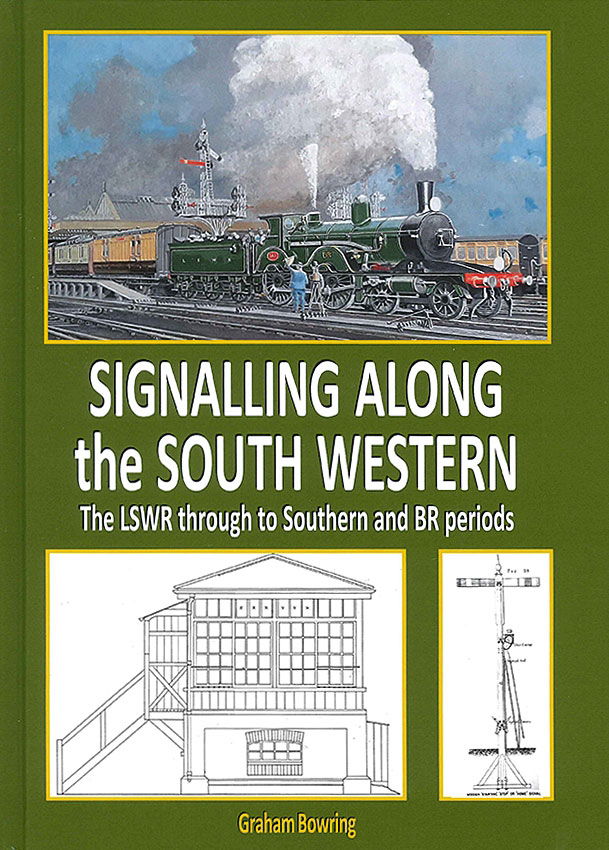
If you’re feeling a bit flush and want a very in-depth book on LSWR signalling I thoroughly recommend Signalling Along the South Western by Graham Bowring. Here’s a link to it.
 

Belperpete

Established Member
Joined
17 Aug 2018
Messages
3,619
The notch or fishtail was introduced in the 1870s and the Board of Trade made it mandatory for new work in 1877; the chevron was a GWR idea a bit later and took a while, probably not until grouping, to be the norm. Yellow was introduced somewhere around The Great War and became mandatory in the mid-1920s.
It was the IRSE (Institution of Railway Signal Engineers) that recommended the use of yellow for caution in 1922. Various railway companies had been experimenting with things like 3 position semaphores and colour lights, and it was felt some standardisation was needed.

At one time, green meant caution, and white was clear "white's all right". Early semaphores only had a red lens for danger, the white light showing when the signal was off. And some companies had a white spot, rather than a white stripe, on their red arms.
 

30907

Veteran Member
Joined
30 Sep 2012
Messages
21,949
Location
Airedale
That struck me also, and yet there's no obvious lack of space either horizontally or vertically (the post) for standard length arms?
The pre-WW2 25" map and the 1964 1:2500 both show a siding on the back of the platform. I wonder if a full-size signal arm would have fouled it?
 

Gloster

Veteran Member
Joined
4 Sep 2020
Messages
12,977
Location
Up the creek
The pre-WW2 25" map and the 1964 1:2500 both show a siding on the back of the platform. I wonder if a full-size signal arm would have fouled it?

The siding between the platform and water was in use 24-05-1938 to 03-04-1967 and was removed the following April. There is a 1966 photo on the SREmG site that suggests that the upper arm was at one time full length, although it is difficult to be sure. As the ramp behind was used for loading vehicles on to the ferries, I wonder if there had been problems with idiot drivers misjudging the sharp turn and bashing the arm.
 

30907

Veteran Member
Joined
30 Sep 2012
Messages
21,949
Location
Airedale
The siding between the platform and water was in use 24-05-1938 to 03-04-1967 and was removed the following April. There is a 1966 photo on the SREmG site that suggests that the upper arm was at one time full length, although it is difficult to be sure.
Looking closely, I think both photos show the starter arm longercthan the distant.
As the ramp behind was used for loading vehicles on to the ferries, I wonder if there had been problems with idiot drivers misjudging the sharp turn and bashing the arm.
Good thought.
 

thesignalman

Member
Joined
9 Jan 2012
Messages
160
Lower quadrant signals did not abruptly cease to be installed in 1923. The Southern Railway installed an L&SWR signal at Mitcham (which was actually LB&SCR territory) in the 1920s and this was still in use in the 1970s but had been converted to Upper Quadrant by 1978.


John
 

Big Jumby 74

Established Member
Joined
12 Feb 2022
Messages
2,238
Location
UK
The pre-WW2 25" map and the 1964 1:2500 both show a siding on the back of the platform. I wonder if a full-size signal arm would have fouled it?
I can still picture in my head the siding to which you refer, but as for the exact clearance detail? I think Gloster has very kindly provided as much detail as we might expect to find.
 

Chiltern 165

Member
Joined
11 Aug 2024
Messages
90
Location
London
Sorry for asking after this has long since died, but does anyone know what happened to Westinghouse colour lights (specifically the rounded ones) - I know LUL have loads still but im not sure about the national network.
 

D6130

Established Member
Joined
12 Jan 2021
Messages
9,051
Location
West Yorkshire/Tuscany
Sorry for asking after this has long since died, but does anyone know what happened to Westinghouse colour lights (specifically the rounded ones) - I know LUL have loads still but im not sure about the national network.
I think they've probably all been replaced by now, TBH, although others may know differently. They were used extensively by the Southern Railway from the late 1920s onwards and also by the LNER for the Stratford - Shenfield and York area resignalling schemes, which were completed by BR in 1949 and 1951 respectively. There may be odd ones still in use as distant signals in otherwise mechanically-signalled areas such as Bognor, Littlehampton or Eastbourne - Hastings.
 

Belperpete

Established Member
Joined
17 Aug 2018
Messages
3,619
I think they've probably all been replaced by now, TBH, although others may know differently. They were used extensively by the Southern Railway from the late 1920s onwards and also by the LNER for the Stratford - Shenfield and York area resignalling schemes, which were completed by BR in 1949 and 1951 respectively. There may be odd ones still in use as distant signals in otherwise mechanically-signalled areas such as Bognor, Littlehampton or Eastbourne - Hastings.
More modern signals use bulbs such as the SL35 with separate circuits for the main and auxiliary, that raise an alarm when the main blows. However, colour light signals of that vintage used bulbs such as the SL17. With such signals, both main and auxiliary filaments were both lit together. The auxiliary filament was lower wattage, so in theory should last longer, and wasn't quite in the optical focus, so appeared dimmer. Drivers were supposed to report a signal that appeared dimmer than usual, so that the bulb could be replaced before its auxillary filament blew and the lamp went out. I seem to recall that there was a collision caused by a SPAD somewhere south of Croydon due to a lamp failure of such a signal, that was a big driver for the Three Bridges resignalling to replace them.

Some of the heritage railways may have some survivors. The GCR (both N and S) seemed to have some heritage looking colour lights on my recent visit.

BR standardised on rectangular back boards for its signals. LT standardised on a more rounded lozenge shape. So whereas a signal with such a rounded lozenge backboard on BR would likely be quite old, I am not sure the same would necessarily apply on LT.

 

30907

Veteran Member
Joined
30 Sep 2012
Messages
21,949
Location
Airedale
Lower quadrant signals did not abruptly cease to be installed in 1923. The Southern Railway installed an L&SWR signal at Mitcham (which was actually LB&SCR territory) in the 1920s and this was still in use in the 1970s but had been converted to Upper Quadrant by 1978.


John
Thanks, that's the signal I remembered, and the photo confirms it was a LSW type not LBSC.
 
Status
Not open for further replies.

Top