Our new ticketing site is now live! Using either this or the original site (both powered by TrainSplit) helps support the running of the forum with every ticket purchase! Find out more and ask any questions/give us feedback in this thread!
Working at a train station you normally see the leaf blower train pass through twice a day one way then the other pushing air and water onto the tracks to get them off but not long after more leaves are back onto the track and glued to be Rails again when trains come through. Is this effective and what would happen if they wasn’t about.
Working at a train station you normally see the leaf blower train pass through twice a day one way then the other pushing air and water onto the tracks to get them off but not long after more leaves are back onto the track and glued to be Rails again when trains come through. Is this effective and what would happen if they wasn’t about.
It's called the RHTT - Railhead Treatment Train, and it's effective but no 100% effective. NR regularly test other technologies, such as dry ice, plasma beams, and lasers but so far none have been as successful as the Waterjet. If they weren't around you'd have a lot more SPADs, with lack of railhead adhesion a factor in the Salisbury Collision.
The interim RAIB report: https://assets.publishing.service.g...IR012022_220221_Salisbury_Tunnel_Junction.pdf notes the impact of low adhesion, and the fact that the RHTT was due to run through every 24 hours year on the day of the incident had been retimed to run through 36 hours after the last treatment.
Working at a train station you normally see the leaf blower train pass through twice a day one way then the other pushing air and water onto the tracks
Network Rail works in conjunction with (or shares information with) overseas administrations to develop the best anti-leaf technology. Various new things have been tried (as zwk500 states above) but what we have now is currently the best way of doing things.
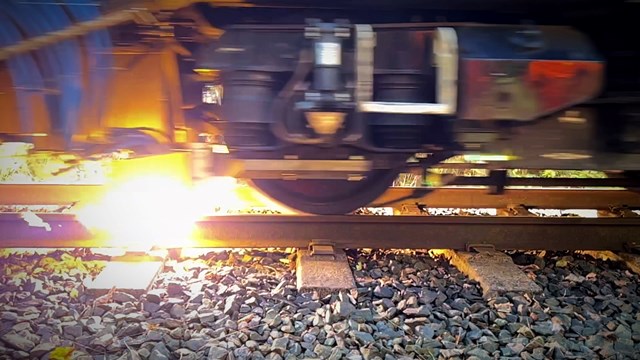
Space-age technology using lasers and plasma jets are being trialled as a more sustainable way to vaporise autumn leaves from railway lines and minimise passenger delays in the future.
www.networkrailmediacentre.co.uk
Space-age technology using lasers and plasma jets are being trialled as a more sustainable way to vaporise autumn leaves from railway lines and minimise passenger delays in the future.
Space-age technology using lasers and plasma jets are being trialled as a more sustainable way to vaporise autumn leaves from railway lines and minimise passenger delays in the future.
There were all sorts of ideas on adhesion, and the related problem of detection by track circuits, throughout my time at British Rail Research and successors (1987-2006). A big one that hasn't been mentioned is bringing back sanders, which are now fitted to many multiple unit classes.
As it's the anniversary of the Salisbury Tunnel Junction accident last year, there's currently an article on the BBC about Network Rail pledging to run more RHTTs, or "leaf-busting trains" according to the article. https://www.bbc.co.uk/news/uk-england-wiltshire-63438590 (link to BBC article entitled, "Salisbury rail crash: Anniversary pledge on leaf-busting trains.")
Rail firms say they are stepping up their fight against leaves on the line after a crash a year ago involving passenger trains in Salisbury. Two moving trains collided inside the Fisherton Tunnel on 31 October 2021, with an interim report revealing it was caused by compacted fallen leaves.
Seventeen people were injured, including one of the train drivers.
Network Rail and South Western Railway (SWR) say "leaf-busting" trains will run more regularly this autumn.
In last year's crash, the SWR driver was unable to brake properly for a red signal as compacted leaves on the line had made the rails slippery and the train travelled 626ft (191m) past the signal until it hit the side of a Great Western Railway (GWR) service at a junction.
As an aside, I hope that dreadful accident will serve as a reminder to the tabloid media whenever they moan about "leaves on the line" being a pitiful excuse.
I seem to recall hearing about the possibility of using technology fitted to the front of passenger trains instead of RHTTs - did that ever progress any further than a couple of inches of column space in RAIL?
There's 2 170s fitted with Water-Trak. Will be interesting to see what happens, as drivers are essentially told to drive as normal and there's no obvious way of telling that the unit is fitted with the equipment.
Any idea whether that’s onto the wheels or the rails? I know some modern stock (700s for one) has tread brakes on certain wheels to remove leaf mulch from the wheel rims.
Any idea whether that’s onto the wheels or the rails? I know some modern stock (700s for one) has tread brakes on certain wheels to remove leaf mulch from the wheel rims.
The rail. There's a description on their website of how it works. From memory the capacity of their water tanks is enough to give the same range before refilling as the fuel tanks on the unit.
Solving the low adhesion problem in the rail industry sometimes known as leaves on the line or slippery rail. Water-Trak gives a step change improvement in adhesion for predictable and consistent braking and traction performance. This reduces the chance of station overruns and other autumn incidents
Any idea whether that’s onto the wheels or the rails? I know some modern stock (700s for one) has tread brakes on certain wheels to remove leaf mulch from the wheel rims.
Are you saying the tread brakes are fitted for this reason?
I was under the impression they use tread brakes on the motor coaches because there was not any space for the disc brakes.
would it be possible to combine this with an RHTT i.e. suck up leaves in the 4ft, and add the sandite? or it would have to go too slowly to be practical?
Are you saying the tread brakes are fitted for this reason?
I was under the impression they use tread brakes on the motor coaches because there was not any space for the disc brakes.
I believe that's the reason for 700s. Some 158s were fitted with tread brakes as well as disc brakes on the end bogies, which I recall was specifically to do with cleaning the wheel treads, but may have been more for track circuit detection than for adhesion.
Maybe the use of tread brakes makes it practical to put 'other equipment' where the disk brakes would be... (i.e. maybe look at it the other way round)
Are you saying the tread brakes are fitted for this reason?
I was under the impression they use tread brakes on the motor coaches because there was not any space for the disc brakes.
I believe that's the reason for 700s. Some 158s were fitted with tread brakes as well as disc brakes on the end bogies, which I recall was specifically to do with cleaning the wheel treads, but may have been more for track circuit detection than for adhesion.
All motored axles on c700 have tread brakes which is why they perform so well in Autumn, every station stop or junction stop the motored wheel tread is scraped , yes they still slip and yes they still slide but the tread brakes make so much difference . I can't remember exact speed they apply but it is below 7 mph
Working at a train station you normally see the leaf blower train pass through twice a day one way then the other pushing air and water onto the tracks to get them off but not long after more leaves are back onto the track and glued to be Rails again when trains come through. Is this effective and what would happen if they wasn’t about.
To answer your last question. The other day, the scheduled rail head treatment train for the Hazel Grove to Buxton line did not run for whatever reason. All trains on that line were cancelled and rail replacement buses ran.
Edited to add. A quick check on RTT shows a few trains DID run, but those were HEAVILY delayed.
All motored axles on c700 have tread brakes which is why they perform so well in Autumn, every station stop or junction stop the motored wheel tread is scraped , yes they still slip and yes they still slide but the tread brakes make so much difference . I can't remember exact speed they apply but it is below 7 mph View attachment 122959
AIUI, at certain times of year (eg now) they are used for main braking at any speed. My 700 today certainly had something that sounded like tread brakes applied, which was just as well as the train had bad wheel slip at the previous station.
So when I was told by instructor during my traction course on the 700 that the reason for tread brakes was because of lack of space for disc brakes, he was mis informed?
Regen braking is used for all braking down to 7mph (can’t precisely remember exact speed!) then the disc and tread brakes take over.
The only other times the disc and tread brakes are used are in emergency braking or in snow brake mode
== Doublepost prevention - post automatically merged: ==
Rather than delete the above I will explain what I meant in a better way!
The tread (friction) brakes on a 700 are only found on the motor coaches.
When braking, the motors on the motor coaches perform the braking until the tread brakes take over at 7mph. On all other coaches the disc brakes are used 100% of the time.
As said above, emergency braking and snow brake mode uses only the friction brakes. ( tread and disc)
If the tread brakes were only specified for adhesion purposes (and not because of space limitations) don’t you think that leaving them to work, in normal circumstances, at speeds below 7mph would be of any use?
So when I was told by instructor during my traction course on the 700 that the reason for tread brakes was because of lack of space for disc brakes, he was mis informed?
AIUI, at certain times of year (eg now) they are used for main braking at any speed. My 700 today certainly had something that sounded like tread brakes applied, which was just as well as the train had bad wheel slip at the previous station.
I must admit, I agree with Need2. What you have probably experienced is where the TMS and the brake modules can adjust the blending. I have a brake graph somewhere that shows where the blending adjusts.
Surely it would take an update to adjust the braking each year otherwise.
We are aware of an issue with emails from the Forum to Microsoft-based email accounts (hotmail/outlook/live.com email addresses). This is being looked into currently, thanks for your patience meanwhile.