Leaf-fall season, contaminated railhead reduced railhead conditions may be the reason the driver is being careful with the power handleI am on a well delayed Class 465 Southeastern train with nothing ahead in signal diagram. I feel that the driver trying to cut time by minimising dwell time as much as possible.
But it appears to me that the train just don’t accelerate fast, as those Class 710 on Overhead lines, which in normal running circumstances, do have the sense of “push back” feeling and train getting to cruising speed in 10 seconds; while Southeastern one would take 45 seconds to achieve that.
It just make taking southeastern metro feeling ages to travel on.
Of course, compare to S stock in London Underground, there is also push back feeling even on those non auto driving section.
Is it the power traction issue, or the rolling stock itself, or just internal driving guidance caused the slower running and longer runtime between stations, especially metro ones? It is even more obvious when comparing Southeastern runtime with Southwestern runtime (faster) and with Great Northern / London Overhround runtime (even faster) on a same distance, same number of stations, simialr curvature conditions.

-
Our new ticketing site is now live! Using either this or the original site (both powered by TrainSplit) helps support the running of the forum with every ticket purchase! Find out more and ask any questions/give us feedback in this thread!
You are using an out of date browser. It may not display this or other websites correctly.
You should upgrade or use an alternative browser.
You should upgrade or use an alternative browser.
Is third rail bad at acceleration?
- Thread starter hkstudent
- Start date
- Status
- Not open for further replies.
Sponsor Post - registered members do not see these adverts; click here to register, or click here to log in
R
RailUK Forums
randyrippley
Established Member
- Joined
- 21 Feb 2016
- Messages
- 5,382
Maybe rather than batteries it's time to revisit flywheel booster sets

Or bionic duckweed!Maybe rather than batteries it's time to revisit flywheel booster sets

coppercapped
Established Member
The main factor which limits acceleration on low voltage third rail systems is the ability to discriminate between the maximum current required for the trains and the fault current caused by a short circuit. Fault currents are limited to around 10,000A to 12,000A at the line voltage to avoid melting the supply cables and kit in the substations, and to do this requires circuit breakers capable of breaking such currents.
Doing some simplified calculations the power dissipated in such a fault is in the order of 7.5MW — which is not dissimilar to the power drawn by a couple of accelerating emus. There are some complicating factors — the further away from the feeding point the fault occurs the lower the current drawn due to the resistance of the third rail and the return so making it even more difficult to discriminate between what should be and what shouldn't be.
Unless feeding points are very, very close together low voltage third (and fourth) rail systems can never deliver the power that a high voltage supply is able to do. Train acceleration on low voltage will always suffer.
Doing some simplified calculations the power dissipated in such a fault is in the order of 7.5MW — which is not dissimilar to the power drawn by a couple of accelerating emus. There are some complicating factors — the further away from the feeding point the fault occurs the lower the current drawn due to the resistance of the third rail and the return so making it even more difficult to discriminate between what should be and what shouldn't be.
Unless feeding points are very, very close together low voltage third (and fourth) rail systems can never deliver the power that a high voltage supply is able to do. Train acceleration on low voltage will always suffer.

Sun Chariot
Established Member
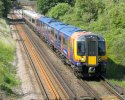
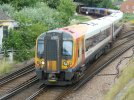
That makes good sense: weekdays, some Portsmouth Direct Line services are booked for 9-cars. No jolting with the 450 + 444 running together and powered.I think that the class 444's software limits the maximum current draw less than the 450s ... gives them comparable performance.
Attachments
In the case of 3rd rail, power supply is specced for max allowed current draw, - and when abnormal demand is made, the voltage sags ever nearer the minimum operating limit.Power supply is specced for peak power draw - which would be a bunch of trains all accelerating at once. If they don't draw more current accelerating than just cruising because the peak power draw is coming out of the battery, you can allow more trains on the same section and your power draw is going to be fairly constant - and/or the train can draw more power than the external supply can deliver.
But that single transmission loss is still proportional to the length of relatively high resistance 3rd rail betwen the two trains.You'd lose a lot regenning into trackside batteries, you're going both ways through the not very efficient 3rd rail distribution system. Would be better for HV overhead where transmission losses are lower. You could just store & pull power directly from other trains though, that's only one transmission loss.
edwin_m
Veteran Member
Another factor that limits the capability of the power supply is the heating of the equipment, which depends on the sum of current drawn over a period of time. This will increase if trains are still drawing the same current to accelerate faster with a boost from the batteries, but drawing more current the rest of the time to charge the batteries.Power supply is specced for peak power draw - which would be a bunch of trains all accelerating at once. If they don't draw more current accelerating than just cruising because the peak power draw is coming out of the battery, you can allow more trains on the same section and your power draw is going to be fairly constant - and/or the train can draw more power than the external supply can deliver.
randyrippley
Established Member
- Joined
- 21 Feb 2016
- Messages
- 5,382
You can laugh but flywheel boosters worked in the class 70 & 71Or bionic duckweed!
According to wiki they could temporarily boost the voltage to 1200V
Would be interesting to know what that really meant in terms of enhanced acceleration
Last edited:
Then compare class 700 trains' performance north of the river with south. They behave like entirely different stock. I'm not sure how much the maximum current has been reduced to on DC, but their full power on ac is 5MW which would equate to about 6,700A, which on a 10,000A or even a 12,000A supply would preclude two trains in the same power section. Applying a similar capping as the class 450s vs 350s, this would be reduced to around 4,500A, which still seems very close to the limit.Leaf-fall season, contaminated railhead reduced railhead conditions may be the reason the driver is being careful with the power handle
InTheEastMids
Established Member
- Joined
- 31 Jan 2016
- Messages
- 1,388
Having travelled on GatEx and EMR today, the 387 felt slow to accelerate compared to the 222.
And then 700s on AC seem quite a lot quicker off the mark than 222s at places like Luton Airport. So yes, the throttling of performance on third rail is very obvious.
To me, it makes the Southern region feel very last-century.
And then 700s on AC seem quite a lot quicker off the mark than 222s at places like Luton Airport. So yes, the throttling of performance on third rail is very obvious.
To me, it makes the Southern region feel very last-century.
craigybagel
Established Member
- Joined
- 25 Oct 2012
- Messages
- 5,826
How does the acceleration of a typical third rail EMU compare with a DMU from a similar era and with broadly the same top speed? Does electrification still provide an improved performance or are the benefits limited to environmental issues?

D365
Veteran Member
- Joined
- 29 Jun 2012
- Messages
- 13,170
I’m not sure what you mean. Traction batteries consist of ’strings’ of cells in series.It would also add more weight, and albeit change some designs of trains as you'd have to reshuffle somethings to fit them. Plus those batteries would have to be a hefty Voltage.
In my experience, even sluggish DC EMUs leave their DMU equivalents standing. The main reason, apart from power to weight ratios is that the much heralded maximum power of a DMU is that of the prime mover, I.e. the diesel engine. There's no additional power available. An EMU can run its electric motors beyond their continuous rating for short periods, including whilst accelerating. They can even run them above their one hour ratings for a very short time, e.e. minutes.How does the acceleration of a typical third rail EMU compare with a DMU from a similar era and with broadly the same top speed? Does electrification still provide an improved performance or are the benefits limited to environmental issues?

NSEWonderer
Established Member
I'm aware but what I meant is such a battery would require a hefty voltage to supply any meaningful current input to the train and be just as good at recharging from regen and this pretty much constantly along a single trip which will undoubtedly cause a lot of wear and tear.I’m not sure what you mean. Traction batteries consist of ’strings’ of cells in series.
The above is asking the battery work in tandem with the DC rail input additional current to the traction system which would mean the only time it really charges is on braking or at a standstill. I'm unaware of the capacities these days of battery powered trains(judging it hasn't been great and that's more so from a reliability stand point in the uk) but you'd be adding some type of system to regulate the two power inputs to work simultaneously and at that point such a "refurbishment" would basically be like making a new train on some of the existing fleet I.e the 465.
Assuming you can make a stable management system to optimally combine the two sources for just accelerating (plus the other required things to fit the batteries on the existing DC Stock) then either from a genuine standstill or acceleration in general till a certain speed it could offer a pretty good boost.
The stadler Class 777/1s are one of the trains in the uk with acclaimed reliable battery testing done and they have the battery power mode only able to supply a total of 320KW at 386V DC, which is about 829 Amps
As Watts = Volts * Amps
The Class 465 motor wise can take some 2,240KW of supply(manufacturer wise). This is only 60KW short off a GA standard 5 Car Class 720 which feels much more nippy with 2,300 kW motor output.
That means Amp wise the Class 465 is asking for roughly 2987 Amps at 750V to achieve its top KW output. Which it definitely is not getting close to that amount of juice.
Compare that to the Class 720s which although some what lighter and yes newer built they're however more likely to reach max output because the Current required is more achievable as the Overhead lines can push more power(Watts) with less current.
Take the Class 720 output of 2300KW and convert that to Amps is 2300KW / 25000V = 92 Amps
If the battery or batteries in addition to the true KW output generated by the DC rail, can push near enough of the 2,240KW needed by the motor than currently supplied by the 3rd rail then assuming the weight isn't sustained for the retrofit the Class 465 would be more nippy I'd say.
Note: Motor Efficiency was negligible here, ofc real world the Class 465 TM motors wouldn't be nearly as efficient as the newer motors on the Class 720s which does reduce the Output Power by a factor and require you to input slightly more than just what the motors can output KW wise maximum.
But overall there would be a noticeable change hence why the Class 365s feel more nippy than the 465s do and the 377/7s feel more nippy on AC than when on DC where the motors are still the same and capable of the same max KW output.
Last edited:
edwin_m
Veteran Member
A DMU might have a slight edge on startup, when available adhesion limits the amount of power that can be used so the main factor affecting acceleration is the proportion of the weight carried on powered axles. For a DMU it's 50% and for the older designs of EMU it's about a third. But the EMU will indeed soon catch up and overtake as speed increases and available power becomes more relevant.In my experience, even sluggish DC EMUs leave their DMU equivalents standing. The main reason, apart from power to weight ratios is that the much heralded maximum power of a DMU is that of the prime mover, I.e. the diesel engine. There's no additional power available. An EMU can run its electric motors beyond their continuous rating for short periods, including whilst accelerating. They can even run them above their one hour ratings for a very short time, e.e. minutes.
In general I agree that a thrashed DMU can provide a kickstart up to about 10 mph, but even that isn't necessarily true all the time. Four years ago I managed to get a ride on a class 769, which was of course an EMU converted to a bimode by adding two diesel genset's. Despite the original class 319's 1/3 driven adhesion weight being reduced to around 25% by the addition of the venset's weight to two of the trailer cars, the application of power was much smoother (and quieter) on acceleration from start compared with the more powerful class 150 I rode immediately after, and I think the racket that the DMU contributed more to the impression of acceleration that was actually true. Of course, the 769 cruising at 70+ mph was infinitely smoother and quieter, and had they been deployed more widely, they would have made much better trains for longer journeys.A DMU might have a slight edge on startup, when available adhesion limits the amount of power that can be used so the main factor affecting acceleration is the proportion of the weight carried on powered axles. For a DMU it's 50% and for the older designs of EMU it's about a third. But the EMU will indeed soon catch up and overtake as speed increases and available power becomes more relevant.

boiledbeans2
Member
Note that for an inverter drive (which both 465s and 720s have), the max power won't be directly related to acceleration.The Class 465 motor wise can take some 2,240KW of supply(manufacturer wise). This is only 60KW short off a GA standard 5 Car Class 720 which feels much more nippy with 2,300 kW motor output.
You will need to look at the max torque, which will be delivered from standstill for inverter drives (unless it has been de-rated software-wise, to avoid a jerk from standstill).
Last edited:
edwin_m
Veteran Member
The power available is indeed not relevant at starting, but becomes significant as speed increases.Note that for an inverter drive (which both 465s and 720s have), the max power won't be directly related to acceleration.
You will need to look at the max torque, which will delivered from standstill for inverter drives (unless it has been de-rated software-wise, to avoid a jerk from standstill).
notadriver
Established Member
- Joined
- 1 Oct 2010
- Messages
- 3,737
This illustrates another point about power supply: a 12-car 375 set on the Chatham Main Line accelerates at snail's pace, but less so on the SEML.
Any specific locations for this? I havent noticed a huge difference.
Snow1964
Established Member
Back in early 1980s, lived at New Milton, and on one occasion due to a problem, train was a single 4REP (without any TC units)
In those days of no electronics and data recording, the driver clearly decided the rare chance to get a main line run was worth giving it some welly. It was lively.
So can have high acceleration on dc, just normally not allowed to and risk cooking the sub stations.
In those days of no electronics and data recording, the driver clearly decided the rare chance to get a main line run was worth giving it some welly. It was lively.
So can have high acceleration on dc, just normally not allowed to and risk cooking the sub stations.
coppercapped
Established Member
Acceleration is dependent on the power to weight ratio, and without the extra weight of the 4TC the 4REP is a pocket rocket, limited by how quickly the camshaft switches out the starting resistors.Back in early 1980s, lived at New Milton, and on one occasion due to a problem, train was a single 4REP (without any TC units)
In those days of no electronics and data recording, the driver clearly decided the rare chance to get a main line run was worth giving it some welly. It was lively.
So can have high acceleration on dc, just normally not allowed to and risk cooking the sub stations.
As the 4REP would reach line speed more quickly and then run under lower power, or even coast, the heavy current draw through the substations would not last so long so, counterintuitively, they are likely to warm up less than in normal operation.
Trains should be as light as possible...!

ExRes
Established Member
I did a fair bit of DC running with 325s (single unit only) and the performance was well below that on AC
Not really, what you described was the equivalent of a pair of electric locos withBack in early 1980s, lived at New Milton, and on one occasion due to a problem, train was a single 4REP (without any TC units)
In those days of no electronics and data recording, the driver clearly decided the rare chance to get a main line run was worth giving it some welly. It was lively.
So can have high acceleration on dc, just normally not allowed to and risk cooking the sub stations.
The 4REP isn't really an EMU as it is effectively a tractor unit for propelling sets of unitised trailer cars (4TC). Running them alone is almost as irrelevant as running locos with a brake van. Running them as a passenger service just wouldn't happen (outside the dreams of some enthusiasts). To provide the capacity needed on the SWML using just 4REPs would definately need a very different chain of 750VDC feeds.Acceleration is dependent on the power to weight ratio, and without the extra weight of the 4TC the 4REP is a pocket rocket, limited by how quickly the camshaft switches out the starting resistors.
As the 4REP would reach line speed more quickly and then run under lower power, or even coast, the heavy current draw through the substations would not last so long so, counterintuitively, they are likely to warm up less than in normal operation.
Trains should be as light as possible...!
In terms of weight, the class 700s are about the same weight as the equivalent number of cars of class 319, but of course near;t three times as powerful!
== Doublepost prevention - post automatically merged: ==
The difference on the 319s between ac and DC was probably as near as could be given their lack of a programmed power cap on DC. Although the Brighton Express held the London-Brighton speed record for a number of years, that speed was lower than could be achieved under OLE because of the 750V sagging when other trains were in the same power section.I did a fair bit of DC running with 325s (single unit only) and the performance was well below that on AC
Last edited:
NSEWonderer
Established Member
That is true whilst not directly it will switch on and off in the frequency using what avaliable max power it has to do so till you start getting to max speed where the max power comes into play fully.Note that for an inverter drive (which both 465s and 720s have), the max power won't be directly related to acceleration.
You will need to look at the max torque, which will be delivered from standstill for inverter drives (unless it has been de-rated software-wise, to avoid a jerk from standstill).
boiledbeans2
Member
That is an incorrect explanation, unfortunately.That is true whilst not directly it will switch on and off in the frequency using what avaliable max power it has to do so till you start getting to max speed where the max power comes into play fully.
With a quick Google search, I found an image of the simplest torque/speed and power/speed curve for an AC inverter drive (or separately excited DC motor), an image you will find in textbooks:
As you can see, the maximum power (blue line) will not be reached until base speed (omega_base on x-axis).
coppercapped
Established Member
I was responding to Snow1964's post no. #50 where he made it clear that the 4REP-only run was the result of some problem and the rest of the train wasn't there. It was a 'one-off'.Not really, what you described was the equivalent of a pair of electric locos with
The 4REP isn't really an EMU as it is effectively a tractor unit for propelling sets of unitised trailer cars (4TC). Running them alone is almost as irrelevant as running locos with a brake van. Running them as a passenger service just wouldn't happen (outside the dreams of some enthusiasts).
Neither Snow1964 nor I suggested that the Waterloo-Bournemouth service could or should be operated by trains made up entirely of 4REPs.To provide the capacity needed on the SWML using just 4REPs would definately need a very different chain of 750VDC feeds.
In terms of weight, the class 700s are about the same weight as the equivalent number of cars of class 319, but of course near;t three times as powerful!
== Doublepost prevention - post automatically merged: ==
The difference on the 319s between ac and DC was probably as near as could be given their lack of a programmed power cap on DC. Although the Brighton Express held the London-Brighton speed record for a number of years, that speed was lower than could be achieved under OLE because of the 750V sagging when other trains were in the same power section.
edwin_m
Veteran Member
Power used is tractive effort multiplied by speed. So when starting the power used is theoretically zero, and as the train accelerates it will use more power to maintain the same tractive effort (which is equivalent to the torque), and acceleration will stay roughly constant (resistance to motion will increase with speed, but is pretty low in this speed range). At higher speeds full power can be used but the available tractive effort decreases as the train accelerates further, and resistance also becomes more significant.
Everywhere, though especially in Medway. A 465 will easily outpace an Electrostar until about 75mph.Any specific locations for this? I havent noticed a huge difference.
NSEWonderer
Established Member
That is an incorrect explanation, unfortunately.
With a quick Google search, I found an image of the simplest torque/speed and power/speed curve for an AC inverter drive (or separately excited DC motor), an image you will find in textbooks:
As you can see, the maximum power (blue line) will not be reached until base speed (omega_base on x-axis).

You can see between 0 and 1 speed the inverters switching on and off in x frequency as the power builds up to max by the base speed(This doing that using what is the avaliable max power to build up the current power load). By Max speed I should have said maybe critical speed. The more power you can produce at max the higher the max speed as the power curve after critical whilst it drops quite a lot on the curve will do that at a gradual rate of time the higher the power is on the Y axis. Which is what I meant by the max/ top speed being where max power fully comes into play(or for better wording where it really makes more of a difference than torque of which it and tractive effort deal more with how quickly you get to top speed).
Last edited:
It's fair to say that EPBs and HAPs took off a lot faster than the very similar class 205 DEMUs. The same applies to 377 versus 171. The EMUs were also much faster than the first gen DMUs. This was proved many times between Gatwick and Earlswood.How does the acceleration of a typical third rail EMU compare with a DMU from a similar era and with broadly the same top speed? Does electrification still provide an improved performance or are the benefits limited to environmental issues?
- Status
- Not open for further replies.