• Our new ticketing site is now live! Using either this or the original site (both powered by TrainSplit) helps support the running of the forum with every ticket purchase! Find out more and ask any questions/give us feedback in this thread!

Identifying rail of UK origin in Australia

Willothewisp

New Member
Joined
3 Jul 2026
Messages
3
Location
Hallett Cove South Australia
The picture below is of some rail that is an exhibit in a museum in Whyalla, South Australia. I was asked whether I could help identify it. The makers markings are similar to those used by Australian manufacturers, but the name is not that of an Australian manufacturer and the year is too early for local manufacture of rail in that region.

It is clearly 40 pounds per yard rail made in October 1906. That would align with early rail construction on the nearby iron ore haulage railway from Iron Knob to Whyalla. My guess is that "B'Head" is Birkenhead, Merseyside, England.

Any ideas about the manufacturer? A quick Google search revealed nothing likely. Does this mean anything to knowledgeable UK rail enthusiasts?

IMG_0003.jpg
 
Sponsor Post - registered members do not see these adverts; click here to register, or click here to log in
R

RailUK Forums

Mcr Warrior

Veteran Member
Joined
8 Jan 2009
Messages
17,306
There's also a Birkenhead in the Adelaide area of South Australia, isn't there? Whyalla not far away in the general scheme of things.
 

Willothewisp

New Member
Joined
3 Jul 2026
Messages
3
Location
Hallett Cove South Australia
There's also a Birkenhead in the Adelaide area of South Australia, isn't there? Whyalla not far away in the general scheme of things.
Yes, but there was not, and still is not, a steel mill and rail manufacturing plant located there. That area is mainly known for cement and fuel, not steel. Whyalla now has a steel mill that makes rail (hence the interest in a piece of rail in the museum), but this did not exist in 1906.
 

mmh

Established Member
Joined
13 Aug 2016
Messages
4,313
It'll be the British Birkenhead, the heart shaped symbol will be an early version of the British Standards 'kitemark' - which was introduced in 1903 and was first used on rails.

 
Joined
23 Nov 2023
Messages
783
Location
Grimsby
After a bit of an internet "rabbit hole", here goes!

B'Head is indeed Birkenhead, England. E.M.P.Co were the English McKenna Process Company with an office address of York Mansion, Westminster, London and a works in Seacombe, Birkenhead (info from the Grace's Guide website).
The factory was constructed in 1904-1905 when English McKenna Process Company was set up; it was a UK offshoot of the (American) McKenna Process Company.
They were essentially a very early recycling firm and had patents for processes which "renewed" worn rail (I assume by grinding it) and also for re-rolling worn heavy section rail into as-new lighter section rail.
So presumably the 40lbs/yard rail pictured had started life as a heavier section version.
At a guess their products were cheaper than buying newly manufactured rail.

There's a full history of the McKenna Company and its English subsidiary on the George's Basement website, link here;
 

Mcr Warrior

Veteran Member
Joined
8 Jan 2009
Messages
17,306
@Pyewipecarshed. Good sleuthing!

There had also been a similar, slightly earlier, business established over in Milwaukee in the State of Wisconsin, namely the 'McKenna Process Company'. The person behind this was an Edward William McKenna, Chief Engineer/Assistant General Superintendent of the Chicago, Milwaukee & St. Paul Railway Company. Born Pittsburgh, Pennsylvania in October 1848. Died March 1920, aged 71, in West Virginia. McKenna had once served in the American Civil War in the U.S. military telegraph corps.

As for the English McKenna Process Co. Ltd, located on Dock Road, Seacombe, the business appears to have become bankrupt by 1912/1913. Big problem seems to have been that little research had been done in England prior to opening the Liverpool plant as regards the potential market for British re-rolled rail.
 

Willothewisp

New Member
Joined
3 Jul 2026
Messages
3
Location
Hallett Cove South Australia
After a bit of an internet "rabbit hole", here goes!

B'Head is indeed Birkenhead, England. E.M.P.Co were the English McKenna Process Company with an office address of York Mansion, Westminster, London and a works in Seacombe, Birkenhead (info from the Grace's Guide website).
The factory was constructed in 1904-1905 when English McKenna Process Company was set up; it was a UK offshoot of the (American) McKenna Process Company.
They were essentially a very early recycling firm and had patents for processes which "renewed" worn rail (I assume by grinding it) and also for re-rolling worn heavy section rail into as-new lighter section rail.
So presumably the 40lbs/yard rail pictured had started life as a heavier section version.
At a guess their products were cheaper than buying newly manufactured rail.

There's a full history of the McKenna Company and its English subsidiary on the George's Basement website, link here;
Thanks Pywipecarshed. That is an amazing find!

It makes sense that at least part of the original iron ore "tramway", as it was originally called to avoid some railway legislation and regulations, would have used cheap and lightweight rail.

I will let the museum know about the company name and history.
 

Prime586

Member
Joined
26 May 2023
Messages
300
Location
Knowsley
The McKenna Process Co. was a 'tech startup' of it's day. The McKenna patent process took worn and battered (the rail ends would get deformed by wheel impacts at the joints) heavy gauge rail, heated it and re-rolled it into lighter gauge rail. The re-rolling process extruded the rail and allowed the battered joint ends to be cut off and still be left with standard rail lengths. The lighter rail the process output was then used for secondary lines.

The company's investors rapidly expanded operations from it's original 1897 mill in Joliet, IL,, opening two further mills in Kansas City and Tremley, NJ, despite there being limited enthusiasm from the railroads for re-rolled rail (the Kansas ciry mill was shut down due to lack of work at the same time they were building the Tremley mill). The investors were also pursuing new markets to expand into and eyed the UK, and they collaborated with a group of British investors to set up the English McKenna Process Company Ltd. A new modern elecrically-powered mill was designed to be built in Birkenhead in 1904 (at the same time, all three of the US mills were in shut down due to lack of work).

There were 2 big problems for the UK operation:
1) The new mill design was totally untried - rather than massive steam engines and flywheels driving the rollers like the US mills, it was electrically driven, powered by generators attached to steam turbines. The turbines, generators and motors were all new technology and took a long time to get right, so the mill spent long periods out of action under repair. Even when working the electrically-driven rollers did not have the same mass and inertia as the US steam-driven ones, which led to process difficulties.
2) The fundamental difference between US and UK rail. The US used flat-bottomed rail that was secured to the sleepers by spikes, with the wear occuring at the railhead and joints. UK rail at the time was predominantly bullhead rail, with the wear taking place in the bottom and sides of the rail where it rubbed against the chairs. The McKenna rerolling process was not suited to this type of rail, and so the UK railways were not interested in becoming experimental customers (note that the rail in the OP is also flat-bottomed - most of it's output seems to have been lightweight flat-bottomed rail for export to industrial users in the Empire ).

The UK arm of the company eventually went under in 1913 (having alienated a potential major customer in Cammell Laird along the way). The managing director, William Tozer, had presumably seen the end coming and resigned from the company (and his father's business, which was one of the company's UK investors) in 1910 and set himself up as a steel merchant in Liverpool.

The US parent company also ran into difficulties - the McKenna process was originally developed to work with low-carbon, soft Bessemer steel rails that were common in the 19th century. From 1900 the US railroads started using rail made from high-carbon Open Hearth process steel, These rails started showing up at McKenna's mills around 1908, and the McKenna process was not compatible with this type of steel, resulting in brittle rails that cracked under load.

The US railroads lost interest in McKenna process refurbished rails once these issues became known, and by 1910 the Kansas City and Tremley mills had shut down. The Joliet mill still received batches of the old Bessemer steel rails to process, while still trying to work out a process for Open Hearth rails without lasting success. The company did develop a new process for straightening rails, which provided them with some business, but the rail re-rolling part of the business was dead by 1923.

In 1924 they developed a new patent process for refurbishing worn and cracked joint bars (or fishplates as they are known here), which was licenced to other steel mills. The Joliet mill carried on refurbishing joint bars and company survived off that and the royalties from it's licencees until a series of litigations regarding infringements of their patents in the late 1930s and a Federal price-fixing case with their licencees went against them. The judgement of the Federal case included voiding the company's patents, and combined with the railroads adopting the new process of welding rail joints, the company went under in 1943.

 
Last edited:

Taunton

Veteran Member
Joined
1 Aug 2013
Messages
12,333
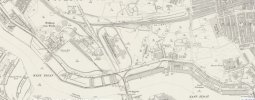
There happens to be a detailed 25" map of the Birkenhead Docks area from 1909 on the NLS site, showing "Birkenhead Steel Rolling Mills", a lengthy building (as such processes needed to be) on Dock Road, which is the road along the north side of Birkenhead docks, alongside the east side of Gorsey Lane. It had rail sidings into both the Wirral Railway Seacombe branch on one side, and the docks internal rail system on the other, and was also well positioned to handle import/export rail by ship from the adjacent wharves, which right up into the 1980s was a departure point for the Blue Funnel shipping line from Birkenhead to the Far East and Australia.

The roads are still there, the land area now occupied by a rather ramshackle set of industrial buildings, with the water side long disused. For precision, this side of the docks is not in Birkenhead, but in adjacent Wallasey, the Seacombe area, which until 1974 were staunchly independent of one another.
 

Attachments

  • Seacombe.JPG
    Seacombe.JPG
    158.8 KB · Views: 25

Prime586

Member
Joined
26 May 2023
Messages
300
Location
Knowsley
There happens to be a detailed 25" map of the Birkenhead Docks area from 1909 on the NLS site, showing "Birkenhead Steel Rolling Mills", a lengthy building (as such processes needed to be) on Dock Road, which is the road along the north side of Birkenhead docks, alongside the east side of Gorsey Lane.

By the next edition of the map (1925) it's all gone, with the land turned over to allotments (presumably during WWI). The Wirral Railway have removed their sidings connection from the east side of the Gorsey Lane bridge, and only the points of the Dock Railway connection on the Dock Road remain (the Dock Railway connection was originally built for Seacombe Brick Works to the east of the site that had closed by the time the McKenna mill was built). This does align with the account I read that the new, unproven electrically-powered mill never really worked properly, so presumsbly nobody was interested in purchasing it for reuse after McKenna's went bankrupt (all the other metal working industries in the area were on the Birkenhead side of the Great Float).

Locally, the site was known as McKenna's Field, and there were still derelict parts of the mill buildings there for years afterwards, as this letter in the Wirral Globe describes.

By 1937 a dog racing track has been built along the northern end of the site alongside the Wirral Railway, but the site basically stood derelict until the current light industrial units were built in the late 1970s/early 1980s (as a result of the Kingsway Tunnel being built, and the A59 that connects it to Gorsey Lane being built on the alignment of the former Wirral Railway Seacombe Branch).

There is a building on the Dock Road next to where the Dock Railway connection into the site was that is called McKenna's Buildings (it was used as offices for many years, but is now sadly derelict and the interior has been gutted). The gutter hoppers on the front have the date 1904 cast into them, which aligns with the date the McKenna mill was built, but on the 1909 and 1925 maps it is marked as the Seacombe Ferry offices, so it may have just been built at the same time as McKenna's mill and later inherited the name.

The quay side of the Dock Road is now the site of the brightly coloured apartment buildings of the Miller's Quay development, part of Peel Holdings' Wirral Waters project (though it should be noted the grain warehouses and flour mills on the Wallasey side of the East Float were actually situated further east along the quayside).
 

Taunton

Veteran Member
Joined
1 Aug 2013
Messages
12,333
Regarding rail products exported to Australia, at the time this was normal as there was limited or no heavy engineering supply base there. My own grandfather went out there in 1908 on a three year contract, to get the mechanical plant and all the associated canefield railways up and running at the Farley Sugar Mill in Mackay, Queensland, not only still there but now the largest sugar mill in the southern hemisphere. Everything of consequence, steam locos, rails, processing plant, etc, was shipped out from the UK. The Sydney Harbour Bridge structure was likewise sent out in steel sections from Middlesbrough.
 

Prime586

Member
Joined
26 May 2023
Messages
300
Location
Knowsley
Wow that's a mind blowing fact about the Sydney harbour bridge made and shipped out of the UK.
Both bridges were designed by the same engineering firm (Mott, Hay & Anderson) and fabricated and erected by the same steel company (Doman Long & Co.) at about the same time (work on the Sydney Harbour Bridge started first, but the Tyne Bridge was completed first). The two bridges are of very similar design, though the Tyne Bridge is obviously much smaller.

Not all the steel for the Sydney Harbour Bridge came from Teeside, however - 20% (mostly used for the decking and approach spans) was locally sourced from the BHP Steelworks in Newcastle, NSW.
 

Top