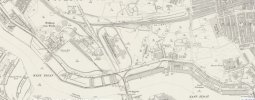
The McKenna Process Co. was a 'tech startup' of it's day. The McKenna patent process took worn and battered (the rail ends would get deformed by wheel impacts at the joints) heavy gauge rail, heated it and re-rolled it into lighter gauge rail. The re-rolling process extruded the rail and allowed the battered joint ends to be cut off and still be left with standard rail lengths. The lighter rail the process output was then used for secondary lines.
The company's investors rapidly expanded operations from it's original 1897 mill in Joliet, IL,, opening two further mills in Kansas City and Tremley, NJ, despite there being limited enthusiasm from the railroads for re-rolled rail (the Kansas ciry mill was shut down due to lack of work at the same time they were building the Tremley mill). The investors were also pursuing new markets to expand into and eyed the UK, and they collaborated with a group of British investors to set up the English McKenna Process Company Ltd. A new modern elecrically-powered mill was designed to be built in Birkenhead in 1904 (at the same time, all three of the US mills were in shut down due to lack of work).
There were 2 big problems for the UK operation:
1) The new mill design was totally untried - rather than massive steam engines and flywheels driving the rollers like the US mills, it was electrically driven, powered by generators attached to steam turbines. The turbines, generators and motors were all new technology and took a long time to get right, so the mill spent long periods out of action under repair. Even when working the electrically-driven rollers did not have the same mass and inertia as the US steam-driven ones, which led to process difficulties.
2) The fundamental difference between US and UK rail. The US used flat-bottomed rail that was secured to the sleepers by spikes, with the wear occuring at the railhead and joints. UK rail at the time was predominantly bullhead rail, with the wear taking place in the bottom and sides of the rail where it rubbed against the chairs. The McKenna rerolling process was not suited to this type of rail, and so the UK railways were not interested in becoming experimental customers (note that the rail in the OP is also flat-bottomed - most of it's output seems to have been lightweight flat-bottomed rail for export to industrial users in the Empire ).
The UK arm of the company eventually went under in 1913 (having alienated a potential major customer in Cammell Laird along the way). The managing director, William Tozer, had presumably seen the end coming and resigned from the company (and his father's business, which was one of the company's UK investors) in 1910 and set himself up as a steel merchant in Liverpool.
The US parent company also ran into difficulties - the McKenna process was originally developed to work with low-carbon, soft Bessemer steel rails that were common in the 19th century. From 1900 the US railroads started using rail made from high-carbon Open Hearth process steel, These rails started showing up at McKenna's mills around 1908, and the McKenna process was not compatible with this type of steel, resulting in brittle rails that cracked under load.
The US railroads lost interest in McKenna process refurbished rails once these issues became known, and by 1910 the Kansas City and Tremley mills had shut down. The Joliet mill still received batches of the old Bessemer steel rails to process, while still trying to work out a process for Open Hearth rails without lasting success. The company did develop a new process for straightening rails, which provided them with some business, but the rail re-rolling part of the business was dead by 1923.
In 1924 they developed a new patent process for refurbishing worn and cracked joint bars (or fishplates as they are known here), which was licenced to other steel mills. The Joliet mill carried on refurbishing joint bars and company survived off that and the royalties from it's licencees until a series of litigations regarding infringements of their patents in the late 1930s and a Federal price-fixing case with their licencees went against them. The judgement of the Federal case included voiding the company's patents, and combined with the railroads adopting the new process of welding rail joints, the company went under in 1943.