• Our new ticketing site is now live! Using either this or the original site (both powered by TrainSplit) helps support the running of the forum with every ticket purchase! Find out more and ask any questions/give us feedback in this thread!

Hydrogen Locomotives

Status
Not open for further replies.

Halifaxlad

Established Member
Joined
5 Apr 2018
Messages
1,791
Location
The White Rose County
Does anybody know if a standard gauge hydrogen locomotive is being developed by anyone ?

I know they're a few conversions being trialled with existing stock but I have been thinking that a Hydrogen powered equivalent of the 68/88 could be used to replace 68's that now operate Transpennine Express services? As it would be a simple change over with the stock.
 
Sponsor Post - registered members do not see these adverts; click here to register, or click here to log in
R

RailUK Forums

randyrippley

Established Member
Joined
21 Feb 2016
Messages
5,383
Same question as every time this subject is raised: where are you going to put the fuel? Power storage density of hydrogen is low, and you need to store it in the roof for safety: underfloor tanks are a danger. You'd probably need a tender to hold the fuel, then you get a whole range of issues related to flexible pipes - and leaks
Hydrogen fueled vehicles need to be designed from scratch, not adapted from existing units. And as you'd probably want to burn the hydrogen in a fuel cell, not an internal combustion engine you'd end up binning one of the more expensive components
 

Halifaxlad

Established Member
Joined
5 Apr 2018
Messages
1,791
Location
The White Rose County
Im certainly not suggesting converting an already built locomotive!

My initial thoughts were regarding a purpose built hydrogen locomotive!

Sorry if I wasn't clear enough.
 

randyrippley

Established Member
Joined
21 Feb 2016
Messages
5,383
I still think that even with a loco design the problem of where to store the fuel will make any hydrogen loco unfeasible simply due to the lack of storage and corresponding lack of range.
Multiple units, with distributed storage in the vehicle roofs would be feasible and I suspect thats where most development will head
 

Fawkes Cat

Established Member
Joined
8 May 2017
Messages
5,265
<checks that this is Speculative Ideas, where ignorance needn't be a bar to comment>

Is it relevant that there's never been a locomotive ( or at least never a fleet of successful locomotives) powered by any gas? That's surely because gas is difficult to handle (if you must, you can carry diesel in a bucket: try that with gas and it will all escape) and doesn't have a great energy density by weight or volume. So you are going to need big fuel tanks.

So does it make more sense to burn the hydrogen in power stations, to power electric trains? Then invest in better battery technology and expanding electric lines.
 

Indigo Soup

Established Member
Joined
17 May 2018
Messages
1,485
So does it make more sense to burn the hydrogen in power stations, to power electric trains? Then invest in better battery technology and expanding electric lines.
No - because you have to use power to make the hydrogen! Far more efficient to use the power, whether from wind, solar, nuclear, or buttered cats, to power electric trains directly.
 

edwin_m

Veteran Member
Joined
21 Apr 2013
Messages
28,617
Location
Nottingham
I saw this article recently suggesting the whole hydrogen economy is a sham. It's from a fairly partisan source and I don't necessarily agree with all of it, but it does suggest the current push towards hydrogen may be due to ulterior motives. https://www.treehugger.com/environmental-policy/natural-gas-and-hydrogen-economy-bridge-nowhere.html

But in fact, Alstom is getting its hydrogen [for the trains recently introduced in Germany] from Linde, which makes it for industrial purposes through steam reformation of natural gas. There are plans to dial up the amount of "green" hydrogen over the next few years, but if one looks at the economics, it doesn't make much sense. That's because, as the Bloomberg headline says, America is awash in natural gas and it's about to get worse.

Hydrogen powered trains may however have something to offer in the mix of decarbonization options, for example if we get to a position where there is surplus renewable energy at certain times of day, which can be used to produce "green" hydrogen to fuel trains on lightly-used lines where electrification isn't viable.
 

Kingspanner

Member
Joined
17 Jul 2019
Messages
328
Location
Dinsdale
The treehugger article seeks to polarise the argument by saying that the real reason for a hydrogen economy is avoid natural gas assets becoming stranded, when it is an additional reason.
It is a win-win if heat and transport get decarbonised AND all those investors avoid stranded assets. It is possible to make decisions based on multiple motivations. but it is not possible to get your blog mentioned in mainstream media unless you are controversial.
Any reasonable manager of a fossil fuel supplier sees climate change as a threat to their business. Of course they do. But they will be far less resistant to decarbonisation policies if they can see a future for themselves, their people and their assets. Hydrogen and Carbon Capture and Storage are obvious routes.
 

edwin_m

Veteran Member
Joined
21 Apr 2013
Messages
28,617
Location
Nottingham
The treehugger article seeks to polarise the argument by saying that the real reason for a hydrogen economy is avoid natural gas assets becoming stranded, when it is an additional reason.
It is a win-win if heat and transport get decarbonised AND all those investors avoid stranded assets. It is possible to make decisions based on multiple motivations. but it is not possible to get your blog mentioned in mainstream media unless you are controversial.
Any reasonable manager of a fossil fuel supplier sees climate change as a threat to their business. Of course they do. But they will be far less resistant to decarbonisation policies if they can see a future for themselves, their people and their assets. Hydrogen and Carbon Capture and Storage are obvious routes.
I mostly agree with that. I suppose the risk is that the decision on how much emphasis to give to hydrogen relative to alternative decarbonization strategies may be skewed by special interests, rather than being taken on the sole basis of how to reduce CO2 with the minimum downside to society as a whole.
 

Llanigraham

On Moderation
Joined
23 Mar 2013
Messages
6,487
Location
Powys
Well it seems that the Germans are managing to do it.
https://www.theguardian.com/environ...-launches-worlds-first-hydrogen-powered-train
Germany has rolled out the world’s first hydrogen-powered train, signalling the start of a push to challenge the might of polluting diesel trains with costlier but more eco-friendly technology.

Two bright blue Coradia iLint trains, built by French TGV-maker Alstom, on Monday began running a 62 mile (100km) route between the towns and cities of Cuxhaven, Bremerhaven, Bremervoerde and Buxtehude in northern Germany – a stretch normally plied by diesel trains.

“The world’s first hydrogen train is entering into commercial service and is ready for serial production,” Alstom CEO Henri Poupart-Lafarge said at an unveiling ceremony in Bremervoerde, the station where the trains will be refuelled with hydrogen.

Alstom has said it plans to deliver another 14 of the zero-emissions trains to Lower Saxony state by 2021, while other German states have also expressed an interest.

Hydrogen trains are equipped with fuel cells that produce electricity through a combination of hydrogen and oxygen, a process that leaves steam and water as the only emissions. Excess energy is stored in ion lithium batteries on board the train.

The Coradia iLint trains can run for about 600 miles (1,000km) on a single tank of hydrogen, similar to the range of diesel trains.

Alstom is betting on the technology as a greener, quieter alternative to diesel on non-electrified railway lines – an attractive prospect to many German cities scrambling to combat air pollution.

“Sure, buying a hydrogen train is somewhat more expensive than a diesel train, but it is cheaper to run,” Stefan Schrank, the project’s manager at Alstom, said.

Other countries are also looking into hydrogen trains, Alstom said, including Britain, the Netherlands, Denmark, Norway, Italy and Canada. In France, the government has already said it wants the first hydrogen train to be on the rails by 2022.
 

xotGD

Established Member
Joined
4 Feb 2017
Messages
7,833
Hydrogen in a tender, fireman to shovel it into the fuel cell...

Seriously, a longer, articulated locomotive to provide hydrogen storage is likely the way to go.
 

HSTEd

Veteran Member
Joined
14 Jul 2011
Messages
20,286
Not sure there is much point using hydrogen as a fuel for a locomotive if ammonia or similar materials are available. The only way to make hydrogen remotely practical is to handle it as a cryogenic liquid, which is a nightmare.


As to the gas argument, given the performance of portable heat pumps (ones with single hoses that go out the window like the stereotype US air con unit), with a COP of about 2.2, the projected 170GWt of peak heating load in the UK, from this recent study which had improved methodology compared to previous studies that gave a far higher result.... we would be looking at an absolute peak space heating electricity demand of about 80GWe.

Hardening the electricity distribution to take the extra load is going to be far cheaper than messing around with some insane hydrogen heating gas system.
 

Halifaxlad

Established Member
Joined
5 Apr 2018
Messages
1,791
Location
The White Rose County
<checks that this is Speculative Ideas, where ignorance needn't be a bar to comment>

Is it relevant that there's never been a locomotive ( or at least never a fleet of successful locomotives) powered by any gas? That's surely because gas is difficult to handle (if you must, you can carry diesel in a bucket: try that with gas and it will all escape) and doesn't have a great energy density by weight or volume. So you are going to need big fuel tanks.

So does it make more sense to burn the hydrogen in power stations, to power electric trains? Then invest in better battery technology and expanding electric lines.

This thread wasn't about the pro's and cons of hydrogen vs alternative fuel sources!

This was mainly about development of hydrogen train and whenever someone is developing a dedicated locomotive. As all hydrogen development at the moment on standard gauge appears to be retrofitting existing DMU's or EMU's. Which up to the re-introduction of driving trailers by Transpennine was the norm.

If a hydrogen locomotive was developed then at least these driving trailer sets wouldn't have to be powered by dirty diesel!
 

Fawkes Cat

Established Member
Joined
8 May 2017
Messages
5,265
This thread wasn't about the pro's and cons of hydrogen vs alternative fuel sources!

Sadly, just because you start a thread you don't get to own what we want to say.

This was mainly about development of hydrogen train and whenever someone is developing a dedicated locomotive.
And we've explained why no-one is likely to be developing a hydrogen powered train.
 

Halifaxlad

Established Member
Joined
5 Apr 2018
Messages
1,791
Location
The White Rose County
Sadly, just because you start a thread you don't get to own what we want to say.


And we've explained why no-one is likely to be developing a hydrogen powered train.

I certainly don't want own what you say, just that this thread should stay on topic!

Don't you agree that threads should stay on topic ?

Anyway if you haven't noticed Hydrogen trains are already been developed as cited by others in this thread!

My point was solely in relation to developing a purpose built Hydrogen locomotive!
 

Struner

Member
Joined
13 Dec 2018
Messages
923
Location
Ommelanden, EU
And we've explained why no-one is likely to be developing a hydrogen powered train.
& that’s where you in the wrong.
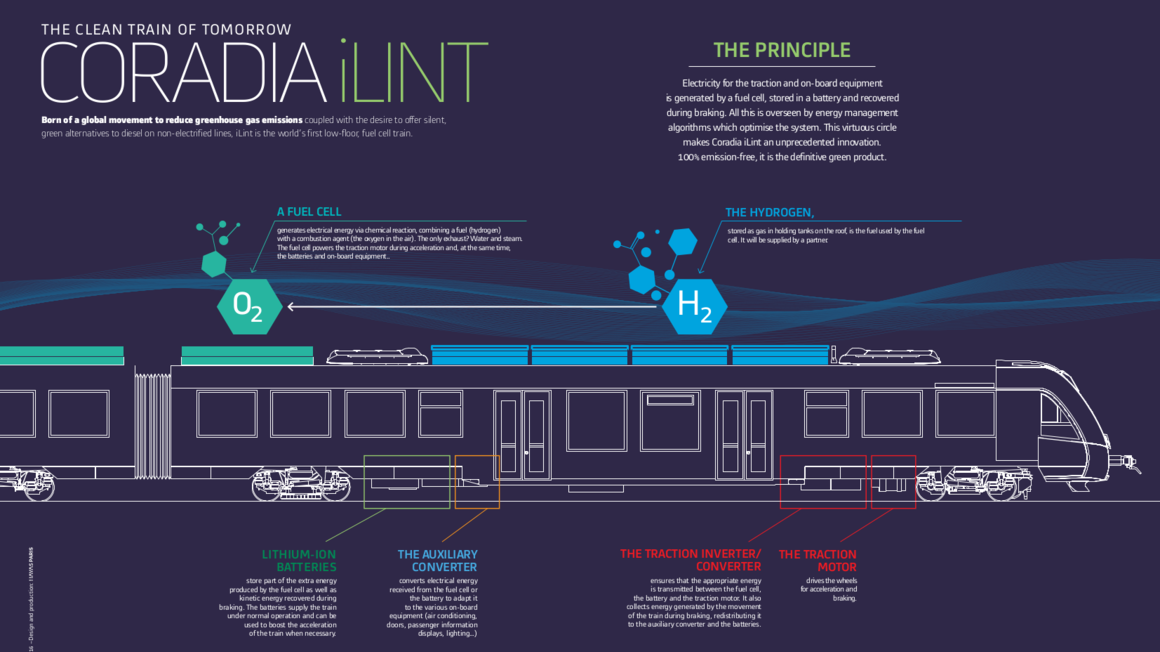
There’s Alstom’s iLint, an HMU for regional traffic:
This is alstom’s picture of the iLint:
Alstom_Coradia-iLint_Decryption_EN_OK.png
 

Meerkat

Established Member
Joined
14 Jul 2018
Messages
9,276
Take two 66’s permanently coupled. One has engine taken out and replaced with fuel tanks.
Strip the engined one of all auxiliaries etc that don’t need to be duplicated. Can keep all twelve traction motors for nice grip levels. Bob is your father’s brother.

Did I mention you will lose a couple of wagons off your train length and might need to extend a shedload of headshunts........
 

randyrippley

Established Member
Joined
21 Feb 2016
Messages
5,383
Take two 66’s permanently coupled. One has engine taken out and replaced with fuel tanks.
Strip the engined one of all auxiliaries etc that don’t need to be duplicated. Can keep all twelve traction motors for nice grip levels. Bob is your father’s brother.

Did I mention you will lose a couple of wagons off your train length and might need to extend a shedload of headshunts........

Hydrogen and internal combustion doesn't go well together especially on a diesel engine. You might make sense of a hydrogen fueled petrol engine, but I don't think any spark ignition engines big enough have been designed since the 1950s. You'd probably need half a dozen non-supercharged Rolls Royce Griffins.........
In reality the engine would have to be replaced by fuel cells, which considering the locomotive body is simply a shroud to enclose the diesel engine makes a nonsense of any conversion. Any hydrogen fueled loco needs to be newly designed, not converted from an existing model.
BUT.......fuel storage issues will make it all too difficult anyway
 

xotGD

Established Member
Joined
4 Feb 2017
Messages
7,833
The only problem that I can see with a hydrogen fuel cell locomotive is a total lack of thrash.

As I said up thread, locos will be designed to incorporate sufficient fuel storage capacity. Also, the fuel cell may well be much smaller than the diesel engine and generator combo it is replacing. Therefore the extra length required may not be too great.
 

HSTEd

Veteran Member
Joined
14 Jul 2011
Messages
20,286
Hydrogen and internal combustion doesn't go well together especially on a diesel engine. You might make sense of a hydrogen fueled petrol engine, but I don't think any spark ignition engines big enough have been designed since the 1950s. You'd probably need half a dozen non-supercharged Rolls Royce Griffins.........
In reality the engine would have to be replaced by fuel cells, which considering the locomotive body is simply a shroud to enclose the diesel engine makes a nonsense of any conversion. Any hydrogen fueled loco needs to be newly designed, not converted from an existing model.
BUT.......fuel storage issues will make it all too difficult anyway
Wartsilla and similar manufacturers build a substantial number of large spark ignition engines.

But a turbine plant is probably more likely as it will be more suited to efficiently utilising the coolth stored in the hydrogen as it is heated prior to combustion
 

Meerkat

Established Member
Joined
14 Jul 2018
Messages
9,276
Hydrogen and internal combustion doesn't go well together especially on a diesel engine. You might make sense of a hydrogen fueled petrol engine, but I don't think any spark ignition engines big enough have been designed since the 1950s. You'd probably need half a dozen non-supercharged Rolls Royce Griffins.........
In reality the engine would have to be replaced by fuel cells, which considering the locomotive body is simply a shroud to enclose the diesel engine makes a nonsense of any conversion. Any hydrogen fueled loco needs to be newly designed, not converted from an existing model.
BUT.......fuel storage issues will make it all too difficult anyway

doh! I forgot hydrogen means fuel cells!
Who is clever enough to work out how big/heavy the fuel cells and fuel tanks would be for equivalent power/range as a 66?
Still think 66 conversions would be a start - it’s just another electricity source for the traction motors so you can keep most of the rest of the stuff.
 

edwin_m

Veteran Member
Joined
21 Apr 2013
Messages
28,617
Location
Nottingham
The 66 would be pushing 30 years old by the time any hydrogen version was up and running. Conversions of trains of similar vintage have thrown up a lot of problems - probably better to start afresh with a new design. There are some small hydrogen locos around on the continent I think.
 

randyrippley

Established Member
Joined
21 Feb 2016
Messages
5,383
Also of note is this corporate brochure from Ballard, listing their full cell technologies. It dates from 2017 so things may have moved on, but they seem to have only been looking at trams and shunters in rail applications.
https://www.fch.europa.eu/sites/def..._H2 Rail Workshop 15.05.2017 (ID 2902212).pdf
Largest listed fuel cell was only 200kW, but it looks like they are modular so presumably a few could be strung together
 

Meerkat

Established Member
Joined
14 Jul 2018
Messages
9,276
The 66 would be pushing 30 years old by the time any hydrogen version was up and running. Conversions of trains of similar vintage have thrown up a lot of problems - probably better to start afresh with a new design. There are some small hydrogen locos around on the continent I think.

A lot of 66s will be available and are presumably pretty solid. if you ‘just’ whip the engines out and plug in fuel cells and tanks, and don’t get too ambitious on squeezing stuff in on the first iteration, it must be a lot simpler than squeezing engines under EMUs?
 

edwin_m

Veteran Member
Joined
21 Apr 2013
Messages
28,617
Location
Nottingham
A lot of 66s will be available and are presumably pretty solid. if you ‘just’ whip the engines out and plug in fuel cells and tanks, and don’t get too ambitious on squeezing stuff in on the first iteration, it must be a lot simpler than squeezing engines under EMUs?
Pardon the cynicism, but I expect they thought that about the 319s once.
 

Meerkat

Established Member
Joined
14 Jul 2018
Messages
9,276
Pardon the cynicism, but I expect they thought that about the 319s once.
Cynicism/realism....but it’s a bit different squeezing stuff under a floor rather than plopping it on top of a frame with a non structural shed on top.
 

randyrippley

Established Member
Joined
21 Feb 2016
Messages
5,383
Largest fuel cell on that Ballard company brochure I linked to upthread was 200kW
Engine output on a 66 maxes out at 2460kW
You'd need twelve of them at least to match the power of the diesel. I can't find any details of the size and weight of the 200kW unit, but a 100kW for a bus appears to be 1200x869x506 mm
Weight of the 100kW unit is 285kg plus 105kg for the air and cooling systems.

If you work on a basis of 24x100kW you're looking at around 9360kg and a volume of around 13 cubic metres.
How does that compare with a diesel genset?
 

DerekC

Established Member
Joined
26 Oct 2015
Messages
2,432
Location
Hampshire (nearly a Hog)
Slightly off-topic, but LU looked seriously at hydrogen locos as a potential replacement for their battery powered maintenance locos a few years ago. Not sure why it didn't happen.

Interestingly enough, it looks from this press release that the Indian railways are playing with the idea of converting an Alco switcher to fuel cell
https://www.railjournal.com/locomotives/indian-railways-to-build-fuel-cell-battery-locomotive/

its a two year old post so things may well have changed, but the fact that they were looking at it is noteworthy

A fuel cell/lead acid storage battery hybrid "Green Goat" switcher was built about ten years ago in the US. This struck me as a very good idea. Part of the reason, as I recall, was to cut down on noise from idling diesels in shunting yards. There is an article about it here: https://www.greencarcongress.com/2008/01/bnsf-railway-an.html

BNSF Railway Company and Vehicle Projects LLC, a developer of large fuel-cell vehicles such as mine loaders and mine locomotives, are leading a project consortium to develop an experimental hydrogen fuel-cell hybrid switch locomotive ……………..
 

Emyr

Member
Joined
8 Apr 2014
Messages
656
If you want to make freight greener, then use transesterification of lipids extracted from algae to produce biodiesel. It's substantially more efficient than producing biodiesel from food-crop oils. The main barrier at present (afaik) is increasing the batch size to get a commercially viable process.
 
Status
Not open for further replies.

Top