• Our new ticketing site is now live! Using either this or the original site (both powered by TrainSplit) helps support the running of the forum with every ticket purchase! Find out more and ask any questions/give us feedback in this thread!

How to read a Bradshaw?

Status
Not open for further replies.

LeoB

Member
Joined
28 Feb 2013
Messages
6
As part of some research I'm doing I had the railway museum copy certain pages of Bradshaw's Continental Guide for 1933. They took photos of the applicable pages and sent them to me. Exactly what I needed, BUT.

But, I'm having a hard time deciphering them. There are multiple time columns and column headings that do not make sense to me.

Does anybody have any Bradshaws from that era? Does it contain any instructions on how to read the timetables?

Best regards,
Leo
 
Sponsor Post - registered members do not see these adverts; click here to register, or click here to log in
R

RailUK Forums

30907

Veteran Member
Joined
30 Sep 2012
Messages
21,949
Location
Airedale
I don't, and I don't know what the instruction page may have said, but I am familiar with the format of the UK version. Perhaps you could post a page on here with a specific query or two, and I or others will have a go.

There is a long standing European set of "conventional signs" which was in use pre WW2, and taking a look at one of the German ones on here might help: http://www.timetableworld.com/
 
Last edited:

LeoB

Member
Joined
28 Feb 2013
Messages
6
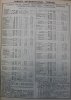
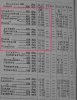
Attached is the full page of the 1932 Bradshaw and a highlighted extract from that page with the segment I'm most interested in.

Here are some of the things I cannot figure out:

- What is the three digit number after the name of the station, such as 421, 418, etc. Is that the train number? And why does that number change?

- What happens at Tzaribrod where it appears to depart before it arrives? And with a different number?

- Why is the column headed "Thurs." blank? Or does that apply to the column to the right of it?

- Why do some stations have both arrival and departure times and others just a departure time?

Those are a few of my questions. I'm approaching this from a state of near complete ignorance of pre-WWII railway timetables but I assume that there are very technical reasons for this, which I thought would be explained in the instructions. Years ago before the pervasiveness of the internet I was quite good at interpreting both of the NY telephone book sized world airline guides (OAG and ABC) and all the arcane symbols and indentations all had meanings, which I'm sure these do.

Thanks,
Leo
 

Attachments

  • Bradshaw Jan-Feb 1932 (full page).jpg
    Bradshaw Jan-Feb 1932 (full page).jpg
    153.4 KB · Views: 72
  • Bradshaw Jan-Feb 1932 extract.jpg
    Bradshaw Jan-Feb 1932 extract.jpg
    416.2 KB · Views: 53

30907

Veteran Member
Joined
30 Sep 2012
Messages
21,949
Location
Airedale
- What is the three digit number after the name of the station, such as 421, 418, etc. Is that the train number? And why does that number change?

- What happens at Tzaribrod where it appears to depart before it arrives? And with a different number?

- Why is the column headed "Thurs." blank? Or does that apply to the column to the right of it?

- Why do some stations have both arrival and departure times and others just a departure time?

1. They are cross-references to the, or another, table number (or possibly page) relating to the stations concerned. Train numbers (or letter codes - SO/OS in traditional French manner) would appear in the timing column.

2. A change of time zone, which the differing symbols against arr and dep refer to (explained at the bottom of the page).

3. On reflection, by comparing the bottom of the eastbound table, the days refer to the departure from Baghdad in the first column. The convention would be to show this as a note in the correct column, or more commonly as a footnote, but older timetables are noted for using every available space! Modern practice would be a footnote.

4. A number of possible reasons, most commonly because the stop is not particularly long and/or space is lacking on the page.

With the exception of no. 3, all are standard timetable practice to this day.

Above comments clarified now I am using my laptop not a tablet - subsequent posters have added much interesting detail.

Hope this helps.
 
Last edited:

itfcfan

Member
Joined
7 May 2011
Messages
346
- What is the three digit number after the name of the station, such as 421, 418, etc. Is that the train number? And why does that number change?
Based on my readings of various timetables, I'd say it's most likely these numbers relate to the timetable number (probably on another page of Bradshaws) with a more detailed set of times for trains on that route (i.e. table 421 should be table covering services between Istanbul and Tzaribrod in more detail).

- What happens at Tzaribrod where it appears to depart before it arrives? And with a different number?
In the symbols in the footer, it shows the ++ symbol (arranged vertically) signifying "East Europe time" (modern name Eastern Europe Time - UTC+2) and the solid block signifying "Mid Europe time" (modern name Central Europe Time - UTC+1). Tzaribrod (now Dimitrovgrad) seems to be the border station where the arriving time is given in EET, but the departing time is given in CET.

- Why is the column headed "Thurs." blank? Or does that apply to the column to the right of it?
The text "Thurs. Sun. & Tues." is not column headings, it's simply a note for trains from Baghdad to describe which days the service is available from Baghdad. This could have been expressed as a letter/symbol in the footer (as X is given for Cairo for a similar purpose) but the footer is already crowded, so the publishers decided on using the top line of the timetable instead. The 2nd & 3rd columns are not empty - they're used to show alternatives from Paris to London.

- Why do some stations have both arrival and departure times and others just a departure time?
At some stations there is a strong benefit to showing both arrival and departure times (for major stations or when trains are divided/joined, etc), whereas for other stations the arrival time is omitted to prevent the timetable becoming any longer than it already is.

It's difficult expressing data with many exceptions in a simple form. If you look at a modern day Thomas Cook European/International timetable you'll see a similar format, with a lot of footnotes for timetables including irregular options for unusual locations.

We're lucky we have such good online timetable options for many journeys these days, but if you can find a way to interpret such a timetable it can give more more context on the options available! I travelled from London to Aleppo by train in 2005 and kept a Thomas Cook International timetable for reference. I've also travelled from Shanghai to London return (out via Ulaanbaatar and Moscow, back via Kiev, Samara, Almaty and Urumqi). The return included a bi-weekly service from Kharkiv to Baku via Volgograd where I alighted - that one was too much of an exception for Thomas Cook!

I wish a London - Cairo through service was possible today. I've travelled overland (via Nuweiba/Aqaba) on that route before but never managed 7 days!
--- old post above --- --- new post below ---
By the way, it's interesting that no extra caveats are given for the Cairo section of the route. To my knowledge, there was a large missing section on the Istanbul-Cairo Route with lines South from Istanbul reaching Damascus/Beirut and lines North from Cairo reaching Port Said around this time. I believe the gap was bridged only for a very brief time around the end of WW2. Presumably this section was covered by motor vehicle instead (I believe I've seen this specified in older versions of the Thomas Cook timetables).
 

Bevan Price

Established Member
Joined
22 Apr 2010
Messages
8,329
Some of the detail is too small to read on my monitor. However, such trains did not always operate daily. The blank "Thurs" column may mean that there was no service on Thursdays.

The train appears to have been a multi-portion service, with portions attached (or detached) at various intermediate stations. That was common practice in mainland Europe.

I am not sure about the "Continental" Bradshaw, but in UK Bradshaws, the timetables did not always distinguish between what were through services, and what were connections.
 

Taunton

Veteran Member
Joined
1 Aug 2013
Messages
12,262
One of the main concerns of the editor(s) of Bradshaw and Cooks was to condense the mainstream timetable into a small space; they used all sorts of informal abbreviations and there were also issues with the printing technology that we no longer have.

The numbers alongside the station names, if just once they are significant connecting services, if a string the same this refers to a more complete table later in the book. The examples are summary pages for long-distance International trains, which both Bradshaw and Cook put at the front, before the individual tables for each country.

Unlike standard UK practice, the numbers are just page numbers rather than table numbers, and there could be multiple tables on a page. The index at the front used these as well, and was so tedious to compile in the days before computer sorting that it stayed static, often for years (another reason to use table numbers that stayed the same), and you might find after say page 123 there was 123a and 123b where extra pages had become necessary.

The station listing is not in the order of the train stops, some will be times up branch lines of connecting trains, and you really need to know the detail of the rail geography to understand which is which. Through trains/carriages or not are not indicated, passengers were expected to be advised by the station staff about what changes were needed.

Days of the week, or even days taken by the journey, are not represented well by this style of timetable. The note ¶ says the 1100 from London Victoria gets to Istanbul on the third day, but I make it the fourth day. leaving London at 1100 on Monday, passing Trieste at 1855 on Tuesday, Nisch at 1500 on Wednesday, and arriving Istanbul at 1200 on Thursday. You really do need to look at the detailed intermediate points along the way, and again know the geography, to understand which day of the week is at each point.

There are all sorts of little details here. Note e says "Third Class dep London 0900", which means that the train shown leaving London at 1100 in that column is First/Second class only, and a train with Third class down to Dover left two hours earlier. Continental express trains still generally had three classes at that period ("1 2 3 cl."), in Britain there had since Victorian times only been First and Third, but the Continental trains from Victoria to the Channel ports uniquely retained the three classes, or combinations thereof, until 1956, and a few British Railways standard vehicles were built to this style.

 

30907

Veteran Member
Joined
30 Sep 2012
Messages
21,949
Location
Airedale
The station listing is not in the order of the train stops, some will be times up branch lines of connecting trains, and you really need to know the detail of the rail geography to understand which is which.

Days of the week, or even days taken by the journey, are not represented well by this style of timetable. The note ¶ says the 1100 from London Victoria gets to Istanbul on the third day, but I make it the fourth day. leaving London at 1100 on Monday...arriving Istanbul at 1200 on Thursday.

The listing (Bucharest, Constanta) is one way of showing a "branch" line.

You could argue that the fourth day of the journey is the third day from London, I suppose - it depends what convention Bradshaw adopt - but I agree it's not obvious.
 
Status
Not open for further replies.

Top