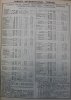
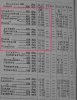
One of the main concerns of the editor(s) of Bradshaw and Cooks was to condense the mainstream timetable into a small space; they used all sorts of informal abbreviations and there were also issues with the printing technology that we no longer have.
The numbers alongside the station names, if just once they are significant connecting services, if a string the same this refers to a more complete table later in the book. The examples are summary pages for long-distance International trains, which both Bradshaw and Cook put at the front, before the individual tables for each country.
Unlike standard UK practice, the numbers are just page numbers rather than table numbers, and there could be multiple tables on a page. The index at the front used these as well, and was so tedious to compile in the days before computer sorting that it stayed static, often for years (another reason to use table numbers that stayed the same), and you might find after say page 123 there was 123a and 123b where extra pages had become necessary.
The station listing is not in the order of the train stops, some will be times up branch lines of connecting trains, and you really need to know the detail of the rail geography to understand which is which. Through trains/carriages or not are not indicated, passengers were expected to be advised by the station staff about what changes were needed.
Days of the week, or even days taken by the journey, are not represented well by this style of timetable. The note ¶ says the 1100 from London Victoria gets to Istanbul on the third day, but I make it the fourth day. leaving London at 1100 on Monday, passing Trieste at 1855 on Tuesday, Nisch at 1500 on Wednesday, and arriving Istanbul at 1200 on Thursday. You really do need to look at the detailed intermediate points along the way, and again know the geography, to understand which day of the week is at each point.
There are all sorts of little details here. Note e says "Third Class dep London 0900", which means that the train shown leaving London at 1100 in that column is First/Second class only, and a train with Third class down to Dover left two hours earlier. Continental express trains still generally had three classes at that period ("1 2 3 cl."), in Britain there had since Victorian times only been First and Third, but the Continental trains from Victoria to the Channel ports uniquely retained the three classes, or combinations thereof, until 1956, and a few British Railways standard vehicles were built to this style.