• Our new ticketing site is now live! Using either this or the original site (both powered by TrainSplit) helps support the running of the forum with every ticket purchase! Find out more and ask any questions/give us feedback in this thread!

High Speed Two (HS2) discussion

Status
Not open for further replies.

D1009

Established Member
Joined
22 Feb 2012
Messages
3,166
Location
Stoke Gifford
I hope HS2 will be like the Olympics - people were indifferent/derided the idea until they actually happened, then it was brilliant. However, I think HS2 will probably be like the Millennium Dome.
And I expect you were one of them.
--- old post above --- --- new post below ---
At the time everyone raved about it, then it was a disaster plagued with mismanagement. To paraphrase Jeremy Clarkson in his Brunel programme - "it was built for a party rather than a purpose" - so a vanity project for New Labour. The Dome as a commercial venture cannot be celebrated as a success by any measure.

The O2 however I agree, is fantastic.
Yes, a use was eventually found for it. You could say the same thing about the Olympic Stadium.
 
Sponsor Post - registered members do not see these adverts; click here to register, or click here to log in
R

RailUK Forums

Dave1987

On Moderation
Joined
20 Oct 2012
Messages
4,563
I have watched question time from last night now, What i thought curious is that people thought the money should be spent on new rolling stock and longer trains I don't think many people realise that most peak time trains are as long as they can be. And that HS2 is mainly about additional capacity and that they reduction in travelling times are just a bonus.
 

ivanhoe

Member
Joined
15 Jul 2009
Messages
961
I have watched question time from last night now, What i thought curious is that people thought the money should be spent on new rolling stock and longer trains I don't think many people realise that most peak time trains are as long as they can be. And that HS2 is mainly about additional capacity and that they reduction in travelling times are just a bonus.

The reduction in travel time is not a bonus!Its the only thing that can sell HS2 to a sceptical nation.
 

HSTEd

Veteran Member
Joined
14 Jul 2011
Messages
20,281
Or one could run cockayed lengths of dual units, of 140 and 260m each, with the 140m unit breaking off for a lesser used branch at York, Sheffeild etc...?

Unfortunately with having two different train lengths in the fleet like that is it means that you could potentially have a compatible train of 140m running in times of disruption if the 260m train was late and couldn't make the HS2 slot assigned. With a pair of 200m trains the slot will always be half full if one train is late and misses it.

It also means you have two fleets of different length trains so not all compatible sets can work all diagrams.
 

Deerfold

Veteran Member
Joined
26 Nov 2009
Messages
13,687
Location
Yorkshire
I I don't think many people realise that most peak time trains are as long as they can be.

That might be true around London and on the main intercity lines but there's plenty of places it's not true.

There's lots more XC services could be doubled if there was more stock, Leeds and Manchester have plenty of crammed commuter services run by 2 and 3 carriage trains only because of a lack of stock.
 

HSTEd

Veteran Member
Joined
14 Jul 2011
Messages
20,281
Liverpool-Norwich also doesn't run with six carriages in peak times either (on the western section certainly its packed to the gunnels).
 

Kettledrum

Member
Joined
13 Nov 2010
Messages
804
I have watched question time from last night now, What i thought curious is that people thought the money should be spent on new rolling stock and longer trains I don't think many people realise that most peak time trains are as long as they can be. And that HS2 is mainly about additional capacity and that they reduction in travelling times are just a bonus.

maybe on some London commuter routes the trains are as long as possible at the moment.

But jam packed 2 and 3 coach trains at Birmingham New Street in the rush hour can and should be lengthened. Cross country trains serving Birmingham to Tamworth are such an example. London Midland trains in New Street look equally crammed.
 

tbtc

Veteran Member
Joined
16 Dec 2008
Messages
18,051
Location
Reston City Centre
Many of the busy train services that can easily be lengthened will be sorted out by the electrification in CP5 (either directly by replacing short DMUs with longer EMUs like most Transpennine routes, or by gaining the "spared" DMUs e.g. I expect XC's Turbostar routes may pick up some extra 170s from LM/ TPE).

The WCML and ECML sees mainly full length trains at peak times that can't be extended (other than Open Access with just five coaches). The MML services are shorter, of course. So the services that HS2 is paralleling/ replacing/ enhancing are generally ones that can't be easily lengthened further.
 

Dave1987

On Moderation
Joined
20 Oct 2012
Messages
4,563
HS2 is needed along with upgrades to the existing network and I have to say I agreed with Alan Johnson (for once ;)). To me the audience seemed obsessed with shiny new very expensive trains.
 

Francis

Member
Joined
22 Dec 2011
Messages
184
Location
Chorley, Lancs
There's all the anti-HS2 moaning about the £33 billion cost over 20 years, yet Cameron has just announced this morning or yesterday morning an extra £160 billion on defence over the ten years from 2015 or 2016, and nobody seems to be grumbling. You could have almost five HS2's for that.

Blair found £5 - £10 billion at the drop of a hat when he wanted war with Iraq, or war in Afghanistan. If we weren't still so eager to play the great imperialists, maybe we'd have better railways. Not saying that we shouldn't defend ourselves against al Qaeda, Putin and Chinese hi-tech espionage, but do we need all that defence expenditure?
 

Dave1987

On Moderation
Joined
20 Oct 2012
Messages
4,563
There's all the anti-HS2 moaning about the £33 billion cost over 20 years, yet Cameron has just announced this morning or yesterday morning an extra £160 billion on defence over the ten years from 2015 or 2016, and nobody seems to be grumbling. You could have almost five HS2's for that.

Blair found £5 - £10 billion at the drop of a hat when he wanted war with Iraq, or war in Afghanistan. If we weren't still so eager to play the great imperialists, maybe we'd have better railways. Not saying that we shouldn't defend ourselves against al Qaeda, Putin and Chinese hi-tech espionage, but do we need all that defence expenditure?

To put MOD defence contracts into perspective. The new FSTA aircraft which is a A330 modified for refuelling, cost about £30m ish per aircraft which I heard airbus said they could modify for military use for about another £8m or something along those lines. Air Tanker is charging the MOD £70m per aircraft!! Just shows how much waste there is in MOD contracts. No wonder there was a £32bn black hole in defence spending after labour had finished. HS2 is an absolute bargain compared to some of the military contacts! E.g two £5bn aircraft carriers that won't b fit for purpose. Maybe the anti HS2 mob should divert their anger towards this waste of money.
 

rebmcr

Established Member
Joined
15 Nov 2011
Messages
4,005
Location
St Neots
To put MOD defence contracts into perspective. The new FSTA aircraft which is a A330 modified for refuelling, cost about £30m ish per aircraft which I heard airbus said they could modify for military use for about another £8m or something along those lines. Air Tanker is charging the MOD £70m per aircraft!! Just shows how much waste there is in MOD contracts. No wonder there was a £32bn black hole in defence spending after labour had finished. HS2 is an absolute bargain compared to some of the military contacts! E.g two £5bn aircraft carriers that won't b fit for purpose. Maybe the anti HS2 mob should divert their anger towards this waste of money.

Yeah but that's not including the maintenance if we bought them outright. Maintenance on aircraft is often more expensive than the list price.
 

HSTEd

Veteran Member
Joined
14 Jul 2011
Messages
20,281
The claims that the two new flat-tops are "not fit for purpose" is based on some overly simplistic notions, there are strong operational reasons for the purchase of F-35Bs for the fleet air arm compared to F-35Cs, and the choice is hardly likely to render the carriers ineffective in combat. (We saw who came off best out of VSTOL and CTOL carrier aviation in the Falklands....)

As to Air Tanker.... it is indeed a money hole.
It was caused by governments on both sides of the political divide desperately avoiding to try and spend money on outright equipment purchases as part of the determination to reap the benefits of the glorious PFI.
All hail the PFI and the free and undying market.

The private sector hires lawyers that are sufficiently expensive that the public sector would be pilloried by the right wing press for hiring them, and then proceed to runaround them in contract negotiations with people who will never have negotiated similar contracts before and never will again.
(And one of the reasons the carrier refit job was so insanely expensive was that someone privatised the military shipyards and let them collapse into one private sector body... and that wasn't Labour. As we can't support a "market" in warship construction having them in the private sector serves no purpose, they should be under the control of a restored Director of Naval Construction)

And then the "£100bn waste" on Trident.... which is only £3bn per year, a tiny fraction of the defence budget. Without the independent deterrent we are reduced to cowering under the American "umbrella".
And who is to say that in our hour of need, an American president will risk Chicago or New York to save London or Birmingham?
(And all those costings assume we wouldn't have to order 4 additional attack subs to keep the production line in Barrow open if we don't order the SSBNs)

Anyway, back onto topic:
We need an infrastructure bank funded by gilt issues to provide loans at gilt rates for any and all infrastructure/transport improvement projects that can generate BCRs above say... 2.
 

Dave1987

On Moderation
Joined
20 Oct 2012
Messages
4,563
Yeah but that's not including the maintenance if we bought them outright. Maintenance on aircraft is often more expensive than the list price.

Don't think it is actually I believe the maintenance contract is on top of this, the squadron will made up of 50/50 civvy to military personnel which is also just wrong! Money just bleeds out of the MOD. Like I said HS2 will be a bargain compared to these contracts.
 

Metrailway

Member
Joined
1 Jun 2011
Messages
575
Location
Birmingham/Coventry/London
Anyway, back onto topic:
We need an infrastructure bank funded by gilt issues to provide loans at gilt rates for any and all infrastructure/transport improvement projects that can generate BCRs above say... 2.

On the topic of BCRs - does anyone know what the BCR of HS2. I've heard that it is less than 2. Is this right?
 

Rhydgaled

Established Member
Joined
25 Nov 2010
Messages
4,856
Comparing the WCML, often said to be the busiest mixed-use railway in Europe, with the predominantly commuter lines out of Waterloo and Victoria and the relatively under-utilised GWML is really comparing apples and oranges.
Comparing the WCML might with services out of Waterloo and Victoria might be like comparing apples and oranges, but the fact is apples and oranges are both edible fruits and both the commuter lines into the south-London termini and the WCML are very busy. As different as the services out of Euston are from the services out of Victoria/Waterloo, both routes are going to need a major step change in capacity if rail passenger growth continues, Waterloo and Victoria even more so than Euston I would guess. If there's a case for providing a huge amount of extra capacity for the WCML coridor by building a new line surely there's also a case for a new line (perhaps not a true HSR one, due to my other point about 250mph being too fast to be 'green' unless there is aviation to compete with. but one in the 125mph-155mph range). The WCML isn't really full quite yet, not all the Pendos have been extended to 11-car after all, whereas I think more services into Waterloo are nearer maximum length.

As for the GWML being 'relatively under-utilised', aren't most of the top-10 crowded services FirstGW operated (or are they the 166/165-worked Thames Valley services and the 2+8 IC125s on the longer-distance trains have enough space)? Even if the line is not full now, continued growth will require a new paralell line to provide extra capacity. Even if there's no passenger growth, it'd be great if we had the rail capacity to suddenly cause a huge modal shift of freight from lorry to rail.

The Great Western still has potential for better utilisation of/extra capacity through electrification, IEP and ERTMS
Electrification may help capacity, but IEP is a step in the other direction. Ok, there are proposals to increase Bristol services to 4tph, but with the IEP fleet makeup published in Modern Railways either some of those or the Cardiff and Swansea services will be formed of 5-car IEP sets, rather than the present 2+8 IC125 fleet.

As for extending HS2 to Heathrow, it already tunnels east into Euston - the cost of then tunnelling back towards Old Oak Common and onto Heathrow would cost a vast and completely unjustifiable amount. Changing at OOC for Heathrow Express would cost a fraction of such a scheme and would probably be quicker too.
If the object was to extend HS2 to Heathrow I would agree, however the point of my suggestion tunnelling back under London towards Heathrow was as the starting point for new lines to Reading and Southampton/Portsmouth to provide a capacity boost on these routes. It also has the added benifit of a potential smaller footprint at Euston, by making it a through station less platforms should be needed, and splitting the service out again to the south and west means there is no need to find space for a terminous capable of terminating the entire HS2 service since there'd be nowhere that every service terminates.

I heard an anti HS2 guy on Radio 4 say that because any slots at Heathrow will be filled by aircraft going elsewhere then the green argument that HS2 will be greener because it replaces some domestic flights doesn't hold water.
Maybe that'll happen, maybe it won't. In my opinion, we should ban any form of airport expansion, knock out domestic and near-European flights with HighSpeed Rail, then close some airports and move the remaining (long-haul) flights from them into the released capacity at larger airports like Heathrow. Alternatively, instead of closing airports you could just cap flights at current levels and perhaps gain improved punctuallity by having airports running at far less than their full capacity so things don't get congested.

if you're going to run high speed trains but not stop them at Birmingham you're probably missing out on one of the biggest sources of paying passengers and not making use of extra capacity over the part of the route where it's needed most. Adding two slower lines to add capacity for that part of the route adds substantial cost and is just perverse.
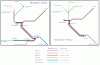
I've attached a rough diagram of my proposal, and what I think the government's is. Note that, unless I'm wrong, the government's proposal does just that, routing HighSpeed services to Manchester/Leeds/Liverpool/Glasgow via Birmingham International only, not central Birmingham. The central Birmingham HS2 station, as far as I can tell, would be served only be served only by London/Europe - Birmingham services and Birmingham - Leeds services (just like the present WCML suituation, most Manchester and Scotland services from London avoid Birmingham), unless my proposal of making central Birmingham a through station was carried out (in which case, Birmingham would have all HS trains to Manchester etc. calling and no HS services just to London that didn't come from further north). If Birmingham central absolutely HAS to be a dead-end spur as the current plans seem to be, that is when I'd suggest London - Birmingham services being 125mph and the 4-track suggestion south of Birmingham International was to ensure these don't hold up the HS trains to Manchester, Liverpool etc. (if you can path a mix of 125mph Birmingham services and 200mph Manchester services on a 2-track HS2 then great, keep it 2-track).

The destonations north/south are only illustrative, it's more to give the general idea than a hard and fast proposal, and the number of lines is no indication of frequency (eg. the Eurostar line(s) would be one an hour max, more likely only a handful of trains a day, but other routes much more frequent).

Welsh politicians have begun debating what to do with the £2bn they would recieve under the Barnett formula as a consequence of HS2. Main idea being put forward is to electrify the North Wales lines and provide good connections to HS2 at Crewe.
If using the HS2 Barnett consequentual is the only way to get north Wales wires then fair enough. If north Wales electrification doesn't have to be funded that way though, I wonder if that £2bn Barnett consequential would cover a Welsh equivelent of the 'north-south' HighSpeed Y-Network in England? Instead of new 250mph lines, the Welsh equivelent I propose would consist of:
  • 90mph Bangor - Caernarfon - Porthmadog line (taking a short-cut rather than going via Afon-Wen as it would if it was a straight reopening), capable of at least 1.5tph between Bangor and Caernarfon and 0.5tph between Caernarfon and Porthmadog
  • Upgraded Cambrian Coast Line between Porthmadog and Dovey Junction, to take an hourly service (0.5tph from Pwllheli, 0.5tph from Bangor) with reduced journey times at least for one train every two hours
  • Upgraded Cambrian Main Line between Dovey Junction and Welshpool to take 1.5tph minimum
  • Reopened Welshpool - Oswestry - Gobowen route, taking at least 0.5tph
  • Broadly 90mph spine Moat Lane Junction - Builth Road - Brecon - Merthyr on a mixture of new and reopened routes capable of an hourly service and possibly electrified between Merthyr and Brecon
Unlike England's, the Welsh north-south divide is physical (at least as far as rail is concerned) rather than purely ecconomic/social, the above would heal at least the physical aspect and hopefully generate significant modal shift to public transport from private cars. If it wouldn't cover the whole cost, how much of the above would the £2bn buy?

 

Attachments

  • Rhydgaled HS2.GIF
    Rhydgaled HS2.GIF
    25.7 KB · Views: 48

Chris125

Established Member
Joined
12 Nov 2009
Messages
3,267
Location
Isle of Wight
Comparing the WCML might with services out of Waterloo and Victoria might be like comparing apples and oranges, but the fact is apples and oranges are both edible fruits and both the commuter lines into the south-London termini and the WCML are very busy.

They are, but the types of services causing the congestion are different and so the most effective solutions differ too - the WCML unusually sees very heavy commuter, freight and intercity traffic serving multiple major cities, leading to numerous severe capacity bottlenecks outside London.

As different as the services out of Euston are from the services out of Victoria/Waterloo, both routes are going to need a major step change in capacity if rail passenger growth continues, Waterloo and Victoria even more so than Euston I would guess.

They are different, and that's the point - Waterloo and Victoria, and the lines out of them, see very heavy and growing suburban and commuter traffic with minimal 'intercity' traffic comparable to Virgin West Coast or East Coast services.

The most effective solution, as already being proposed for the SWML, is to create more capacity into on the existing line into London such as the fifth bi-directional track out to Surbiton or the much more likely Crossrail 2, which would also help relieve tube congestion.

As for the GWML being 'relatively under-utilised', aren't most of the top-10 crowded services FirstGW operated (or are they the 166/165-worked Thames Valley services and the 2+8 IC125s on the longer-distance trains have enough space)? Even if the line is not full now, continued growth will require a new paralell line to provide extra capacity.

The GWML has very overcrowded services, but that's much more a rolling stock issue which can (and will) be eased with electrification and longer, faster accelerating multiple units. There is also the potential to bump HEx onto the relief lines, and it's never had the same level of inner-suburban traffic as other mainlines to get in the way.

As for building an entirely new line, it's unlikely that the intercity traffic available is sufficient for a new long distance line - once again it makes more sense to deal with the capacity constraints caused by suburban services inside the M25.

If the object was to extend HS2 to Heathrow I would agree, however the point of my suggestion tunnelling back under London towards Heathrow was as the starting point for new lines to Reading and Southampton/Portsmouth to provide a capacity boost on these routes.

The problem, as i hope i've explained, is that the SWML and arguably the GWML too lack the intercity traffic to warrant new long distance mainlines. Crossrail schemes would be much more effective at freeing up capacity while also helping to relieve the tube.

Chris
 
Last edited:

The Ham

Veteran Member
Joined
6 Jul 2012
Messages
12,034
Sorry, silly expression....:oops:

"I don't suppose 400m platforms could be built somewhere in Glasgow and then that the "compatible" trains to on the West Coast could be run as 400m Eurostar esque formations."

Better?

I know that siting 400m platforms in other destinations is near impossible (I tried with Edinburgh using Google Earth) but I don't know about other places like Glasgow and Liverpool.

It's OK, I knew what you meant I just didn't want to be included in this list:

In a perfect world we would have HSTed volunteer to personally complete the reported £18bn British rail electrification, including wires on Southern territory while the 3rd is live, and RAGNARØKR to handcraft Mk5 coaching stock hauled by EuroSprinters (Taurus).

<D
 
Joined
27 Jan 2011
Messages
203
Location
North Staffs/Cheshire border
A couple of points on Rhyd's last post:

The Government diagram is a bit misleading at the northern ends as Leeds is effectively on a spur and the line connects to ECML south of York. So services could go to York and points north. Also the two Manchester stations are also effectively on a spur, again with the new line connecting with WCML, much like you've shown in your proposal. I guess this would allow some services for further north to carry on past Crewe at high speed and save an additional 5 minutes or so.

Whilst I think I understand your proposal for going in and out of London more clearly I think you'll find that there could be big probs at the central London station with the vast majority of passengers from all those destinations wanting to get off or embark at a central London stop. Sure there'll be some through traffic, but I suspect that the number of passengers wanting Heathrow or points south are tiny compared to the numbers flowing to the West End/City/Dockland/south Thames edge office/shop areas.

I got shot down in flames for suggesting that existing lines around London should all link to 'partner' lines on the opposite side and do away with enormous terminii and your proposal is very similar, probably concentrating even more passengers on just one, or maybe two London stations.

The connections at OOC should provide some of the services your suggestion covers, albeit not high speed, saving people a journey in and out of London at the expense of a change of train.
 

NSEFAN

Established Member
Joined
17 Jun 2007
Messages
3,518
Location
Southampton
Chris125 said:
They are different, and that's the point - Waterloo and Victoria, and the lines out of them, see very heavy and growing suburban and commuter traffic with minimal 'intercity' traffic comparable to Virgin West Coast or East Coast services.

The most effective solution, as already being proposed for the SWML, is to create more capacity into on the existing line into London such as the fifth bi-directional track out to Surbiton or the much more likely Crossrail 2, which would also help relieve tube congestion.

Apologies for dragging the thread further off topic, but are there any plans to remove the old Eurostar curve to allow 8 tracks all the way from Clapham Junction to Waterloo? Or are the Windsor lines coping well enough so far?
 

Nym

Established Member
Joined
2 Mar 2007
Messages
9,784
Location
Somewhere, not in London
Comparing the WCML might with services out of Waterloo and Victoria might be like comparing apples and oranges, but the fact is apples and oranges are both edible fruits and both the commuter lines into the south-London termini and the WCML are very busy. As different as the services out of Euston are from the services out of Victoria/Waterloo, both routes are going to need a major step change in capacity if rail passenger growth continues, Waterloo and Victoria even more so than Euston I would guess. If there's a case for providing a huge amount of extra capacity for the WCML coridor by building a new line surely there's also a case for a new line (perhaps not a true HSR one, due to my other point about 250mph being too fast to be 'green' unless there is aviation to compete with. but one in the 125mph-155mph range). The WCML isn't really full quite yet, not all the Pendos have been extended to 11-car after all, whereas I think more services into Waterloo are nearer maximum length.
Wouldn't this be something of the order of Crosrail Two? Designed for 240m operation at 32tph...
As for the GWML being 'relatively under-utilised', aren't most of the top-10 crowded services FirstGW operated (or are they the 166/165-worked Thames Valley services and the 2+8 IC125s on the longer-distance trains have enough space)? Even if the line is not full now, continued growth will require a new paralell line to provide extra capacity. Even if there's no passenger growth, it'd be great if we had the rail capacity to suddenly cause a huge modal shift of freight from lorry to rail.
They will be, but this is only measured for services terminating at a terminus, so does not take account of a significant amount of busy services around BHM, MAN/MCV, LDS etc. Also, the previous time it simply didn't include these services...

And isn't Crossrail being built right now for this? Including electrification of the GW route to provide more tph into Paddington...
Electrification may help capacity, but IEP is a step in the other direction. Ok, there are proposals to increase Bristol services to 4tph, but with the IEP fleet makeup published in Modern Railways either some of those or the Cardiff and Swansea services will be formed of 5-car IEP sets, rather than the present 2+8 IC125 fleet.
I will not support the IEP in it's current form. However, a 10 car 140mph EMU, that could be potentally lengthened out towards 11 or 12 car. You'd be looking at an increase in capacity from the current 2+7 and 2+8 formations, basically adding 1.2 carriages in 10 car form and 2.13 in 11 car form, although some more comfort features you would still have more capacity than before. Might I note that splitting services at Bristol Parkway could take the form of two seven car units splitting, having run from Paddington. (I'll look up Paddington Platform Lengths when it's downloaded)
If the object was to extend HS2 to Heathrow I would agree, however the point of my suggestion tunnelling back under London towards Heathrow was as the starting point for new lines to Reading and Southampton/Portsmouth to provide a capacity boost on these routes. It also has the added benifit of a potential smaller footprint at Euston, by making it a through station less platforms should be needed, and splitting the service out again to the south and west means there is no need to find space for a terminous capable of terminating the entire HS2 service since there'd be nowhere that every service terminates.

Maybe that'll happen, maybe it won't. In my opinion, we should ban any form of airport expansion, knock out domestic and near-European flights with HighSpeed Rail, then close some airports and move the remaining (long-haul) flights from them into the released capacity at larger airports like Heathrow. Alternatively, instead of closing airports you could just cap flights at current levels and perhaps gain improved punctuallity by having airports running at far less than their full capacity so things don't get congested.

I've attached a rough diagram of my proposal, and what I think the government's is. Note that, unless I'm wrong, the government's proposal does just that, routing HighSpeed services to Manchester/Leeds/Liverpool/Glasgow via Birmingham International only, not central Birmingham. The central Birmingham HS2 station, as far as I can tell, would be served only be served only by London/Europe - Birmingham services and Birmingham - Leeds services (just like the present WCML suituation, most Manchester and Scotland services from London avoid Birmingham), unless my proposal of making central Birmingham a through station was carried out (in which case, Birmingham would have all HS trains to Manchester etc. calling and no HS services just to London that didn't come from further north). If Birmingham central absolutely HAS to be a dead-end spur as the current plans seem to be, that is when I'd suggest London - Birmingham services being 125mph and the 4-track suggestion south of Birmingham International was to ensure these don't hold up the HS trains to Manchester, Liverpool etc. (if you can path a mix of 125mph Birmingham services and 200mph Manchester services on a 2-track HS2 then great, keep it 2-track).

The destonations north/south are only illustrative, it's more to give the general idea than a hard and fast proposal, and the number of lines is no indication of frequency (eg. the Eurostar line(s) would be one an hour max, more likely only a handful of trains a day, but other routes much more frequent).

If using the HS2 Barnett consequentual is the only way to get north Wales wires then fair enough. If north Wales electrification doesn't have to be funded that way though, I wonder if that £2bn Barnett consequential would cover a Welsh equivelent of the 'north-south' HighSpeed Y-Network in England? Instead of new 250mph lines, the Welsh equivelent I propose would consist of:
  • 90mph Bangor - Caernarfon - Porthmadog line (taking a short-cut rather than going via Afon-Wen as it would if it was a straight reopening), capable of at least 1.5tph between Bangor and Caernarfon and 0.5tph between Caernarfon and Porthmadog
  • Upgraded Cambrian Coast Line between Porthmadog and Dovey Junction, to take an hourly service (0.5tph from Pwllheli, 0.5tph from Bangor) with reduced journey times at least for one train every two hours
  • Upgraded Cambrian Main Line between Dovey Junction and Welshpool to take 1.5tph minimum
  • Reopened Welshpool - Oswestry - Gobowen route, taking at least 0.5tph
  • Broadly 90mph spine Moat Lane Junction - Builth Road - Brecon - Merthyr on a mixture of new and reopened routes capable of an hourly service and possibly electrified between Merthyr and Brecon
Unlike England's, the Welsh north-south divide is physical (at least as far as rail is concerned) rather than purely ecconomic/social, the above would heal at least the physical aspect and hopefully generate significant modal shift to public transport from private cars. If it wouldn't cover the whole cost, how much of the above would the £2bn buy?

Gave up on reading now.
 

The Ham

Veteran Member
Joined
6 Jul 2012
Messages
12,034
I will not support the IEP in it's current form. However, a 10 car 140mph EMU, that could be potentally lengthened out towards 11 or 12 car. You'd be looking at an increase in capacity from the current 2+7 and 2+8 formations, basically adding 1.2 carriages in 10 car form and 2.13 in 11 car form, although some more comfort features you would still have more capacity than before. Might I note that splitting services at Bristol Parkway could take the form of two seven car units splitting, having run from Paddington. (I'll look up Paddington Platform Lengths when it's downloaded).

Not wanting to drag IEP into a HS2 thread too much, but I have pointed this out before:

Comparisons per vehicle of a Class 390 and an IEP per vehicle are not comparing like with like. An 11 coach 390 has a capacity of 589 seats, whilst a 9 coach IEP has a capacity of 627. This then means that less IEP coaches are needed compared to 390 coaches (about 1/3).

The length of an 11 coach 390 is 253m whilst a 9 coach IEP is 234m, meaning that by lengthening each station by just 7m more than would be needed for an 11 coach 390 it would enable a 10 coach IEP to call there. Which could mean that in the future the electric 9 coach IEP's could be lengthened to 10 coaches at a fairly low infrastructure cost (similar to the 11 coach lengthening of the 390 which has just happened). This would further increase capacity of the IEP's over and above the 390's.

Also to whoever posted about the fact that not all the 390's aren't 11 coaches, that is because (as I understand it) places like Liverpool can not cope with a 390 of more than 9 coaches not because (as they were implying) there is not enough demand for all the 390's to be full length trains.
 
Joined
9 Feb 2009
Messages
807
More than half of Liverpool services are 11-car so you're wrong there...

The 9 cars are primarily used on Manchester services.
 

Nym

Established Member
Joined
2 Mar 2007
Messages
9,784
Location
Somewhere, not in London
Not to be pedantic, but nowhere did I mention the Class 390...

If we're comparing with anything, it would be the Class 180 DMU layout or the Class 444...

Working from a GC Class 180...

Standard: 72
Standard Driving: 56
Standard Buffet: 56
Standard Driving Wheelchair: 46 + 2
First Buffet: 40
First Resturant (Guessing): 30

So, my '10 car EMU' with lets say, DMF, MF, MF, MFRA, MS, MS, MSB, MS, MS, DMSA would have a capacity of...

40 + 46 + 46 + 30 + 72 + 72 + 56 + 72 + 72 + 46(2)

So thats; 162F 390S based on a comfortable layout, one could tweak these, but with 11 or 12 car layouts the amount of Standard can increase by 72 each time, up to 534S...

With platforms at Paddington kicking around the 250m mark, one would need some platfor extentions to push it past 10 car formations, but there is plenty of space for this, especially with all the space they nicked for retail (so I've been told).
 

D365

Veteran Member
Joined
29 Jun 2012
Messages
13,161
It's OK, I knew what you meant I just didn't want to be included in this list

I'm sure we'll find a good job for you - building 400m platforms to the exact dimensions? We'll be done in no time <D
 

The Ham

Veteran Member
Joined
6 Jul 2012
Messages
12,034
More than half of Liverpool services are 11-car so you're wrong there...

The 9 cars are primarily used on Manchester services.

Sorry :oops: I stand corrected, having checked, it's they can't take 12 coach pendelinos.

Not to be pedantic, but nowhere did I mention the Class 390...

If we're comparing with anything, it would be the Class 180 DMU layout or the Class 444...

Working from a GC Class 180...

Standard: 72
Standard Driving: 56
Standard Buffet: 56
Standard Driving Wheelchair: 46 + 2
First Buffet: 40
First Resturant (Guessing): 30

So, my '10 car EMU' with lets say, DMF, MF, MF, MFRA, MS, MS, MSB, MS, MS, DMSA would have a capacity of...

40 + 46 + 46 + 30 + 72 + 72 + 56 + 72 + 72 + 46(2)

So thats; 162F 390S based on a comfortable layout, one could tweak these, but with 11 or 12 car layouts the amount of Standard can increase by 72 each time, up to 534S...

With platforms at Paddington kicking around the 250m mark, one would need some platfor extentions to push it past 10 car formations, but there is plenty of space for this, especially with all the space they nicked for retail (so I've been told).

OK, I was just using the class 390 as it is a train we have in service. However my point still stands with your 12 coach layout has a capacity of 696 (with 23.3% first class), whilst a 10 coach IEP (which is shorter than the 12 coach, or only 7m longer than the 11 coach and only 10m longer than the current platform lengths at Paddington) will have the capacity of the 9 coach IEP (627) plus one other coach which can be up to 88 seats more (for instance it could be 683 seats made up of 157 first class and 526 standard - 22.9% first class). Although this example is a little less (13 seats) than the 12 coach train (23m) it only requires 10m of extra platform rather than 26m.

Given there are other locations on our network where 12 coach trains (23m) wouldn't fit (Liverpool for instance) without expensive works it could well be that 11 coach trains (23m) and 10 coach (26m) could be the practical limit.
 

Nym

Established Member
Joined
2 Mar 2007
Messages
9,784
Location
Somewhere, not in London
But how crammed in and cramped would the seating be in the IEP solution that has more seats per metre of train?

If you fit more seats in per metre of absolute length, then you must reduce the seat pitch, it's as simple as that... If I was to use the same seat pitch as the IEP is looking at I'd come out at a similar level of capacity. I also wouldn't need to gauge clear the entire railway all over again...

I could turn round and say that in a 230m formation I can fit 70F 598S but this isn't as higher level of comfort as the Class 180 layout. IC Travel isn't stack em in and sell em cheap, it will never be the latter, but a certain degree of comfort is required, even in standard, and especially in first...
 

rebmcr

Established Member
Joined
15 Nov 2011
Messages
4,005
Location
St Neots
But how crammed in and cramped would the seating be in the IEP solution that has more seats per metre of train?

If you fit more seats in per metre of absolute length, then you must reduce the seat pitch, it's as simple as that...

Not exactly. Reducing the gangway:saloon ratio (using longer carriages) has the effect of increasing the seats:train length ratio, with the same density.
 
Status
Not open for further replies.

Top