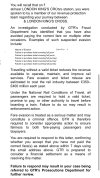
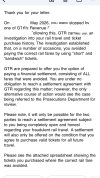
I’m a student and I have a grad job but don’t make much I had an enhanced dbs check when I joined so I’m past that and plan on staying at the firm long term would going to court and being convicted mean I have to notify my employer I probably could raise the sum of money if it was reduced to 2000
Thanks - I suppose the point I was making is - if your career is hoping to be in the legal profession, or maybe medical or something like that - where a very high degree of trust and probity is expected, then a conviction for this sort of thing could really damage your career, then £4k is a small price when set against your future earnings potential - even just your annual earnings potential.
If your job has lower standards of probity expected then a court conviction might have far less impact on you at work
ref current employment - esp if it went to court:
You need to consult a union rep at work if you have one on what you need to tell the employer
if you don't have a union, you need to read whatever it says in your work HR guidebook about what to tell the employer about prosecutions and convictions if it went to court. Be aware that employers may well consider not telling them about convictions as more serious than the actual conviction itself = so you should check this.
I doubt the railway / GTR will be interested in negotiating with you over reducing the sum to £2k - they have investigated what you evaded and calculated a sum in line with some sort of policy they use for this - they regard this as a debt you owe, for a sum you in everyday language, 'stole' from them. But maybe you can ask them, just like asking about instalment plans, if you have nothing to lose by doing so.
If it went to court AIUI you would end up with - from another helpful post that I copied a while back:
The Magistrates Courts will typically deal with an offender convicted under byelaw 18 by way of a "band A fine".
The amount of a "band A fine" is:
- 50% of one week's wages, with a maximum fine of £1,000, if the offender has a job and has declared their income on the court paperwork;
- £60, if the offender is a student, or on benefits; or
- £220, if the offender has not engaged with the court case or provided the necessary information.
The fine would then be adjusted downwards if the offender had pleaded guilty, with a reduction of one-third for a plea at the first opportunity, tapering down to one-tenth for a plea at the start of a trial.
There are also three more amounts to pay:
- A victim surcharge, which is 40% of the fine
- Compensation for the unpaid fare (I believe this would be the unpaid fare for the occasion when they stopped you and have the evidence of evasion for which they would bring the court case and aim to easily secure a guilty verdict)
- The prosecution costs
Non payment can result in bailiffs chasing you or attachment of earnings orders to your employers payroll department.
You would have a criminal conviction that you would have to declare when required until it is 'spent'
But
This also potentially opens the door to GTR seeking to obtain the debt for the other tickets evaded via the County Court as a debt owed, but that isn't a criminal conviction - it's a CCJ for a debt with less serious impact on you. They have 6 years in which to bring such a claim which has a lower burden of proof required by the county court (balance of probabilities you owe them the debt, rather than beyond reasonable doubt for a criminal case I believe would be the way to distinguish it)
We don't know if GTR would do that as we have not seen instances of it - but we have seen it with others railway companies (GWR in particular).
FWIW - Whilst I sympathise with the situation you now find yourself in, I am sure you can see it from their point of view - or the point of view of other passengers who do actually pay their fares in full - some of whom will be on low incomes no different to yourself I suspect.