• Our new ticketing site is now live! Using either this or the original site (both powered by TrainSplit) helps support the running of the forum with every ticket purchase! Find out more and ask any questions/give us feedback in this thread!

Great Western Electrification Progress

Status
Not open for further replies.

The Ham

Veteran Member
Joined
6 Jul 2012
Messages
12,021
I know someone (an engineer) who did Engineering with Archicture at Uni, they said that the engineers would design buildings that were fairly easy to build and get low marks but the architectural students would "design " (by which I mean draw with no thought to how it was even possible to be built) buildings that looked good and get good grades.

I've also given architects technical advice, only to have to exactly repeat it 3 or 4 times because it didn't suit what they wanted to do.

That said they do have their uses in creating some nice looking buildings and in doing so keeping a lot of engineers busy.
 
Sponsor Post - registered members do not see these adverts; click here to register, or click here to log in
R

RailUK Forums

QueensCurve

Established Member
Joined
22 Dec 2014
Messages
2,195
The design specification for the route asked that wherever practical, OLE installation (and routine maintenance) leave one pair of lines operational, which instantly led to outside masts and nothing in the ten foot between the pair of lines.

Correct me if I am wrong, but the Trent Valley four-tracking was also specified for one pair of lines operational and is (if my memory serves me right) partly wired with 2 pairs of single track cantilevers.
 

GRALISTAIR

Established Member
Joined
11 Apr 2012
Messages
10,461
Location
Preston Lancs

OMG -They are functional - as you say they would look well in Goring :D:D:lol:. At the end of the day it is a matter of opinion and I just absolutely love functionality with a passion. I married a woman who is the exact opposite thank goodness. IMHO there has to be a balance. Sorry to be slightly OT.
 

QueensCurve

Established Member
Joined
22 Dec 2014
Messages
2,195
Mark 3 is utter crap and nothing of its design deserves to be used anywhere, the sooner it's removed from the GB network, the better. It's a pitiful design riddled, absolutely littered with design faults. The headspans have nice masts though.

We seem to be forgetting that the ECML OHLE was also designed for 140mph running. This was successfully trialled and only abandoned because of the alleged shortcomings of lineside signals. No concerns with the OHLE were identified for 140mph running?

I seem to recall reading many years ago that the design of OHLE in Britain and for the French high speed lines was designed with an understanding of the complex dyamics of the wire/pantograph interaction (I think this lead to the design of the BR/Brecknell-Willis???) But that the Japanese Shinkansen was designed to keep the pantograph on the wire with a very stiff wire and very high force by the pantograph. I can't recall my source for this, but the French design specifically avoided use of more than one pantograph on a train.

Now of course we are proposing to operate Japanese designed trains on the GWML. These have high force pantographs and need stiff wires.

I admire Philip's expertise and still question are we imposing inferior Japanese design standards on the British railway?

And will the ECML require modification at great expense to allow IEPs to run? [yes???]

Would be be able to tolerate a lower spec of wire if IEPs were fitted with Brecknell-Willis pantographs?

I am deliberately framing most of this message as questions hoping to stimulate some discussion.
--- old post above --- --- new post below ---
For what it's worth, the OHLE just erected around Norton Bridge for the new flyover route appears to be neither Series 1 or 2 (nor Mk3).
This is a new high-density 100mph route (WCML slow lines), albeit only 2-3 miles long.
So there must be more than one design around for 100mph lines.
The next OHLE test will be the Bromsgrove-Barnt Green section of the Midland, up the Lickey.
The Chase line probably won't be better than 75mph, nor GOBLIN.

There is a picture of this at http://www.londonmidland.com/your-j.../?hootPostID=85f743bd50b282522f2570233ea27698 - simple and elegant:-

2753.jpg
 

Philip Phlopp

Established Member
Joined
31 May 2015
Messages
3,003
Correct me if I am wrong, but the Trent Valley four-tracking was also specified for one pair of lines operational and is (if my memory serves me right) partly wired with 2 pairs of single track cantilevers.

Yes, the only difference really is a difference in the design of the cantilever and ease of installation. The old 'lattice' style twin track cantilevers take longer to build, the new Series 1 twin track cantilever is a mast and a cross span which can be fitted in well under an hour with a smaller RRV.
--- old post above --- --- new post below ---
We seem to be forgetting that the ECML OHLE was also designed for 140mph running. This was successfully trialled and only abandoned because of the alleged shortcomings of lineside signals. No concerns with the OHLE were identified for 140mph running?

I seem to recall reading many years ago that the design of OHLE in Britain and for the French high speed lines was designed with an understanding of the complex dyamics of the wire/pantograph interaction (I think this lead to the design of the BR/Brecknell-Willis???) But that the Japanese Shinkansen was designed to keep the pantograph on the wire with a very stiff wire and very high force by the pantograph. I can't recall my source for this, but the French design specifically avoided use of more than one pantograph on a train.

Now of course we are proposing to operate Japanese designed trains on the GWML. These have high force pantographs and need stiff wires.

I admire Philip's expertise and still question are we imposing inferior Japanese design standards on the British railway?

And will the ECML require modification at great expense to allow IEPs to run? [yes???]

Would be be able to tolerate a lower spec of wire if IEPs were fitted with Brecknell-Willis pantographs?

I am deliberately framing most of this message as questions hoping to stimulate some discussion.

IEP is fitted with two British Rail/Brecknell Willis High Speed Pantographs, one on each driving vehicle. The normal mode of operation will be for the leading vehicle's pantograph to be raised, the pantograph orientated that when operated in this fashion, the pantograph knuckle is facing the direction of travel, which gives fractionally better contact performance.

Changing direction/changing ends will see the pantographs swapped, this also happens with the Pendolino sets, though their pantograph is on the third coach from the end, but they too like knuckle forward operation. The second pantograph on both units can be used if one pantograph suffers damage, chipped carbon etc.

IEP sets operating individually, either 5 or 9 car sets, are perfectly capable of 140mph operation on the ECML with no modification to the OLE, but there would be a fall-off in reliability associated with the InterCity East Coast franchise's intended 65 train sets all running at 140mph, plus additional trains elsewhere on the route (ScotRail electric units, Hull Trains own Hitachi AT300 units, more/longer Great Northern services etc).

IEP sets won't operate individually though - the 5 car sets will run in multiple, this will require them to have 2 pantographs raised (one per unit). The ECML OLE can't cope with two pantographs operating at 140mph, the contact wire isn't sufficiently tensioned, and will oscillate too severely for the second pantograph to maintain satisfactory contact - you get VCB activation and risk damage to pantograph through 'bounce' and subsequent to that, the OLE. The existing catenary can cope with 2 pantographs at 125mph, but with caveats.

The initial course of action was to upgrade the contact wire and increase the tension of the headspans, but Mark 3 OLE was designed around the current contact wire thickness and weight, so can't easily be upgraded. It's possible, but it will increase the failure rate on an OLE system that is already at risk of increased dewirement rates, resulting from increased numbers of electric services, and from the oscillation forces that 2 x 125mph and more 3 x 100mph units will create.

To mitigate against increased component failure, more maintenance will be needed, but this is disruptive because of the way everything is interconnected on a headspan. The grim reality is without headspan to portal conversion, because of the increased usage, particularly units operating in multiple at relatively high speed, there will be an risk of an increase in dewirement rates. It will be difficult to avoid this, even if dewirements attributable to the OLE itself can be virtually eliminated through more and more maintenance.

The move to a portal system with mechanically independent registration, with Series 1 OLE which will enable higher tensioning, will also make 3 x 110mph 12 car EMU operation possible, which may well improve pathing options (not my area) and in turn, further increase traffic.

Every scenario for increasing capacity and providing more and faster trains, results in increased risks of dewirement, in the case of Mark 3, that risk is both from the OLE itself and from damage caused by trains themselves. The move to Series 1 designed with higher traffic rates in mind, reduces the risk of OLE failures, but the increase in risk of dewirements caused by trains remains.

 
Last edited:

33Hz

Member
Joined
2 Dec 2010
Messages
513
When electrification was mooted previously, was the technical specification as demanding as it currently is? Indeed, are the technical requirements of other country's OHLE systems as rigorous as that for the GWML? Some people need to remember that a railway is a means of transporting passengers and freight from place to place, and not an art gallery.

I'm sure the technical requirements of other countries' 350 km/h railways are inferior to our 200 km/h. There is no reason they can't be met while making something aesthetically pleasing. A building is a thing for living or working in, should we all go back to 1960s boxes?

The article I am thinking of was over a decade ago, on paper and therefore tricky to track down. Nevertheless it was still in the context of providing for 200 km/h or more.

The best I can find right now is: https://www.gov.uk/government/uploa.../78261/WHAF_Brunel_s_Great_Western_report.pdf
 

D1009

Established Member
Joined
22 Feb 2012
Messages
3,166
Location
Stoke Gifford
IEP is fitted with two British Rail/Brecknell Willis High Speed Pantographs, one on each driving vehicle. The normal mode of operation will be for the leading vehicle's pantograph to be raised, the pantograph orientated that when operated in this fashion, the pantograph knuckle is facing the direction of travel, which gives fractionally better contact performance.
I thought the system employed when the Pendolinos first started was that the leading pantograph was raised, but this was changed to the trailing pantograph to give the driver more of a chance to lower the pan if he spotted a problem with the OHLE.
 

Tio Terry

Member
Joined
2 May 2014
Messages
1,197
Location
Spain
I'm sure the technical requirements of other countries' 350 km/h railways are inferior to our 200 km/h. There is no reason they can't be met while making something aesthetically pleasing. A building is a thing for living or working in, should we all go back to 1960s boxes?

The article I am thinking of was over a decade ago, on paper and therefore tricky to track down. Nevertheless it was still in the context of providing for 200 km/h or more.

The best I can find right now is: https://www.gov.uk/government/uploa.../78261/WHAF_Brunel_s_Great_Western_report.pdf

All pantographs used throughout Europe have to be designed to meet the requirements of the Energy Technical Standard for Interoperability. There would be no question of using pantographs from Japan or anywhere else if they did not meet this standard. Much of the standard revolves around the interface between the catenary and the pantograph.
 

Domh245

Established Member
Joined
6 Apr 2013
Messages
8,426
Location
nowhere
I'm sure the technical requirements of other countries' 350 km/h railways are inferior to our 200 km/h. There is no reason they can't be met while making something aesthetically pleasing. A building is a thing for living or working in, should we all go back to 1960s boxes?

The article I am thinking of was over a decade ago, on paper and therefore tricky to track down. Nevertheless it was still in the context of providing for 200 km/h or more.

The best I can find right now is: https://www.gov.uk/government/uploa.../78261/WHAF_Brunel_s_Great_Western_report.pdf

When I referred to the technical requirements, I meant the ancillary bits (for want of a better word), rather than the primary function of holding the wires up. For example, the need for above-track anchoring, HOPS friendliness (although that didn't quite work out), quicker installation times, etc, as listed in part in this brochure
 

Philip Phlopp

Established Member
Joined
31 May 2015
Messages
3,003
I thought the system employed when the Pendolinos first started was that the leading pantograph was raised, but this was changed to the trailing pantograph to give the driver more of a chance to lower the pan if he spotted a problem with the OHLE.

Virgin and Alstom might well have changed the pan usage around to help if there's an issue with the OLE (though the driver only has a second or so to drop the pantograph and it's still likely to pick up debris or a broken dropper) but the BR/BW High Speed pantograph has pretty much always worked just marginally better with the knuckle facing the direction of travel, so it would have worked to everybody's advantage in any case.
 

LNW-GW Joint

Veteran Member
Joined
22 Feb 2011
Messages
21,898
Location
Mold, Clwyd
I don't see any auto-transformer wiring on this pic.

Strangely, I noticed last week that the AT wire from Stoke, I think only recently installed, was routed via the "old" line through Norton Bridge Jn and up the WCML.
Maybe it will all be rerouted via the new flyover during the switchover.
That picture is of the bridge where the new line to/from Stoke crosses the WCML (350 passing below).
 

Class 170101

On Moderation
Joined
1 Mar 2014
Messages
8,661
IEP sets won't operate individually though - the 5 car sets will run in multiple, this will require them to have 2 pantographs raised (one per unit). The ECML OLE can't cope with two pantographs operating at 140mph, the contact wire isn't sufficiently tensioned, and will oscillate too severely for the second pantograph to maintain satisfactory contact - you get VCB activation and risk damage to pantograph through 'bounce' and subsequent to that, the OLE. The existing catenary can cope with 2 pantographs at 125mph, but with caveats.

Could just one pantograph be raised and the second unit be powered through electrical cross feeding?
 

jopsuk

Veteran Member
Joined
13 May 2008
Messages
12,774
The idea of having a traction current crossfeed through an autocoupler is entertaining. But a fundamental non-starter. The sheer amount of power, be that at 25kV or a lower voltage, much higher current, that would need to be carried is not what you want on that sort of electrical coupling
 

QueensCurve

Established Member
Joined
22 Dec 2014
Messages
2,195
IEP is fitted with two British Rail/Brecknell Willis High Speed Pantographs, one on each driving vehicle. The normal mode of operation will be for the leading vehicle's pantograph to be raised, the pantograph orientated that when operated in this fashion, the pantograph knuckle is facing the direction of travel, which gives fractionally better contact performance.

Changing direction/changing ends will see the pantographs swapped, this also happens with the Pendolino sets, though their pantograph is on the third coach from the end, but they too like knuckle forward operation. The second pantograph on both units can be used if one pantograph suffers damage, chipped carbon etc.

IEP sets operating individually, either 5 or 9 car sets, are perfectly capable of 140mph operation on the ECML with no modification to the OLE, but there would be a fall-off in reliability associated with the InterCity East Coast franchise's intended 65 train sets all running at 140mph, plus additional trains elsewhere on the route (ScotRail electric units, Hull Trains own Hitachi AT300 units, more/longer Great Northern services etc).

IEP sets won't operate individually though - the 5 car sets will run in multiple, this will require them to have 2 pantographs raised (one per unit). The ECML OLE can't cope with two pantographs operating at 140mph, the contact wire isn't sufficiently tensioned, and will oscillate too severely for the second pantograph to maintain satisfactory contact - you get VCB activation and risk damage to pantograph through 'bounce' and subsequent to that, the OLE. The existing catenary can cope with 2 pantographs at 125mph, but with caveats.

The initial course of action was to upgrade the contact wire and increase the tension of the headspans, but Mark 3 OLE was designed around the current contact wire thickness and weight, so can't easily be upgraded. It's possible, but it will increase the failure rate on an OLE system that is already at risk of increased dewirement rates, resulting from increased numbers of electric services, and from the oscillation forces that 2 x 125mph and more 3 x 100mph units will create.

To mitigate against increased component failure, more maintenance will be needed, but this is disruptive because of the way everything is interconnected on a headspan. The grim reality is without headspan to portal conversion, because of the increased usage, particularly units operating in multiple at relatively high speed, there will be an risk of an increase in dewirement rates. It will be difficult to avoid this, even if dewirements attributable to the OLE itself can be virtually eliminated through more and more maintenance.

The move to a portal system with mechanically independent registration, with Series 1 OLE which will enable higher tensioning, will also make 3 x 110mph 12 car EMU operation possible, which may well improve pathing options (not my area) and in turn, further increase traffic.

Every scenario for increasing capacity and providing more and faster trains, results in increased risks of dewirement, in the case of Mark 3, that risk is both from the OLE itself and from damage caused by trains themselves. The move to Series 1 designed with higher traffic rates in mind, reduces the risk of OLE failures, but the increase in risk of dewirements caused by trains remains.

Thank you for your detailed and thoughtful response.
 

tsangpogorge

Member
Joined
1 Mar 2016
Messages
54
Just a little something regarding high speed operation using two pantographs. While reading up about the APT I came to know that the engineers solution to the problem of oscillating head spans was to couple the two power cars together in the centre of the train, is this simply not an option with the IEP's?
 

Philip Phlopp

Established Member
Joined
31 May 2015
Messages
3,003
Just a little something regarding high speed operation using two pantographs. While reading up about the APT I came to know that the engineers solution to the problem of oscillating head spans was to couple the two power cars together in the centre of the train, is this simply not an option with the IEP's?

No. It's two completely separate units which will couple together in service, splitting to go to different destinations and vice versa. The trainsets themselves have two transformers and a 25kV bus linking them together, much like APT, changes in regulations and improved cable quality/reliability have allowed 25kV buses to run the length of the train, rather than needing transformers (and pantographs, if more than one is fitted) to be back to back.

It'll be very, very, very similar to the Class 395 sets which operate HS1 services, probably with front pantograph on one unit and rear pantograph on trailing unit being used to increase pan spacing.

https://www.youtube.com/watch?v=Bn4E5UObxS8

It's also worth watching some other videos on HS1 trains - Eurostar sets run with two pantographs, the rear pantograph can always be seen struggling to maintain contact with the contact wire, resulting in arcing (the little flashes).
 

mewstone

Member
Joined
6 Sep 2015
Messages
24
tsangpogorge wrote "Just a little something regarding high speed operation using two pantographs. While reading up about the APT I came to know that the engineers solution to the problem of oscillating head spans was to couple the two power cars together in the centre of the train, is this simply not an option with the IEP's?"

From reading on here, I think the oscillating from pantographs scenario is from when more than 2 IEP sets are coupled together as they require a pantograph to be raised on each set.
 

GRALISTAIR

Established Member
Joined
11 Apr 2012
Messages
10,461
Location
Preston Lancs
It's also worth watching some other videos on HS1 trains - Eurostar sets run with two pantographs, the rear pantograph can always be seen struggling to maintain contact with the contact wire, resulting in arcing (the little flashes).

Is that because they arranged with one pan knuckle forward and the other knuckle back or vice versa and hence not ideal?
 

edwin_m

Veteran Member
Joined
21 Apr 2013
Messages
28,595
Location
Nottingham
Strangely, I noticed last week that the AT wire from Stoke, I think only recently installed, was routed via the "old" line through Norton Bridge Jn and up the WCML.
Maybe it will all be rerouted via the new flyover during the switchover.
That picture is of the bridge where the new line to/from Stoke crosses the WCML (350 passing below).

If I recall correctly there will still be a connection via the old line so that trains to/from Stoke can run on the fast lines, probably only during disruption or engineering access. So presumably the AT wire is taking the shortest route and attached to structures that will still be there.
 

CardiffKid

Member
Joined
13 Feb 2011
Messages
1,081
Location
Cardiff
Severn Tunnel to close for six weeks from 12.09.16 to 21.10.16

The Severn Tunnel is due to close for nearly six weeks from September, causing disruption for rail users.

Work to prepare for the £2.8bn electrification project, to speed up journeys between London and south Wales, will cause the longest closure of the tunnel for at least 50 years.

Rail users will be diverted via Gloucester or use replacement buses.

Network Rail told BBC Wales the work had to be done in one block and guaranteed it would not overrun.

Work has already been carried out to prepare the 130-year-old tunnel for closure with four tonnes of soot removed from the tunnel walls and 7,000 holes drilled into the roof. A conductor rail will be installed to provide power.

Network Rail said there would be fewer services while the tunnel is closed and added that the work would take four years if only done at weekends.

David Sidebottom, from the group Passenger Director for Transport Focus which represents rail users, said: "The important thing is actually hearing from passengers, and this is the beauty of social media these days.

"We'll be gathering that up and making sure Network Rail and train companies are listening to the experience on the day because there will be times when they don't get things right and it's important they learn from that and put it right for the following day."

Dan Tipper from Network Rail said: "We have a significant volume of work going on across the western and Wales routes, and we have to avoid disrupting passengers twice in one journey, so we have to pick a time when we avoid other works."

Electrification is expected to cut journey times between Swansea and London by 20 minutes.

The tunnel will shut on 12 September and reopen on 21 October.

http://www.bbc.co.uk/news/uk-wales-35857118
 

Philip Phlopp

Established Member
Joined
31 May 2015
Messages
3,003
Thanks for blaming it all on electrification.

Permanent way are changing the track maintenance regime to radically reduce weekend closures, so re-track, re-sleeper and re-ballast can be done around 5/10/15 year intervals, rather than bits needing done this year, some next year, a bit more the year after and so on.

And pet hate - it's not a conductor rail, it's a rigid overhead conductor. Conductor rail is the comedy thing used in the south-east and on Merseyside.
 

swt_passenger

Veteran Member
Joined
7 Apr 2010
Messages
34,229
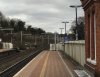
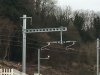
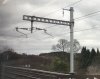
Thought I'd add a few photos taken at Pangbourne on Saturday, the area has a mixture of TTCs and portals, the relief side platforms having portals presumably to keep the uprights off the platforms.

What is odd that the TTCs on the mains 'change side' through the station, away from the station the uprights are all on the cess side. The 2nd photo shows the ATF insulator hanging down with the ATF yet to be fitted, so here's a question. How will they deal with the main line's ATF for the short distance where the TTCs are in the middle of the formation?

TTC = Twin track cantilever
ATF = Auto transformer feeder
 

Attachments

  • Pangbourne Down direction.jpg
    Pangbourne Down direction.jpg
    56.1 KB · Views: 108
  • Pangbourne Details.jpg
    Pangbourne Details.jpg
    56.3 KB · Views: 101
  • Pangbourne Up direction.jpg
    Pangbourne Up direction.jpg
    52.6 KB · Views: 100
Last edited:

QueensCurve

Established Member
Joined
22 Dec 2014
Messages
2,195
It's also worth watching some other videos on HS1 trains - Eurostar sets run with two pantographs, the rear pantograph can always be seen struggling to maintain contact with the contact wire, resulting in arcing (the little flashes).

I thought Eurostar followed the French TGV practice of having 1 pantograph raised connected to the other by a 25kV bus along the roof?
--- old post above --- --- new post below ---
Conductor rail is the comedy thing used in the south-east and on Merseyside.

I love it. :lol:
 

edwin_m

Veteran Member
Joined
21 Apr 2013
Messages
28,595
Location
Nottingham
I thought Eurostar followed the French TGV practice of having 1 pantograph raised connected to the other by a 25kV bus along the roof?

No, because Eurostar units needed to be separable into two halves under Channel Tunnel fire regulations (this one no longer applies). A Eurostar is about the same length as two TGVs in multiple and either would have one pantograph raised for each half.
 
Status
Not open for further replies.

Top