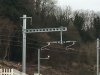
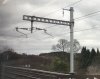
Correct me if I am wrong, but the Trent Valley four-tracking was also specified for one pair of lines operational and is (if my memory serves me right) partly wired with 2 pairs of single track cantilevers.
Yes, the only difference really is a difference in the design of the cantilever and ease of installation. The old 'lattice' style twin track cantilevers take longer to build, the new Series 1 twin track cantilever is a mast and a cross span which can be fitted in well under an hour with a smaller RRV.
--- old post above --- --- new post below ---
We seem to be forgetting that the ECML OHLE was also designed for 140mph running. This was successfully trialled and only abandoned because of the alleged shortcomings of lineside signals. No concerns with the OHLE were identified for 140mph running?
I seem to recall reading many years ago that the design of OHLE in Britain and for the French high speed lines was designed with an understanding of the complex dyamics of the wire/pantograph interaction (I think this lead to the design of the BR/Brecknell-Willis???) But that the Japanese Shinkansen was designed to keep the pantograph on the wire with a very stiff wire and very high force by the pantograph. I can't recall my source for this, but the French design specifically avoided use of more than one pantograph on a train.
Now of course we are proposing to operate Japanese designed trains on the GWML. These have high force pantographs and need stiff wires.
I admire Philip's expertise and still question are we imposing inferior Japanese design standards on the British railway?
And will the ECML require modification at great expense to allow IEPs to run? [yes???]
Would be be able to tolerate a lower spec of wire if IEPs were fitted with Brecknell-Willis pantographs?
I am deliberately framing most of this message as questions hoping to stimulate some discussion.
IEP is fitted with two British Rail/Brecknell Willis High Speed Pantographs, one on each driving vehicle. The normal mode of operation will be for the leading vehicle's pantograph to be raised, the pantograph orientated that when operated in this fashion, the pantograph knuckle is facing the direction of travel, which gives fractionally better contact performance.
Changing direction/changing ends will see the pantographs swapped, this also happens with the Pendolino sets, though their pantograph is on the third coach from the end, but they too like knuckle forward operation. The second pantograph on both units can be used if one pantograph suffers damage, chipped carbon etc.
IEP sets operating individually, either 5 or 9 car sets, are perfectly capable of 140mph operation on the ECML with no modification to the OLE, but there would be a fall-off in reliability associated with the InterCity East Coast franchise's intended 65 train sets all running at 140mph, plus additional trains elsewhere on the route (ScotRail electric units, Hull Trains own Hitachi AT300 units, more/longer Great Northern services etc).
IEP sets won't operate individually though - the 5 car sets will run in multiple, this will require them to have 2 pantographs raised (one per unit). The ECML OLE can't cope with two pantographs operating at 140mph, the contact wire isn't sufficiently tensioned, and will oscillate too severely for the second pantograph to maintain satisfactory contact - you get VCB activation and risk damage to pantograph through 'bounce' and subsequent to that, the OLE. The existing catenary can cope with 2 pantographs at 125mph, but with caveats.
The initial course of action was to upgrade the contact wire and increase the tension of the headspans, but Mark 3 OLE was designed around the current contact wire thickness and weight, so can't easily be upgraded. It's possible, but it will increase the failure rate on an OLE system that is already at risk of increased dewirement rates, resulting from increased numbers of electric services, and from the oscillation forces that 2 x 125mph and more 3 x 100mph units will create.
To mitigate against increased component failure, more maintenance will be needed, but this is disruptive because of the way everything is interconnected on a headspan. The grim reality is without headspan to portal conversion, because of the increased usage, particularly units operating in multiple at relatively high speed, there will be an risk of an increase in dewirement rates. It will be difficult to avoid this, even if dewirements attributable to the OLE itself can be virtually eliminated through more and more maintenance.
The move to a portal system with mechanically independent registration, with Series 1 OLE which will enable higher tensioning, will also make 3 x 110mph 12 car EMU operation possible, which may well improve pathing options (not my area) and in turn, further increase traffic.
Every scenario for increasing capacity and providing more and faster trains, results in increased risks of dewirement, in the case of Mark 3, that risk is both from the OLE itself and from damage caused by trains themselves. The move to Series 1 designed with higher traffic rates in mind, reduces the risk of OLE failures, but the increase in risk of dewirements caused by trains remains.



 . At the end of the day it is a matter of opinion and I just absolutely love functionality with a passion. I married a woman who is the exact opposite thank goodness. IMHO there has to be a balance. Sorry to be slightly OT.