• Our new ticketing site is now live! Using either this or the original site (both powered by TrainSplit) helps support the running of the forum with every ticket purchase! Find out more and ask any questions/give us feedback in this thread!

Glasgow parcels station, Ordsall Lane & Empty vans

Status
Not open for further replies.

Andy873

Established Member
Joined
23 Mar 2017
Messages
1,419
This one has me curious, please bare with me...

From my 1962 summer WTT:

I can see daily ECS trains running from Glasgow parcels station to Ordsall Lane - 2 05pm (Glasgow) daily taking empty vans back.

Firstly, Glasgow parcels station - was this part of Glasgow Central? or was this a separate place? I don't know the area at all.

Secondly, Ordsall Lane, where is that? Salford, Manchester?
The route the train takes is down the S&C, then Hellifield / Blackburn / Bolton to Ordsall Lane SO. The SX train disappears at Blackburn.

Thirdly, why would you take empty vans all the way back from Glasgow?

Last, I can see express passenger trains running up to Glasgow Central from either Manchester Exchange or Victoria, but I don't see any specific parcel trains. I presume the loaded parcel vans were attached to the passenger trains?

All trains listed above are steam hauled.

Thanks,
Andy.
 
Last edited:
Sponsor Post - registered members do not see these adverts; click here to register, or click here to log in
R

RailUK Forums

Mcr Warrior

Veteran Member
Joined
8 Jan 2009
Messages
17,292
Ordsall Lane station is/was in Salford. The station closed to passengers in 1957. On the route to Liverpool (via Chat Moss) out of Manchester just West of where the lines from Manchester Victoria, Manchester London Road (now Manchester Piccadilly) and the original Manchester Liverpool Road all joined together.
 

Falcon1200

Established Member
Joined
14 Jun 2021
Messages
6,588
Location
Neilston, East Renfrewshire
Firstly, Glasgow parcels station - was this part of Glasgow Central? or was this a separate place? I don't know the area at all.

Before my time working in Scotland but I believe the Parcels station was at Salkeld St, just beyond Bridge St Junction where the lines to the south and west diverge, and parallel to the west (Paisley) line; A large building, only recently demolished, with the throat being where the M74 now crosses. The site was a triangle, bordered by the two routes mentioned plus the City Union Line to the south.
 

Mcr Warrior

Veteran Member
Joined
8 Jan 2009
Messages
17,292
Wondering whether Ordsall Lane (Salford) was the actual end destination, or maybe just the location where the train was split/joined before continuing elsewhere?
 

Andy873

Established Member
Joined
23 Mar 2017
Messages
1,419
Wondering whether Ordsall Lane (Salford) was the actual end destination, or maybe just the location where the train was split/joined before continuing elsewhere?
The WTT doesn't say sorry, but it would be interesting to know. The ones going to Ordsall Lane are ECS trains so we would probably need a WTT covering that area / period.

By the way, the SX from Blackburn goes via Cherry Tree - Chorley.
 
Last edited:

Gloster

Veteran Member
Joined
4 Sep 2020
Messages
13,034
Location
Up the creek
Two possibilities for why the vans were taken all this way, although I can’t vouch for them being valid as far back as the early 1960s:

Empty newspaper vans returning to Manchester after taking the ‘Northern editions’ of papers to Scotland. Newspaper vans had some internal alterations, such as sorting tables, and so were only used in newspaper traffic and had to be returned empty to where the papers were printed after their night-time journeys taking them to the distributors.

Due to the number of mail-order companies in some areas, there was an imbalance of traffic at these locations. Far more vehicles went out loaded than came in loaded, so trains of empty vans had to be worked in to the areas to provide vehicles to be loaded.

As said, I have no idea if this was the reason for this particular train at this date.
 
Last edited:

Mcr Warrior

Veteran Member
Joined
8 Jan 2009
Messages
17,292
Wondering whether Ordsall Lane (Salford) was the actual end destination, or maybe just the location where the train was split/joined before continuing elsewhere?

Empty newspaper vans returning to Manchester after taking the ‘Northern editions’ of papers to Scotland. Newspaper vans had some internal alterations, such as sorting tables, and so were only used in newspaper traffic and had to be returned empty to where the papers were printed after their night-time journeys taking them to the distributors.
If the Ordsall Lane working was for a newspaper train, perhaps it would subsequently be moved the short distance to/from Manchester Victoria/Manchester Exchange for loading up of the first editions.
 

Andy873

Established Member
Joined
23 Mar 2017
Messages
1,419
If the Ordsall Lane working was for a newspaper train, perhaps it would subsequently be moved the short distance to/from Manchester Victoria/Manchester Exchange for loading up of the first editions.
Yes, I guess that would be logical.

If the parcels were actually mail order catalogues tagged onto passenger trains going the route the other way (from Manchester via either Chorley or Bolton to Blackburn - Hellifield and then the S&C) which is a slower more convoluted path then the urgency is less.

Thanks,
Andy.
 

Taunton

Veteran Member
Joined
1 Aug 2013
Messages
12,313
This is the return of the outwards overnight newspaper train. National papers were printed in two city locations, in London and Manchester, and newspaper trains ran outwards from these, with the vans returning empty in the daytime. A line, very roughly east-west through the Midlands from Aberystwyth to Skegness, divided the distribution areas of the two, determined in detail by railway logistics. Scotland had a higher proportion of locally printed papers than elsewhere, The Scotsman (Edinburgh), The Glasgow Herald, etc, but there was still a distribution of "the nationals" from Manchester to all newsagents as well. Because of the distance, they would be the first editions, printed well before midnight. Although printed at separate presses, they were all close together, and the trains were actually chartered and paid for by the Newspaper Publishers Association, which represented all newspapers.
 

matchmaker

Established Member
Joined
8 Mar 2009
Messages
1,884
Location
Central Scotland
Before my time working in Scotland but I believe the Parcels station was at Salkeld St, just beyond Bridge St Junction where the lines to the south and west diverge, and parallel to the west (Paisley) line; A large building, only recently demolished, with the throat being where the M74 now crosses. The site was a triangle, bordered by the two routes mentioned plus the City Union Line to the south.
Yes, Salkeld Street was the location.

From Railscot
 

Big Jumby 74

Established Member
Joined
12 Feb 2022
Messages
2,244
Location
UK
Empty newspaper vans returning to Manchester after taking the ‘Northern editions’ of papers to Scotland. Newspaper vans had some internal alterations, such as sorting tables, and so were only used in newspaper traffic and had to be returned empty to where the papers were printed after their night-time journeys taking them to the distributors
The same pattern applied out of Waterloo. The Newspaper trains (to Yeovil, Bournemouth, Portsmouth, Aldershot/Petersfield) all returned empty to Clapham Yard next day, which was the hub for all internal loco hauled stock. Remarshalled as necessary, and tripped up to Waterloo late evening for the next days workings.
 

Taunton

Veteran Member
Joined
1 Aug 2013
Messages
12,313
One of the last major steam services was the return vans from Newcastle etc to Manchester. It may have been made up of two outward trains (early and late editions) joined up at some point. A big formation, always double-headed, running at speed in the middle of the day 7 days a week, it got much attention, both reports and photographs, in the railway magazines in the final years, and indeed months, of steam. From York it came the old L&Y way, through Normanton and Todmorden.
 

Cheshire Scot

Established Member
Joined
24 Jul 2020
Messages
1,677
Location
North East Cheshire
One of the last major steam services was the return vans from Newcastle etc to Manchester. It may have been made up of two outward trains (early and late editions) joined up at some point. A big formation, always double-headed, running at speed in the middle of the day 7 days a week, it got much attention, both reports and photographs, in the railway magazines in the final years, and indeed months, of steam. From York it came the old L&Y way, through Normanton and Todmorden.
There was also a daily Perth to Red Bank empty vans train (5M20), probably a mix of newspaper and mail order vans, the southbound vans being consolidated in Perth probably including some of those off the Inverness to Perth empty vans and some from Aberdeen and Dundee - which predominantly went north attached to passenger trains - 01.10 Perth to Inverness, 01.05 Perth to Aberdeen with detachments at Dundee, both too early for first edition Manchester newspapers, but there was a Carstairs to Perth news conveying vans detached from the Manchester to Glasgow news and from Perth one Manchester van went forward to Aberdeen on the down Postal and one to Inverness on the 'mail'.
 

Gloster

Veteran Member
Joined
4 Sep 2020
Messages
13,034
Location
Up the creek
The same pattern applied out of Waterloo. The Newspaper trains (to Yeovil, Bournemouth, Portsmouth, Aldershot/Petersfield) all returned empty to Clapham Yard next day, which was the hub for all internal loco hauled stock. Remarshalled as necessary, and tripped up to Waterloo late evening for the next days workings.
Slightly off subject, but the Yeovil used to go back to London as a passenger: I used to commute on it from Salisbury in 1978. The Sunday morning Petersfield also used to go back to Guildford as a staff train. However, from the early 1980s sectorisation weeded out many of these marginal workings.
 

Shaw S Hunter

Established Member
Joined
21 Apr 2016
Messages
3,497
Location
Over The Hill
Slightly off subject, but the Yeovil used to go back to London as a passenger: I used to commute on it from Salisbury in 1978. The Sunday morning Petersfield also used to go back to Guildford as a staff train. However, from the early 1980s sectorisation weeded out many of these marginal workings.
The Yeovil actually survived the end of rail-based distribution of newspapers and ran as a passenger service both ways: something like 0105 ex Waterloo and 0510 return. I did it once and it was quite well loaded from London with people who had been to see a show, etc. And yes the return had at least one passenger who appeared to be a regular, complete with bowler hat and carefully rolled umbrella!

As for the train in the OP I suspect Ordsall Lane was effectively just a holding point and the train would have continued in due course, perhaps after attaching vans from elsewhere and possibly with a different reporting number, to the main carriage sidings for Victoria/Exchange at Red Bank.
 

MadMac

Established Member
Joined
13 Jun 2008
Messages
1,501
Location
Moorpark, CA
There was also a daily Perth to Red Bank empty vans train (5M20), probably a mix of newspaper and mail order vans, the southbound vans being consolidated in Perth probably including some of those off the Inverness to Perth empty vans and some from Aberdeen and Dundee - which predominantly went north attached to passenger trains - 01.10 Perth to Inverness, 01.05 Perth to Aberdeen with detachments at Dundee, both too early for first edition Manchester newspapers, but there was a Carstairs to Perth news conveying vans detached from the Manchester to Glasgow news and from Perth one Manchester van went forward to Aberdeen on the down Postal and one to Inverness on the 'mail'.
There was a newspaper working that went to Lairg on Sunday mornings and came back on the afternoon passenger to Inverness.
 

Cheshire Scot

Established Member
Joined
24 Jul 2020
Messages
1,677
Location
North East Cheshire
There was a newspaper working that went to Lairg on Sunday mornings and came back on the afternoon passenger to Inverness.
Just one van from Euston plus some from Glasgow and Manchester. The loco and vans needed to come back so there was a long running arrangement to attach coaches at Inverness to provide a passenger service on the way back from Lairg and in later years (70s onwards) it ran as passenger both ways.

Once back in Inverness the vans would come south on the Inverness to Perth van train.

I imagine Lairg would be the furthest point a Manchester newspaper van got to (or a Euston one for that matter) but maybe .........................?
 

Gloster

Veteran Member
Joined
4 Sep 2020
Messages
13,034
Location
Up the creek
If the parcels were actually mail order catalogues tagged onto passenger trains going the route the other way (from Manchester via either Chorley or Bolton to Blackburn - Hellifield and then the S&C) which is a slower more convoluted path then the urgency is less.
I think that mail-order catalogues were sent direct from the printers to the (mail-order house’s) customers, although it is possible that that was only the practice later on. Some catalogues would still have gone to the mail-order companies offices for new customers, publicity, etc. The surplus of vans was mainly caused by them being loaded with the goods ordered by customers, with the much smaller number of returns arriving back in dribs and drabs. (My, rather cynical, feeling is that in those days there was much more likelihood of people buying carefully and keeping what they bought, rather than today’s habit of buying on a whim and then sending it back, or using it for one occasion and then returning it.)
 

Cheshire Scot

Established Member
Joined
24 Jul 2020
Messages
1,677
Location
North East Cheshire
(My, rather cynical, feeling is that in those days there was much more likelihood of people buying carefully and keeping what they bought, rather than today’s habit of buying on a whim and then sending it back, or using it for one occasion and then returning it.)
I'm inclined to think this is a realistic view rather than a cynical one
 

Magdalia

Established Member
Joined
1 Jan 2022
Messages
7,405
Location
The Fens
I think that mail-order catalogues were sent direct from the printers to the (mail-order house’s) customers, although it is possible that that was only the practice later on. Some catalogues would still have gone to the mail-order companies offices for new customers, publicity, etc. The surplus of vans was mainly caused by them being loaded with the goods ordered by customers, with the much smaller number of returns arriving back in dribs and drabs. (My, rather cynical, feeling is that in those days there was much more likelihood of people buying carefully and keeping what they bought, rather than today’s habit of buying on a whim and then sending it back, or using it for one occasion and then returning it.)
We had a discussion about catalogue shopping not long ago.


Big Jumby 74

Established Member
Joined
12 Feb 2022
Messages
2,244
Location
UK
Slightly off subject, but the Yeovil used to go back to London as a passenger: I used to commute on it from Salisbury in 1978. The Sunday morning Petersfield also used to go back to Guildford as a staff train. However, from the early 1980s sectorisation weeded out many of these marginal workings
Indeed, you are quite correct - I was speaking off the top of my head/from an aged memory, never a good idea :lol:. The 0650 off Yeovil, due in Waterloo 0933, and the Petersfield being a SUN working as well. Well spotted, and apologies to Andy873 for veering OT, or off area.
 

Taunton

Veteran Member
Joined
1 Aug 2013
Messages
12,313
As for the train in the OP I suspect Ordsall Lane was effectively just a holding point and the train would have continued in due course, perhaps after attaching vans from elsewhere and possibly with a different reporting number, to the main carriage sidings for Victoria/Exchange at Red Bank.
I believe that Manchester Red Bank sidings, to the east of Victoria, were used for services which departed east and west from that station, on former L&Y lines. Exchange station, although physically connected to Victoria by the well-known long platform (which really came into its own at midnight with multiple news trains being loaded along its length), was onetime LNWR, as were Ordsall Lane sidings to its west, and these were used for services departing from Exchange. Old traditions died hard.
 

Cheshire Scot

Established Member
Joined
24 Jul 2020
Messages
1,677
Location
North East Cheshire
I believe that Manchester Red Bank sidings, to the east of Victoria, were used for services which departed east and west from that station, on former L&Y lines. Exchange station, although physically connected to Victoria by the well-known long platform (which really came into its own at midnight with multiple news trains being loaded along its length), was onetime LNWR, as were Ordsall Lane sidings to its west, and these were used for services departing from Exchange. Old traditions died hard.
Rail Map online indicates Ordsall Lane Sidings were fairly extensive in days gone by - the OP quotes 1962 - which would be difficult to visualise on the ground today although even just a few years ago there was a fair bit of rusted rail adjacent to the running lines, remnants of a bygone age.
 

6Gman

Established Member
Joined
1 May 2012
Messages
9,218
There was also a daily Perth to Red Bank empty vans train (5M20), probably a mix of newspaper and mail order vans, the southbound vans being consolidated in Perth probably including some of those off the Inverness to Perth empty vans and some from Aberdeen and Dundee - which predominantly went north attached to passenger trains - 01.10 Perth to Inverness, 01.05 Perth to Aberdeen with detachments at Dundee, both too early for first edition Manchester newspapers, but there was a Carstairs to Perth news conveying vans detached from the Manchester to Glasgow news and from Perth one Manchester van went forward to Aberdeen on the down Postal and one to Inverness on the 'mail'.
Did this run part-way as a passenger train at one time? Back in c.1982 I caught a mid-morning train from Perth made up of one BSK (Brake Second) and numerous Full Brakes and parcel vans. I assume it was mostly empty newspaper vans and the BSK had carried sorters northbound. We changed locos at Mossend (to an 85 I think) and stopped at Motherwell where all the passengers alighted. The train then departed southbound purely as a non passenger service.

By "all the passengers alighted" I basically mean me!
 

Taunton

Veteran Member
Joined
1 Aug 2013
Messages
12,313
The several newspaper trains from Paddington to the West Country always carried one, sometimes two, BSK/BCK, to give some van space and also provision for the guard. Not on the Paddington departure board but they also conveyed a few "in the know", at the discretion of the guard. Wayward international travellers coming home, and in particular naval personnel headed for Plymouth at the end of leave - the guard put the officers in the firsts of the BCK and the ratings in the seconds. If you had one too many in the pub beforehand, forget it. Many WR staff of all grades, particularly at Plymouth, had done their time in the Navy, and knew the score.

The first Penzance News ran at Cornish Riviera speeds, with the vans on B4 bogies. When a small subset of diesel hydraulic Westerns were specially fettled up for the Cornish Riviera and the Golden Hind (the "Golden Westerns"), they were also used on this first news service.
 

Gloster

Veteran Member
Joined
4 Sep 2020
Messages
13,034
Location
Up the creek
The several newspaper trains from Paddington to the West Country always carried one, sometimes two, BSK/BCK, to give some van space and also provision for the guard. Not on the Paddington departure board but they also conveyed a few "in the know", at the discretion of the guard. Wayward international travellers coming home, and in particular naval personnel headed for Plymouth at the end of leave - the guard put the officers in the firsts of the BCK and the ratings in the seconds. If you had one too many in the pub beforehand, forget it. Many WR staff of all grades, particularly at Plymouth, had done their time in the Navy, and knew the score.
My recollection from the early 1980s is that the Penzance news was all newspaper vans, except for the Motorail one. The guard would have been in a BG: he definitely was when I had to stop the service and speak to him. There might have been one van with Red Star traffic.
 

Springs Branch

Established Member
Joined
7 Nov 2013
Messages
1,683
Location
Where my keyboard has no £ key
I was surprised to see Glasgow Parcels Station appearing in a timetable as early as 1962.

Previously, I'd thought Salkeld Street parcels depot (re-purposed redundant Eglington St Goods Yard) only opened in the late 60s.

IIRC the Parcels Station was intended to keep parcels trains & parcels handling away from Glasgow Central and Queen St stations following closure of St Enoch and Buchanan St in 1966 (I believe part of St Enoch remained in use for parcels trains for around a year after closure to passengers - a 1967 WTT shows a Euston to Glasgow St Enoch parcels train).

A bit of Googling suggests the opening date for Salkeld St Parcels is not well defined - and certainly looks a bit earlier than I thought.

@Andy873 mentioned he's not familiar with the Glasgow area. A RCH map of the lines is attached below. Glasgow Parcels Station was on the site of the Eglington St Goods Yard at the right-hand extremity of the "yellow line". A close-to-the-city location for road deliveries, right enough, but always looked a tricky place to access directly for trains from most origins & destinations, unless travelling in the Paisley direction.

Last, I can see express passenger trains running up to Glasgow Central from either Manchester Exchange or Victoria, but I don't see any specific parcel trains. I presume the loaded parcel vans were attached to the passenger trains?
1S04, the overnight Manchester - Glasgow Central newspaper, mail & parcels train, ran as a Class 1 train, rather than the Class 3 you might expect for a purely parcels train at the time. This is presumably on account of conveying newspapers & mail. There's no indication in the late-1960s public or WTTs that it's available for passengers - not officially, at least.

By the way, the SX from Blackburn goes via Cherry Tree - Chorley.
I believe that Manchester Red Bank sidings, to the east of Victoria, were used for services which departed east and west from that station, on former L&Y lines. Exchange station, although physically connected to Victoria by the well-known long platform (which really came into its own at midnight with multiple news trains being loaded along its length), was onetime LNWR, as were Ordsall Lane sidings to its west, and these were used for services departing from Exchange. Old traditions died hard.
The overnight Manchester - Glasgow news / parcels departed from Manchester Exchange, rather than Victoria, right up to the closure of Exchange in 1968. It was routed via Atherton, Dobbs Brow, Blackrod and Chorley (rather than through Bolton) then up the WCML, until the Hilton House line closed in 1968, moving to Victoria - Bolton - WCML after that.

Departure from Exchange would explain the ECS vans being stabled at the extensive, but sparingly used, sidings at Ordsall Lane in the 1960s. Ordsall Lane would be a faff to access inbound from the Bolton line, so the OP's ECS vans possibly approached from the Eccles direction on weekdays. Either via the Tyldesley route, or via Parkside and Chat Moss, having used the Adlington - Boar's Head line to access the WCML north of Wigan.


Glasgow RJD 29
Railway Clearing House, Public domain, via Wikimedia Commons
 
Last edited:

Andy873

Established Member
Joined
23 Mar 2017
Messages
1,419
Thanks every one for the interesting replies and maps, and explaining about Glasgow parcels station & Ordsall lane. I certainly spent all yesterday reading what you all said here.

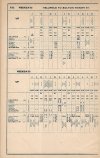
I've attached one of the pages that show the 3M43 ECS train for those who would like to see it. As said before, the SO goes from Blackburn to Bolton route, the SX goes the Blackburn to Chorley route.

I do recall seeing vans but never any actually moving. From what I can read here (link) most seemed to have been BR Mark 1 stock.


Thanks,
Andy.
 

Attachments

  • F52.jpg
    F52.jpg
    630 KB · Views: 16

Cheshire Scot

Established Member
Joined
24 Jul 2020
Messages
1,677
Location
North East Cheshire
Did this run part-way as a passenger train at one time? Back in c.1982 I caught a mid-morning train from Perth made up of one BSK (Brake Second) and numerous Full Brakes and parcel vans. I assume it was mostly empty newspaper vans and the BSK had carried sorters northbound. We changed locos at Mossend (to an 85 I think) and stopped at Motherwell where all the passengers alighted. The train then departed southbound purely as a non passenger service.

By "all the passengers alighted" I basically mean me!
I have no recollection of it running part way as a passenger train and can find no trace of such in the 1982 GBTT on Timetable World but your description of the train very much suggests that would have been what you travelled on. The 78/79 WTT shows 5M20 departing Perth at 10.24.

== Doublepost prevention - post automatically merged: ==

I was surprised to see Glasgow Parcels Station appearing in a timetable as early as 1962.

Previously, I'd thought Salkeld Street parcels depot (re-purposed redundant Eglington St Goods Yard) only opened in the late 60s.
Railscot website states Eglinton St Goods Yard until 1970 and Salkeld St Parcels Depot 1970 to 1990. Was there perhaps an earlier Parcels Depot in the City?

Incidentally in the 70s and 80s Salkeld Street was also the site of the International Freight depot where Train Ferry traffic was Customs cleared.
 
Last edited:

Falcon1200

Established Member
Joined
14 Jun 2021
Messages
6,588
Location
Neilston, East Renfrewshire
Did this run part-way as a passenger train at one time? Back in c.1982 I caught a mid-morning train from Perth made up of one BSK (Brake Second) and numerous Full Brakes and parcel vans.

I have no recollection of it running part way as a passenger train and can find no trace of such in the 1982 GBTT on Timetable World but your description of the train very much suggests that would have been what you travelled on. The 78/79 WTT shows 5M20 departing Perth at 10.24.

I believe it did run as a passenger train for part of the way; The Peter Watts publications 1H80 and 1H81 (detailing all loco-hauled passenger trains) show 1D50 1014 Perth-Motherwell, however in the 1982 edition it had disappeared, which corresponds to both the comments above. Why it ran at some times and not others, and when it did why only for that particular segment of the journey, is a mystery however !
 
Status
Not open for further replies.

Top