Our new ticketing site is now live! Using either this or the original site (both powered by TrainSplit) helps support the running of the forum with every ticket purchase! Find out more and ask any questions/give us feedback in this thread!
If this was pre covid with the A14 works complete then i'd say a fast Peterborough-Huntingdon-Cambridge service with high quilty kit would be a no brainer to me as the XC train service is terrible
If it is just a bus/coach service, it would merely be competing for passengers travelling between the three places. The (XC) train service between Peterborough and Cambridge runs every hour, with I think only 3 carriages, and a good proportion of the passengers in these carriages will have tickets from further afield [ or intermediately to a place the bus/coach isn't going to] and no reason to change to/from a bus/coach at Peterborough or Cambridge, and pay again. Would the overall journey time be any quicker by bus/coach, including stopping at Huntingdon Station? Probably not. Would this bus effectively compete with the railway between Peterborough and Huntingdon? Bearing in mind the frequency and journey time - probably not.
If the bus/coach was part of the railway system (funding, ticketing and operationally) then perhaps some passengers might change at Peterborough or Cambridge and then catch it. But why would the railway want to fund a competitive service, when their trains are usually not leaving passengers behind?
I am really unsure what this 'no-brainer' service would add to the current offer?
There used to to be a X23/X18 Sheffield to Hanley (Stoke-on-Trent), First Potteries gradually cut the service and withdrew it (at one stage split the service as 118/218 at Buxton ) jointly running with First South Yorkshire.
Although D&G 16 runs Hanley -Buxton and a Stagecoach 65 to Sheffield-Buxton, times don't coordinate
It could never be described as "express" though. The original X18 route (before the re-routing through Bakewell) used to take 3 hours! I t was agreat journey though, especially in the winter with snow over the tops.
Actually, for an area where rail was not used greatly, thre were hardly any long distance services from Stoke. No Stoke-Manchester or Wolverhampton/Birmingham. I recall a Hanley-Derby service which operated on Saturdays and maybe even a Leicester service that ran for a while, but with the notable exceptions of Sheffield, Chester & later in the 70s Shrewsbury, there was nothing beyond Stafford, Crewe or Buxton. You couldn't even get a through bus fro Hanley to Congleton!
There are the occasional success stories. I think it was in the 1980s when the British Rail (Rail Link) coach service started between Peterborough and King’s Lynn via Wisbech, later extended to Norwich via Swaffham and Dereham. This was ostensibly for students studying at East Midlands universities who would travel home by train to Peterborough and change there for the coach link with its through ticketing. It was included on the fold out GB rail map which enhanced its status as part of an integrated network. The service proved popular for other passengers too and frequencies improved, so much so that we now have a 30 minute frequency running end to end, operated by First Bus, connecting towns and villages once served by train, into the rail network for onward journeys.
Other limited stop bus links that could provide a similar integrated function include:
Penrith - Keswick - Workington;
Some of the TrawsCambria routes in Wales, particularly the Aberystwyth - Carmarthen link;
Skipton - Colne;
Oxford - Witney;
High Wycombe - Maidenhead etc etc.
Travellers need to be shown that these links exist (online journey planners help greatly in this regard). Through ticketing could add to customer confidence that journeys can be made more efficiently by combining train and bus in certain instances.
High Wycombe is a massive one, especially for wider links like Reading/Slough to High Wycombe to Bucks and vice versa, Maidenhead and Slough do have a direct link to HW with the 37 and the X74. Reading has a stopping service in the 800/850 to High Wycombe through Twyford/Caversham, Henley and Marlow that takes way too long (roughly 1 1/2 hours for the full journey) and is way too unreliable to be used for commuting and longer leisure journeys into the Chilterns/vice versa into the Thames Valley proper.
Seriously marketed and provided rail/bus integration (integrated fares and a direct connecting non-stop bus link between Marlow and High Wycombe using a Solo or such) would produce a lot of the benefits for a lot less running cost compared to an entirely motorway-based link.
But a Maidenhead Rail Station -> fast along Bath Rd to Maidenhead Thicket A404(M) junction -> Marlow North A404 junction stops -> High Wycombe Coachway -> fast down Marlow Hill to High Wycombe Bus Station would cream off a lot of a car traffic from the A404(M)/M4/M40 in the area, especially given the price of parking and chronic congestion in any of the Thames Valley conurbations - MK being a possible exception.
It would also provide proof to public transport planners that there is demand for a fast public transport link from the mid Thames Valley (i.e Maidenhead and west) to the M40 corridor.
Running time would be about 20 mins between stops, plus 2 mins for each stop and the journey could be done in 30 mins, plus turnaround time built into the timetable. 2 buses an hour, PVR of 5 wouldn't be a huge gamble.
Reading to High Wycombe public transport could be cut in half with this service.
If the initial service was profitable, an hourly extension could head down from Maidenhead Thicket to Bracknell, the awful roads/rail links between Maidenhead/Bracknell prevent any sort of public transport modal shift at the moment, journey times would be give or take within 10 or 15 mins longer than the car, certainly competitive.
The reason it hasn't happened before despite the obvious link is 1) the lack of transport integration in the TV across the many county boundaries and 2) the lack of ambition by bus companies in the areas.
Arriva (the operator of the 37) don't seem interested in providing an express service anywhere in their Bucks/Oxon subdivision, First (the operator of the X74) are gradually being pushed out of Berks it seems.
Most others were too small to have the resources to commit to a frequent and high spec service to make this successful - my hope is that Reading Buses, now they have purchased Courtney, see the potential returns they could make from such a service.
== Doublepost prevention - post automatically merged: ==
Newbury Bus Station to Oxford would also be worth a pop as an hourly extension of the Thames Travel ST1 Connector service stopping off at East Ilsley, Chieveley services on the M4 and Vodafone HQ in Donnington for the north end of Newbury. In the absence of the Go Op service's actual realisation, Newbury to Oxford would be an very useful connector for Oxfordshire/Northants/Cotswolds/South Warks people to go to the West Country, plus more local travel from Oxfordshire to the Kennet Valley. Overall journey times would be about an hour, a modest increase in PVR for the extra 20 mins or so down to Newbury, including the stops.
That and Maidenhead/Reading to High Wycombe are the biggest non-public transport served flows in the Thames Valley and some of the biggest in the South East.
But a Maidenhead Rail Station -> fast along Bath Rd to Maidenhead Thicket A404(M) junction -> Marlow North A404 junction stops -> High Wycombe Coachway -> fast down Marlow Hill to High Wycombe Bus Station would cream off a lot of a car traffic from the A404(M)/M4/M40 in the area, especially given the price of parking and chronic congestion in any of the Thames Valley conurbations - MK being a possible exception.
It would also provide proof to public transport planners that there is demand for a fast public transport link from the mid Thames Valley (i.e Maidenhead and west) to the M40 corridor.
No chance. People don't live and work in central Maidenhead and central High Wycombe such that this sort of bus would appeal to anyone. That is why the routes which exist are the 800/850 and the 37 and there isn't an express route - they link the places where people live and where they want to get to. It is no accident that the 800 and 850 services take detours into more populated locations than staying on the main roads. Even if there is a missing flow between High Wycombe and Reading, the bus only makes money by also serving Marlow and Henley (and other places) on the way. I suspect the last time brand new buses were used on the 800/850 (and before that the 328/329) was back in 1983 when High Wycombe got the HJB---W Bristol VRs. It seems to currently be in the hands of 58 and 12 registration Citaros.
The reason it hasn't happened before despite the obvious link is 1) the lack of transport integration in the TV across the many county boundaries and 2) the lack of ambition by bus companies in the areas.
Newbury Bus Station to Oxford would also be worth a pop as an hourly extension of the Thames Travel ST1 Connector service stopping off at East Ilsley, Chieveley services on the M4 and Vodafone HQ in Donnington for the north end of Newbury. In the absence of the Go Op service's actual realisation, Newbury to Oxford would be an very useful connector for Oxfordshire/Northants/Cotswolds/South Warks people to go to the West Country, plus more local travel from Oxfordshire to the Kennet Valley. Overall journey times would be about an hour, a modest increase in PVR for the extra 20 mins or so down to Newbury, including the stops.
Seen at the October 1994 open day is Reading Buses MCW Metrorider DP26F 216 WOI3005. This bus had been new as an Optare demonstrator registered G683KNW in 1989. It joined the Ipswich Travel fleet in 1991 where it gained the Northern Irish registration from another member of the fleet. It arrived at Reading in 1993, initially on loan, where it was allocated to the Newbury Buses fleet for use on the Oxford Connection X34 service.
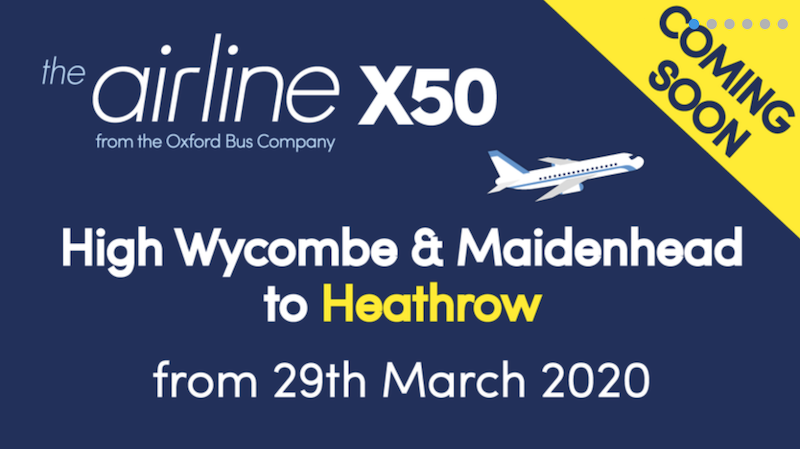
I was very much looking forward to using The Airline's (Oxford Bus Company) hourly X50 service that would have run High Wycombe-Heathrow via Maidenhead. Unfortunately, being planned to start in March/April 2020 and being financially supported by the airport, the service never even launched. Only 35 minutes between Maidenhead and Wycombe rail stations.
The calling points were:
High Wycombe bus station - High Wycombe railway station - High Wycombe coachway (Cressex) - Maidenhead Newlands Drive - Maidenhead Castle Hill - Maidenhead Frascati Way - Maidenhead Grenfell Place/Railway Bridge (for Maidenhead railway station) - Heathrow Terminal 5 - Compass Centre - Heathrow Central Bus Station.
No chance. People don't live and work in central Maidenhead and central High Wycombe such that this sort of bus would appeal to anyone. That is why the routes which exist are the 800/850 and the 37 and there isn't an express route - they link the places where people live and where they want to get to. It is no accident that the 800 and 850 services take detours into more populated locations than staying on the main roads. Even if there is a missing flow between High Wycombe and Reading, the bus only makes money by also serving Marlow and Henley (and other places) on the way. I suspect the last time brand new buses were used on the 800/850 (and before that the 328/329) was back in 1983 when High Wycombe got the HJB---W Bristol VRs. It seems to currently be in the hands of 58 and 12 registration Citaros.
...and, no doubt, 3) they know it won't make any money.
It has been tried, multiple times. It has never survived too long.
There's a crap ton of flats being built in central Maidenhead and High Wycombe, not to mention the business parks close to M'head Thicket, the offices including 3's headquarters in M'head town centre, Bucks New University in High Wycombe round the corner from the bus station and the sizeable business parks close to High Wycombe Coachway.
The report on Thames Valley transport options I have cited specifically mentions Reading/Maidenhead to High Wycombe direct as in the top 9 most frequent route, every other route apart from perhaps Reading to Oxon has direct public transport options. Link here:Thames Valley Multi Modal Plan
The reason there is no express route is the journey time of the existing options, there clearly is demand for an express service, but no sane resident is going to choose 1 1/2 on the 800/even longer on the 850 or 50 mins on the 37 (train and bus would shave at most 20-30 mins off, assuming a seamless connection), when the car can do Reading - HW in 30-35 mins in peak and 15-20 mins M'head to HW.
The bus types have no bearing on the profitability of the routes - Carousel placed large coaches off the X90 on the Chiltern Hundreds and they were cut back.
Arriva in HW turf out the same old crap, regardless of the route's profitability - the 1A to Amersham is quite well patronised throughout the day and gets an old Citaro just like the 800/850.
As for Newbury, the idea that I'm proposing reinstatement of the entire X34 is deeply disingenuous - the current ST1 and additional services not provided back in the time of the X34's existence to Harwell Campus already do the 16 miles from Oxford to Harwell Campus each way.
To Newbury is another 14 miles - Southampton is 51 miles from Harwell Campus, Winchester to Southampton is already well served by public transport, there's a whole lot of nothing between Newbury and Winchester apart from Sutton Scotney and Whitchurch, which have a direct bus to Winchester. Newbury to Southampton is 38 miles, the 25 mile section of the A34 has 92k within 3 miles of the A34 between Chieveley and Kennington.
The quickest train from Oxford to Newbury direct is 46 mins including the difficult change in Reading; if you don't live in central Oxford, that 14 minute difference is not insurmountable.
Given the levels of congestion on the A14 (I commute along there by car 5 times a week) a journey would definitely take longer than the Busway does!
Stagecoach have had a punt at a Huntingdon - Cambridge fast several times.
The previously mentioned X51 wasn't a success, along with the X6 which ran Peterborough-Huntingdon-Cambridge-Stansted Airport.
Pre covid there was also some experimenting with running peak time B services direct via the A14 into Huntingdon from the end of the Busway, they didn't last long either.
Cambridge is an interesting case, because perhaps much of steep decline in express bus and coach services that has happened here gives an example of each of the things that have happened all over the country! It used to have quite a decent long distance coach network. Further, Stagecoach was quite good at trying out new shorter distance coach services, and the one that worked remained but all the others ultimately failed (mirroring a lot of the rest of the country).
Cambridge also demonstrates just how much of a problem roads have. Rail keeps succeeding over coaches (eg Royston / Newmarket / Norwich) even despite the station being in a location that is far from ideal! And the miserable experience that was the pre covid peak time rail services to Ely and Newmarket, for example, did their very best to create an opportunity for buses to thrive (except of course the A10 and A14 were worse).
Gaps in rail services do exist and created a genuine opportunity for the X5, and Stagecoach took advantage of it. Even with the X5 at its peak there seemed to be a under-capacity to St Neots (very much of course a rail black hole in terms of Cambridge), and Stagecoach tried an additional service. Whippet have also tried to take advantage of a possible gap in service provision to the Corby area, and... well... who knows how that would be doing if times weren't changed.
The only other things that had, in before Covid times, sort of thrived were National Express airport services, but even they weren't running at the levels they once did, and the increasing concentration of services at times trains didn't run suggested that they weren't the preferred way of travelling. This matches the rest of the country.
The regional National Express routes were in long term decline, but there were a couple of places they were a reasonable way of getting to at particular times of day (Northampton and Nottingham were two).
Longstanding commuter only coaches into Cambridge (such as from Royston) had been killed; probably by congestion and more frequent trains.
The longstanding coach service to London had a stench of death about it. It was a good way of getting to Stratford, but unless you were really time rich and money poor with an urgent need to get to London at rush hour I can only think that most of the small number of people still using it just didn't know about Liverpool Street only fares on the trains. The less journeys it offered the less sense it made.
There used to be more coaches towards Suffolk and (more so) Norfolk. Improved rail frequencies to Ipswich and direct trains to Norwich probably did the most to see most of them off, but congestion probably had a role too.
Finally of course, congestion had also been hurting even the local bus network in Cambridge that had no rail competition - most routes are half as frequent as they were 15 years ago.
The new A14 is also an interesting case. You would assume that the old A14 was choking out bus / coach services and that with a lovely shiny new fast A14 there'd be an opportunity. 15 years ago I even moved from a lovely flat near the bus station in Huntingdon to a slightly grotty shared house in a less salubrious part of Cambridge because the travelling was just too much for me. It's perhaps partly a measure of how successful the guided busway really has been (yeah I know it's a rail forum, sorry) that the new A14 doesn't seem to create any new opportunities for buses or coaches, but also a measure of the fact that buses need to serve places and the new A14 does an amazing job of taking you well away from getting near Huntingdon.
So it becomes the bizarre case that the only public transport achievement of the A14 project has been to allow political interference to result in a misguided diversion of the eastern remnants of the former X5 through the north of Cambridge! Perhaps, in different times, it could have helped a few National Express airport services from the midlands pass through Cambridge?
I was very much looking forward to using The Airline's (Oxford Bus Company) hourly X50 service that would have run High Wycombe-Heathrow via Maidenhead. Unfortunately, being planned to start in March/April 2020 and being financially supported by the airport, the service never even launched. Only 35 minutes between Maidenhead and Wycombe rail stations.
The calling points were:
High Wycombe bus station - High Wycombe railway station - High Wycombe coachway (Cressex) - Maidenhead Newlands Drive - Maidenhead Castle Hill - Maidenhead Frascati Way - Maidenhead Grenfell Place/Railway Bridge (for Maidenhead railway station) - Heathrow Terminal 5 - Compass Centre - Heathrow Central Bus Station.
You're joking me? The pandemic has ruined another great idea it seems. The Heathrow extension from Maidenhead could have been marketed as a cheaper version of the Heathrow Western Access, no costly land purchase and you'll get a lot more frequent coaches for 5 percent of the Western Access' costs - 27 mins Maidenhead to Heathrow Terminal 5. The 703 from Slough to T5 or Railair from Reading are both at least 10 mins longer than this route plus train from Reading. Carousel are often producing great plans like this, I hope they revisit this as it would be a huge breakthrough for the area.
Perhaps swap Maidenhead Castle Hill for Marlow North A404 jcn bus stops, seeing as there's a business park and school to serve right by the northern A404 exit in Marlow and Castle Hill/Frascati Way are very close to each other.
With a couple of new bus stops on the junction by Burchett's Green Roundabout, there'd be a stop within 10 mins walk of the Berks College of Agriculture, which draws students from all over Berks, Bucks and Oxon - student travel income could be quite lucrative for them. All of this could still be done in 35 mins.
You're joking me? The pandemic has ruined another great idea it seems. The Heathrow extension from Maidenhead could have been marketed as a cheaper version of the Heathrow Western Access, no costly land purchase and you'll get a lot more frequent coaches for 5 percent of the Western Access' costs. Carousel are often producing great plans like this, I hope they come back.
Perhaps swap Maidenhead Castle Hill for Marlow North A404 jcn bus stops, seeing as there's a business park and school to serve right by the northern A404 exit in Marlow and Castle Hill/Frascati Way are very close to each other.
Monday 16th March 2020 For those who enjoy trying out new bus routes and train services, as I do, there are some exciting developments planned for the next few weeks. Or are there? Not just because…
Monday 16th March 2020 For those who enjoy trying out new bus routes and train services, as I do, there are some exciting developments planned for the next few weeks. Or are there? Not just because…
I must have missed that one, I'm originally from the Reading area and a frequent reader of his blog, can't believe I missed a public transport development for the Thames Valley. I managed to get a source of the timetable for download anyway.
I must have missed that one, I'm originally from the Reading area and a frequent reader of his blog, can't believe I missed a public transport development for the Thames Valley. I managed to get a source of the timetable for download anyway.
It's not the first recent attempt at a regular route on the A404(M) corridor. First Berkshire (Slough) had a crack with their X9 Maidenhead-Wycombe in 2013-14, that also bypassed Marlow. As an unsubsidised route, it only lasted 7 months. Marketing for the route was minimal if not non-existent, and I suspect many prospective punters never knew it even existed.
Maidenhead, Frascati Way Here it is. One of the recently delivered Enviros working as a route X9 which will change to route 8. Today it was first day of their operation. During the ride on routes 8+X9 I took there were only 2 passagners including me as a route 8 to Halifax Road but later it...
After reading through some the above posts, some thoughts spring to mind:
Generally speaking, the over 66 year olds rarely if ever use bus services that they can’t travel for free on, so won’t consider using a medium distance express bus route for an optional day trip.
There are some companies whose watchword is innovation, but these are dwarfed by the numbers of operators who won’t even just try out something new to test the market. Locally, no thanks to the dominant operator butchering our bus links, we’ve ended up with routes that go no further than the next towns in each direction.
Some operators idea of marketing is just to have a presence on the web with a list of routes and their timetables. Potential passengers won’t look there if they don’t know there’s a new route waiting to be discovered. New routes have to be marketed in a range of methods to reach potential new users. A lot of people still find out what’s happening either by chatting to fellow passengers or an enthusiastic driver. Even that won’t reach those people that have long stopped using buses and reach for the car keys for every journey. Bus enquiry offices are going the way of the dodo and TICs aren’t far behind them. How are operators going to get lapsed users back onto their services without publicising them?
The fact that in many towns and cities the rail station is some distance from the main bus stops often means that fewer (or no) routes directly enable bus/rail interchange. And as for integrated timetabling.....
After reading through some the above posts, some thoughts spring to mind:
Generally speaking, the over 66 year olds rarely if ever use bus services that they can’t travel for free on, so won’t consider using a medium distance express bus route for an optional day trip.
There are some companies whose watchword is innovation, but these are dwarfed by the numbers of operators who won’t even just try out something new to test the market. Locally, no thanks to the dominant operator butchering our bus links, we’ve ended up with routes that go no further than the next towns in each direction.
Some operators idea of marketing is just to have a presence on the web with a list of routes and their timetables. Potential passengers won’t look there if they don’t know there’s a new route waiting to be discovered. New routes have to be marketed in a range of methods to reach potential new users. A lot of people still find out what’s happening either by chatting to fellow passengers or an enthusiastic driver. Even that won’t reach those people that have long stopped using buses and reach for the car keys for every journey. Bus enquiry offices are going the way of the dodo and TICs aren’t far behind them. How are operators going to get lapsed users back onto their services without publicising them?
The fact that in many towns and cities the rail station is some distance from the main bus stops often means that fewer (or no) routes directly enable bus/rail interchange. And as for integrated timetabling.....
I agree and bus rears are a good way to promote services to motorists who tailgate the bus in front of them. However our local company thinks it’s more important to get a bit of advertising revenue by selling the space to a vaping product. Maybe they’ve given up trying to get motorists back on the bus.
If this was pre covid with the A14 works complete then i'd say a fast Peterborough-Huntingdon-Cambridge service with high quilty kit would be a no brainer to me as the XC train service is terrible
It existed 35 years ago in the form of the 792 Ipswich Peterboro, was close to working but never quite got the numbers. operated jointly with Cambus and Premier.
It's not the first recent attempt at a regular route on the A404(M) corridor. First Berkshire (Slough) had a crack with their X9 Maidenhead-Wycombe in 2013-14, that also bypassed Marlow. As an unsubsidised route, it only lasted 7 months. Marketing for the route was minimal if not non-existent, and I suspect many prospective punters never knew it even existed.
Maidenhead, Frascati Way Here it is. One of the recently delivered Enviros working as a route X9 which will change to route 8. Today it was first day of their operation. During the ride on routes 8+X9 I took there were only 2 passagners including me as a route 8 to Halifax Road but later it...
That explains why I'd never heard of it, First Berks were in a worse state back then; they seem to have put some efforts into improving their service in Slough nowadays.
I have in the past travelled a lot between Long Eaton and Derby/Nottingham and still travel there from Nottingham to this day! It is frustrating that the Red Arrow cuts straight through the town on the A52, but is unable to make a stop without needing to go through a 10/15 minute detour...depending on traffic! The train is a long way from certain parts of the town and doesn't offer the most frequent service...
Skylink provides a slightly faster service between Nottingham and the centre of Long Eaton, bypassing Beeston. The A52 passes near Stapleford and Sandiacre, not Long Eaton itself, and the Red Arrow takes the same route into Nottingham as the existing bus service so there wouldn't be much journey time benefit.
Red Arrow is a good example of filling a gap in the rail network, serving Queens Medical Centre which is the only intermediate stop and potentially offers Derby connections to and from the various suburban bus routes. It also gets to the centre of Derby which is a longish walk from the railway station (probably also closer to the centre of Nottingham, but only slightly). But people making longer distance public transport journeys with a Derby-Nottingham leg are going to use the train for that part of their journey, because they can make connections if there is no through train, and have the advantage of more reliable journey times and protection if those connections are missed. So there's not much reason to integrate the Red Arrow with the rail network.
What may be worthwhile in certain places is a bus service filling a gap in the rail network, calling at stations to connect with the rest of the network and treated as part of it for the purposes of funding, timetabling and ticketing. This would recognise, as someone posted above, that such a service would have a far lower whole-life cost than building a new railway even if it needed some operating subsidy. However, it's important for service reliability that they wouldn't routinely encounter congestion delays, which rules many routes out because of the amount of traffic around many major stations. But the most important reason why that can't happen is the bus deregulation in GB outside London, which in turn is a product of the historic inability to see buses and trains as part of an integrated network.
What may be worthwhile in certain places is a bus service filling a gap in the rail network, calling at stations to connect with the rest of the network and treated as part of it for the purposes of funding, timetabling and ticketing. This would recognise, as someone posted above, that such a service would have a far lower whole-life cost than building a new railway even if it needed some operating subsidy. However, it's important for service reliability that they wouldn't routinely encounter congestion delays, which rules many routes out because of the amount of traffic around many major stations. But the most important reason why that can't happen is the bus deregulation in GB outside London, which in turn is a product of the historic inability to see buses and trains as part of an integrated network.
I am not sure what bus deregulation has got to do with it. I do not think there would be anything in law stopping the DfT controlled rail industry ('for the purposes of funding, timetabling and ticketing') , through a contracted franchise, to operate a bus service calling at stations to connect with the rest of the network. In fact this has happened with various services over the last few years (eg Coventry-Stratford).
The main reasons it is not done is because the DfT do not want to (a) take on the funding of new routes - the whole country will start clamouring for funded 'rail-bus' connections , and (b) the effect that these 'rail-bus' services might have on the finances of local bus services of the area [i.e. taking the through passengers off existing inter-urban routes leaving an uneconomic rump (which the DfT would be under pressure to pay for), or more likely, loss of service]. Assimilating the local and 'rail-bus' services into one service will likely leave an unattractive through service and the DfT in London making timetable and routeing decisions for local bus services, neither of which is particularly desirable, but it is the funding that is the main issue.
Drivers Hours Regulations also make express services less attractive for operators, having to have a timing point every 15 minutes to keep them on domestic regulations isn't always possible if routes are intended to use dual carriageway roads or motorways for extended periods to make them truly "express".
Running time would be about 20 mins between stops, plus 2 mins for each stop and the journey could be done in 30 mins, plus turnaround time built into the timetable. 2 buses an hour, PVR of 5 wouldn't be a huge gamble.
Reading to High Wycombe public transport could be cut in half with this service.
If the initial service was profitable, an hourly extension could head down from Maidenhead Thicket to Bracknell, the awful roads/rail links between Maidenhead/Bracknell prevent any sort of public transport modal shift at the moment, journey times would be give or take within 10 or 15 mins longer than the car, certainly competitive.
The reason it hasn't happened before despite the obvious link is 1) the lack of transport integration in the TV across the many county boundaries and 2) the lack of ambition by bus companies in the areas.
You say 'wouldn't be a huge gamble' but when you consider the operating costs of just one vehicle for a year, you're talking about £100,000 to £150,000 depending on how you write down the vehicle's value. If you're assuming a bus no longer owes anything after 10 years, from brand new then you're figure is nearer to £150k than 100.
So over a 3 year period, which is the longest time it'll take for a brand new service to be anything close to commercially viable that is £1.5m to £2.2m in costs, before you get anything back from fares and people making journeys. This is almost the annual profit for a large 300 vehicle bus operation. So a sizeable amount of money by any stretch.
You can reduce this cost by finding other work for the vehicles - such as a schools/college contract to spread out some of the overhead.
The vehicle is then available off peak for such a new service and some of the standing costs have been covered. That is how I'd look to introduce an express route like you describe.
Whilst I'm not the first to defend the large bus operators, you can see why they might prefer to not sink millions into an untried service which will take years to recover it's costs, if it does at all when they cannot even provide their current commercial services which do have known levels of revenue.
Especially when operators such as Arriva, and the others expect management teams to deliver their projected budgets and deliver the dividends required by the owners - get that wrong and you're looking for new employment as the tolerance level for 'failure' varies from group to group!
Stagecoach became more tolerant of risk taking when someone asked out loud, why won't anyone try anything new - the response 'because we'll get the sack if it goes wrong' marked a change in attitudes at the top of the business in the early 2000s.
First, under Moir Lockhead had no tolerance at all for management teams who didn't deliver and that is one reason why they've had to do a lot of work since he retired to look again at what they have and only now, after 10 years is it beginning to show positive results.
National Express in the late 70s and early -mid 80s operated Poole / Bmth - Southampton - London with two alternating routings: IIRC 720 service via Ringwood and 721 via Christchurch and Lyndhurst.
The Ringwood routing was straight out onto the A338 and then A31 with the Ringwood Stop being a very short diversion off the main route. The Lyndhurst routing suffered because of the congestion and poorer roads through the New Forest. Overtime it became obvious that more time had to be be built into the Lyndhurst routing which meant that passengers to / from Bmth and Poole chose the Ringwood departures as it was quicker. Thus eventually the 721 was withdrawn.
The issue was compounded by the introduction of the Rapide 515 service which avoided Southampton and again IIRC operated Bmth - London Victoria non stop knocking about 45 minutes off the end to end journey time. This was very popular for a time as it wasnt that much slower than the train and was a lot cheaper.
Bournemouth to Bath used to operate 3 or 4 times a day as part of the Bmth - Bristol service. IIRC there were a number of different routings giving a variety of journey times. I dont really know why but patronage declined until eventually all (virtually??) the services were withdrawn. This was despite the fact that Bmth - Bath and Bristol is a xxx of a journey requiring either via Southampton or via Dorchester (change of station) or Upwey / Weymouth.
Drivers Hours Regulations also make express services less attractive for operators, having to have a timing point every 15 minutes to keep them on domestic regulations isn't always possible if routes are intended to use dual carriageway roads or motorways for extended periods to make them truly "express".
That isn’t a requirement for domestic drivers hours regulations. The service would simply have to be a registered local bus service (with appropriate splits if over 50km in total length), which is the case for virtually all the current services that would fall under this topic. Timing points can be more than 15 minutes apart if there are no stops, but there must be recognised stops every 15 miles, as the crow flies.
You say 'wouldn't be a huge gamble' but when you consider the operating costs of just one vehicle for a year, you're talking about £100,000 to £150,000 depending on how you write down the vehicle's value. If you're assuming a bus no longer owes anything after 10 years, from brand new then you're figure is nearer to £150k than 100.
So over a 3 year period, which is the longest time it'll take for a brand new service to be anything close to commercially viable that is £1.5m to £2.2m in costs, before you get anything back from fares and people making journeys. This is almost the annual profit for a large 300 vehicle bus operation. So a sizeable amount of money by any stretch.
You can reduce this cost by finding other work for the vehicles - such as a schools/college contract to spread out some of the overhead.
The vehicle is then available off peak for such a new service and some of the standing costs have been covered. That is how I'd look to introduce an express route like you describe.
Whilst I'm not the first to defend the large bus operators, you can see why they might prefer to not sink millions into an untried service which will take years to recover it's costs, if it does at all when they cannot even provide their current commercial services which do have known levels of revenue.
Especially when operators such as Arriva, and the others expect management teams to deliver their projected budgets and deliver the dividends required by the owners - get that wrong and you're looking for new employment as the tolerance level for 'failure' varies from group to group!
Stagecoach became more tolerant of risk taking when someone asked out loud, why won't anyone try anything new - the response 'because we'll get the sack if it goes wrong' marked a change in attitudes at the top of the business in the early 2000s.
First, under Moir Lockhead had no tolerance at all for management teams who didn't deliver and that is one reason why they've had to do a lot of work since he retired to look again at what they have and only now, after 10 years is it beginning to show positive results.
With drivers' wages and differing depreciation periods, I tend now to think of £120k p.a. to run a vehicle as a fag packet figure. Therefore, for people to blithely talk about no-brainers and "not a huge gamble" really displays a lack of understanding of the economics.
People will point to the Stagecoach SW Falcon (and boy, that was a brave move) but that is very much the exception. There probably are other opportunities out there but you wonder how much cash Transdev burned through with CityZap MCR, or Stagecoach with the Belles Express? It perhaps explains the reticence for being too innovative with new untried routes.
With drivers' wages and differing depreciation periods, I tend now to think of £120k p.a. to run a vehicle as a fag packet figure. Therefore, for people to blithely talk about no-brainers and "not a huge gamble" really displays a lack of understanding of the economics.
People will point to the Stagecoach SW Falcon (and boy, that was a brave move) but that is very much the exception. There probably are other opportunities out there but you wonder how much cash Transdev burned through with CityZap MCR, or Stagecoach with the Belles Express? It perhaps explains the reticence for being too innovative with new untried routes.
In my area it is getting closer to £140k, and that for a 7-19 Mo-Sa service. Start running in the evening, and on Sundays, (which surely a 'fully integrated' service as envisaged by #63 would be?), and that figure will not be far off £200k.
Mustn't forget the costs of 'seriously marketed'. It is notoriously difficult to get a good coverage for what would be a relatively niche local product whilst [in the case of the proposal in #63] telling people in Gunnislake that they can go to High Wycombe by changing onto a bus at Reading. To enthusiasts, if anyone in the country doesn't know of its existence then the marketing wasn't good enough. £500k could easily be spent on the initial launch, in both advertising and fares promotions, with large ongoing sums required too. Goodness knows what the management cost of negotiating proper fares integration would be? It is just a hypothetical concept at present.
That isn’t a requirement for domestic drivers hours regulations. The service would simply have to be a registered local bus service (with appropriate splits if over 50km in total length), which is the case for virtually all the current services that would fall under this topic. Timing points can be more than 15 minutes apart if there are no stops, but there must be recognised stops every 15 miles, as the crow flies.
What's now Reading Buses' Green Line 702 (London - Windsor, journeys to / from Reading) is a registered local service (albeit split in to two halves for drivers' hours purposes) and runs non stop from Hammersmith to Langley via the M4.
The 15 minutes between timing points rule is not absolute, even on a more conventional service, if it's 15 minutes for much of the day but a bit more in peak hours.
Mustn't forget the costs of 'seriously marketed'. It is notoriously difficult to get a good coverage for what would be a relatively niche local product whilst [in the case of the proposal in #63] telling people in Gunnislake that they can go to High Wycombe by changing onto a bus at Reading. To enthusiasts, if anyone in the country doesn't know of its existence then the marketing wasn't good enough. £500k could easily be spent on the initial launch, in both advertising and fares promotions, with large ongoing sums required too. Goodness knows what the management cost of negotiating proper fares integration would be? It is just a hypothetical concept at present.
We can get a fair indication of the likely uptake of integrated bus links from the number of passengers put off travelling when there are fully integrated rail replacement services on the actual rail network.
Most people simply choose not to travel with 50 seat buses and coaches able to deputise for trains with much more capacity.
What does this mythical flow of people from High Wycombe do at the moment to get to Reading and onward train connections?
I am at this moment on a rail replacement bus from Cambridge North to Audley End. There are three passengers on board. Admittedly it is New Years Day and perhaps against the flow but there would be more people on a train if it was running.
That isn’t a requirement for domestic drivers hours regulations. The service would simply have to be a registered local bus service (with appropriate splits if over 50km in total length), which is the case for virtually all the current services that would fall under this topic. Timing points can be more than 15 minutes apart if there are no stops, but there must be recognised stops every 15 miles, as the crow flies.
What's now Reading Buses' Green Line 702 (London - Windsor, journeys to / from Reading) is a registered local service (albeit split in to two halves for drivers' hours purposes) and runs non stop from Hammersmith to Langley via the M4.
The 15 minutes between timing points rule is not absolute, even on a more conventional service, if it's 15 minutes for much of the day but a bit more in peak hours.
Agreed (I have had this debate with the licensing team at the TC office previously when registering services).
My point was that it is an inconvenience having to deviate off main roads for the purpose of a timing point, or splitting the registration at "odd places".
Interested by the stop every 15 miles rule, I wasn't aware of that so you live and learn.
We can get a fair indication of the likely uptake of integrated bus links from the number of passengers put off travelling when there are fully integrated rail replacement services on the actual rail network.
Most people simply choose not to travel with 50 seat buses and coaches able to deputise for trains with much more capacity.
What does this mythical flow of people from High Wycombe do at the moment to get to Reading and onward train connections?
I am at this moment on a rail replacement bus from Cambridge North to Audley End. There are three passengers on board. Admittedly it is New Years Day and perhaps against the flow but there would be more people on a train if it was running.
They drive, because it is the only remotely viable option. Arriva's buses are not an attractive option, not just because of the speed too. The maintenance and onboard facilities are not up to scratch compared to many rival operators in the area and that does matter in an area booming economically like the Thames Valley.
== Doublepost prevention - post automatically merged: ==
You say 'wouldn't be a huge gamble' but when you consider the operating costs of just one vehicle for a year, you're talking about £100,000 to £150,000 depending on how you write down the vehicle's value. If you're assuming a bus no longer owes anything after 10 years, from brand new then you're figure is nearer to £150k than 100.
So over a 3 year period, which is the longest time it'll take for a brand new service to be anything close to commercially viable that is £1.5m to £2.2m in costs, before you get anything back from fares and people making journeys. This is almost the annual profit for a large 300 vehicle bus operation. So a sizeable amount of money by any stretch.
You can reduce this cost by finding other work for the vehicles - such as a schools/college contract to spread out some of the overhead.
The vehicle is then available off peak for such a new service and some of the standing costs have been covered. That is how I'd look to introduce an express route like you describe.
Whilst I'm not the first to defend the large bus operators, you can see why they might prefer to not sink millions into an untried service which will take years to recover it's costs, if it does at all when they cannot even provide their current commercial services which do have known levels of revenue.
Especially when operators such as Arriva, and the others expect management teams to deliver their projected budgets and deliver the dividends required by the owners - get that wrong and you're looking for new employment as the tolerance level for 'failure' varies from group to group!
Stagecoach became more tolerant of risk taking when someone asked out loud, why won't anyone try anything new - the response 'because we'll get the sack if it goes wrong' marked a change in attitudes at the top of the business in the early 2000s.
First, under Moir Lockhead had no tolerance at all for management teams who didn't deliver and that is one reason why they've had to do a lot of work since he retired to look again at what they have and only now, after 10 years is it beginning to show positive results.
The issue with the idea of using buses from school contracts is the peak flow that you would seek to capture between Reading and High Wycombe would be commuters travelling around the time.
Although, with an investment with some bus stops off Burchett's Green slips on the A404, they could run it as an extension of a Maidenhead to Berks College of Agriculture shuttle in peak to spread those overheads.
National Express in the late 70s and early -mid 80s operated Poole / Bmth - Southampton - London with two alternating routings: IIRC 720 service via Ringwood and 721 via Christchurch and Lyndhurst.
The Ringwood routing was straight out onto the A338 and then A31 with the Ringwood Stop being a very short diversion off the main route. The Lyndhurst routing suffered because of the congestion and poorer roads through the New Forest. Overtime it became obvious that more time had to be be built into the Lyndhurst routing which meant that passengers to / from Bmth and Poole chose the Ringwood departures as it was quicker. Thus eventually the 721 was withdrawn.
The issue was compounded by the introduction of the Rapide 515 service which avoided Southampton and again IIRC operated Bmth - London Victoria non stop knocking about 45 minutes off the end to end journey time. This was very popular for a time as it wasnt that much slower than the train and was a lot cheaper.
Bournemouth to Bath used to operate 3 or 4 times a day as part of the Bmth - Bristol service. IIRC there were a number of different routings giving a variety of journey times. I dont really know why but patronage declined until eventually all (virtually??) the services were withdrawn. This was despite the fact that Bmth - Bath and Bristol is a xxx of a journey requiring either via Southampton or via Dorchester (change of station) or Upwey / Weymouth.
Meanwhile the Bournemouth - Salisbury express bus service, with no direct rail connection is still working commercially on a 30-minute headway, but evening service has to be council-subsidised. However it doesn't connect to the rail station directly at Salisbury, and the PlusBus ticket coverage doesn't extend to most of the route, to provide a good connection from Bournemouth Hospital along Ringwood, Fordingbridge to Salisbury to connect to the train to Bristol.
Thinking of Hampshire. There is not a service between Andover and Southampton. The service to Winchester is quite limited. Not much runs from Newbury to the west I have noticed.
We are aware of an issue with emails from the Forum to Microsoft-based email accounts (hotmail/outlook/live.com email addresses). This is being looked into currently, thanks for your patience meanwhile.