• Our new ticketing site is now live! Using either this or the original site (both powered by TrainSplit) helps support the running of the forum with every ticket purchase! Find out more and ask any questions/give us feedback in this thread!

Exeter to Waterloo Electrification?

Status
Not open for further replies.

SpacePhoenix

Established Member
Joined
18 Mar 2014
Messages
5,491
I can't imagine it's just switched from DC but looks cool anyway!

https://www.youtube.com/watch?v=BmFhd1l7dAE

Would it have lowerd its pan there for a neutral section?

A major layout change you propose there. I think if AC conversion goes ahead NR have to bite the bullet and accept that there will be an area of dual electrification through Basingstoke station and its approaches. All the state of the art mitigations need to be applied to limit and protect against the stray current issue, and they will be expensive, but not so much as your comprehensive layout redevelopment.

How much time would be added ish to all services on the Weymouth-Waterloo route if all were made to stop at Basingstoke? Once Crossrail comes online could a shuttle services be added going between Basingstoke and Reading, timed where possible to connect up with SWML services at Basingstoke and Crossrail at Reading?


Basingstoke is a good choice for the changeover as there's only one non-stop passenger service an hour in each direction off-peak. All other passenger services either call, start or terminate there. If necessary, the Weymouth Expresses and any additional non-stop peak services could all be booked to make an additional call at Basingstoke. The better acceleration and possibly higher top speed on AC west of there should easily be able to make up any lost time due to the extra stop within existing end-to-end timings.
 
Sponsor Post - registered members do not see these adverts; click here to register, or click here to log in
R

RailUK Forums

The Ham

Veteran Member
Joined
6 Jul 2012
Messages
12,035
The problem with changing voltages is with the pantograph lowered, it has a tendency to collect bits of trees in the well, so when it's raised, things can go wrong. It's therefore a good idea to shuffle into a platform on DC and shuffle out on AC if the pan goes up without issues, rather than trying to change en route either after a station, or before a station so you don't need to run DC into the station.

It's less of an issue with Eurostar services, as the route's a bit less rural, but on some of the proposed routes, you definitely want to be able to get a dual voltage unit into a platform in case you have to terminate a service short and de-train pax, so that means both voltages at platform.

I wouldn't call London to Basingstoke all that rural, and even the more rural section (Woking to Basingstoke) has some quite long sections of elevated sections on embankments where there are no trees higher than the coaches.

I also don't remember noticing debris in the wells of the existing trains (although there's no pantograph to get things tangled in/hold things in place).
 

Tio Terry

Member
Joined
2 May 2014
Messages
1,198
Location
Spain
And before that at Continental junction for trains emerging from the Channel Tunnel. Its still used today for 92 going to or from Dollands Moor and by 378s on the West London Line.

I use the Clapham Junction - Milton Keynes route quite a lot, they always come to a stop to change over. I've never been on one that's done it on the move.
 

HowardGWR

Established Member
Joined
30 Jan 2013
Messages
4,981
Basingstoke is a good choice for the changeover as there's only one non-stop passenger service an hour in each direction off-peak. All other passenger services either call, start or terminate there. If necessary, the Weymouth Expresses and any additional non-stop peak services could all be booked to make an additional call at Basingstoke. The better acceleration and possibly higher top speed on AC west of there should easily be able to make up any lost time due to the extra stop within existing end-to-end timings.

I became a little confused here. Which sections are you assuming will be AC and which DC. Weymouth is DC from Basingstoke at present. Did you mean to write 'Exeter' perhaps?

Replying to the poster who mentioned the Salisbury route bridges, the alternative route for freight from Southampton via Salisbury triangle, was improved for large boxes recently. I assume the bridges were made high enough for OLE installation. An electric spine route has to have both routes to Basingstoke from Southampton made AC (one would assume).

So an extension of AC to Salisbury station itself would allow a 159 replacement to be a 'push pull' set to have a dual electric loco from Waterloo to Salisbury (changing to AC at Basingstoke) and then changing the engine to a diesel one at Salisbury. The driving trailers would always face Waterloo.

The nature of this subject was extensively written up by Roger Ford when he was railing (!) against bi-mode.

Glad to have holes picked in the above!
 

SpacePhoenix

Established Member
Joined
18 Mar 2014
Messages
5,491
So an extension of AC to Salisbury station itself would allow a 159 replacement to be a 'push pull' set to have a dual electric loco from Waterloo to Salisbury (changing to AC at Basingstoke) and then changing the engine to a diesel one at Salisbury. The driving trailers would always face Waterloo.
What about a variant of the AT300s with dual voltage?
 

Philip Phlopp

Established Member
Joined
31 May 2015
Messages
3,003
I wouldn't call London to Basingstoke all that rural, and even the more rural section (Woking to Basingstoke) has some quite long sections of elevated sections on embankments where there are no trees higher than the coaches.

I also don't remember noticing debris in the wells of the existing trains (although there's no pantograph to get things tangled in/hold things in place).

It's happened a handful of times on ThamesLink throughout the years, so it's far from a regular occurrence, but it's something that has the potential to cause a lot of disruption and is worth planning around.

The presence of a pantograph in the well does tend to catch debris, and even if there's no debris in the well when the pantograph is raised, it can have been damaged whilst on DC, so either can't raise or when raised, the ADD functions - not what you want when trying to raise the pantograph on the move if you don't have a spare pantograph on your unit to get it and you out of trouble. Raising a damaged pantograph on the move will cause OLE damage, doing it stationary in the station is less likely to, and if you bring down the wires on one platform, you should still be able to work around the issue for the rest of the day - do it further west, and it's a show stopper for the day.

Thinking about it a bit further, running DC units in some of the more rural areas west/south west of Basingstoke, out to Exeter, there's a bit more of a chance of damage to shoe gear too, so it might be the case that you want to terminate a London bound service at Basingstoke too and transfer pax onto another service.

I'd recommend 25kV AC as far east as the carriage sidings so that any cripple units that can't head back to London on DC can be dumped in the carriage sidings and can await a fitter.
--- old post above --- --- new post below ---
What about a variant of the AT300s with dual voltage?

Yes - as long as there is space for the additional electric equipment needed for 750V DC to be installed. They're a little tight for space, but it should be achievable.
 
Last edited:

MarkyT

Established Member
Joined
20 May 2012
Messages
7,551
Location
Torbay
I became a little confused here. Which sections are you assuming will be AC and which DC. Weymouth is DC from Basingstoke at present. Did you mean to write 'Exeter' perhaps?

I was thinking of London-bound AC passenger trains on both lines, both switching systems at Basingstoke to DC either on the move or stationary. Freight from either route to Reading could stay on AC throughout, as could any electrified cross country trains.

An electric spine route has to have both routes to Basingstoke from Southampton made AC (one would assume).

It makes sense that both routes would be equally capable, both for short-term reactive diversions and during planned closures when the diesels otherwise required for alternative routing would often be tied up with the engineering work concerned.

. . . changing the engine to a diesel one at Salisbury. The driving trailers would always face Waterloo.

Why not a tri-mode locomotive/power car with both AC and DC capability and a reasonably-powered diesel. Or as Spacephoenix said, I'm sure Hitachi would be able to lash up a suitably configured AT300 variant tri-mode unit with a less streamlined gangway nose.

The nature of this subject was extensively written up by Roger Ford when he was railing (!) against bi-mode.

I've slowly warmed to the idea of the bi-modes over the years after first being very skeptical. A big attraction is that the technology decouples stock replacement from incremental electrification projects. The DfT exaggerated loco coupling time in their comparative analysis, no doubt. With auto-couplers, attaching or detaching a purpose built modern locomotive should take no longer than splitting or joining a train of modern units. The DfT was right, however, about facilities for shunting, fuelling, and stabling those locos at the changeover point. A system switch can only occur when trains are stationary and locos need to be able to fall off the back of an incoming service, refuel and service as necessary then wait to drop back into the other direction platform at the appropriate time for the next departure. The infrastructure for that is reasonable to provide at a major station where everything stops, and where the site is planned to remain a long-term boundary between the electrified and non-electrified networks. For a temporary boundary, however, all that extra infrastructure would still be required but would become entirely redundant after only a short period, so with diesel locos hauling fully-electric units, electrification really has to fully reach the next major hub to be effective in reducing diesel mileage.

With bi-modes being able to switch on the move, the live electrification boundary could be moved forward fairly frequently or when convenient as an incremental programme progresses. Even isolated sections of electrified track could be introduced to good effect, perhaps to improve performance over the South Devon banks for instance.
 
Last edited:

coppercapped

Established Member
Joined
13 Sep 2015
Messages
3,319
Location
Reading
A major layout change you propose there. I think if AC conversion goes ahead NR have to bite the bullet and accept that there will be an area of dual electrification through Basingstoke station and its approaches. All the state of the art mitigations need to be applied to limit and protect against the stray current issue, and they will be expensive, but not so much as your comprehensive layout redevelopment.

There are, I think, two issues. One is to remove a pinch point at Basingstoke and the other concerns electrification.

Regarding the congestion. At the moment there is a roughly hourly service of container trains in each direction, these were one of the driving forces for the recent grade separation at Reading. The next bottlenecks which will have to be dealt with are the Didcot/Oxford corridor and Basingstoke. There is already a suggestion on the table for grade separation at Basingstoke, in part because the southbound container trains off the Reading line currently cross to the Down Southampton line at the eastern end of the station. As the trains are long and the crossings severely speed limited this movement effectively stops the job for five or six minutes each hour as the Southampton track is the southernmost of the four and the trains have to cross the whole layout.
Northbound container trains towards Reading also have to slow for the junction turnout and sometimes have to wait for the half-hourly Reading shuttle to clear. This means that the Up Slow Line platform is also occupied for longish periods.

By shifting the point where the freights join and leave South Western metals to the west of the station much of the difficulties could be eased. The trackbed through the station already exists, being the end of the old GWR branch from Reading, and there are engineers sidings extant to the north of the line extending more than half a mile further west.
The only major thing preventing the track being relaid is the pedestrian exit to the car park to the north of the track from the platform serving the Up Slow and the Reading Bay. By extending the passenger subway by a few yards to the car park the container trains could run unhindered past the station and join the Main Lines to the west of the station. Ideally in the Down direction this would be grade separated, joining the Southampton via Eastleigh route near Worting Junction. In the Up direction a turnout from the Up Southampton line between Worting Junction and the station could lead straight to the freight avoiding line.

The electrification issue is different. If the Southampton via Eastleigh to Basingstoke section is converted then there is no alternative than to kit out the station area with both systems. However as I understand it there are now suggestions that this conversion will cause no end of issues and as an alternative wiring the route from the Southampton container terminals via the Laverstock curve at Salisbury to Basingstoke is being considered. This solution would cause less disruption and remove the freights from the congested stretch from Southampton Central, through the tunnel and up through Eastleigh.

By adding about 3.5 miles of a fifth track, electrified at 25kV, from the Salisbury route at Battledown flyover to Basingstoke for use by the freights, none of the station area would need dual electrification and the freights would be kept out of the SW side of Basingstoke station completely. The need for grade separation for the Eastleigh/Southampton route would also be eliminated.

I suggest that this would be a cheaper and less intrusive solution than a new flyover and a dual-voltage station.

 
Last edited:

NSEFAN

Established Member
Joined
17 Jun 2007
Messages
3,518
Location
Southampton
If there is to be through electrification from reading towards worting, why instead not put the AC-DC changeover East of the station between Basingstoke and Hook? That way the more complex junction arrangements etc can all have AC and the line down towards Soton can also be AC. I refuse to believe that changeover on the move is beyond the scope of magic. And anyway, through trains to/from Waterloo seem to be invariably brought to a stand outside Basing anyway waiting for the signaller to wake up :lol:
 

swt_passenger

Veteran Member
Joined
7 Apr 2010
Messages
34,248
Replying to the poster who mentioned the Salisbury route bridges, the alternative route for freight from Southampton via Salisbury triangle, was improved for large boxes recently. I assume the bridges were made high enough for OLE installation...

Not necessarily. W10/12 gauge clearance does not need to provide any real height increase at the centreline of a loco gauge - it is about opening out overbridges to give a width increase for the container top corners, but the extra height needed for OHLE is not always provided.
 

The Ham

Veteran Member
Joined
6 Jul 2012
Messages
12,035
Not necessarily. W10/12 gauge clearance does not need to provide any real height increase at the centreline of a loco gauge - it is about opening out overbridges to give a width increase for the container top corners, but the extra height needed for OHLE is not always provided.

Although if bridges are replaced then I assume that they are designed for OHLE. Likewise when other electrical equipment (i.e. signals) is replaced I would assume that they are done with the thought that OHLM could be installed during their lifespan. If this is the case then it should have a positive impact on the costs for the electrification project.
--- old post above --- --- new post below ---
If there is to be through electrification from reading towards worting, why instead not put the AC-DC changeover East of the station between Basingstoke and Hook? That way the more complex junction arrangements etc can all have AC and the line down towards Soton can also be AC. I refuse to believe that changeover on the move is beyond the scope of magic. And anyway, through trains to/from Waterloo seem to be invariably brought to a stand outside Basing anyway waiting for the signaller to wake up :lol:

That was my thought, a few extra points and some bi directional signals and if a train failed the capacity of the lines wouldn't fall by much if a train did fail. It would certainly be cheaper than having the change over at the station.

Even if a train were to fail and there was a need to detrain the passengers, it wouldn't be that difficult as it's a fairly easy to access location not that far from a station and carriage sidings (I.e. should be easy enough to get relevantly trained staff to site fairly quickly if needed).
 
Last edited:

Taunton

Veteran Member
Joined
1 Aug 2013
Messages
12,235
Always felt it was a missed opportunity that when the Bournemouth line was electrified, with trains taken on to Weymouth by diesel locos, the same approach was not taken by electrifying from Basingstoke to Salisbury as well, with diesels taking half the train on from there. It would suit the demand pattern, where half the load from Waterloo has got out beyond Salisbury.
 

Class 170101

On Moderation
Joined
1 Mar 2014
Messages
8,661
I use the Clapham Junction - Milton Keynes route quite a lot, they always come to a stop to change over. I've never been on one that's done it on the move.

I imagine thats more to with the trains themselves than the OLE if the Eurostars swapped on the move at this location.
Phillip Phlopp one for you
 

Domh245

Established Member
Joined
6 Apr 2013
Messages
8,426
Location
nowhere
I imagine thats more to with the trains themselves than the OLE if the Eurostars swapped on the move at this location.
Phillip Phlopp one for you

I believe that it is actually to do with the drivers, and how southern have instructed their drivers to change power supplies. The LO 378s that operate over the same route will change power source on the move northbound, but the southern trains don't. My understanding is that whilst the 377s are physically capable of changing over on the move, Southern get the drivers to stop when changing over to ensure that they don't take the pantographs of the trains on the southbound journey, but for consistency, they do it in both directions. LO only are timetabled to stop southbound
 

SpacePhoenix

Established Member
Joined
18 Mar 2014
Messages
5,491
When a Electrostar/Capitalstar's pan is down, will the TMS sound an alarm if the pan is ever detected to not be "locked" down?
 

Busaholic

Veteran Member
Joined
7 Jun 2014
Messages
14,671
Regarding level of service, seem to remember reading something recently about a half hourly Exeter to Axminster proposal, with every other train terminating at the latter, to provide a service comparable to the Exmouth branch.
 

superalbs

Verified Rep - Superalbs Travels
Joined
3 Jul 2014
Messages
2,834
Location
Kraków
Regarding level of service, seem to remember reading something recently about a half hourly Exeter to Axminster proposal, with every other train terminating at the latter, to provide a service comparable to the Exmouth branch.

I think that is the service from Barnstaple, ran by GWR.
 

Philip Phlopp

Established Member
Joined
31 May 2015
Messages
3,003
I imagine thats more to with the trains themselves than the OLE if the Eurostars swapped on the move at this location.
Phillip Phlopp one for you

It's not an OLE issue - the pantograph will continue to rise until it either hits the OLE or it trips its the over height system and the automatic drop device works.

If you can avoid raising a pantograph on the move, it's probably slightly better for the pan carbon, especially with those pantographs fitted with aerofoils, they'll hit the OLE with quite a bit of force at speed, but ultimately it doesn't really matter.

Swapping over from one pantograph to another at speed is a bit more of an issue as you then have to deal with the existing oscillations - doing so at a neutral section or end of tensioning section is the best option there as it reduces the oscillations and gives the pan better contact.
 

D365

Veteran Member
Joined
29 Jun 2012
Messages
13,161
When a Electrostar/Capitalstar's pan is down, will the TMS sound an alarm if the pan is ever detected to not be "locked" down?

Most types of pantograph don't 'lock down'. They use air pressure to raise the collector, it's quite interesting to read up about if you have the time. As I'm sure you do ;)
 

edwin_m

Veteran Member
Joined
21 Apr 2013
Messages
28,613
Location
Nottingham
Any solution for the Basingstoke area has to consider that the 455s will probably still be running and converting them to 25kV is unlikely to be cost-effective. So either (some of) the 455 fleet is replaced prematurely or it is necessary to provide for 455s terminating in Basingstoke on DC power.

If the two voltages are used on adjacent tracks, a lot of the earthing problems of using the two on the same track still apply although not to quite as great an extent.
 

NSEFAN

Established Member
Joined
17 Jun 2007
Messages
3,518
Location
Southampton
edwin_m said:
Any solution for the Basingstoke area has to consider that the 455s will probably still be running and converting them to 25kV is unlikely to be cost-effective. So either (some of) the 455 fleet is replaced prematurely or it is necessary to provide for 455s terminating in Basingstoke on DC power.
Are 455s even used on services to Basing? I've seen some services to Guildford via Woking, but that's about the limit of operation as far as I was aware.

Regarding the maintenance trips, why do the 455s have to go to Bournemouth for this? Could the equipment required not be moved to Wimbledon? Failing that, I would imagine that simply dragging them with a diesel would be more cost effective than converting them to AC.
 

HowardGWR

Established Member
Joined
30 Jan 2013
Messages
4,981
Regarding level of service, seem to remember reading something recently about a half hourly Exeter to Axminster proposal, with every other train terminating at the latter, to provide a service comparable to the Exmouth branch.

You are correct.
 

swt_passenger

Veteran Member
Joined
7 Apr 2010
Messages
34,248
Are 455s even used on services to Basing? I've seen some services to Guildford via Woking, but that's about the limit of operation as far as I was aware.

Regarding the maintenance trips, why do the 455s have to go to Bournemouth for this? Could the equipment required not be moved to Wimbledon?

Correct, they don't normally go west of Woking on the mainline (in timetabled passenger service).

The 455s currently go to Bournemouth because there was room there to build a new paint shop dedicated to the current repaint. They didn't always go to Bournemouth for planned work, one of the last routine overhauls was done at Ashford.

As I suggested a couple of days ago once the class is fully re-painted at Bournemouth and re-tractioning is completed (probably at Eastleigh), they may never be planned to go to Bournemouth again.

Of course as has been discussed before, if there was to be a DC route as far as Southampton Central from St Denys for the benefit of Southern services, then any SWT DC stock needing to get beyond Southampton could simply run via Havant and Fareham. The electric spine is only ever mentioned as reaching Southampton Docks, so the route west of Southampton will be DC.

I suppose the sum total of that is that any AC electrification in the Basingstoke area will not exactly be planned around the existence of the 455 or even the 458 fleets.
 
Last edited:

HowardGWR

Established Member
Joined
30 Jan 2013
Messages
4,981
Just as this discussion was 'invaded' by Electric Spine issues, quite appropriately of course, I came across this from the GWS at Didcot.

" The Reading to Basingstoke line was converted to mixed gauge in 1856 after the government stipulated that the Great Western Railway must provide a continuous route from the north to the south coast without a break of gauge."

I just found it interesting that the subject, albeit with different technical issues involved, has been running for rather a long time!:)
 
Last edited:

MarkyT

Established Member
Joined
20 May 2012
Messages
7,551
Location
Torbay
There are, I think, two issues. One is to remove a pinch point at Basingstoke and the other concerns electrification.

Regarding the congestion. At the moment there is a roughly hourly service of container trains in each direction, these were one of the driving forces for the recent grade separation at Reading. The next bottlenecks which will have to be dealt with are the Didcot/Oxford corridor and Basingstoke. There is already a suggestion on the table for grade separation at Basingstoke, in part because the southbound container trains off the Reading line currently cross to the Down Southampton line at the eastern end of the station. As the trains are long and the crossings severely speed limited this movement effectively stops the job for five or six minutes each hour as the Southampton track is the southernmost of the four and the trains have to cross the whole layout.
Northbound container trains towards Reading also have to slow for the junction turnout and sometimes have to wait for the half-hourly Reading shuttle to clear. This means that the Up Slow Line platform is also occupied for longish periods.

By shifting the point where the freights join and leave South Western metals to the west of the station much of the difficulties could be eased. The trackbed through the station already exists, being the end of the old GWR branch from Reading, and there are engineers sidings extant to the north of the line extending more than half a mile further west.
The only major thing preventing the track being relaid is the pedestrian exit to the car park to the north of the track from the platform serving the Up Slow and the Reading Bay. By extending the passenger subway by a few yards to the car park the container trains could run unhindered past the station and join the Main Lines to the west of the station. Ideally in the Down direction this would be grade separated, joining the Southampton via Eastleigh route near Worting Junction. In the Up direction a turnout from the Up Southampton line between Worting Junction and the station could lead straight to the freight avoiding line.

The electrification issue is different. If the Southampton via Eastleigh to Basingstoke section is converted then there is no alternative than to kit out the station area with both systems. However as I understand it there are now suggestions that this conversion will cause no end of issues and as an alternative wiring the route from the Southampton container terminals via the Laverstock curve at Salisbury to Basingstoke is being considered. This solution would cause less disruption and remove the freights from the congested stretch from Southampton Central, through the tunnel and up through Eastleigh.

By adding about 3.5 miles of a fifth track, electrified at 25kV, from the Salisbury route at Battledown flyover to Basingstoke for use by the freights, none of the station area would need dual electrification and the freights would be kept out of the SW side of Basingstoke station completely. The need for grade separation for the Eastleigh/Southampton route would also be eliminated.

I suggest that this would be a cheaper and less intrusive solution than a new flyover and a dual-voltage station.

I knew Basingstoke very well, changing trains there frequently both before and after resignalling. I doubt a new route for the freights around the north side of the station using the old infrastructure would gain any speed as it was rather a tortuous route to clear the station buildings, and pass over the narrow Vyne Road and Chapel Hill bridges, which couldn't be widened easily. Platfom 4 at the west end is also very narrow, only just compliant for a side platform, so there would likely be trouble converting it to an island at that end and there's clearly no room on the bridge structures to accommodate a platform on the other side of the track, limiting potential length. I think such a line would be useful however, but mainly for up freights and Crosscountry trains, the latter also usually being fairly short so possible to accommodate in a platform likely to be shorter than the 12-car capability of the other through platforms.

A down freight can cross to either the down fast or down slow and if it is using the fast to the west to Worting Jn as part of a long 'weave', the current layout allows a down train on the fast to cross to the down slow in parallel with the freight movement (40MPH crossover, perfect for a stopping passenger train - the majority of trains remember). Whilst a down freight is crossing, the layout also allows an unconstrained up arrival in either up platform (3 or 4) with a clear safe overlap swung over to the Reading branch. If expedient, the signalling allows trains from the Reading direction to run through either up platform (3 or 4) in the down direction and cross over to the down side to the west of the station. This can allow a down freight to run through at the same time as a down fast platform (2) arrival.

I think the idea of AC electrification via Laverstock Loop is primarily about maintaining an alternative equally capable freight route from the port to Basingstoke. That route today is the preferred alternative and can be used with the existing diesel haulage either for planned Winchester route engineering closures, even for short-term reactive diversions. If the freight is converted to electric haulage, both routes need to be AC electrified as there would be insufficient spare diesels remaining to substitute on all traffic.

Your idea to move the junction west of the station has many merits in reducing conflict but I think to make it really useful, at least two additional tracks would be required and necessary widening of the west end road underbridges would make it difficult and expensive. Both roads are rising steeply under the railway from south to north and are already height limited for road vehicles. Widening the railway would make the road vehicle clearance even worse unless the new railway spans were built a little higher than the existing track level. The new independent Reading platforms themselves might then have to be a little higher than the rest of the station to remain broadly level, although that could help with constructing passenger access beneath them. A higher platform level through the Reading lines would provide a good launching point for an additional grade separation flyover to the west, which could also be used by the terminating stopping services from Waterloo to avoid fast line conflicts as they shunt and reverse as well as allow the down freights to cross over to the slow (or the fast depending on which line they were taking west of Worting Junction). The up freights would continue to use Battledown flyover.
 
Last edited:

MarkyT

Established Member
Joined
20 May 2012
Messages
7,551
Location
Torbay
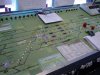
I found a picture of the inside of the old panel signal box at Basingstoke towards the end of its life. Note the old through line behind platform 5 was still shown on the control panel even though the track had been lifted many years before!
 

Attachments

  • DSC01075.jpg
    DSC01075.jpg
    147.3 KB · Views: 61

adrock1976

Established Member
Joined
10 Dec 2013
Messages
4,450
Location
What's it called? It's called Cumbernauld
Regarding the Basingstoke - Southampton AC electrification, I believe that the Bournemouth - Weymouth section was DC electrified with a low specification circa 1988, possibly making this the youngest DC section on BR/NR metals.

Would it be possible to electrify AC all the way to Weymouth, with the DC equipment being dismantled and reused to extend the DC system from Ormskirk to Preston and Kirkby to Wigan Wallgate?
 

D365

Veteran Member
Joined
29 Jun 2012
Messages
13,161
Regarding the Basingstoke - Southampton AC electrification, I believe that the Bournemouth - Weymouth section was DC electrified with a low specification circa 1988, possibly making this the youngest DC section on BR/NR metals.

The most recent new DC electrification on NR would be on the WLL - debatably there is also ELLX, Metro to Sunderland, Supertram to Rotherham... ;)

Would it be possible to electrify AC all the way to Weymouth, with the DC equipment being dismantled and reused to extend the DC system from Ormskirk to Preston and Kirkby to Wigan Wallgate?

I was under the impression that most, if not all extensions to Merseyrail would be completed using AC electrification; following introduction of replacement rolling stock.
 
Last edited:

Taunton

Veteran Member
Joined
1 Aug 2013
Messages
12,235
Regarding the Basingstoke - Southampton AC electrification, I believe that the Bournemouth - Weymouth section was DC electrified with a low specification circa 1988, possibly making this the youngest DC section on BR/NR metals.?
Waterloo International, the Stewarts Lane curve, etc are mid-1990s, and I think maybe Redhill to Tonbridge the same.
 

adrock1976

Established Member
Joined
10 Dec 2013
Messages
4,450
Location
What's it called? It's called Cumbernauld
I'm aware that the phrasing of the Bournemouth - Weymouth sentence could have been better.

What I meant was one of the youngest sections excluding Eurostar services to Waterloo International, and London Overground.

Anyway, is there potential for the dismantled DC equipment to be reused elsewhere as an infill scheme, or would it be retained for spares to replace older equipment that is not being converted to AC overhead when that need arises?
 
Status
Not open for further replies.

Top